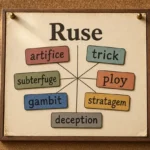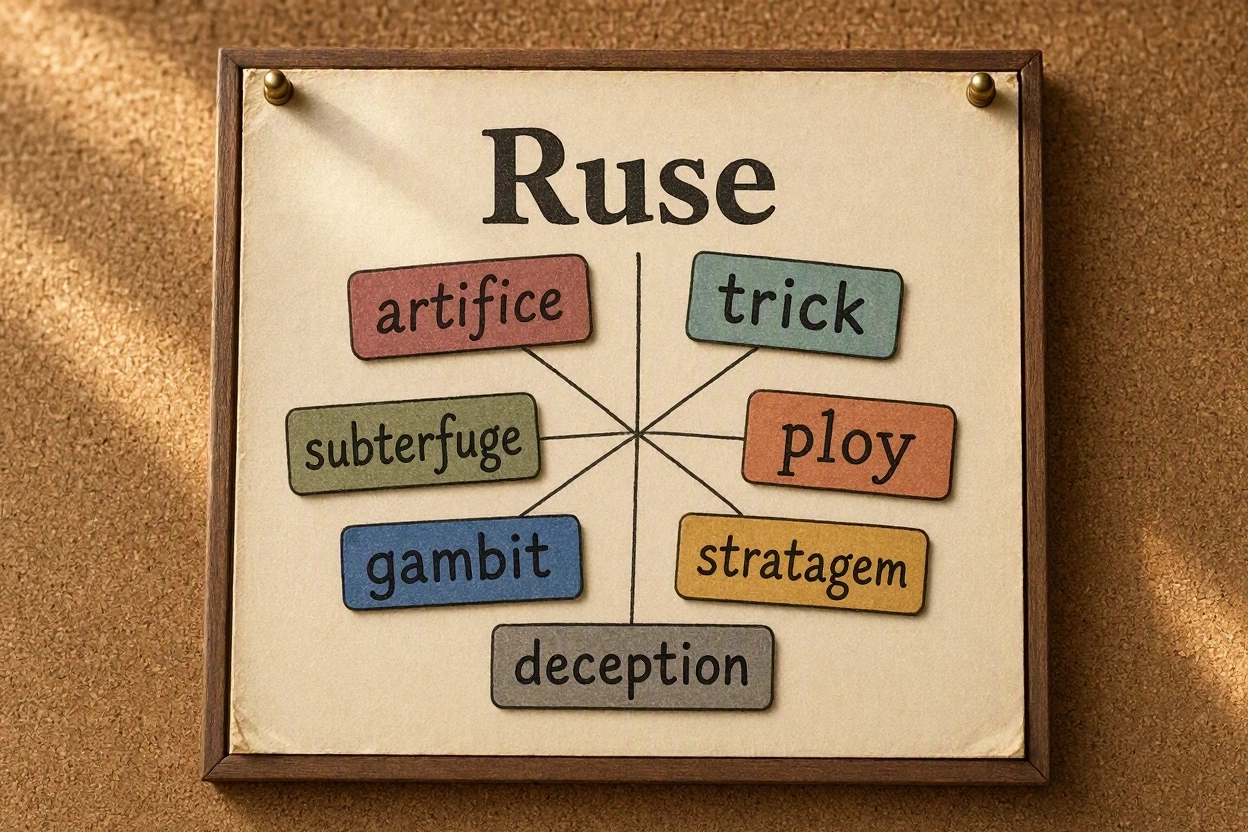
Finding the right synonym for ruse can make your writing more precise, natural, and engaging. The word ruse describes a clever trick or deceptive plan used to achieve a particular purpose. Depending on the situation, you may want a synonym that sounds neutral, playful, formal, negative, or strongly associated with deception.
For example, a writer describing a harmless strategy might use ploy or tactic, while a serious situation involving intentional deception may call for words such as deception, scheme, or stratagem. Understanding these differences helps you choose a word that matches the exact meaning and tone you want.
This guide explains 30 synonyms for ruse in simple English. Each word includes an easy definition, an example sentence, and a practical note about when it works best. Whether you are a student, ESL learner, writer, or content creator, this list can help you expand your vocabulary and write with greater accuracy.
What Does Ruse Mean?
A ruse is a clever trick or plan designed to deceive someone or hide the real purpose of an action.
In simple English, a ruse is a trick used to make someone believe something that is not completely true so that you can achieve a goal.
For example:
The journalist used a ruse to discover the truth.
Here, the journalist used a clever plan to get information that might otherwise have been difficult to obtain.
The word ruse is usually associated with deliberate deception, but it does not always sound extremely harsh. Its tone often depends on the context.
Tone and Usage of Ruse
Ruse is generally a neutral-to-negative word because it involves deception. However, it can sometimes describe a clever or harmless trick.
For example:
- Neutral: The magician used a clever ruse to distract the audience.
- Negative: The scammer used a ruse to steal money.
- Strategic: The soldiers created a ruse to confuse the enemy.
- Playful: She used a little ruse to surprise her friend.
Choosing the right synonym depends on whether you want to emphasize cleverness, deception, planning, manipulation, or strategy.
30 Synonyms for Ruse
1. Ploy
Meaning: A clever action or plan used to achieve a particular purpose.
Example:
The salesman used a friendly ploy to attract more customers.
Best usage context:
Use ploy when describing a clever strategy, especially in everyday situations.
2. Trick
Meaning: An action intended to fool or deceive someone.
Example:
The magician used a simple trick to amaze the children.
Best usage context:
Use trick for general deception, especially in informal English.
3. Stratagem
Meaning: A carefully planned method used to achieve a goal.
Example:
The general developed a clever stratagem to surprise the opposing army.
Best usage context:
Best for formal writing, military situations, or carefully planned actions.
4. Scheme
Meaning: A secret or clever plan, often intended to achieve something dishonest.
Example:
The company uncovered a scheme to manipulate the financial records.
Best usage context:
Use scheme when the plan has a suspicious, dishonest, or secret quality.
5. Deception
Meaning: The act of making someone believe something that is not true.
Example:
The investigation revealed a deliberate deception.
Best usage context:
Best when emphasizing the act of misleading someone rather than the specific trick.
6. Subterfuge
Meaning: A secret method or trick used to hide the truth.
Example:
The organization used subterfuge to keep its plans confidential.
Best usage context:
Useful in formal, serious, or sophisticated writing about hidden actions.
7. Artifice
Meaning: A clever method or trick used to achieve a goal.
Example:
The character relied on artifice to escape from the difficult situation.
Best usage context:
Good for literary, formal, or sophisticated writing.
8. Stratagem
Meaning: A carefully designed plan intended to gain an advantage.
Example:
Their stratagem allowed them to solve the problem without causing conflict.
Best usage context:
Use when the focus is on careful planning and cleverness.
9. Feint
Meaning: A movement or action that pretends to be one thing while intending another.
Example:
The player made a feint before moving toward the goal.
Best usage context:
Common in sports, combat, competition, and strategic situations.
10. Maneuver
Meaning: A planned action designed to gain an advantage.
Example:
The team made a clever maneuver to avoid the difficult situation.
Best usage context:
Useful for strategic, political, military, business, or competitive contexts.
11. Gambit
Meaning: An action or statement made to gain an advantage.
Example:
His opening gambit was to offer a generous deal.
Best usage context:
Common in business, negotiations, games, and strategic discussions.
12. Tactic
Meaning: A specific method used to achieve a particular result.
Example:
Ignoring the criticism was a useful tactic.
Best usage context:
Best when the idea involves strategy rather than outright deception.
13. Ruse
Meaning: A clever trick used to deceive someone or achieve a purpose.
Example:
The detective created a ruse to make the suspect reveal important information.
Best usage context:
Use the original word when you specifically mean a deliberate deceptive trick.
14. Hoax
Meaning: A false story or situation deliberately created to trick people.
Example:
The story about the mysterious creature turned out to be a hoax.
Best usage context:
Use hoax when the deception involves a fabricated story, event, or claim.
15. Deceit
Meaning: Dishonest behavior intended to make someone believe something false.
Example:
The investigation exposed years of deceit.
Best usage context:
Use when emphasizing dishonesty or a pattern of misleading behavior.
16. Fraud
Meaning: Deliberate deception used to gain money, property, or another advantage illegally or dishonestly.
Example:
The company was investigated for financial fraud.
Best usage context:
Best for financial, legal, or serious forms of deception.
17. Sham
Meaning: Something presented as genuine or real when it is actually false.
Example:
The supposed agreement was merely a sham.
Best usage context:
Use when something is fake or deliberately presented as something it is not.
18. Ruse of Hand
Meaning: A clever trick or deceptive action, especially one involving skill or distraction.
Example:
The performer relied on a ruse of hand to direct the audience’s attention elsewhere.
Best usage context:
Useful in literary or descriptive contexts involving clever manipulation or distraction.
19. Pretense
Meaning: An attempt to make something appear true when it is not.
Example:
Under the pretense of asking for directions, he entered the building.
Best usage context:
Use when someone pretends to have a particular reason or intention.
20. Bluff
Meaning: An attempt to make someone believe something that may not be true.
Example:
The player’s confident statement was only a bluff.
Best usage context:
Common in poker, negotiations, competitions, and informal conversation.
21. Masquerade
Meaning: An action or appearance that hides the true identity or nature of something.
Example:
Their friendly meeting was actually a masquerade for a secret negotiation.
Best usage context:
Useful when something false is deliberately presented as genuine.
22. Disguise
Meaning: Something used to hide the true identity or appearance of a person or thing.
Example:
The spy used a disguise to enter the building unnoticed.
Best usage context:
Best when the deception involves hiding identity or appearance.
23. Con
Meaning: A dishonest trick used to persuade someone to give money or accept something false.
Example:
The advertisement turned out to be a con.
Best usage context:
Informal English, especially for scams and dishonest schemes.
24. Scam
Meaning: A dishonest scheme designed to trick someone, usually for money or personal benefit.
Example:
The email was a scam designed to steal personal information.
Best usage context:
Use for modern fraud, online deception, financial tricks, and dishonest offers.
25. Fabrication
Meaning: Something invented or made up, especially a false story or piece of information.
Example:
The entire story was a fabrication.
Best usage context:
Good for formal writing when discussing invented information or false claims.
26. Falsehood
Meaning: A statement or idea that is not true.
Example:
The article contained several dangerous falsehoods.
Best usage context:
Use when focusing on an untrue statement rather than the method used to deceive.
27. Manipulation
Meaning: The act of controlling or influencing someone unfairly or cleverly.
Example:
The advertisement relied on emotional manipulation.
Best usage context:
Best when the trick involves influencing someone’s thoughts, feelings, or decisions.
28. Subterfuge
Meaning: A secret or indirect method used to accomplish something while hiding the real intention.
Example:
The negotiations continued through a series of carefully planned acts of subterfuge.
Best usage context:
Useful in formal writing involving secrecy, concealment, or complicated deception.
29. Expedient
Meaning: A practical action or method used to solve a problem or achieve an immediate goal.
Example:
As a temporary expedient, the manager changed the meeting location.
Best usage context:
Use when the action is mainly practical rather than intentionally deceptive.
30. Device
Meaning: A clever method or plan used to achieve a particular purpose.
Example:
The author used a clever narrative device to hide the character’s true identity.
Best usage context:
Useful in literary, technical, and formal contexts where device means a deliberate method or technique.
Comparison Guide: Synonyms for Ruse
Not every synonym for ruse has exactly the same meaning. Some emphasize deception, while others focus on strategy or cleverness.
| Synonym | Main Meaning | Tone | Best Context |
| Ploy | Clever plan | Neutral | Everyday strategy |
| Trick | Act of deception | Informal | General use |
| Stratagem | Carefully planned strategy | Formal | Military or strategic writing |
| Scheme | Secret plan | Negative | Suspicious or dishonest plans |
| Deception | Misleading someone | Formal/negative | Serious writing |
| Subterfuge | Hidden method | Formal | Secrecy and concealment |
| Artifice | Clever trick | Formal/literary | Literary writing |
| Feint | Pretended movement | Strategic | Sports or combat |
| Gambit | Strategic opening action | Neutral | Business or competition |
| Tactic | Specific strategy | Neutral | General strategy |
| Hoax | False creation | Negative | Fake stories or events |
| Bluff | False show of confidence | Informal | Negotiations or games |
| Pretense | False appearance or reason | Neutral/negative | Pretending |
| Scam | Dishonest scheme | Negative | Financial or online fraud |
| Fraud | Deliberate dishonest action | Strongly negative | Legal or financial contexts |
| Sham | Fake thing or situation | Negative | False appearances |
| Disguise | Hidden identity | Neutral | Concealment |
| Manipulation | Unfair influence | Negative | Psychological or social contexts |
| Fabrication | Made-up information | Negative | False stories or claims |
| Falsehood | Something untrue | Formal | Statements and claims |
Ruse vs. Ploy
Ruse and ploy are closely related, but they are not always interchangeable.
A ruse usually involves deception. A ploy is a clever action or strategy that may involve deception but does not necessarily have to.
For example:
- The thief used a ruse to distract the guard.
- The company used a marketing ploy to attract new customers.
The first sentence clearly involves deception, while the second describes a clever marketing strategy.
Ruse vs. Trick
A trick is a broader and more common word than ruse. A trick can be playful, skillful, or deceptive.
A ruse usually refers specifically to a planned method of deception.
Compare:
- The magician performed a trick.
- The detective created a ruse.
The first could be entertainment. The second suggests a deliberate plan to deceive.
Ruse vs. Scheme
A scheme often suggests a secret or dishonest plan, while a ruse is specifically a deceptive trick used for a purpose.
For example:
- The company developed a new business scheme.
- The criminal used a ruse to escape.
The word scheme can sometimes be neutral, but in many contexts it carries a negative suggestion.
Ruse vs. Stratagem
Both words can describe carefully planned actions.
However, stratagem often emphasizes intelligence and strategy, while ruse emphasizes deception.
For example:
- The commander created a military stratagem.
- The commander used a ruse to mislead the opposing force.
Use stratagem when planning and strategy are central. Use ruse when misleading someone is central.
Ruse vs. Deception
Deception is a broader concept. It refers to the act or practice of misleading someone.
A ruse is usually a specific trick or plan used to accomplish that deception.
Think of it this way:
Deception = the act of misleading
Ruse = a particular trick used to mislead
How to Choose the Right Synonym for Ruse
Choosing the right synonym depends on what you want the reader to notice.
For a Clever Strategy
Choose:
- Ploy
- Tactic
- Maneuver
- Gambit
- Stratagem
These words work when clever planning is more important than dishonesty.
For Deliberate Deception
Choose:
- Ruse
- Trick
- Deception
- Deceit
- Subterfuge
These are better when the central idea is misleading someone.
For Dishonest or Suspicious Plans
Choose:
- Scheme
- Scam
- Fraud
- Con
- Sham
These words usually create a stronger negative impression.
For Formal Writing
Choose:
- Stratagem
- Subterfuge
- Artifice
- Deception
- Fabrication
These choices can work well in academic, professional, historical, or literary writing.
For Informal English
Choose:
- Trick
- Bluff
- Con
- Scam
- Ploy
These words are generally easier and more natural in everyday conversation.
For Sports or Competition
Choose:
- Feint
- Bluff
- Gambit
- Maneuver
- Tactic
These words highlight strategic behavior rather than simple dishonesty.
For Fake Stories or Claims
Choose:
- Hoax
- Fabrication
- Falsehood
- Sham
These are useful when the deception involves false information or something presented as genuine.
Examples of Ruse in Different Sentences
Here are some practical examples showing how ruse works in different contexts:
Everyday situation:
She used a clever ruse to surprise her brother.
Business:
The advertisement was a marketing ruse designed to attract attention.
Military:
The soldiers created a ruse to mislead the opposing force.
Literature:
The character’s friendly behavior was merely a ruse.
Investigation:
The detective used a ruse to obtain the information.
Informal conversation:
His excuse was just a ruse to leave the party early.
These examples show that ruse can appear in many types of writing, from casual conversation to formal storytelling.
Common Mistakes When Using Synonyms for Ruse
One common mistake is assuming that every synonym has exactly the same meaning.
For example, fraud is much stronger and more specific than ruse. Fraud normally involves serious dishonest conduct and may have legal implications.
Similarly, tactic does not necessarily mean deception. A tactic can be completely honest.
Another common mistake is using hoax for every kind of ruse. A hoax usually involves creating or spreading something false, such as a fake story or event.
It is also important to consider tone. Words such as trick and ploy can sound relatively casual, while subterfuge and deceit can sound more formal or serious.
Frequently Asked Questions About Synonyms for Ruse
What is the best synonym for ruse?
The most suitable synonym depends on the sentence. Ploy, trick, stratagem, scheme, and deception are common alternatives, but each emphasizes a slightly different idea.
What is a simple synonym for ruse?
Trick is one of the simplest and most familiar synonyms for ruse. Ploy is another useful choice when describing a clever plan.
Is ploy a synonym for ruse?
Yes. Ploy can be a synonym for ruse, especially when describing a clever action or plan. However, a ploy does not always involve deception.
Is scheme a synonym for ruse?
Yes, in some contexts. Both can describe a planned action, but scheme often suggests a secret or dishonest plan.
What is a formal synonym for ruse?
Subterfuge, stratagem, artifice, and deception can work as formal alternatives, depending on the context.
What is the opposite of ruse?
Possible opposites include honesty, truthfulness, openness, sincerity, and transparency. The best opposite depends on the sentence.
Is ruse a negative word?
Usually, ruse has a mildly negative or suspicious association because it involves deception. However, the word can sometimes describe a clever or harmless trick.
Can ruse be used in academic writing?
Yes. Ruse can be used in academic or formal writing when discussing deception, strategy, literature, history, psychology, or related subjects. More formal alternatives such as subterfuge or deception may sometimes fit better.
What is the difference between a ruse and a scam?
A ruse is a deceptive trick or plan, while a scam generally refers to dishonest deception intended to obtain money, information, or another benefit.
What is the difference between a ruse and a bluff?
A bluff involves pretending to have confidence, information, strength, or another advantage. A ruse is broader and can involve many kinds of deceptive plans.
Final Thoughts on Synonyms for Ruse
The word ruse describes a clever trick or deceptive plan, but the best synonym depends on the exact situation. Words such as ploy, trick, and tactic can sound relatively neutral, while scheme, deceit, fraud, and scam carry stronger negative meanings.
For formal or sophisticated writing, subterfuge, stratagem, and artifice can provide more precise alternatives. In everyday English, trick, ploy, and bluff are often easier and more natural.
The key is not simply to replace ruse with another word. Instead, consider what you want to emphasize: cleverness, strategy, secrecy, deception, dishonesty, or manipulation. Choosing the synonym that matches that meaning will make your writing clearer, more accurate, and more natural.

I am Axel James, a passionate writer who loves exploring synonyms and alternative words. I enjoy helping readers improve their vocabulary and express ideas clearly.