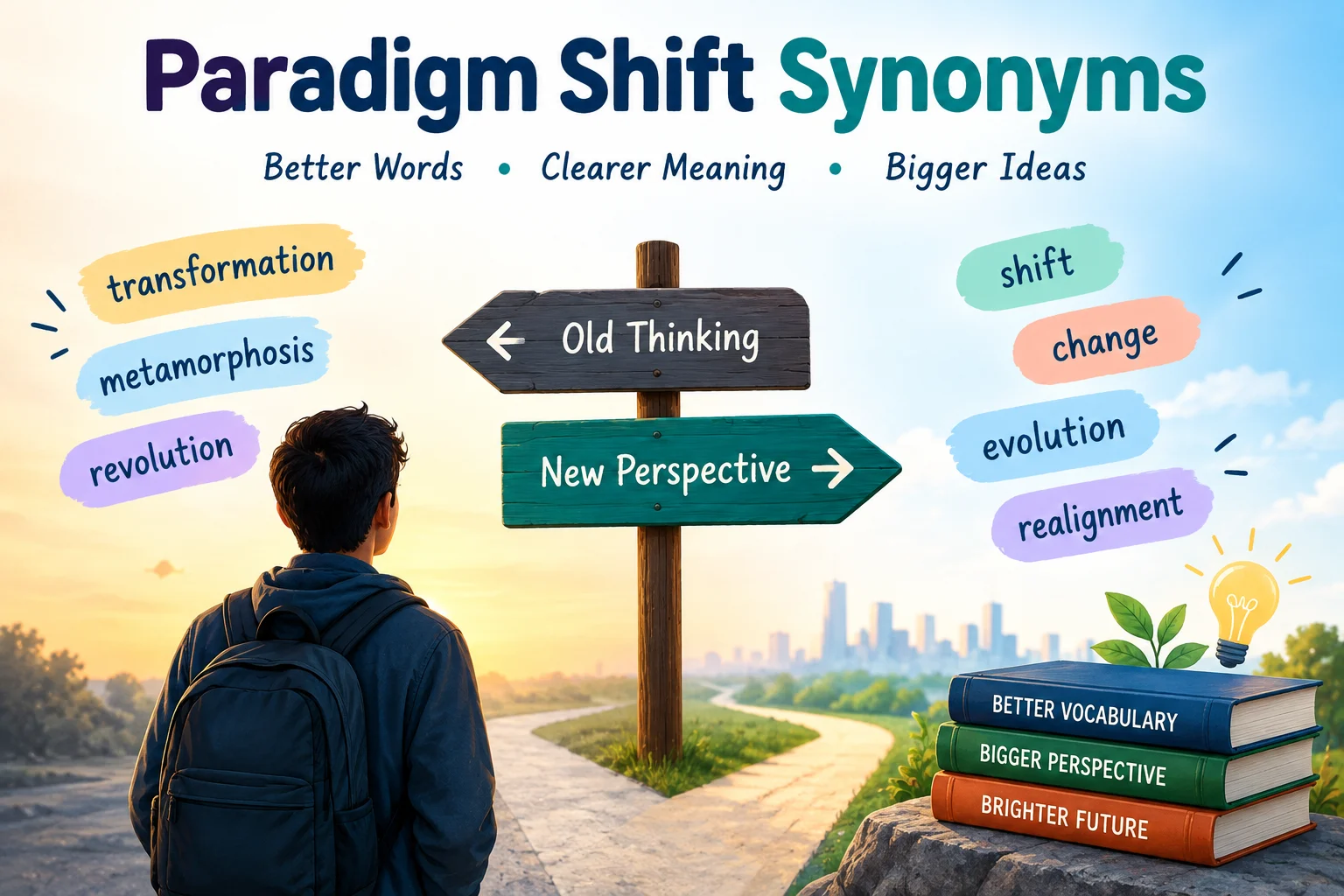
A paradigm shift describes a major change in the way people understand, approach, or think about something. It is more than a small adjustment. It usually means that an old way of thinking is replaced by a new perspective, model, or system.
Finding the right paradigm shift synonyms can make your writing more precise and engaging. Depending on the context, you may want to describe a transformation, a change in perspective, a new approach, or a complete break from traditional thinking. Using the right alternative helps readers understand exactly what kind of change you mean.
This guide explains useful alternatives to “paradigm shift” in simple English. It also covers the meaning of demure, 30 synonyms for demure, practical examples, tone differences, and guidance for choosing the best word for different situations.
What Does “Paradigm Shift” Mean?
A paradigm shift is a fundamental change in the way something is understood or approached.
The phrase is often used in science, technology, business, education, culture, and society. For example, the move from traditional paper maps to digital navigation can be described as a paradigm shift because it changed how people think about finding their way.
Example:
The rise of artificial intelligence could create a paradigm shift in the way businesses solve complex problems.
In simple terms, a paradigm shift means a major change in the usual way of thinking or doing something.
Why Use Synonyms for “Paradigm Shift”?
Repeating the same phrase can make an article sound predictable. Choosing a suitable alternative can improve clarity and help you match your language to the situation.
For example:
- Transformation emphasizes major change.
- Change in perspective emphasizes a new way of seeing something.
- Revolution suggests dramatic or far-reaching change.
- Turning point focuses on an important moment.
- New approach sounds practical and straightforward.
- Breakthrough emphasizes an important discovery or achievement.
The best synonym depends on what you want to emphasize.
30 Useful Paradigm Shift Synonyms and Alternatives
There is no single synonym that perfectly replaces “paradigm shift” in every sentence. The following alternatives are close in meaning but have different shades of meaning and usage.
1. Transformation
Meaning: A major change in form, character, or function.
Example:
The company experienced a complete transformation after adopting digital technology.
Best usage: Use it when describing a broad and significant change.
2. Revolution
Meaning: A dramatic and fundamental change in an established system or way of thinking.
Example:
The internet caused a revolution in global communication.
Best usage: Good for powerful, large-scale changes.
3. Major Change
Meaning: A significant difference from the previous situation.
Example:
Remote learning represents a major change in modern education.
Best usage: Best when you want simple, direct language.
4. Fundamental Change
Meaning: A change that affects the basic nature or structure of something.
Example:
The new policy brought a fundamental change to the organization’s operations.
Best usage: Useful in academic, business, and professional writing.
5. Radical Change
Meaning: A very significant change that moves far away from the previous approach.
Example:
The industry has undergone a radical change in recent years.
Best usage: Use it when the difference between the old and new systems is substantial.
6. Shift in Perspective
Meaning: A change in the way someone understands or views something.
Example:
The research produced a shift in perspective about climate adaptation.
Best usage: Excellent for opinions, beliefs, research, and intellectual discussions.
7. Change in Thinking
Meaning: A new way of thinking about a subject.
Example:
The discovery encouraged a change in thinking among researchers.
Best usage: Particularly useful for simple and ESL-friendly writing.
8. Change in Approach
Meaning: A different way of dealing with a problem or task.
Example:
The organization needs a change in approach to improve customer service.
Best usage: Ideal for business, education, management, and problem-solving.
9. New Approach
Meaning: A different method or way of doing something.
Example:
The teacher introduced a new approach to language learning.
Best usage: Best when the emphasis is on methods rather than beliefs.
10. New Perspective
Meaning: A different way of looking at or understanding something.
Example:
The study offers a new perspective on workplace productivity.
Best usage: Useful for academic writing, essays, research, and analysis.
11. Turning Point
Meaning: An event or moment that causes an important change.
Example:
The invention of the smartphone was a turning point in personal communication.
Best usage: Use it when referring to a specific event or moment.
12. Breakthrough
Meaning: An important discovery or development that makes progress possible.
Example:
The medical breakthrough changed how the disease was treated.
Best usage: Best when a major discovery or achievement drives the change.
13. Transition
Meaning: The process of moving from one state, system, or condition to another.
Example:
The transition to renewable energy is changing the global energy market.
Best usage: Useful when the change happens over a period of time.
14. Evolution
Meaning: A gradual development or change over time.
Example:
The evolution of online education has changed how students access information.
Best usage: Choose it when the change is gradual rather than sudden.
15. Overhaul
Meaning: A complete or extensive improvement or restructuring.
Example:
The company conducted an overhaul of its outdated management system.
Best usage: Good for systems, organizations, processes, and structures.
16. Rethinking
Meaning: The process of considering something again in a new way.
Example:
The crisis led to a complete rethinking of public transportation.
Best usage: Useful when people reconsider established ideas.
17. Reorientation
Meaning: A change in direction, focus, or priorities.
Example:
The organization underwent a reorientation toward sustainable development.
Best usage: Strong choice for formal, academic, and organizational writing.
18. Redirection
Meaning: A change toward a different direction or goal.
Example:
The company’s investment strategy required a major redirection.
Best usage: Best when the focus or resources move toward a new goal.
19. Restructuring
Meaning: A major change to the organization or arrangement of something.
Example:
The restructuring changed how the company managed its international teams.
Best usage: Common in business, finance, and organizational contexts.
20. Reinvention
Meaning: Creating something in a significantly new way.
Example:
The brand’s reinvention helped it attract a younger audience.
Best usage: Effective for companies, careers, products, and personal development.
21. Renewal
Meaning: The process of making something fresh, modern, or effective again.
Example:
The city began a period of cultural renewal.
Best usage: Useful when something is refreshed rather than completely replaced.
22. New Model
Meaning: A new system, framework, or way of operating.
Example:
The researchers proposed a new model for understanding consumer behavior.
Best usage: Excellent for academic, scientific, business, and technical contexts.
23. New Framework
Meaning: A new structure for organizing ideas or understanding a subject.
Example:
The theory provides a new framework for studying social development.
Best usage: Especially useful in academic and analytical writing.
24. Change of Course
Meaning: A decision to move in a different direction.
Example:
The unexpected results forced the company to make a change of course.
Best usage: Best for decisions, strategies, plans, and organizations.
25. New Era
Meaning: A period characterized by new conditions or ideas.
Example:
The technology opened a new era of digital communication.
Best usage: Effective for broad historical, technological, and cultural changes.
26. Break from Tradition
Meaning: A decision to move away from established customs or practices.
Example:
The school’s new teaching method represented a break from tradition.
Best usage: Use it when an established practice is being replaced.
27. Departure from the Norm
Meaning: A move away from what is usual or accepted.
Example:
The company’s four-day workweek was a departure from the norm.
Best usage: Good for formal writing when highlighting unusual behavior.
28. Sea Change
Meaning: A major and noticeable transformation.
Example:
There has been a sea change in public attitudes toward renewable energy.
Best usage: Suitable for dramatic shifts in attitudes, policies, or conditions.
29. Game Changer
Meaning: Something that significantly changes the situation or creates a new standard.
Example:
Cloud computing became a game changer for many small businesses.
Best usage: Best for conversational, business, marketing, and modern writing.
30. New Way of Thinking
Meaning: A different way of understanding or approaching an issue.
Example:
The research encouraged a new way of thinking about workplace collaboration.
Best usage: Excellent for general audiences and ESL learners.
Paradigm Shift Synonyms Comparison Table
| Alternative | Main Meaning | Tone | Best Context |
| Transformation | Major overall change | Neutral | General, business |
| Revolution | Dramatic fundamental change | Strong | Technology, society |
| Fundamental change | Change to basic structure | Formal | Academic, professional |
| Shift in perspective | Different way of viewing something | Neutral | Research, essays |
| New approach | Different method | Simple | Education, business |
| Turning point | Important moment of change | Neutral | History, personal stories |
| Breakthrough | Major discovery or achievement | Positive | Science, technology |
| Transition | Movement from one state to another | Neutral | Business, education |
| Evolution | Gradual development | Neutral | Technology, culture |
| Overhaul | Extensive restructuring | Strong | Organizations, systems |
| Rethinking | Considering something differently | Neutral | Strategy, policy |
| Reinvention | Creating something in a new way | Modern | Business, branding |
| New framework | New structure for understanding | Formal | Academic, research |
| New era | Beginning of a different period | Strong | History, technology |
| Break from tradition | Moving away from old practices | Neutral | Culture, education |
| Game changer | Something that alters the situation | Informal | Business, media |
How to Choose the Right Paradigm Shift Synonym
Choosing the right alternative depends mainly on context, intensity, tone, and the type of change you are describing.
For Academic Writing
Use more precise and formal expressions such as:
- Fundamental change
- Shift in perspective
- New framework
- Reorientation
- Change in thinking
- New model
Example:
“The discovery led to a fundamental change in the scientific understanding of the phenomenon.”
These choices sound more precise than casual terms such as “game changer.”
For Business Writing
Business writing often benefits from practical terms such as:
- Transformation
- Restructuring
- Reinvention
- Change in approach
- Overhaul
- Change of course
Example:
“The company began a digital transformation to improve its customer experience.”
For Technology Topics
Technology frequently involves rapid and significant changes. Suitable alternatives include:
- Revolution
- Breakthrough
- Transformation
- New era
- Game changer
- New model
Example:
“Generative AI may represent a new era in content creation.”
For Changes in Opinions or Beliefs
When the main idea is a change in how people understand something, choose:
- Shift in perspective
- Change in thinking
- New perspective
- Rethinking
- New way of thinking
Example:
“The study encouraged a shift in perspective on how students learn.”
For Gradual Changes
If the change develops slowly, avoid words that suggest sudden disruption. Better choices include:
- Evolution
- Transition
- Renewal
- Reorientation
Example:
“The evolution of digital publishing has changed how readers consume information.”
For Dramatic Changes
When the change is sudden, powerful, or extensive, consider:
- Revolution
- Radical change
- Sea change
- Transformation
- Overhaul
- Break from tradition
Example:
“The introduction of online banking caused a revolution in financial services.”
Paradigm Shift vs. Transformation
“Paradigm shift” and “transformation” are closely related, but they are not always interchangeable.
A transformation describes a significant change in something’s form, structure, or operation.
A paradigm shift focuses more strongly on a fundamental change in the underlying way people think about or understand something.
Compare:
- “The company underwent a digital transformation.”
- “Digital technology created a paradigm shift in how companies communicate with customers.”
The first emphasizes the change itself. The second emphasizes the change in the underlying model or perspective.
Paradigm Shift vs. Revolution
A revolution generally suggests a dramatic and far-reaching change. It can be used similarly to “paradigm shift,” but it often sounds stronger.
Example:
“The internet caused a revolution in communication.”
This suggests a dramatic transformation across society.
“Paradigm shift” is often more analytical:
“The internet caused a paradigm shift in how people access and share information.”
Paradigm Shift vs. Turning Point
A turning point usually refers to a particular event or moment that changes the direction of something.
A paradigm shift describes the broader change in thinking or the system that follows.
Example:
“The invention of the printing press was a turning point in human history.”
“The printing press contributed to a paradigm shift in how information was produced and distributed.”
Paradigm Shift vs. Evolution
These terms differ mainly in speed and scale.
An evolution usually happens gradually.
A paradigm shift tends to suggest a fundamental change that may happen relatively quickly or become apparent after a major discovery or development.
Example:
“The evolution of smartphones took place over many years.”
“The smartphone created a paradigm shift in mobile communication.”
Simple Alternatives to “Paradigm Shift”
If you are writing for beginners or a general audience, complicated vocabulary is not always necessary.
Instead of “paradigm shift,” you can often say:
- Major change
- New way of thinking
- New approach
- Change in perspective
- Different way of doing things
- Fundamental change
- New model
These alternatives are especially useful for ESL learners because they communicate the core idea without unnecessary complexity.
What Does “Demure” Mean?
The word demure describes someone who is quiet, modest, reserved, and polite, especially in their appearance or behavior.
It often describes a person who does not seek attention and behaves in a calm, restrained way.
Example:
“She gave a demure smile when everyone complimented her.”
The tone of “demure” is generally positive or neutral, although the exact meaning can depend on context. It may suggest modesty, shyness, restraint, or a deliberately reserved manner.
The word is commonly used when describing someone’s behavior, expression, clothing, or appearance.
30 Synonyms of “Demure”
Although “demure” has a fairly specific meaning, several words can express similar ideas. The best choice depends on whether you mean modest, quiet, shy, reserved, or well-mannered.
1. Modest
Meaning: Not showing off or seeking attention.
Example:
“She was modest about her achievements.”
Best usage: Use it for behavior, achievements, clothing, or personality.
2. Reserved
Meaning: Quiet and not openly expressing feelings.
Example:
“He was reserved when meeting new people.”
Best usage: Good for personality and social behavior.
3. Shy
Meaning: Nervous or uncomfortable around other people.
Example:
“The shy student rarely spoke in large groups.”
Best usage: Best when someone lacks social confidence.
4. Retiring
Meaning: Avoiding attention or social activity.
Example:
“She had a retiring personality and preferred quiet gatherings.”
Best usage: Formal or literary descriptions of quiet people.
5. Unassuming
Meaning: Not trying to appear important or impressive.
Example:
“Despite his success, he remained unassuming.”
Best usage: Excellent for describing humble personalities.
6. Meek
Meaning: Gentle and not aggressive or forceful.
Example:
“Her meek manner made her seem very gentle.”
Best usage: Use carefully because it can imply excessive passiveness.
7. Quiet
Meaning: Making little noise or speaking very little.
Example:
“She was quiet during the meeting.”
Best usage: Simple everyday descriptions.
8. Gentle
Meaning: Calm, kind, and not harsh.
Example:
“He had a gentle manner when speaking to children.”
Best usage: Positive descriptions of behavior.
9. Subdued
Meaning: Quiet, restrained, or less energetic than usual.
Example:
“She wore a subdued expression throughout the ceremony.”
Best usage: Useful for moods, expressions, colors, and behavior.
10. Restrained
Meaning: Controlled and not excessive.
Example:
“Her restrained response showed considerable self-control.”
Best usage: Formal and professional contexts.
11. Unobtrusive
Meaning: Not attracting attention or disturbing others.
Example:
“She chose an unobtrusive style for the formal event.”
Best usage: Good for appearance, design, behavior, and presence.
12. Demure
Meaning: Modest, reserved, and quietly well-mannered.
Example:
“She gave a demure nod before leaving.”
Best usage: The original word; especially useful for modest appearance or behavior.
13. Ladylike
Meaning: Traditionally associated with polite, graceful, and refined behavior.
Example:
“She maintained a ladylike manner at the formal dinner.”
Best usage: Traditional or gender-specific contexts; use thoughtfully.
14. Proper
Meaning: Behaving according to accepted standards of politeness or behavior.
Example:
“She maintained a proper manner during the ceremony.”
Best usage: Formal behavior and social expectations.
15. Polite
Meaning: Showing good manners and respect.
Example:
“He was polite and considerate toward everyone.”
Best usage: Everyday descriptions of good behavior.
16. Well-Mannered
Meaning: Behaving in a socially polite way.
Example:
“The well-mannered child thanked the guests.”
Best usage: Children, social behavior, and everyday descriptions.
17. Courteous
Meaning: Polite and respectful toward others.
Example:
“The receptionist was courteous and helpful.”
Best usage: Professional and social situations.
18. Refined
Meaning: Elegant, cultured, and socially polished.
Example:
“She had a refined style and calm manner.”
Best usage: Appearance, manners, taste, and culture.
19. Graceful
Meaning: Elegant and pleasing in movement or behavior.
Example:
“She gave a graceful response to the criticism.”
Best usage: Movement, manners, responses, and appearance.
20. Mild
Meaning: Gentle and not extreme.
Example:
“He has a mild personality and rarely becomes angry.”
Best usage: Personality, behavior, temperament, or reactions.
21. Soft-Spoken
Meaning: Speaking quietly and gently.
Example:
“The soft-spoken teacher was easy to approach.”
Best usage: Speech and personality.
22. Bashful
Meaning: Shy or easily embarrassed.
Example:
“She became bashful when the group praised her work.”
Best usage: Informal and friendly descriptions of shyness.
23. Coy
Meaning: Shy or pretending to be shy in a playful or deliberate way.
Example:
“She gave a coy smile before answering the question.”
Best usage: Often used for playful or flirtatious behavior.
24. Modest-Mannered
Meaning: Behaving in a humble and restrained way.
Example:
“The modest-mannered speaker avoided discussing his achievements.”
Best usage: Descriptive writing and character descriptions.
25. Humble
Meaning: Not believing you are more important than others.
Example:
“Despite winning the award, she remained humble.”
Best usage: Achievements, personality, and character.
26. Self-Effacing
Meaning: Deliberately avoiding praise or attention.
Example:
“His self-effacing humor made the interview more relaxed.”
Best usage: Formal writing, personality descriptions, and social behavior.
27. Dignified
Meaning: Calm, serious, and worthy of respect.
Example:
“She maintained a dignified manner throughout the ceremony.”
Best usage: Formal situations, behavior, and appearance.
28. Composed
Meaning: Calm and in control of emotions.
Example:
“She remained composed during the difficult conversation.”
Best usage: Emotional control and stressful situations.
29. Unpretentious
Meaning: Simple and not designed to impress others.
Example:
“His unpretentious personality made him easy to talk to.”
Best usage: People, lifestyles, places, and styles.
30. Unaffected
Meaning: Natural and not deliberately trying to impress.
Example:
“She gave an unaffected response to the unexpected praise.”
Best usage: Behavior, manner, speech, and personality.
Demure Synonyms Comparison Guide
| Synonym | Main Idea | Tone | Best Context |
| Modest | Not showing off | Positive | Personality, clothing |
| Reserved | Emotionally quiet | Neutral | Personality |
| Shy | Lacking confidence socially | Neutral | People |
| Unassuming | Not seeking importance | Positive | Personality |
| Meek | Gentle and passive | Neutral/negative | Behavior |
| Quiet | Not talkative | Neutral | Everyday speech |
| Restrained | Controlled | Formal | Behavior, emotions |
| Polite | Good manners | Positive | Social situations |
| Refined | Elegant and cultured | Positive | Style, manners |
| Graceful | Elegant and pleasing | Positive | Movement, behavior |
| Bashful | Easily embarrassed | Warm | Informal descriptions |
| Coy | Playfully shy | Context-dependent | Social or romantic contexts |
| Humble | Not boastful | Positive | Achievements |
| Self-effacing | Avoiding praise | Positive | Personality |
| Dignified | Calm and respectable | Formal | Serious situations |
| Composed | Emotionally controlled | Positive | Difficult situations |
How to Choose the Right Synonym for “Demure”
The meaning you want to emphasize should determine your word choice.
If You Mean “Not Showing Off”
Choose:
- Modest
- Humble
- Unassuming
- Unpretentious
- Self-effacing
If You Mean “Quiet or Shy”
Choose:
- Shy
- Reserved
- Bashful
- Quiet
- Retiring
- Soft-spoken
If You Mean “Elegant or Polished”
Choose:
- Refined
- Graceful
- Dignified
- Ladylike
If You Mean “Controlled or Restrained”
Choose:
- Restrained
- Subdued
- Composed
- Unobtrusive
If You Mean “Polite”
Choose:
- Polite
- Courteous
- Well-mannered
- Proper
This distinction matters because two words can be similar without having exactly the same meaning.
Frequently Asked Questions About Paradigm Shift Synonyms
What is the best synonym for “paradigm shift”?
Transformation, fundamental change, and shift in perspective are among the most useful alternatives. The best option depends on the context.
What is another way to say “paradigm shift” in simple English?
You can say major change, new way of thinking, change in perspective, or new approach.
Is “revolution” a synonym for “paradigm shift”?
Sometimes. Both can describe major changes, but “revolution” usually emphasizes the dramatic scale of the change, while “paradigm shift” emphasizes a fundamental change in thinking or an established model.
Is “transformation” the same as “paradigm shift”?
Not exactly. Transformation describes significant change, while a paradigm shift specifically suggests a fundamental change in the way something is understood, organized, or approached.
What is the opposite of a paradigm shift?
Depending on context, possible opposites include continuity, stability, consistency, preservation of the status quo, and maintaining the traditional approach.
What does “demure” mean in simple English?
“Demure” means quiet, modest, reserved, and polite, especially in someone’s behavior or appearance.
What is the closest synonym to “demure”?
Modest, reserved, and shy are among the closest common alternatives, although each has a slightly different meaning.
Is “demure” positive or negative?
“Demure” is generally neutral to positive when used to describe modest or reserved behavior. However, context can affect its tone.
Final Thoughts on Paradigm Shift Synonyms
Understanding paradigm shift synonyms is useful when you want to make your writing more accurate, natural, and varied. While phrases such as transformation, revolution, fundamental change, shift in perspective, and new approach can often replace “paradigm shift,” they do not all communicate exactly the same idea.
For academic writing, choose precise terms such as fundamental change, new framework, or shift in perspective. For business writing, transformation, restructuring, and reinvention may work better. For general readers, simple expressions such as major change and new way of thinking are often clearer.
The same principle applies to words such as demure. A good synonym should match not only the basic meaning but also the tone and situation. Learning these small differences helps students, ESL learners, writers, and content creators communicate ideas with greater confidence and precision.

I am Axel James, a passionate writer who loves exploring synonyms and alternative words. I enjoy helping readers improve their vocabulary and express ideas clearly.