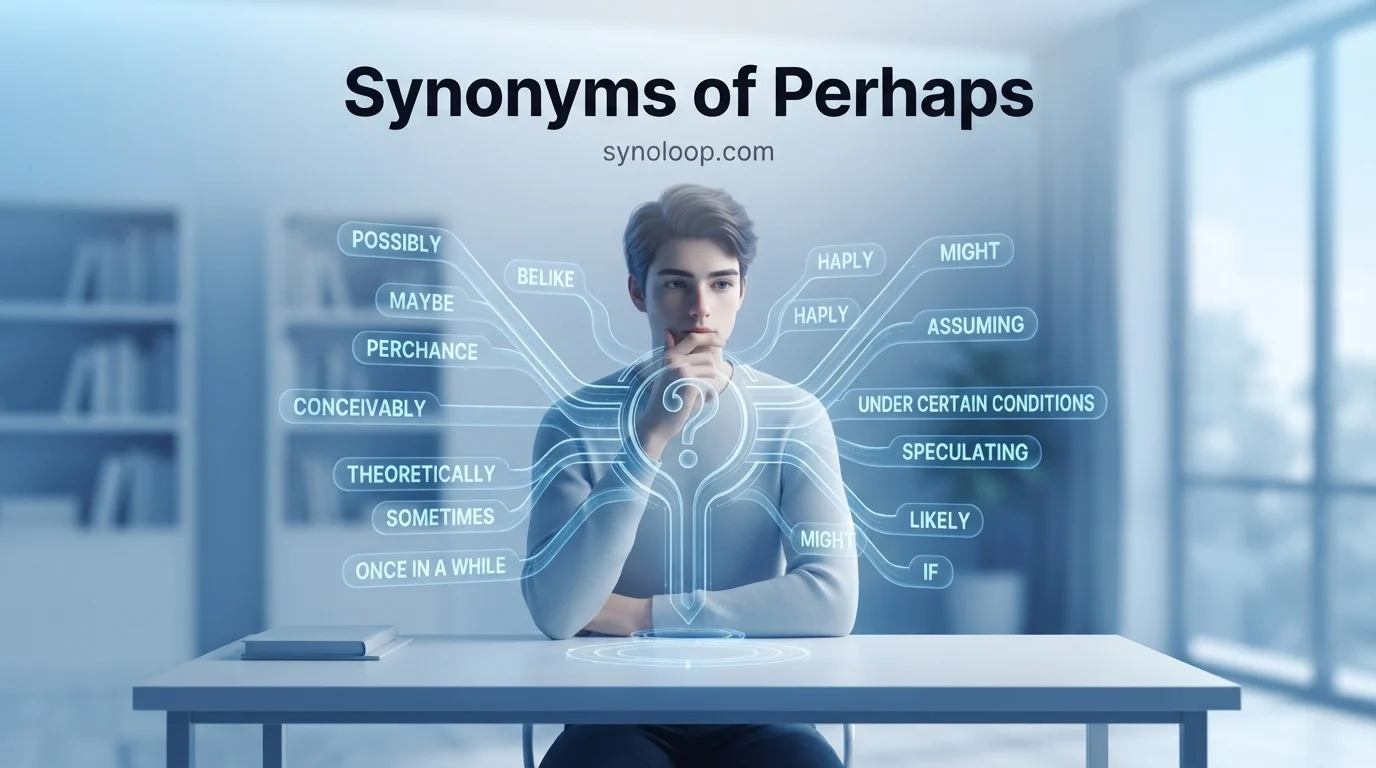
The word perhaps is commonly used in English to express possibility, uncertainty, or a gentle suggestion. It means that something may happen or may be true, but there is no complete certainty. For example, you might say, “Perhaps we will visit the museum tomorrow.” This means that visiting the museum is possible, but the plan is not definite.
Learning the synonyms of perhaps can help you make your writing more varied, natural, and expressive. Although many alternatives have similar meanings, each one can create a slightly different tone. Some sound more formal, while others are common in everyday conversation. Choosing the right word can make your message clearer and more appropriate for the situation.
This guide explains 30 useful alternatives to perhaps in simple English. It includes meanings, example sentences, and practical usage notes to help students, ESL learners, writers, and content creators understand when to use each word.
What Does Perhaps Mean?
Perhaps is an adverb used to show that something is possible but not certain. It is similar to maybe or possibly.
Simple meaning
Perhaps means maybe, possibly, or it could be true.
Examples
- Perhaps she will join us later.
- Perhaps I made a mistake.
- Perhaps we should try another approach.
The word does not confirm that something will happen. It simply presents an idea or possibility.
Tone and usage
Perhaps is flexible and can be used in both formal and informal English. It often sounds slightly more polite, thoughtful, or tentative than maybe.
| Sentence | Meaning |
| Perhaps he is busy. | It is possible that he is busy. |
| Perhaps we should leave early. | This is a gentle suggestion. |
| Perhaps they know the answer. | They may know the answer, but it is uncertain. |
30 Synonyms of Perhaps
The following words and phrases can replace perhaps in suitable contexts. Some are direct synonyms, while others express possibility, uncertainty, or suggestion in a more specific way.
1. Maybe
Meaning: Maybe means that something is possible but not certain.
Example sentence: Maybe we can meet after lunch.
Best usage context: Everyday conversations, text messages, and casual writing.
2. Possibly
Meaning: Possibly means that something might happen or might be true.
Example sentence: She could possibly arrive before noon.
Best usage context: Formal and informal writing when discussing possibilities.
3. Conceivably
Meaning: Conceivably means that something is possible, even if it seems unlikely.
Example sentence: Conceivably, the project could be completed within a week.
Best usage context: Formal writing, academic discussions, and situations involving theoretical possibilities.
4. Potentially
Meaning: Potentially means that something may happen or develop in the future.
Example sentence: This new technology could potentially improve communication.
Best usage context: Business, technology, research, and discussions about future results.
5. Perchance
Meaning: Perchance is an old-fashioned or literary word meaning perhaps or maybe.
Example sentence: Perchance we shall meet again someday.
Best usage context: Poetry, literature, creative writing, and deliberately old-fashioned language.
6. Maybe So
Meaning: Maybe so means that something could be true or that you accept it as a possibility.
Example sentence: “He might be the right person for the job.” “Maybe so, but we need more information.”
Best usage context: Informal conversations and responses to uncertain statements.
7. It Could Be
Meaning: It could be means that something is a possible explanation or answer.
Example sentence: It could be a problem with the internet connection.
Best usage context: Everyday speech, explanations, and discussions involving uncertainty.
8. It Is Possible
Meaning: It is possible means that something may happen or may be true.
Example sentence: It is possible that the meeting will be postponed.
Best usage context: Formal writing, professional communication, and careful explanations.
9. In All Likelihood
Meaning: In all likelihood means that something is probably true or likely to happen.
Example sentence: In all likelihood, the train will arrive shortly.
Best usage context: Formal writing and situations where something seems more likely than unlikely.
Note: This expression usually suggests a stronger level of probability than perhaps.
10. In All Probability
Meaning: In all probability means that something is very likely to happen or be true.
Example sentence: In all probability, the team will finish the work tomorrow.
Best usage context: Formal discussions, reports, and analytical writing.
11. By Any Chance
Meaning: By any chance asks whether something might be possible, especially when making a polite request or inquiry.
Example sentence: Do you, by any chance, have an extra pen?
Best usage context: Polite questions and casual conversations.
Note: It is not a direct replacement for perhaps in every sentence.
12. If Possible
Meaning: If possible means that something should happen only if it can be done.
Example sentence: If possible, please send me the document today.
Best usage context: Requests, instructions, workplace communication, and polite suggestions.
13. In Some Cases
Meaning: In some cases means that something may be true or happen under certain circumstances.
Example sentence: In some cases, exercise may help improve sleep.
Best usage context: Academic writing, health information, and general explanations.
Note: This phrase refers to certain situations rather than simply expressing uncertainty.
14. Under Certain Circumstances
Meaning: This phrase means that something may happen when particular conditions exist.
Example sentence: Under certain circumstances, the company may extend the deadline.
Best usage context: Formal writing, policies, legal explanations, and professional communication.
15. For All I Know
Meaning: For all I know means that something may be true because you do not have enough information to know otherwise.
Example sentence: For all I know, they may already have left.
Best usage context: Informal conversations when admitting limited knowledge.
16. For All We Know
Meaning: For all we know means that something is possible because nobody in the group has enough information.
Example sentence: For all we know, the package could have arrived yesterday.
Best usage context: Conversations, storytelling, and informal explanations.
17. As It May Be
Meaning: As it may be suggests that something could be the case, although the exact situation is uncertain.
Example sentence: As it may be, we should prepare for several possible outcomes.
Best usage context: Careful explanations and reflective writing.
Note: This is not a common direct substitute for perhaps and may sound unnatural in ordinary conversation.
18. Who Knows?
Meaning: Who knows? expresses uncertainty about what might happen or what might be true.
Example sentence: Who knows? Perhaps we will discover something unexpected.
Best usage context: Informal speech, casual writing, and open-ended possibilities.
19. It May Be That
Meaning: It may be that introduces a possibility or uncertain explanation.
Example sentence: It may be that the instructions were misunderstood.
Best usage context: Formal writing, thoughtful explanations, and discussions of possible causes.
20. It Might Be That
Meaning: It might be that means that something could be true, although there is no certainty.
Example sentence: It might be that she needs more time to decide.
Best usage context: Conversations, explanations, and situations involving uncertain reasons.
21. Maybe It Will
Meaning: Maybe it will expresses uncertainty about whether something will happen.
Example sentence: Maybe it will rain this evening.
Best usage context: Informal conversations and predictions about the future.
22. Maybe Not
Meaning: Maybe not means that something might not happen or might not be true.
Example sentence: We could go hiking tomorrow, but maybe not if the weather is bad.
Best usage context: Casual conversations and uncertain plans.
23. Perhaps So
Meaning: Perhaps so means that something may be true, but the speaker is not completely certain.
Example sentence: “Do you think this is the best solution?” “Perhaps so, but we should consider other options.”
Best usage context: Polite discussions, thoughtful responses, and formal conversations.
24. It Is Conceivable That
Meaning: It is conceivable that means that something can reasonably be imagined as possible.
Example sentence: It is conceivable that the discovery could change modern medicine.
Best usage context: Academic writing, research, analytical discussions, and formal explanations.
25. It Is Not Impossible
Meaning: It is not impossible means that something could happen, even if it is not expected.
Example sentence: It is not impossible that the team will reach the final.
Best usage context: Formal discussions, careful predictions, and situations involving low-probability events.
26. There Is a Chance
Meaning: There is a chance means that something may happen or may be true.
Example sentence: There is a chance that the flight will be delayed.
Best usage context: Everyday speech, travel discussions, and practical situations involving uncertainty.
27. There Is a Possibility
Meaning: There is a possibility means that something could happen or exist.
Example sentence: There is a possibility that the event will be moved indoors.
Best usage context: Professional communication, reports, and formal explanations.
28. Perhaps Not
Meaning: Perhaps not means that something may not be true or may not happen.
Example sentence: “Will they accept the offer?” “Perhaps not, but we can still try.”
Best usage context: Polite disagreement, uncertain answers, and thoughtful conversations.
29. It May Be Possible
Meaning: It may be possible means that something could potentially be done or achieved.
Example sentence: It may be possible to complete the repairs by Friday.
Best usage context: Workplace communication, planning, and discussions about solutions.
30. If It Happens
Meaning: If it happens introduces a possible future event without saying that it will definitely occur.
Example sentence: If it happens, we will need to adjust our schedule.
Best usage context: Conditional statements, planning, and discussions about uncertain future events.
Note: This phrase is conditional and does not have the same meaning as perhaps in every sentence.
Comparison Table: When to Use Different Synonyms of Perhaps
Choosing the right alternative depends on the level of certainty, tone, and situation. The following table provides a quick guide.
| Synonym or phrase | Main meaning | Tone | Example |
| Maybe | Something might happen | Casual | Maybe I will call later. |
| Possibly | Something is possible | Neutral | She could possibly help us. |
| Conceivably | A possible, sometimes unlikely situation | Formal | Conceivably, the plan could work. |
| Potentially | Something may happen in the future | Neutral/formal | The idea could potentially succeed. |
| Perchance | Perhaps in an old-fashioned style | Literary | Perchance we shall meet again. |
| It could be | A possible explanation | Neutral | It could be a misunderstanding. |
| It is possible | A possibility exists | Formal | It is possible that prices will rise. |
| In all likelihood | Something is probably true | Formal | In all likelihood, he will agree. |
| Who knows? | The answer is uncertain | Casual | Who knows? Anything could happen. |
| For all I know | You lack enough information | Informal | For all I know, they are already there. |
| There is a chance | Something might happen | Neutral | There is a chance of rain. |
| There is a possibility | A possible event or result | Formal | There is a possibility of delays. |
| Perhaps not | Something might not happen | Neutral | Perhaps not, but we can ask. |
| If possible | Only if something can be done | Polite/formal | If possible, send it today. |
| It may be that | A possible explanation | Formal | It may be that he forgot. |
Difference Between Perhaps, Maybe, and Possibly
Perhaps, maybe, and possibly are among the most common alternatives to one another. They often express the same general idea, but their tone and placement can differ.
Perhaps vs. Maybe
Both words express uncertainty.
- Perhaps: Perhaps we should take a break.
- Maybe: Maybe we should take a break.
The meaning is almost identical. Perhaps can sound a little more polite or formal, while maybe is especially common in everyday speech.
Perhaps vs. Possibly
Both words indicate that something may be true or may happen.
- Perhaps: Perhaps the results will improve.
- Possibly: The results could possibly improve.
Possibly is often useful in formal or analytical contexts. It can also emphasize that something is within the range of possible outcomes.
Perhaps vs. Potentially
These words are related but not always interchangeable.
- Perhaps: Perhaps she will become a successful writer.
- Potentially: She is potentially a successful writer.
The first sentence expresses uncertainty about a future outcome. The second emphasizes someone’s potential or capacity, although the wording may need additional context to sound natural.
How to Choose the Right Synonym
The best synonym depends on what you want to express. Consider whether you are talking casually, writing formally, making a suggestion, or describing an uncertain possibility.
1. For casual conversations
Use simple words that sound natural in everyday speech.
Useful choices:
- Maybe
- It could be
- Maybe so
- Who knows?
- There is a chance
Example:
“Maybe we can watch a movie tonight.”
2. For formal or academic writing
Choose expressions that clearly explain uncertainty or possibility.
Useful choices:
- Possibly
- Conceivably
- It is possible that
- It may be that
- There is a possibility
- It is conceivable that
Example:
“It is possible that the findings will lead to further research.”
3. For polite suggestions
When you want to offer an idea without sounding too forceful, perhaps itself is often a good choice.
Useful choices:
- Perhaps
- Maybe
- If possible
- It may be worth considering
- Perhaps we should
Example:
“Perhaps we should review the instructions once more.”
4. For uncertain predictions
When discussing something that may happen in the future, use expressions that indicate possibility.
Useful choices:
- Possibly
- Potentially
- There is a chance
- It may be possible
- Maybe it will
Example:
“There is a chance that the weather will improve tomorrow.”
5. For unlikely but possible situations
Some alternatives suggest that an event is imaginable, even if it does not seem very likely.
Useful choices:
- Conceivably
- It is conceivable that
- It is not impossible
- Perchance
Example:
“It is conceivable that the discovery could change the industry.”
6. For uncertain answers
When you do not have enough information to give a definite answer, these phrases can be useful.
Useful choices:
- For all I know
- For all we know
- Who knows?
- It could be
- Perhaps not
Example:
“For all we know, the meeting may already be over.”
Common Mistakes When Using Synonyms of Perhaps
Understanding similar words is helpful, but not every alternative fits every sentence. Here are some common mistakes to avoid.
Mistake 1: Using “if possible” as a direct replacement for “perhaps”
Incorrect replacement:
Perhaps she will attend the meeting.
If possible she will attend the meeting.
The second sentence changes the meaning. If possible refers to a condition, while perhaps expresses uncertainty.
Better sentence:
If possible, she will attend the meeting.
This means she will attend if circumstances allow it.
Mistake 2: Confusing possibility with probability
Perhaps simply indicates that something may be true. Expressions such as in all likelihood suggest that something is more likely to happen.
- Perhaps he will win. — It is possible.
- In all likelihood, he will win. — It is considered probable.
Choose the expression that matches the certainty you intend to communicate.
Mistake 3: Using literary words in ordinary conversation
Words such as perchance can sound poetic or old-fashioned.
Literary style: Perchance we shall meet again.
Natural everyday style: Perhaps we will meet again.
Both express a possibility, but their styles are different.
Mistake 4: Overusing formal phrases
Expressions such as it is conceivable that and it is not impossible may sound unnecessarily complicated in a simple conversation.
Instead of:
“It is conceivable that we may arrive late.”
You can say:
“Maybe we will arrive late.”
Simple language is often clearer and more natural.
Mistake 5: Forgetting that some phrases have special meanings
Potentially, by any chance, and for all I know do not always work as direct substitutes for perhaps.
For example:
- “Do you have a spare charger, by any chance?” is a polite question.
- “This plan could potentially save money” focuses on possible benefits.
- “For all I know, the store may be closed” shows limited knowledge.
Understanding the context helps you choose the correct expression.
Synonyms of Perhaps in Different Writing Styles
The word you choose can change the feeling of your sentence. Here are examples for several common writing situations.
Academic writing
Academic writing often requires careful language that avoids claiming certainty without evidence.
Examples:
- It is possible that the results were affected by external factors.
- The findings could potentially support further research.
- Conceivably, the observed pattern may have another explanation.
Professional writing
In business communication, clear and polite expressions are useful.
Examples:
- Perhaps we should discuss the proposal tomorrow.
- There is a possibility that the deadline will change.
- It may be possible to arrange an alternative meeting time.
Creative writing
Creative writing may use unusual or expressive alternatives to create a particular mood.
Examples:
- Perchance, a new beginning awaited her.
- Who knows what secrets the old house contained?
- Perhaps the journey would change everything.
Everyday conversation
Simple words usually sound the most natural.
Examples:
- Maybe I will join you later.
- It could be a mistake.
- Perhaps we can talk after dinner.
Frequently Asked Questions About Synonyms of Perhaps
What is the most common synonym of perhaps?
Maybe is the most common everyday synonym of perhaps. Both words express uncertainty or possibility.
What is a formal synonym for perhaps?
Possibly is a common formal or neutral alternative. Other formal expressions include it is possible that, conceivably, and there is a possibility.
Is possibly the same as perhaps?
Possibly and perhaps are closely related and can often be used interchangeably. However, possibly may sound more analytical or formal in some contexts.
Is maybe more informal than perhaps?
Generally, yes. Maybe is very common in everyday speech, while perhaps can sound slightly more formal or polite. Both are acceptable in many situations.
What is a literary synonym for perhaps?
Perchance is a literary or old-fashioned synonym for perhaps. It is more common in poetry and creative writing than in ordinary conversation.
Can perhaps be used to make a suggestion?
Yes. Perhaps can introduce a polite or gentle suggestion.
Example: Perhaps we should start earlier tomorrow.
What is the opposite of perhaps?
There is no single exact opposite of perhaps. Depending on the context, words such as certainly, definitely, or surely can express a much higher level of certainty.
How do I use perhaps in a sentence?
Place perhaps before the main verb in many sentences, or at the beginning of a sentence.
Examples:
- Perhaps she knows the answer.
- She perhaps knows the answer. (Grammatically possible, but less natural in many contexts.)
- Perhaps we should leave now.
Is “there is a chance” a synonym for perhaps?
It can express a similar idea of possibility, but it is not a direct replacement in every sentence. It is often used when discussing whether an event might happen.
Example: There is a chance that the bus will be late.
Which synonym of perhaps is best for ESL learners?
Maybe, possibly, and it could be are useful starting points. They are common, easy to understand, and applicable in many everyday situations.
Conclusion:
Learning the synonyms of perhaps helps you express uncertainty, possibility, and suggestions more naturally. While maybe, possibly, and perhaps are often interchangeable, other expressions have more specific meanings or tones.
For everyday conversations, maybe and it could be are simple and natural choices. For academic and professional writing, possibly, it is possible that, and there is a possibility can communicate uncertainty clearly. In creative writing, perchance may add a literary touch.
The most important lesson is to choose a synonym based on meaning, tone, and context. By practicing these 30 alternatives, you can expand your vocabulary, improve your writing style, and communicate your ideas with greater precision.

I am Evelyn Marie, the Administrator of Synoloop. I enjoy helping readers discover useful synonyms, alternative words, and better ways to express their ideas. I focus on keeping Synoloop simple, reliable, informative, and helpful for everyone.