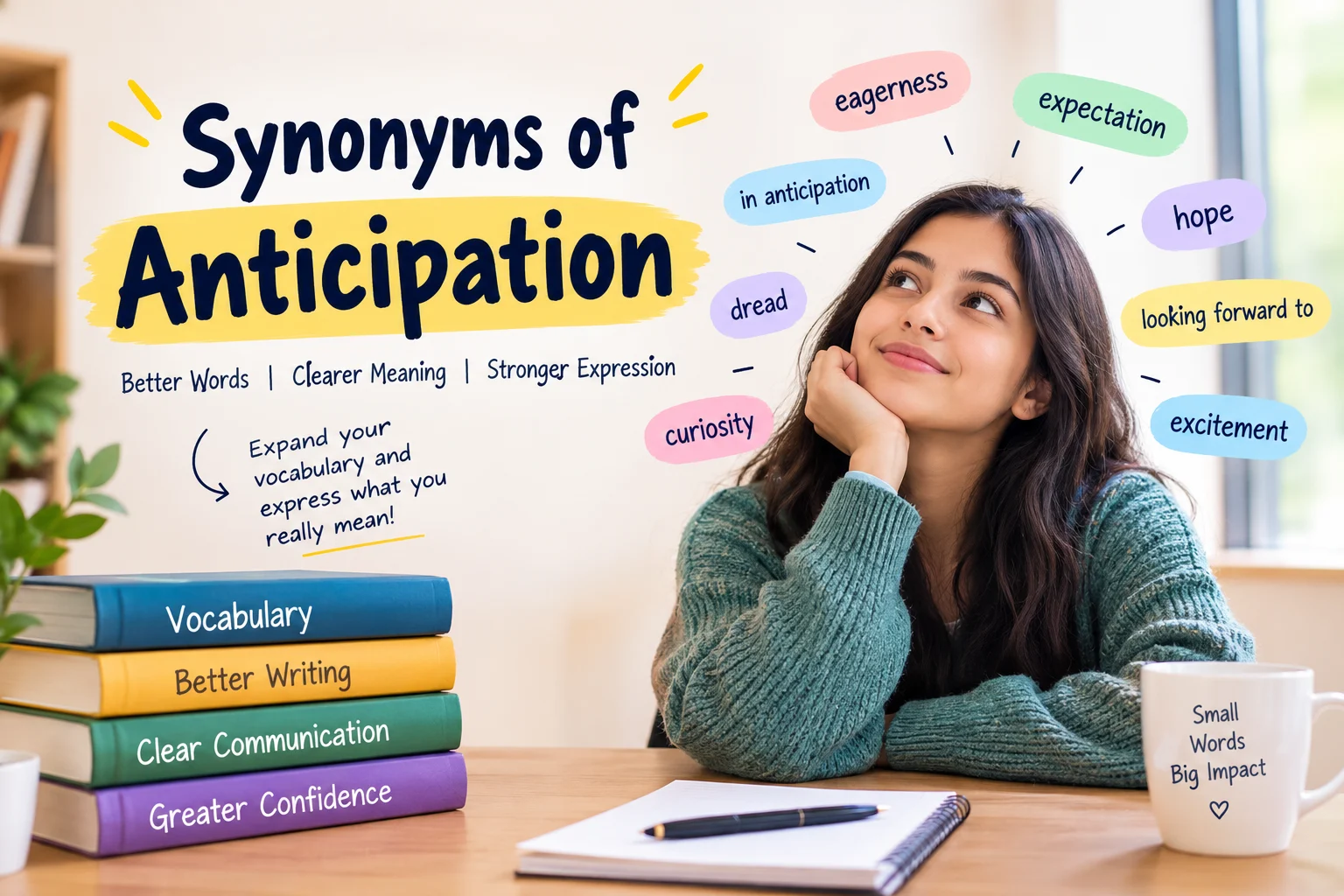
When you are waiting for something to happen, the feeling you experience can be described as anticipation. It may be the excitement you feel before a holiday, the expectation of receiving important news, or the nervous feeling that comes before a major event. Because anticipation can describe several different emotions, knowing its synonyms can help you choose a word that expresses your exact meaning.
The synonyms of anticipation include words such as expectation, excitement, eagerness, hope, suspense, prospect, prediction, and forethought. Although these words are related, they are not always interchangeable. Each one can carry a slightly different meaning, emotional tone, or context.
For students, ESL learners, writers, and content creators, learning these alternatives is useful because it makes writing more precise and natural. Instead of repeatedly using the word “anticipation,” you can select a synonym that better communicates whether you mean excitement, expectation, preparation, uncertainty, or hope.
What Does Anticipation Mean?
Anticipation is the feeling of expecting something to happen in the future. It can involve excitement, hope, curiosity, nervousness, or simply awareness that an event is approaching.
For example:
“The children waited in anticipation for the holiday to begin.”
Here, anticipation describes their excited expectation of something they are looking forward to.
The word can also refer to the act of preparing for or expecting something before it happens.
Simple meaning:
Anticipation means expecting something to happen and often feeling excited, hopeful, curious, or nervous about it.
30 Synonyms of Anticipation
The best synonym depends on what kind of anticipation you want to express. Below are 30 useful alternatives, with simple meanings, examples, and usage guidance.
1. Expectation
Meaning: A belief that something will happen.
Example:
“She waited with expectation for the results of her exam.”
Best usage: Use “expectation” when someone believes an event is likely to happen.
2. Excitement
Meaning: A strong feeling of happiness or enthusiasm about something that is going to happen.
Example:
“There was great excitement before the concert began.”
Best usage: Best when anticipation involves strong positive emotion.
3. Eagerness
Meaning: A strong desire to do or experience something.
Example:
“His eagerness to start the new project was obvious.”
Best usage: Use it when someone is enthusiastic and ready for something.
4. Hope
Meaning: A feeling that something desired may happen.
Example:
“She waited with hope for a positive response.”
Best usage: Appropriate when the future event is desired but not certain.
5. Prospect
Meaning: The possibility or likelihood of something happening.
Example:
“The prospect of traveling abroad filled her with excitement.”
Best usage: Useful when discussing a possible future opportunity or event.
6. Suspense
Meaning: A feeling of uncertainty about what will happen next.
Example:
“The movie kept the audience in suspense until the final scene.”
Best usage: Especially useful for stories, films, mysteries, and uncertain situations.
7. Expectancy
Meaning: A state of waiting for something expected to happen.
Example:
“The audience sat in silent expectancy before the announcement.”
Best usage: A formal or literary alternative to anticipation.
8. Foresight
Meaning: The ability to think about and prepare for future events.
Example:
“Her foresight helped the company avoid serious problems.”
Best usage: Use this when anticipation involves planning or preparation.
9. Forethought
Meaning: Careful consideration of something before it happens.
Example:
“With some forethought, they prepared an alternative plan.”
Best usage: Best when someone considers future needs before taking action.
10. Prediction
Meaning: A statement about what you believe will happen in the future.
Example:
“His prediction about the weather proved correct.”
Best usage: Use when anticipation involves making a specific forecast.
11. Premonition
Meaning: A strong feeling that something is going to happen, especially something unusual or unpleasant.
Example:
“She had a strange premonition that something was wrong.”
Best usage: Appropriate for mysterious, intuitive, or negative expectations.
12. Readiness
Meaning: The state of being prepared for something.
Example:
“The team’s readiness for the competition impressed the coach.”
Best usage: Use when anticipation leads to practical preparation.
13. Preparedness
Meaning: The condition of being prepared for a future situation.
Example:
“Emergency preparedness can save lives during natural disasters.”
Best usage: Common in professional, academic, safety, and organizational writing.
14. Apprehension
Meaning: Anxiety or worry about something that may happen.
Example:
“She approached the interview with some apprehension.”
Best usage: Choose this when anticipation has a fearful or nervous tone.
15. Curiosity
Meaning: A strong desire to know or discover something.
Example:
“Curiosity made him eager to see what was inside the box.”
Best usage: Useful when anticipation is driven by wanting to know what happens next.
16. Enthusiasm
Meaning: Strong excitement and interest in something.
Example:
“The students showed enthusiasm for the new course.”
Best usage: Best for positive anticipation connected with interest or energy.
17. Eagerness
Meaning: An intense desire or willingness to experience something.
Example:
“Her eagerness to meet the author was easy to see.”
Best usage: Particularly useful for people who are excited to take action.
18. Hopefulness
Meaning: A positive belief that something good may happen.
Example:
“Despite the difficulties, he remained hopeful about the future.”
Best usage: Use when anticipation is optimistic rather than certain.
19. Confidence
Meaning: A strong belief that something will happen or succeed.
Example:
“She entered the competition with confidence.”
Best usage: Appropriate when future expectations are based on belief or certainty.
20. Belief
Meaning: Acceptance that something is true or likely to happen.
Example:
“His belief that the team would win never changed.”
Best usage: Use when anticipation is based on personal conviction.
21. Expectancy
Meaning: A feeling of waiting for something to occur.
Example:
“There was a sense of expectancy throughout the room.”
Best usage: Especially suitable for formal or descriptive writing.
22. Foreboding
Meaning: A strong feeling that something bad may happen.
Example:
“A sense of foreboding filled the house before the storm.”
Best usage: Use when anticipation has a dark, threatening, or negative feeling.
23. Impatience
Meaning: A feeling of wanting something to happen immediately.
Example:
“The children showed impatience as they waited for the doors to open.”
Best usage: Useful when anticipation makes waiting difficult.
24. Longing
Meaning: A strong desire for something that may be difficult to obtain.
Example:
“She felt a deep longing to return to her hometown.”
Best usage: Best for emotional or personal anticipation involving strong desire.
25. Desire
Meaning: A strong wish to have or experience something.
Example:
“His desire to succeed motivated him to work harder.”
Best usage: Use when anticipation centers on wanting a particular outcome.
26. Possibility
Meaning: Something that may happen or exist in the future.
Example:
“The possibility of a promotion gave her extra motivation.”
Best usage: Appropriate when the future event is uncertain.
27. Outlook
Meaning: A person’s view or expectation of what the future may bring.
Example:
“The company’s financial outlook improved this year.”
Best usage: Common in business, economics, planning, and formal writing.
28. Promise
Meaning: An indication that something good or successful may happen.
Example:
“The young athlete showed great promise.”
Best usage: Use when something suggests a positive future result.
29. Waiting
Meaning: Remaining in a place or state until something happens.
Example:
“The long waiting period increased their anticipation.”
Best usage: A simple everyday alternative when focusing on the time before an event.
30. Expectation
Meaning: A belief or assumption about what will happen.
Example:
“The team entered the final with high expectations.”
Best usage: One of the closest general alternatives to anticipation, especially in everyday and academic writing.
Quick Comparison of Synonyms of Anticipation
Not every synonym has exactly the same meaning. The following guide can help you choose the most suitable word.
| Synonym | Main Idea | Emotional Tone | Common Context |
| Expectation | Belief something will happen | Neutral | Everyday, academic |
| Excitement | Happiness about what is coming | Positive | Events, entertainment |
| Eagerness | Strong desire to act | Positive | Personal, professional |
| Hope | Desire for a positive outcome | Positive | Personal, emotional |
| Suspense | Uncertainty about what comes next | Tense | Stories, movies |
| Apprehension | Nervous expectation | Negative | Interviews, difficult events |
| Premonition | Feeling something will happen | Mysterious | Literary, unusual |
| Forethought | Thinking ahead | Practical | Planning |
| Foresight | Preparing for the future | Positive/practical | Business, leadership |
| Preparedness | Being ready | Neutral | Safety, work |
| Curiosity | Desire to know what happens | Neutral/positive | Learning, discovery |
| Foreboding | Expectation of something bad | Negative | Dramatic writing |
| Enthusiasm | Strong positive interest | Positive | Work, activities |
| Longing | Strong emotional desire | Emotional | Relationships, memories |
| Prospect | Possibility of something happening | Neutral/positive | Opportunities |
| Prediction | Statement about the future | Neutral | Research, weather |
| Outlook | View of the future | Neutral | Business, planning |
Anticipation vs. Expectation
“Anticipation” and “expectation” are among the closest related words, but they are not always identical.
Expectation usually emphasizes the belief that something will happen.
Anticipation often emphasizes the emotional experience of waiting for it.
For example:
- “I expect the package tomorrow.”
- “I am waiting in anticipation of the package.”
The first sentence focuses on belief. The second emphasizes the feeling associated with waiting.
Anticipation vs. Excitement
Excitement is a more emotional word.
If you say:
“The children were excited about the trip.”
You clearly communicate happiness and enthusiasm.
If you say:
“The children waited in anticipation of the trip.”
The sentence focuses more on their expectation and the period before the trip.
Therefore, excitement is a good synonym when anticipation is strongly positive and energetic.
Anticipation vs. Suspense
Suspense is connected with uncertainty.
For example, when watching a mystery movie, you may anticipate the ending. However, if you do not know what the ending will be, you are also experiencing suspense.
A useful distinction is:
- Anticipation: expecting something to happen.
- Suspense: waiting anxiously to discover what will happen.
Anticipation vs. Apprehension
These words can describe similar situations but have very different emotional tones.
Anticipation can be positive, neutral, or negative.
Apprehension usually suggests worry, fear, or nervousness.
For example:
“She felt anticipation before her wedding.”
This sounds positive.
“She felt apprehension before the difficult examination.”
This suggests anxiety.
What Does “Demure” Mean?
Although demure is unrelated to anticipation, it is a useful vocabulary word with a distinctive meaning.
Demure describes someone who behaves in a quiet, modest, reserved, and well-mannered way. It is often used to describe a person’s appearance, behavior, or manner.
Simple meaning:
Demure means quiet, modest, and not showing a lot of confidence or emotion openly.
For example:
“She gave a demure smile when everyone complimented her.”
The word can have a positive meaning when describing someone as graceful, modest, or reserved. Depending on context, it can also suggest that someone is deliberately behaving in a shy or modest way.
30 Synonyms of Demure
Here are 30 useful alternatives to demure, along with simple meanings, examples, and usage contexts.
1. Modest
Meaning: Not showing off or drawing attention to yourself.
Example:
“She wore a modest dress to the formal event.”
Best usage: Clothing, behavior, personality.
2. Reserved
Meaning: Quiet and not openly expressing feelings.
Example:
“He was reserved when meeting new people.”
Best usage: Personality and social behavior.
3. Shy
Meaning: Nervous or uncomfortable around other people.
Example:
“The shy student rarely spoke in class.”
Best usage: Everyday descriptions of personality.
4. Bashful
Meaning: Easily embarrassed or shy.
Example:
“She became bashful when her friends praised her.”
Best usage: Friendly or affectionate descriptions.
5. Retiring
Meaning: Avoiding attention and preferring a quiet life.
Example:
“Her retiring nature made her uncomfortable at large gatherings.”
Best usage: Formal or literary descriptions.
6. Unassuming
Meaning: Not trying to appear important or impressive.
Example:
“Despite his success, he remained unassuming.”
Best usage: Personality and professional writing.
7. Quiet
Meaning: Not talking or making much noise.
Example:
“She was quiet during the meeting.”
Best usage: Simple everyday English.
8. Gentle
Meaning: Calm, kind, and not aggressive.
Example:
“He had a gentle manner when speaking to children.”
Best usage: Personality and behavior.
9. Mild
Meaning: Calm and not extreme.
Example:
“She has a mild and pleasant personality.”
Best usage: Personality and temperament.
10. Soft-spoken
Meaning: Speaking quietly and calmly.
Example:
“The soft-spoken teacher created a relaxed classroom.”
Best usage: Speech and personality.
11. Meek
Meaning: Very quiet, gentle, and unlikely to argue or resist.
Example:
“He was meek and rarely challenged anyone.”
Best usage: Use carefully because it can imply weakness.
12. Timid
Meaning: Lacking confidence because of fear or nervousness.
Example:
“The timid child hesitated before answering.”
Best usage: Shyness or lack of confidence.
13. Coy
Meaning: Shy or pretending to be shy, often in a playful way.
Example:
“She gave him a coy smile.”
Best usage: Flirtatious, playful, or literary contexts.
14. Dainty
Meaning: Delicate, small, and graceful.
Example:
“She placed the flowers in a dainty vase.”
Best usage: Appearance, movements, objects.
15. Refined
Meaning: Elegant, polished, and well-mannered.
Example:
“She had a refined sense of style.”
Best usage: Social behavior, appearance, taste.
16. Graceful
Meaning: Elegant and attractive in movement or behavior.
Example:
“She made a graceful entrance.”
Best usage: Movement, manners, appearance.
17. Courteous
Meaning: Polite and respectful.
Example:
“He was courteous to everyone at the event.”
Best usage: Manners and social behavior.
18. Polite
Meaning: Showing good manners and respect.
Example:
“She gave a polite response.”
Best usage: Everyday communication.
19. Well-mannered
Meaning: Behaving politely and appropriately.
Example:
“The well-mannered child thanked the guests.”
Best usage: Children, social behavior, formal descriptions.
20. Proper
Meaning: Appropriate and socially acceptable.
Example:
“She maintained a proper and respectful manner.”
Best usage: Formal or social contexts.
21. Ladylike
Meaning: Traditionally associated with polite, graceful, and socially respectable feminine behavior.
Example:
“She was known for her ladylike manners.”
Best usage: Traditional or descriptive writing; can sound old-fashioned.
22. Demurely
Meaning: In a quiet, modest, or reserved manner.
Example:
“She smiled demurely at the compliment.”
Best usage: Describing how an action is performed.
23. Subdued
Meaning: Quiet, restrained, or not intense.
Example:
“Her subdued reaction surprised everyone.”
Best usage: Emotions, reactions, colors, atmosphere.
24. Restrained
Meaning: Controlled and not openly emotional.
Example:
“He gave a restrained response to the criticism.”
Best usage: Formal, emotional, and professional contexts.
25. Composed
Meaning: Calm and in control of your emotions.
Example:
“She remained composed during the difficult conversation.”
Best usage: Professional and emotional situations.
26. Serene
Meaning: Calm, peaceful, and untroubled.
Example:
“She had a serene expression on her face.”
Best usage: Appearance, personality, atmosphere.
27. Docile
Meaning: Quiet and willing to accept instructions or control.
Example:
“The normally energetic dog became docile after a long walk.”
Best usage: Animals or people who are easy to manage; not always a positive description.
28. Innocent
Meaning: Showing a lack of experience, guilt, or harmful intention.
Example:
“She had an innocent and gentle expression.”
Best usage: Personality, appearance, or intentions.
29. Unobtrusive
Meaning: Not attracting attention or disturbing others.
Example:
“His unobtrusive manner made him easy to work with.”
Best usage: Formal descriptions of behavior or presence.
30. Unpretentious
Meaning: Simple and not trying to appear more important than you are.
Example:
“Her unpretentious personality made everyone feel comfortable.”
Best usage: Personality, lifestyle, writing, and professional descriptions.
How to Choose the Right Synonym for Anticipation
Choosing the right synonym depends on the exact feeling or idea you want to communicate.
For Positive Anticipation
Use:
- Excitement
- Eagerness
- Enthusiasm
- Hope
- Hopefulness
- Desire
- Longing
These words work well when someone is looking forward to something.
Example:
“The students waited with excitement for the school trip.”
For Neutral Expectation
Use:
- Expectation
- Expectancy
- Prospect
- Possibility
- Outlook
- Belief
These words work when you want to discuss what someone thinks may happen without emphasizing strong emotion.
Example:
“There is a strong expectation that sales will increase.”
For Nervous Anticipation
Use:
- Apprehension
- Suspense
- Impatience
- Premonition
These words are useful when waiting creates tension, worry, or uncertainty.
Example:
“She entered the room with apprehension.”
For Future Planning
Use:
- Foresight
- Forethought
- Preparedness
- Readiness
These words are better when anticipation involves preparing for something before it occurs.
Example:
“Good foresight helped the organization prepare for future challenges.”
For Uncertain Future Events
Use:
- Suspense
- Possibility
- Prospect
- Prediction
- Premonition
These alternatives are useful when the outcome is unknown or not guaranteed.
How to Choose the Right Synonym
Before replacing “anticipation,” ask yourself what you really mean.
If you mean believing something will happen, choose expectation.
If you mean being excited about something, choose excitement or enthusiasm.
If you mean wanting something to happen, choose eagerness, desire, or longing.
If you mean hoping for a good result, choose hope or hopefulness.
If you mean worrying about something that may happen, choose apprehension.
If you mean uncertainty about what will happen, choose suspense.
If you mean thinking ahead and preparing, choose foresight, forethought, or preparedness.
This approach is particularly helpful for ESL learners because it focuses on meaning rather than simply memorizing vocabulary lists.
Synonyms of Anticipation in Different Types of Writing
Different writing situations call for different vocabulary.
Academic Writing
Academic writing often benefits from precise and neutral terms such as:
- Expectation
- Prediction
- Prospect
- Outlook
- Possibility
- Preparedness
Example:
“Researchers developed several predictions regarding future environmental changes.”
Creative Writing
Creative writing gives you more freedom to use emotional and descriptive alternatives such as:
- Suspense
- Foreboding
- Premonition
- Longing
- Excitement
- Hope
Example:
“A strange sense of foreboding followed her as she walked toward the old house.”
Professional Writing
For business and workplace communication, consider:
- Expectation
- Outlook
- Preparedness
- Foresight
- Readiness
- Prospect
Example:
“The company’s positive financial outlook has encouraged investors.”
Everyday Conversation
Simple words are usually the most natural:
- Excitement
- Expectation
- Hope
- Eagerness
- Curiosity
- Waiting
Example:
“I can’t hide my excitement about the trip.”
Common Mistakes When Using Synonyms of Anticipation
A synonym should not be selected only because it appears in a thesaurus. Related words can have different emotional meanings.
For example, replacing “anticipation” with “apprehension” can completely change the tone of a sentence. Anticipation may be positive, while apprehension suggests worry.
Similarly, “foresight” does not simply mean excitement about the future. It describes the ability to think ahead and prepare wisely.
“Suspense” is also different from ordinary expectation because suspense usually involves uncertainty and tension.
The best practice is to consider meaning, emotion, context, and sentence structure before choosing a replacement.
Frequently Asked Questions About Synonyms of Anticipation
What is the closest synonym for anticipation?
Expectation is one of the closest general synonyms for anticipation. However, excitement, eagerness, hope, or suspense may be more accurate depending on the context.
What is a positive synonym for anticipation?
Common positive alternatives include excitement, eagerness, enthusiasm, hope, hopefulness, and expectancy.
What is a negative synonym for anticipation?
When anticipation involves worry or fear, words such as apprehension and foreboding can be appropriate.
Is excitement the same as anticipation?
Not exactly. Anticipation means expecting something that is going to happen, while excitement describes a strong positive emotional response. Anticipation can include excitement, but it can also involve nervousness or uncertainty.
Is expectation a synonym for anticipation?
Yes, expectation can be a synonym for anticipation, especially when the focus is on believing that something will happen. However, “anticipation” often carries more emotional meaning.
What is a synonym for anticipation in a formal context?
Depending on the sentence, expectancy, expectation, foresight, forethought, preparedness, prospect, or outlook may work well in formal writing.
What is the meaning of demure?
Demure means quiet, modest, reserved, and well-mannered. It is often used to describe someone’s behavior, appearance, or manner.
Final Thoughts on Synonyms of Anticipation
Understanding the synonyms of anticipation can make your vocabulary more flexible and your writing more precise. While words such as expectation, excitement, eagerness, hope, suspense, apprehension, foresight, and prospect are related to anticipation, each one highlights a different aspect of looking toward the future.
The key is to choose a word based on the meaning you want to communicate. Use excitement for positive energy, expectation for belief, hope for a desired outcome, suspense for uncertainty, apprehension for nervousness, and foresight for thoughtful preparation.
For students and ESL learners, learning these distinctions is more useful than simply memorizing a long synonym list. When you understand the tone and context of each word, you can write clearer essays, create stronger content, and communicate your ideas more naturally.

I am Jace Thomas, a passionate synonym writer dedicated to making word choices simple and meaningful. I enjoy exploring language, discovering synonyms, and helping readers express ideas clearly and creatively.