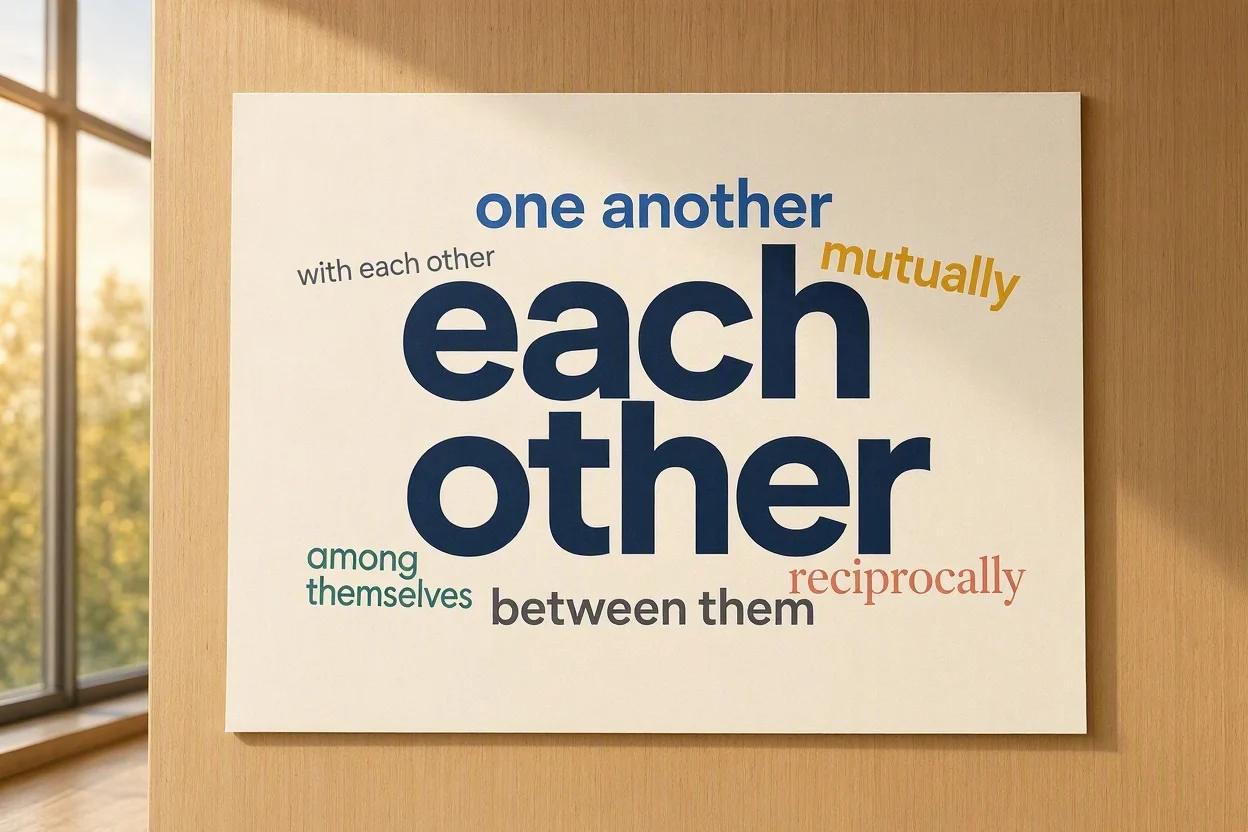
Finding the right each other synonyms can make your English more natural, varied, and precise. The phrase “each other” is commonly used when two or more people or things perform an action toward one another. For example, “The two friends helped each other” means that both friends helped the other person.
Although “each other” is already correct and natural, writers sometimes need alternatives to avoid repetition or to express a slightly different relationship. Depending on the sentence, you may use phrases such as one another, mutually, together, reciprocally, in return, back and forth, or between themselves.
For students, ESL learners, writers, and content creators, understanding these alternatives is useful because not every synonym fits every grammatical situation. Some work naturally with people, some describe reciprocal actions, and others are better for formal or specific contexts.
What Does “Each Other” Mean?
Each other is a reciprocal pronoun used when two or more people or things do something to or for one another.
Simple meaning: one person does something to another, and the other person does the same or is involved in the same relationship.
Example:
- Sarah and Emma helped each other with their homework.
- The two teams respected each other.
- We should listen to each other.
The phrase usually expresses a reciprocal relationship, meaning that an action, feeling, or response goes in both directions.
Tone and Usage
“Each other” is neutral, common, and suitable for everyday English as well as most forms of writing.
It is especially useful when you want to describe:
- Mutual actions
- Shared feelings
- Reciprocal relationships
- Cooperation
- Communication
- Mutual support
For example, “The children encouraged each other” sounds natural in both conversation and writing.
30 Each Other Synonyms and Alternatives
There is no single replacement for “each other” that works in every sentence. The best alternative depends on grammar, meaning, and context.
1. One Another
Meaning: Each person or thing in a group interacts with the others.
Example: The team members supported one another during the difficult project.
Best usage context: Formal or polished writing, especially when referring to more than two people.
2. Mutually
Meaning: In a way that affects both or all sides.
Example: The two companies mutually agreed to continue their partnership.
Best usage context: Formal, professional, and academic writing.
3. Reciprocally
Meaning: In a way where an action or feeling is returned by another person.
Example: Their respect was reciprocally expressed.
Best usage context: Formal, academic, or technical contexts.
4. Together
Meaning: With one another or as a group.
Example: The friends worked together to solve the problem.
Best usage context: Everyday English and situations involving cooperation.
5. In Return
Meaning: As a response to something someone has done.
Example: She helped him, and he helped her in return.
Best usage context: Situations involving exchanged actions or favors.
6. Back and Forth
Meaning: Moving or communicating repeatedly between two sides.
Example: The two colleagues sent emails back and forth.
Best usage context: Conversations, messages, arguments, or repeated exchanges.
7. Between Themselves
Meaning: Among the people involved, without others participating.
Example: The students discussed the problem between themselves.
Best usage context: Private conversations or group interactions.
8. Among Themselves
Meaning: Within a particular group.
Example: The players shared ideas among themselves.
Best usage context: Groups of people rather than just two individuals.
9. Jointly
Meaning: Done together by two or more people or organizations.
Example: The researchers jointly published the report.
Best usage context: Business, academic, legal, and professional writing.
10. Collectively
Meaning: Done or considered as a group.
Example: The employees collectively decided to improve the workplace.
Best usage context: Formal writing and group decisions.
11. Cooperatively
Meaning: In a helpful way by working together.
Example: The students worked cooperatively to complete the assignment.
Best usage context: Education, teamwork, and professional settings.
12. Collaboratively
Meaning: By working together toward a shared goal.
Example: The designers worked collaboratively on the new website.
Best usage context: Business, technology, education, and creative projects.
13. In Cooperation
Meaning: By working together or helping one another.
Example: The organizations acted in cooperation to solve the issue.
Best usage context: Formal and professional writing.
14. In Partnership
Meaning: By working together as partners.
Example: The two companies developed the product in partnership.
Best usage context: Business, organizations, and professional relationships.
15. In Collaboration
Meaning: By working jointly with another person or group.
Example: The artists created the project in collaboration.
Best usage context: Creative, academic, professional, and business contexts.
16. In Agreement
Meaning: Sharing the same opinion or decision.
Example: The committee members were in agreement about the proposal.
Best usage context: Opinions, decisions, and formal discussions.
17. In Unity
Meaning: Acting together with shared purpose.
Example: The community stood in unity during the difficult period.
Best usage context: Communities, groups, organizations, and inspirational writing.
18. In Common
Meaning: Shared by two or more people or groups.
Example: The two students have many interests in common.
Best usage context: Shared interests, characteristics, experiences, or qualities.
19. Shared
Meaning: Experienced, used, or possessed by more than one person.
Example: They have a shared interest in literature.
Best usage context: Interests, experiences, responsibilities, and relationships.
20. Mutual
Meaning: Felt, experienced, or done by both sides.
Example: Their friendship was based on mutual respect.
Best usage context: Relationships, feelings, respect, trust, and agreements.
21. Mutual Understanding
Meaning: A situation where both sides understand one another.
Example: The discussion helped create mutual understanding.
Best usage context: Relationships, communication, diplomacy, and conflict resolution.
22. Mutual Support
Meaning: Both sides provide help to one another.
Example: The members benefited from mutual support.
Best usage context: Friendships, families, teams, and communities.
23. Mutual Respect
Meaning: Both sides respect the other.
Example: A healthy workplace should be built on mutual respect.
Best usage context: Professional, social, and personal relationships.
24. Reciprocal
Meaning: Given, felt, or returned by both sides.
Example: The two countries developed a reciprocal relationship.
Best usage context: Formal writing, relationships, agreements, and exchanges.
25. Reciprocated
Meaning: Returned in response to something received.
Example: Her kindness was quickly reciprocated.
Best usage context: Feelings, kindness, support, affection, and actions.
26. In Exchange
Meaning: Given or received as part of an exchange.
Example: They shared information in exchange for useful advice.
Best usage context: Transactions, communication, favors, and negotiations.
27. In Concert
Meaning: Acting together toward the same purpose.
Example: The organizations worked in concert to protect the environment.
Best usage context: Formal writing, organizations, and coordinated actions.
28. Side by Side
Meaning: Together or next to one another.
Example: The two workers stood side by side during the ceremony.
Best usage context: Physical proximity, teamwork, and figurative cooperation.
29. Together With One Another
Meaning: Acting or participating as a group.
Example: The children learned together with one another during the activity.
Best usage context: Educational or explanatory writing.
30. In Relation to One Another
Meaning: Considered or understood in connection with one another.
Example: The two ideas should be examined in relation to one another.
Best usage context: Academic, analytical, and formal writing.
Each Other vs. One Another
Each other and one another are often interchangeable in modern English.
Traditionally, some grammar guides suggested using each other for two people and one another for three or more. In contemporary English, however, this distinction is not usually followed strictly.
Examples:
- The two sisters helped each other.
- The two sisters helped one another.
- The team members encouraged each other.
- The team members encouraged one another.
Both forms are natural.
For everyday conversation, each other is extremely common. One another can sometimes sound slightly more formal or polished.
Comparison Guide: Which Alternative Should You Use?
| Alternative | Main Meaning | Tone | Example Use |
| Each other | Reciprocal action | Neutral | They helped each other. |
| One another | Reciprocal action | Neutral/Formal | They respected one another. |
| Mutually | Affecting both sides | Formal | They mutually agreed. |
| Reciprocally | Returned by both sides | Formal | Their feelings were reciprocally expressed. |
| Together | Acting as a group | Casual/Neutral | They worked together. |
| In return | Returning an action | Neutral | He helped her in return. |
| Back and forth | Repeated exchange | Casual/Neutral | They talked back and forth. |
| Between themselves | Within a group | Neutral | They discussed it between themselves. |
| Jointly | Done together | Formal | They jointly created the report. |
| Collaboratively | Working together | Professional | They worked collaboratively. |
| Mutual | Shared by both sides | Formal/Neutral | They showed mutual respect. |
| Reciprocated | Something returned | Formal | Her kindness was reciprocated. |
| Side by side | Together or beside one another | Neutral | They worked side by side. |
| Collectively | As a group | Formal | They collectively made a decision. |
| In concert | Acting together | Formal | They acted in concert. |
How to Choose the Right Synonym
Choosing an alternative depends on what you want to communicate. Instead of replacing “each other” automatically, consider the exact meaning of your sentence.
For Everyday English
Use:
- Each other
- One another
- Together
- In return
- Back and forth
These alternatives sound natural in conversations and general writing.
For Formal or Academic Writing
Use:
- Mutually
- Reciprocally
- Jointly
- Collectively
- In concert
- In relation to one another
These choices can work well when discussing research, organizations, policies, or analytical ideas.
For Cooperation
Use:
- Together
- Collaboratively
- Cooperatively
- Jointly
- In cooperation
- In partnership
These emphasize people working toward a shared goal.
For Relationships and Feelings
Use:
- Mutual
- Mutual respect
- Mutual support
- Mutual understanding
- Reciprocated
- One another
These are particularly useful when discussing friendship, trust, affection, respect, or communication.
For Repeated Communication
Use:
- Back and forth
- In exchange
- In return
- Between themselves
These phrases are useful when people are responding to one another or exchanging information.
For Physical Position
Use:
- Side by side
- Together
- Next to one another
These work when the sentence describes where people or objects are positioned.
Common Mistakes When Using Each Other Synonyms
Not every alternative can simply replace “each other” without changing the grammar.
For example:
Natural:
“The two friends helped each other.”
Natural:
“The two friends helped one another.”
But replacing the phrase with mutually requires a different sentence structure:
Natural:
“The two friends mutually supported each other.”
Simply saying “The two friends mutually” would be incomplete.
Similarly, together emphasizes joint action rather than necessarily showing that the action is directed from one person toward another.
Compare:
- “They worked together.”
- “They helped each other.”
The first sentence emphasizes cooperation. The second emphasizes reciprocal help.
Each Other vs. Mutual
These words are related but do not always perform the same grammatical function.
Each other is generally used as a pronoun:
The students helped each other.
Mutual is an adjective:
The students had mutual respect.
So, while both can communicate a shared relationship, they should not automatically be substituted for one another.
Each Other vs. Together
These phrases can also have different meanings.
Each other focuses on reciprocal interaction:
The brothers supported each other.
Together focuses on people doing something as a group:
The brothers studied together.
A sentence can even use both:
The brothers studied together and helped each other.
This example shows the difference clearly: together describes how they studied, while each other describes whom they helped.
Each Other vs. One Another
In most everyday situations, these expressions have essentially the same meaning.
Use each other when you want a very common, natural expression:
The friends trusted each other.
Use one another when you prefer a slightly more formal or polished style:
The members of the organization respected one another.
Neither choice is inherently better. The surrounding sentence and tone should guide your decision.
Why Learning Each Other Synonyms Matters
Learning alternatives to “each other” is useful for more than avoiding repetition.
It helps you understand subtle differences in English. For example, mutually emphasizes both sides, collaboratively emphasizes teamwork, reciprocally emphasizes a returned action, and back and forth emphasizes repeated exchange.
This distinction is especially important for ESL learners because English often uses different expressions for ideas that appear similar at first.
Writers can also use these alternatives to make sentences more precise instead of simply replacing a word for variety.
Frequently Asked Questions About Each Other Synonyms
What is the closest synonym for “each other”?
The closest common alternative is one another. In many sentences, the two expressions can be used interchangeably.
Is “one another” the same as “each other”?
Yes, in modern English they generally have the same reciprocal meaning. The traditional distinction between two people and more than two people is not strictly observed in contemporary usage.
What is a formal synonym for “each other”?
Depending on the sentence, formal alternatives can include mutually, reciprocally, jointly, or one another.
What is another way to say “help each other”?
You can say help one another, support one another, provide mutual support, or work together to help one another, depending on the intended meaning.
Can “together” replace “each other”?
Not always. “Together” describes joint action, while “each other” normally describes reciprocal interaction.
What is the difference between “each other” and “mutually”?
“Each other” is a reciprocal pronoun, while “mutually” is an adverb meaning that something applies to both sides. Their grammar and sentence structure are different.
Is “reciprocally” a synonym for “each other”?
It can express a similar idea of reciprocal action, but it is more formal and cannot replace “each other” in every sentence.
What does “mutual” mean?
Mutual means shared by or involving two or more sides. Examples include “mutual respect,” “mutual trust,” and “mutual agreement.”
Final Thoughts on Each Other Synonyms
The phrase each other is simple, useful, and extremely common in English. Its alternatives can help you express reciprocal actions, cooperation, shared feelings, and exchanges with greater precision.
For everyday English, one another, together, and in return are useful choices. In formal writing, mutually, reciprocally, jointly, and collectively may be more appropriate. When discussing relationships, expressions such as mutual respect, mutual support, and mutual understanding can communicate the intended idea clearly.
The most important point is to choose an alternative based on meaning and grammar, not simply because it looks like a synonym. Understanding these differences will help you write clearer sentences, expand your vocabulary, and communicate more naturally in English.

I am Evelyn Marie, the Administrator of Synoloop. I enjoy helping readers discover useful synonyms, alternative words, and better ways to express their ideas. I focus on keeping Synoloop simple, reliable, informative, and helpful for everyone.