When you are looking for synonyms for hallucination, the best word depends on what you mean. A hallucination is generally a perception or experience that seems real but occurs without a corresponding external stimulus. For example, a person might see a figure, hear a voice, or experience a sensation that others cannot perceive.
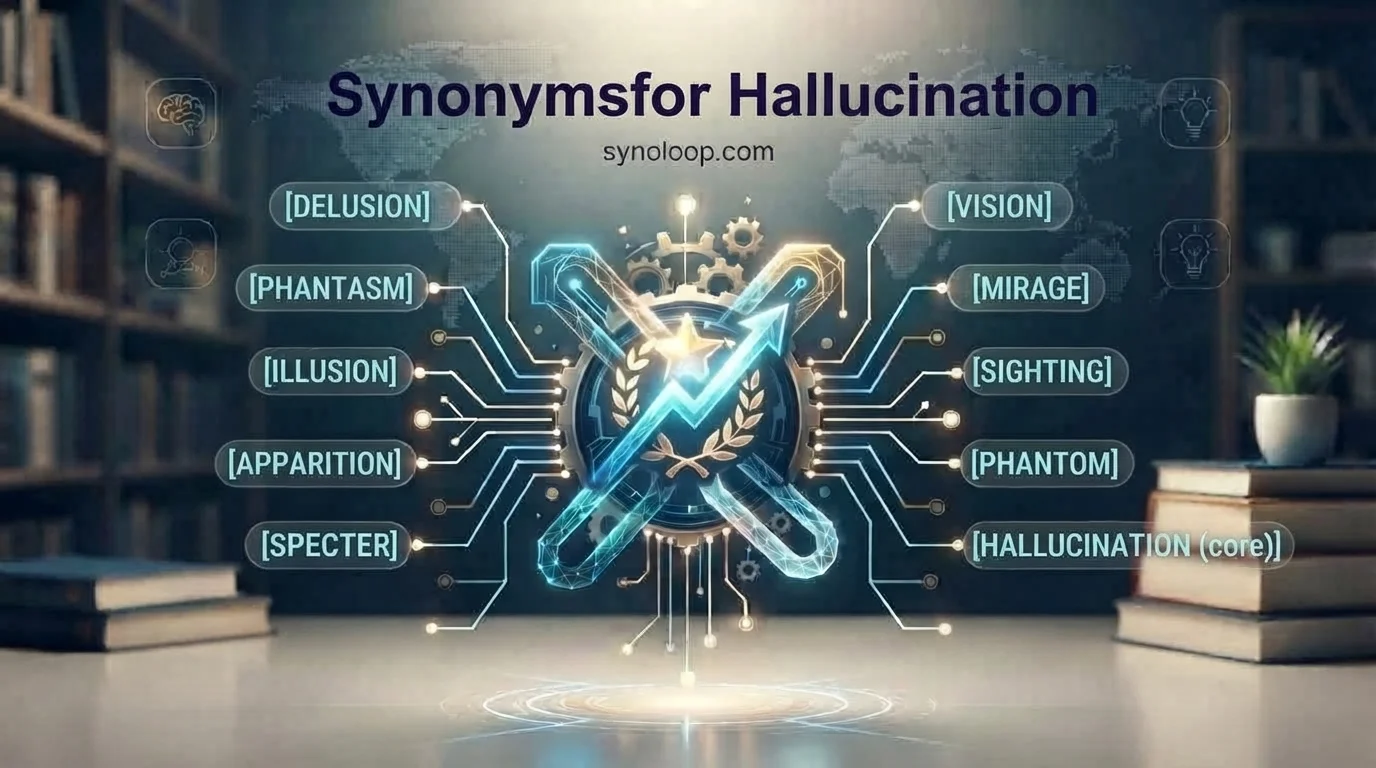
Finding the right alternative can make your writing more precise. Words such as vision, apparition, illusion, and delusion may seem similar, but they do not always mean the same thing. Some describe unusual perceptions, while others refer to mistaken beliefs or imaginary experiences.
This guide explains 30 useful alternatives in simple English. Each word includes a meaning, example sentence, and a practical note about when it works best.
What Does Hallucination Mean?
In simple English, hallucination means experiencing something through your senses that does not have a matching external source. It can involve seeing, hearing, smelling, tasting, or feeling something.
For example:
The patient reported seeing a bright light that was not actually present.
The word is commonly used in medical, psychological, literary, and everyday contexts. However, it is important not to treat every unusual experience as a hallucination. The exact meaning depends on context.
30 Synonyms for Hallucination
1. Illusion
Meaning: A false or misleading perception of something.
Example: The shadow in the distance turned out to be an illusion.
Best usage context: Use illusion when something appears different from reality because of perception or appearance.
2. Vision
Meaning: A vivid image or experience of seeing something.
Example: She described a strange vision that appeared during the night.
Best usage context: Useful in literary, spiritual, historical, or general descriptions of unusual visual experiences.
3. Apparition
Meaning: A ghostlike or mysterious figure that seems to appear.
Example: The traveler claimed to see an apparition near the old house.
Best usage context: Best for supernatural, ghostly, or mysterious writing.
4. Delusion
Meaning: A strongly held belief that does not match reality.
Example: He had the delusion that strangers were secretly communicating with him.
Best usage context: Use carefully in psychological or clinical contexts when referring to a false belief rather than a sensory experience.
5. Mirage
Meaning: Something that appears real but is actually an optical effect.
Example: The travelers thought they could see water ahead, but it was only a mirage.
Best usage context: Excellent for deserts, heat, distance, and figurative descriptions of something deceptive.
6. Phantasm
Meaning: An imaginary or ghostlike image.
Example: The figure disappeared like a phantasm in the darkness.
Best usage context: Useful in literary, fantasy, gothic, and dramatic writing.
7. Phantom
Meaning: A ghostlike or imaginary figure.
Example: He thought he saw a phantom moving through the hallway.
Best usage context: Best for supernatural or figurative descriptions.
8. Specter
Meaning: A frightening ghost or imagined presence.
Example: A dark specter seemed to stand beside the doorway.
Best usage context: Common in literary and dramatic writing, especially when fear is involved.
9. Fantasy
Meaning: An imagined situation, idea, or experience.
Example: The story blurred the line between fantasy and reality.
Best usage context: Use when discussing imagination rather than a literal sensory experience.
10. Fanciful Image
Meaning: An imaginative picture created by the mind.
Example: The artist filled the painting with fanciful images.
Best usage context: Suitable for creative writing, art, and imaginative descriptions.
11. Imagination
Meaning: The ability to create ideas or pictures in the mind.
Example: His imagination turned the ordinary room into a magical place.
Best usage context: Use when an experience is clearly connected with creative thought or mental imagery.
12. Daydream
Meaning: A pleasant or imaginative series of thoughts while awake.
Example: She drifted into a daydream during the long lecture.
Best usage context: Appropriate for ordinary imaginative experiences rather than clinical hallucinations.
13. Reverie
Meaning: A dreamy state of deep thought or imagination.
Example: He sat by the window in a quiet reverie.
Best usage context: A gentle, literary word for dreamy thinking.
14. Dream
Meaning: A series of images, thoughts, or experiences, especially during sleep.
Example: The strange scene felt more like a dream than reality.
Best usage context: Best for sleep-related experiences or figurative descriptions.
15. Nightmare
Meaning: A frightening dream or disturbing imagined experience.
Example: The dark scene felt like a waking nightmare.
Best usage context: Use when the experience is frightening or distressing.
16. Perceptual Distortion
Meaning: A change or disturbance in the way something is perceived.
Example: The patient experienced perceptual distortion after taking the medication.
Best usage context: Useful in medical, scientific, and psychological writing.
17. False Perception
Meaning: A perception that does not accurately reflect what is externally present.
Example: The unusual sound was described as a false perception.
Best usage context: Helpful in formal or explanatory writing when precision matters.
18. Misperception
Meaning: An incorrect understanding or perception of something.
Example: The supposed figure was actually a misperception caused by poor lighting.
Best usage context: Good when someone incorrectly interprets a real stimulus.
19. Mental Image
Meaning: A picture or representation formed in the mind.
Example: He developed a vivid mental image of the place.
Best usage context: Useful for neutral descriptions of internal imagery.
20. Imaginary Experience
Meaning: An experience created or perceived in the mind rather than caused by an external event.
Example: The author described the character’s imaginary experience in great detail.
Best usage context: Useful when you want a neutral, accessible phrase.
21. Phantom Image
Meaning: An image that appears ghostlike or unreal.
Example: A phantom image seemed to float across the screen.
Best usage context: Suitable for literary, visual, or technical descriptions depending on context.
22. Ghostly Image
Meaning: An image that looks like a ghost or supernatural figure.
Example: A ghostly image appeared briefly in the photograph.
Best usage context: Best for horror, mystery, and supernatural storytelling.
23. Apparitional Experience
Meaning: An experience involving an apparent supernatural or unusual figure.
Example: The researcher recorded several reports of apparitional experiences.
Best usage context: Appropriate for academic or paranormal discussions.
24. False Vision
Meaning: Seeing something that is not actually present as perceived.
Example: He described the event as a false vision.
Best usage context: Useful in simple explanations, although it is less precise than the clinical term hallucination.
25. Spectral Image
Meaning: An image that resembles a ghost or something supernatural.
Example: The photographer captured what looked like a spectral image.
Best usage context: Excellent for atmospheric and supernatural writing.
26. Mental Projection
Meaning: An image or idea experienced as though it exists outside the mind.
Example: The character struggled to distinguish reality from a mental projection.
Best usage context: Useful in fiction, psychology-related discussions, and explanatory writing.
27. Imagined Figure
Meaning: A person or shape created by the imagination.
Example: The frightened child realized the figure was imagined.
Best usage context: Good for simple storytelling and beginner-friendly explanations.
28. Fantasm
Meaning: A ghostlike or imaginary figure or appearance.
Example: The mysterious shape vanished like a fantasm.
Best usage context: Mostly literary, poetic, or old-fashioned writing.
29. Unreal Perception
Meaning: A perception that does not correspond to external reality.
Example: The character struggled with an unreal perception of the room.
Best usage context: Useful as an explanatory phrase when writing for a general audience.
30. Imaginary Apparition
Meaning: A figure or presence that seems to appear but is not externally present.
Example: The mysterious visitor may have been an imaginary apparition.
Best usage context: Best for fiction, supernatural stories, and descriptive writing.
Synonyms for Hallucination: Quick Comparison
Not every synonym for hallucination can be used interchangeably. The table below shows the main differences.
| Word | Main idea | Tone | Best context |
| Illusion | Misleading appearance | Neutral | Everyday and visual descriptions |
| Vision | Vivid visual experience | Neutral/Literary | Stories and unusual experiences |
| Apparition | Ghostlike appearance | Mysterious | Supernatural writing |
| Delusion | False belief | Clinical | Psychological contexts |
| Mirage | Optical illusion | Neutral | Nature and figurative writing |
| Phantasm | Imaginary or ghostlike image | Literary | Fiction and poetry |
| Phantom | Ghostlike figure | Dramatic | Horror and mystery |
| Specter | Frightening ghostlike presence | Dramatic | Literary writing |
| Fantasy | Imagined situation | Neutral | Fiction and imagination |
| Daydream | Pleasant wandering thoughts | Casual | Everyday situations |
| Reverie | Dreamy thought | Literary | Reflective writing |
| Dream | Sleep imagery | Neutral | Sleep and figurative language |
| Nightmare | Frightening dream | Emotional | Horror and distress |
| Misperception | Incorrect interpretation | Formal | Psychology and everyday explanation |
| False perception | Inaccurate perception | Formal | Academic contexts |
| Mental image | Image in the mind | Neutral | Education and writing |
Hallucination vs. Illusion
These two words are often confused.
A hallucination generally involves perceiving something without a corresponding external stimulus. An illusion, by contrast, involves misinterpreting something that is actually present.
For example, seeing a person standing in an empty room could be described as a hallucination if there is no external person or object producing that perception. Mistaking a coat hanging on a chair for a person would be an example of an illusion or misperception.
The distinction is especially important in medical, psychological, and educational writing.
Hallucination vs. Delusion
A hallucination is primarily a perceptual experience, while a delusion is a false belief.
For example, hearing a voice when there is no corresponding external source can be described as a hallucination. Believing that a person is secretly sending you messages despite evidence to the contrary may be described as a delusion.
Because these terms have specific clinical meanings, they should not be treated as exact synonyms in professional writing.
Hallucination vs. Mirage
A mirage is a specific optical phenomenon caused by atmospheric conditions. It can make distant objects or light appear distorted.
A hallucination is a broader term for a perception without an appropriate external stimulus. Therefore, mirage should generally be used when the context specifically involves an optical effect.
Hallucination vs. Vision
The word vision is much broader and can have positive, neutral, spiritual, or literary meanings.
Someone can have a vision in a dream, religious experience, creative imagination, or story. Therefore, vision is sometimes a useful alternative in general writing, but it is not always an exact substitute for hallucination.
Hallucination Synonyms by Tone
Clinical and Formal
If you are writing an academic or professional text, consider:
- Perceptual distortion
- False perception
- Misperception
- Unreal perception
- Apparitional experience
These phrases can sound more precise and less dramatic.
Literary and Descriptive
For stories, essays, and creative writing, consider:
- Vision
- Apparition
- Phantasm
- Phantom
- Specter
- Spectral image
- Fantasm
These words can create a stronger atmosphere.
Imaginative and Casual
For everyday or creative contexts, consider:
- Imagination
- Fantasy
- Daydream
- Reverie
- Dream
- Imagined figure
These words are generally softer and less clinical.
Supernatural or Gothic
For horror and supernatural fiction, consider:
- Apparition
- Phantom
- Specter
- Phantasm
- Spectral image
- Ghostly image
These choices create a mysterious or frightening mood.
How to Choose the Right Synonym for Hallucination
Start by asking what you actually want to communicate.
If you mean an incorrect interpretation of something that really exists, illusion or misperception may be more appropriate.
If you mean a false belief, delusion may fit, but it should be used carefully because it has a specific psychological meaning.
If you are describing a ghostlike figure in fiction, apparition, phantom, or specter can make the writing more vivid.
If you mean ordinary imagination, words such as daydream, fantasy, or mental image may be better choices.
For formal or scientific writing, phrases such as perceptual distortion and false perception can be useful when they accurately describe the phenomenon.
The most important rule is simple: choose the word according to meaning, not just similarity. A thesaurus may give you related words, but context determines whether a synonym is actually appropriate.
Common Mistakes When Using Hallucination Synonyms
One common mistake is treating illusion, hallucination, and delusion as identical. They describe different concepts, so replacing one with another can change the meaning of a sentence.
Another mistake is using clinical terminology casually. Words such as hallucination and delusion can carry specific meanings in medical and psychological contexts.
Writers should also consider tone. Specter sounds dramatic, while misperception sounds formal. Daydream sounds much lighter than hallucination.
Examples of Better Word Choice
Instead of writing:
The character experienced a hallucination of a ghost.
You could write:
The character saw an apparition in the abandoned house.
For an optical phenomenon:
The travelers mistook a mirage for water.
For imagination:
The scene existed only in his fantasy.
For an incorrect interpretation:
The strange shape was a misperception caused by the darkness.
For a false belief:
The character developed a delusion that everyone was watching him.
Each replacement changes the meaning slightly, which is why context matters.
Frequently Asked Questions About Synonyms for Hallucination
What is the closest synonym for hallucination?
There is no single perfect synonym for every context. False perception, vision, and apparition can be close depending on the intended meaning.
Is illusion a synonym for hallucination?
Not exactly. An illusion usually involves incorrectly interpreting something that is actually present, while a hallucination generally involves perceiving something without an appropriate external stimulus.
Is delusion the same as hallucination?
No. A delusion is a false belief, whereas a hallucination is primarily a perceptual experience.
What is a literary synonym for hallucination?
Apparition, phantom, phantasm, and specter are useful literary alternatives, particularly in mysterious or supernatural writing.
What is a simple synonym for hallucination?
Depending on the context, vision, false perception, or imagined experience may be easier for general readers to understand.
What is a synonym for seeing something that is not there?
Depending on the context, hallucination, apparition, vision, or false perception may describe the experience. The exact choice depends on why and how the perception occurs.
Can I use fantasy instead of hallucination?
Usually not in clinical writing. Fantasy generally refers to imagination or an imagined scenario, while hallucination has a more specific meaning.
Final Thoughts on Synonyms for Hallucination
The best synonyms for hallucination depend on the exact experience, tone, and purpose of your writing. Illusion and misperception work well for mistaken interpretations, while apparition, phantom, and specter are useful for supernatural or literary descriptions. Words such as fantasy, daydream, and reverie are better when the subject is imagination.
For professional or educational writing, accuracy should come before variety. In particular, hallucination, illusion, and delusion have different meanings and should not be casually substituted for one another.
A strong writer does not simply choose a word that looks similar in a dictionary. The goal is to select the word that communicates the intended meaning clearly, naturally, and accurately.

I am Axel James, a passionate writer who loves exploring synonyms and alternative words. I enjoy helping readers improve their vocabulary and express ideas clearly.