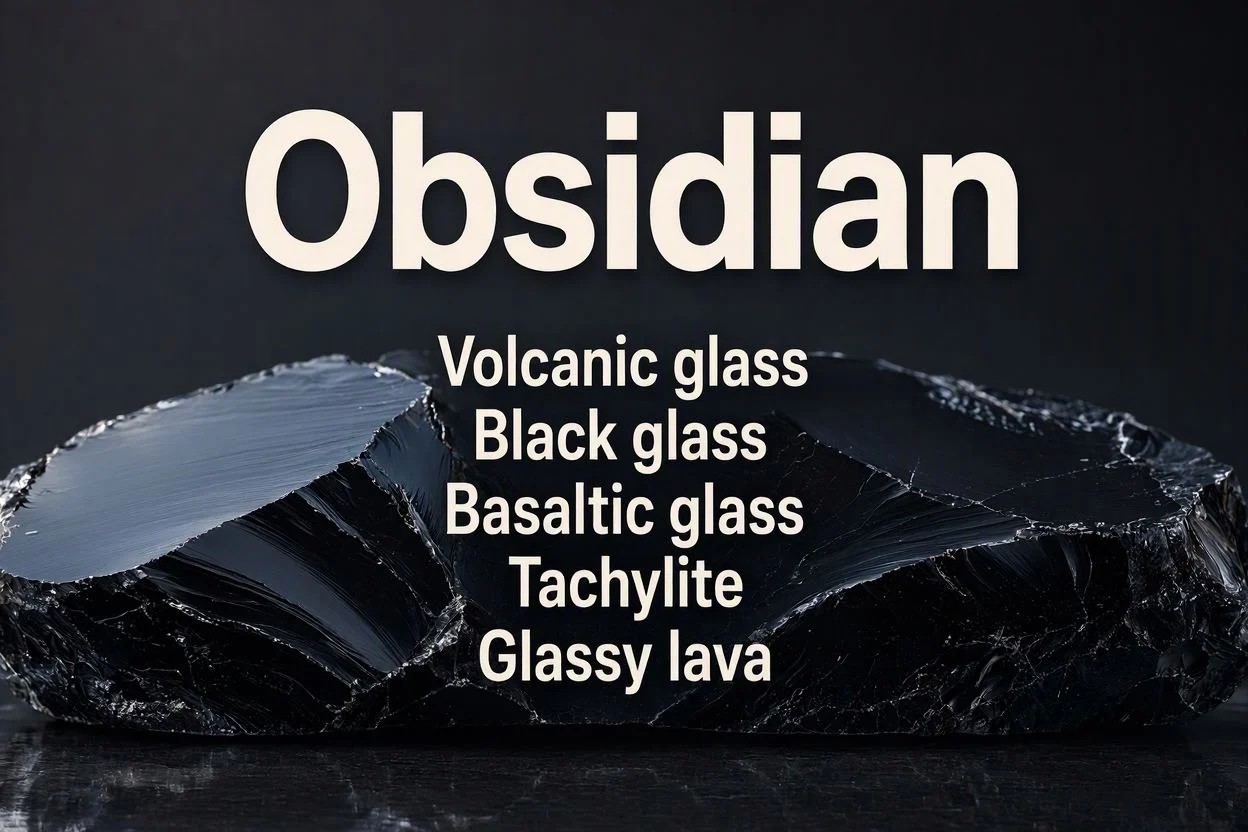
Obsidian is a naturally occurring volcanic glass formed when lava cools rapidly with very little crystal growth. It is usually dark, smooth, and glossy, although natural obsidian can also appear brown, gray, green, or even have colorful patterns. Because of its distinctive appearance and volcanic origin, the word often appears in geology, archaeology, jewelry, art, and descriptive writing.
When looking for synonyms for obsidian, it is important to understand that obsidian has no perfect one-word synonym. It is the specific name of a natural volcanic material. However, several related terms and descriptive expressions can help explain or describe obsidian depending on the context.
This guide provides 30 useful alternatives, related terms, and descriptive expressions. Each one includes a simple meaning, an example sentence, and guidance on when it is most appropriate.
What Does Obsidian Mean?
Obsidian is a natural volcanic glass created when molten lava cools so quickly that large crystals do not have enough time to form.
In simple English, obsidian is a hard, glass-like volcanic rock that usually has a shiny, dark appearance.
Obsidian is commonly associated with black color, but not all obsidian is black. Its appearance can vary depending on its mineral composition and the presence of tiny inclusions or bubbles.
The word is often used in scientific writing, historical descriptions, fantasy literature, jewelry descriptions, and discussions of ancient tools.
Is Obsidian a Rock, Glass, or Mineral?
Obsidian is generally described as a natural volcanic glass rather than a conventional mineral. It forms from rapidly cooled lava and has a glassy structure rather than the well-developed crystal structure associated with most minerals.
For everyday writing, calling obsidian a volcanic glass is one of the most accurate alternatives.
30 Synonyms and Related Terms for Obsidian
Because obsidian is a specific geological material, the following words are not all exact synonyms. Some are scientific alternatives, while others describe its appearance, origin, or common uses.
1. Volcanic Glass
Meaning: A glass-like material formed when volcanic lava cools rapidly.
Example: The archaeologist discovered a sharp tool made from volcanic glass.
Best usage context: Scientific, geological, and educational writing.
2. Natural Glass
Meaning: Glass that occurs naturally rather than being manufactured by humans.
Example: Obsidian is a well-known type of natural glass.
Best usage context: General explanations and geology.
3. Volcanic Glass Rock
Meaning: A descriptive term for a rock formed from rapidly cooled volcanic material with a glassy texture.
Example: The museum displayed several samples of volcanic glass rock.
Best usage context: Beginner-friendly geological descriptions.
4. Lava Glass
Meaning: A simple descriptive expression referring to glass formed from lava.
Example: The black lava glass had a smooth, reflective surface.
Best usage context: Informal descriptions and educational content.
5. Glassy Lava
Meaning: Lava that cooled into a glass-like substance.
Example: The eruption produced layers of glassy lava along the volcanic slope.
Best usage context: Geology and descriptive writing.
6. Volcanic Stone
Meaning: A broad term for stone produced by volcanic activity.
Example: The artisan used dark volcanic stone to make decorative objects.
Best usage context: General descriptions, although it is less precise than “volcanic glass.”
7. Black Volcanic Glass
Meaning: A descriptive term emphasizing obsidian’s common black color and glass-like texture.
Example: The pendant was carved from polished black volcanic glass.
Best usage context: Jewelry, art, and product descriptions.
8. Dark Volcanic Glass
Meaning: Volcanic glass with a dark appearance.
Example: The dark volcanic glass reflected the light beautifully.
Best usage context: Descriptive and creative writing.
9. Glassy Rock
Meaning: A rock with a smooth, glass-like texture.
Example: The geologist identified the sample as a naturally occurring glassy rock.
Best usage context: General geology explanations.
10. Volcanic Material
Meaning: A broad term for material produced by volcanic activity.
Example: The researchers examined the volcanic material found near the ancient settlement.
Best usage context: Academic and scientific writing.
11. Igneous Glass
Meaning: Glass formed from molten material associated with igneous processes.
Example: The specimen was classified as an igneous glass formed during volcanic activity.
Best usage context: Technical and geological writing.
12. Natural Volcanic Glass
Meaning: Glass created naturally through volcanic activity.
Example: The collection included several pieces of natural volcanic glass.
Best usage context: Educational, museum, and scientific writing.
13. Silica-Rich Volcanic Glass
Meaning: Volcanic glass containing a relatively high amount of silica.
Example: The eruption produced silica-rich volcanic glass with a glossy surface.
Best usage context: More technical geology discussions.
14. Volcanic Vitreous Material
Meaning: A technical description of glass-like material formed through volcanic processes.
Example: The study examined volcanic vitreous material from an ancient eruption.
Best usage context: Formal scientific writing.
15. Vitreous Rock
Meaning: A rock with a glass-like, non-crystalline appearance.
Example: The specimen had the dark, smooth surface typical of a vitreous rock.
Best usage context: Technical descriptions and geology.
16. Black Glass
Meaning: A simple descriptive phrase for a material that looks like dark glass.
Example: The craftsman shaped the black glass into a decorative blade.
Best usage context: Creative writing and visual descriptions.
17. Dark Glass
Meaning: Glass or glass-like material with a deep, dark appearance.
Example: The artifact looked like a piece of dark glass under the museum lights.
Best usage context: General and creative descriptions.
18. Glossy Volcanic Stone
Meaning: Volcanic stone with a shiny or reflective surface.
Example: The necklace featured a piece of glossy volcanic stone.
Best usage context: Jewelry and product descriptions.
19. Shiny Volcanic Rock
Meaning: A descriptive term for volcanic rock with a smooth, reflective surface.
Example: The shiny volcanic rock caught the sunlight as the hikers walked past.
Best usage context: Travel writing and simple descriptions.
20. Black Lava Glass
Meaning: A descriptive phrase combining obsidian’s common color, volcanic origin, and glass-like texture.
Example: The artist carved the black lava glass into a small pendant.
Best usage context: Artistic and informal descriptions.
21. Volcanic Silicate Glass
Meaning: A technical description emphasizing the silicate composition of volcanic glass.
Example: The laboratory analyzed the volcanic silicate glass for its chemical composition.
Best usage context: Scientific and academic writing.
22. Glassy Volcanic Material
Meaning: Volcanic material that has a glass-like structure or appearance.
Example: The excavation uncovered pieces of glassy volcanic material.
Best usage context: Archaeology and geology.
23. Volcanic Byproduct
Meaning: Material produced as a result of volcanic activity.
Example: The researchers studied the volcanic byproduct preserved around the ancient site.
Best usage context: Broad scientific discussions, although it is less specific than “obsidian.”
24. Volcanic Formation
Meaning: A geological feature or material created through volcanic processes.
Example: The unusual volcanic formation attracted researchers from several universities.
Best usage context: General geology, but it should not be used as a direct replacement for obsidian in precise writing.
25. Igneous Glass Material
Meaning: A glass-like material produced through igneous geological processes.
Example: The collection contained several examples of igneous glass material.
Best usage context: Educational and technical descriptions.
26. Stone Glass
Meaning: A descriptive expression suggesting a stone-like material with a glassy appearance.
Example: The artifact looked almost like stone glass because of its dark, polished surface.
Best usage context: Creative descriptions; not a standard scientific synonym.
27. Glassy Volcanic Stone
Meaning: Volcanic stone characterized by a smooth, glass-like texture.
Example: The ancient tool was made from glassy volcanic stone.
Best usage context: Archaeology, history, and educational writing.
28. Dark Igneous Glass
Meaning: A dark-colored glass-like material formed through igneous activity.
Example: The artifact was made from dark igneous glass.
Best usage context: Scientific and archaeological descriptions.
29. Obsidian Glass
Meaning: A descriptive phrase referring to the glass-like nature of obsidian.
Example: The polished obsidian glass had a deep black appearance.
Best usage context: Descriptive writing and jewelry contexts; “obsidian” remains the more precise term.
30. Volcanic Glass Stone
Meaning: A descriptive phrase for a stone-like material with a glassy volcanic origin.
Example: The craftsman used volcanic glass stone to create a polished ornament.
Best usage context: Informal descriptions, crafts, and product writing.
Obsidian Synonyms at a Glance
| Term | Main Meaning | Best Context |
| Volcanic glass | Glass formed from lava | Geology |
| Natural glass | Naturally occurring glass | General science |
| Lava glass | Glass-like volcanic material | Informal writing |
| Glassy lava | Lava with a glass-like structure | Geology |
| Volcanic stone | Broad volcanic material | General writing |
| Black volcanic glass | Dark volcanic glass | Jewelry and descriptions |
| Igneous glass | Glass associated with igneous processes | Technical writing |
| Vitreous rock | Glass-like rock | Geology |
| Glassy rock | Rock with a glass-like texture | General geology |
| Volcanic material | Material produced by volcanoes | Academic writing |
| Dark volcanic glass | Dark-colored volcanic glass | Descriptive writing |
| Volcanic silicate glass | Silicate-rich volcanic glass | Scientific writing |
| Glassy volcanic stone | Volcanic stone with a glassy texture | Archaeology |
| Dark igneous glass | Dark glass formed through igneous activity | Technical writing |
| Glossy volcanic stone | Shiny volcanic material | Jewelry |
What Are the Closest Synonyms for Obsidian?
If you need a term that can replace obsidian in an explanation, volcanic glass is usually the closest and most accurate choice.
Other useful alternatives include natural glass, glassy volcanic stone, and black volcanic glass. However, each has a slightly different meaning.
For example, “volcanic glass” describes the material accurately, while “black volcanic glass” adds information about appearance. “Natural glass” is broader because not every naturally occurring glass is necessarily obsidian.
Obsidian vs. Volcanic Glass
The terms obsidian and volcanic glass are closely related, but they are not completely interchangeable in every situation.
Obsidian is the specific name of a naturally occurring volcanic glass. Volcanic glass is a broader descriptive category for glassy material formed during volcanic processes.
Therefore, if you are writing a scientific or geological sentence, “obsidian” is usually more precise. If you are explaining the material to beginners, “volcanic glass” can make the meaning easier to understand.
Words to Describe the Appearance of Obsidian
Writers often need descriptive vocabulary rather than a direct synonym. Depending on the specimen, useful words include:
- Black
- Dark
- Glossy
- Shiny
- Smooth
- Glassy
- Reflective
- Polished
- Sleek
- Lustrous
- Silky
- Translucent
These words describe characteristics rather than replacing the geological name obsidian.
For example:
The polished obsidian had a smooth, glossy, almost mirror-like surface.
This sentence uses descriptive vocabulary to make the image clearer without incorrectly treating every descriptive word as a synonym.
Obsidian in Different Contexts
Obsidian in Geology
In geology, precision is especially important. Terms such as volcanic glass, natural volcanic glass, and igneous glass can help explain obsidian’s geological characteristics.
Example:
Obsidian is a natural volcanic glass produced when lava cools rapidly.
Obsidian in Archaeology
Obsidian is important in archaeology because ancient people used it to make sharp-edged tools and other objects.
Useful related expressions include volcanic glass, glassy volcanic stone, and volcanic material.
Example:
Archaeologists found an obsidian blade among the remains of the settlement.
Obsidian in Jewelry
In jewelry descriptions, appearance is often more important than geological terminology.
Words such as black volcanic glass, glossy volcanic stone, polished volcanic glass, and dark glass-like stone can create a vivid description.
Example:
The necklace featured a polished piece of black volcanic glass.
Obsidian in Creative Writing
Creative writers can use descriptive language to communicate obsidian’s appearance and mood.
Useful expressions include:
- Midnight-black glass
- Dark glass-like stone
- Glossy volcanic stone
- Black volcanic glass
- Smooth, reflective stone
Example:
The character held a shard of dark volcanic glass that gleamed beneath the moonlight.
These are descriptive phrases rather than scientific synonyms.
How to Choose the Right Synonym for Obsidian
Choosing the right alternative depends on what you are trying to communicate.
For Scientific Writing
Use precise terms such as:
- Volcanic glass
- Natural volcanic glass
- Igneous glass
- Volcanic silicate glass
- Vitreous rock
These terms work well in geology, laboratory reports, textbooks, and academic articles.
For Beginner-Friendly Explanations
Choose simple expressions such as:
- Natural glass
- Volcanic glass
- Glassy rock
- Glassy volcanic stone
These make the concept easier for ESL learners and general readers.
For Jewelry Descriptions
Focus on appearance:
- Black volcanic glass
- Glossy volcanic stone
- Dark volcanic glass
- Polished volcanic glass
- Shiny volcanic rock
These terms help readers imagine the product.
For Creative Writing
Use vivid descriptive phrases:
- Midnight-black glass
- Dark glass-like stone
- Glossy volcanic stone
- Reflective black stone
- Smooth volcanic glass
Creative writing gives you more freedom, but scientific accuracy should still be maintained when the material itself matters.
For Archaeology
Useful terms include:
- Obsidian
- Volcanic glass
- Glassy volcanic stone
- Natural volcanic glass
- Volcanic material
When discussing an archaeological artifact, obsidian is usually preferable when the material has been specifically identified.
Common Mistakes When Using Obsidian Synonyms
One common mistake is assuming that every dark volcanic rock is obsidian. Color alone is not enough to identify the material.
Another mistake is treating volcanic rock as a perfect synonym. Volcanic rocks include many different materials, while obsidian is a specific type of volcanic glass.
It is also important not to use black glass as an exact scientific synonym. Manufactured black glass can look similar to obsidian but does not have the same natural geological origin.
For precise writing, use obsidian when you mean the specific material and use related terms when you are explaining or describing it.
Obsidian Synonyms for and Content Writing
If you are creating content about obsidian, natural language is more useful than repeatedly using the exact keyword.
Related terms can include:
- Volcanic glass
- Natural volcanic glass
- Black volcanic glass
- Glassy volcanic stone
- Volcanic rock
- Igneous glass
- Dark volcanic stone
- Polished volcanic glass
- Glass-like stone
- Natural glass
Using related vocabulary naturally can make an article more readable while helping readers understand the subject from different angles.
However, these terms should not be treated as interchangeable in every sentence. Their meanings and levels of precision differ.
Frequently Asked Questions About Obsidian Synonyms
What is the closest synonym for obsidian?
The closest commonly used alternative is volcanic glass. Obsidian is a specific type of natural volcanic glass formed when lava cools rapidly.
Is volcanic glass another name for obsidian?
Volcanic glass is a broader term, while obsidian is a specific type of volcanic glass. Therefore, the terms are closely related but are not always exact substitutes.
What is another word for black obsidian?
You can describe black obsidian as black volcanic glass, dark volcanic glass, or glossy volcanic stone. These are descriptive alternatives rather than exact synonyms.
Is obsidian a type of glass?
Yes. Obsidian is a naturally occurring volcanic glass. It forms when lava cools rapidly, preventing large crystals from developing.
Is obsidian a mineral?
Obsidian is generally not classified as a mineral because it lacks the ordered crystalline structure characteristic of minerals. It is commonly classified as a natural volcanic glass.
What are some words that describe obsidian?
Common descriptive words include black, dark, glossy, smooth, glassy, shiny, reflective, polished, sleek, and lustrous.
What is a simple way to explain obsidian?
A simple explanation is: Obsidian is a natural, glass-like volcanic material formed when lava cools very quickly.
What is obsidian used for?
Obsidian has been used historically for sharp-edged tools and weapons, and today it is also used for decorative objects, jewelry, carvings, and collectibles.
Final Thoughts on Synonyms for Obsidian
Finding synonyms for obsidian requires a little more care than finding synonyms for an ordinary adjective or verb. Obsidian is the specific name of a natural volcanic glass, so it does not have 30 perfect one-word synonyms.
The closest and most useful alternative is volcanic glass, while terms such as natural glass, igneous glass, glassy volcanic stone, black volcanic glass, and vitreous rock can provide additional context. Descriptive words such as glossy, dark, smooth, shiny, and reflective are useful when you want to describe how obsidian looks.
The key is to choose the term based on your purpose. Scientific writing benefits from precise geological vocabulary, while creative writing, jewelry descriptions, and beginner-friendly explanations can use broader or more descriptive language.
By understanding these distinctions, you can write about obsidian more naturally, accurately, and clearly while giving readers a better understanding of this fascinating volcanic material.

I am Ace Michael, an author passionate about words, language, and vocabulary. I enjoy exploring synonyms and finding simple, useful alternatives that help readers express their ideas clearly, naturally, and creatively. At Synoloop, I share helpful word choices to make writing easier and more effective.