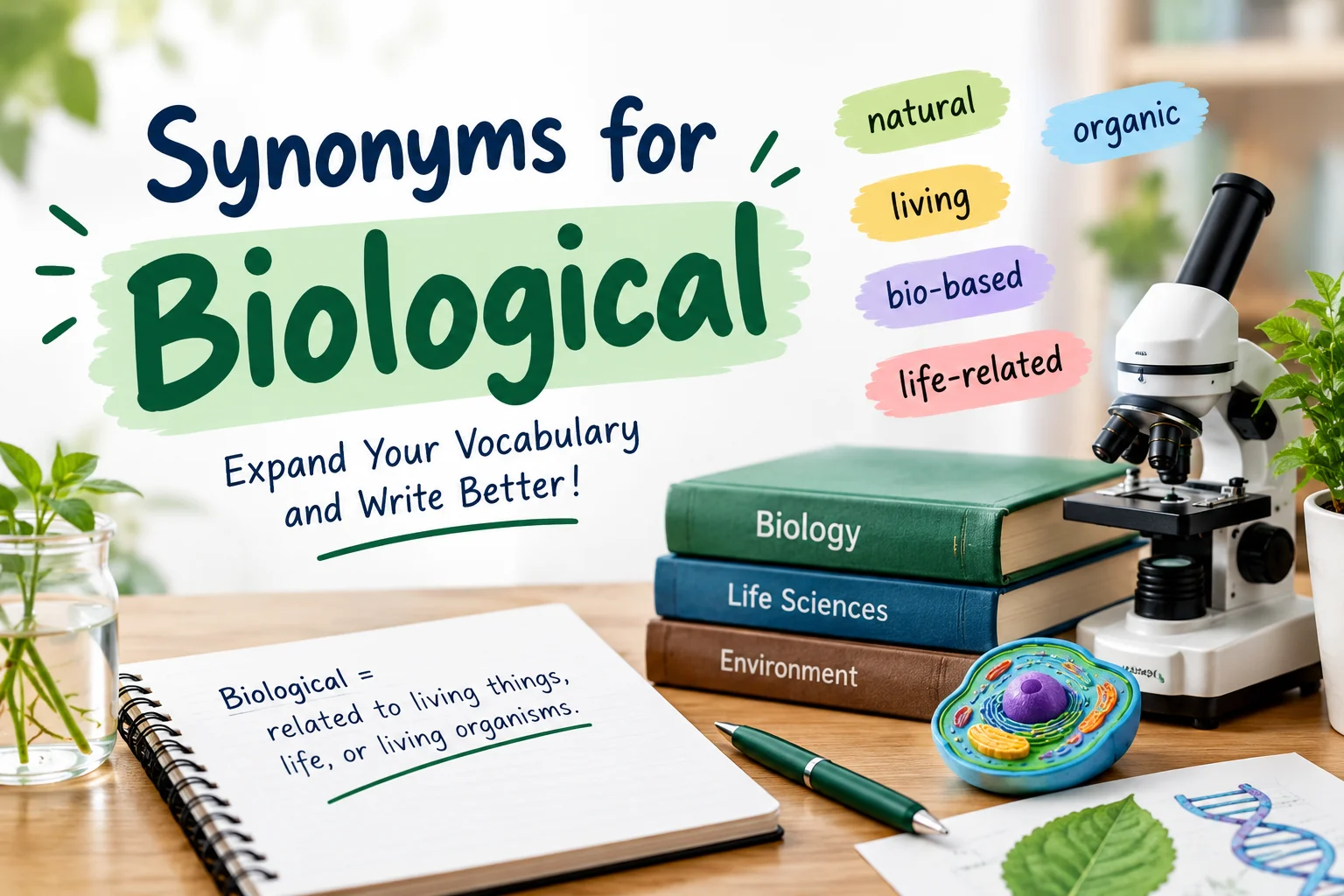
When you are writing about life, living organisms, health, nature, or scientific processes, choosing the right vocabulary can make your writing much clearer. The word biological is common in science and academic writing, but using suitable alternatives can help you avoid repetition and express your exact meaning more naturally.
Understanding synonyms for biological is especially useful for students, ESL learners, researchers, writers, and content creators. Depending on the context, words such as organic, physiological, living, genetic, or life-related may communicate a similar idea while carrying a slightly different meaning.
This guide explains useful alternatives to “biological” in simple English. It also includes examples, usage notes, comparison guidance, and practical tips for choosing the best word for your sentence.
What Does “Biological” Mean?
Biological is an adjective related to biology, the scientific study of living organisms and life processes.
It can describe something connected with plants, animals, humans, cells, genes, ecosystems, or natural processes involving living things.
For example:
- Biological process: a process that happens in a living organism.
- Biological science: the scientific study of life.
- Biological parent: a person’s parent by birth rather than adoption.
- Biological response: a reaction that occurs in a living organism.
The exact synonym depends on what you mean. For instance, genetic is useful when discussing genes, while physiological is more appropriate when discussing the functions of a living body.
30 Synonyms for Biological
There is no single replacement for biological that works in every situation. The following alternatives cover different meanings and contexts.
1. Living
Meaning: Existing as a living organism rather than being nonliving.
Example: Scientists studied the effects of the chemical on living cells.
Best usage context: General writing about organisms, plants, animals, or cells.
2. Organic
Meaning: Related to living matter or produced by living organisms.
Example: The soil contains a large amount of organic material.
Best usage context: Biology, environmental science, agriculture, and chemistry. Be careful because “organic” can also refer to food produced under specific farming standards.
3. Physiological
Meaning: Related to the normal functions of a living body.
Example: Exercise can cause several physiological changes in the body.
Best usage context: Medicine, biology, sports science, and health research.
4. Genetic
Meaning: Related to genes or inherited characteristics.
Example: Researchers investigated the genetic cause of the condition.
Best usage context: Genetics, medicine, heredity, and scientific research.
5. Hereditary
Meaning: Passed from parents to children through genes.
Example: The researchers were looking for evidence of a hereditary disorder.
Best usage context: Family traits, inherited diseases, and genetics.
6. Life-related
Meaning: Connected with life or living organisms.
Example: The course introduces students to several life-related sciences.
Best usage context: General or educational writing when you want a simple alternative.
7. Vital
Meaning: Connected with life or necessary for life.
Example: Oxygen is vital to many biological functions.
Best usage context: Health, medicine, biology, and general explanations.
8. Anatomical
Meaning: Related to the physical structure of a living body.
Example: The researchers examined the anatomical structure of the animal.
Best usage context: Anatomy, medicine, biology, and healthcare.
9. Cellular
Meaning: Related to cells, the basic units of living organisms.
Example: The treatment produces important cellular changes.
Best usage context: Cell biology, medicine, genetics, and laboratory research.
10. Biotic
Meaning: Related to living organisms in an ecosystem.
Example: The researchers measured both biotic and environmental factors.
Best usage context: Ecology and environmental science.
11. Natural
Meaning: Existing in nature rather than being artificially created.
Example: The study examined natural processes that influence plant growth.
Best usage context: General science and environmental discussions. “Natural” is broader than “biological.”
12. Biochemical
Meaning: Related to the chemical processes that occur inside living organisms.
Example: The researchers examined biochemical reactions in the cells.
Best usage context: Biochemistry, medicine, molecular biology, and laboratory science.
13. Biophysical
Meaning: Related to the physical principles and processes of living systems.
Example: The research focused on the biophysical properties of cell membranes.
Best usage context: Biophysics and advanced scientific writing.
14. Ecological
Meaning: Related to relationships between living organisms and their environment.
Example: The project examined the ecological effects of pollution.
Best usage context: Ecology, conservation, climate, and environmental science.
15. Zoological
Meaning: Related specifically to animals and their study.
Example: The museum has an extensive zoological collection.
Best usage context: Animal science and zoology.
16. Botanical
Meaning: Related specifically to plants.
Example: The researcher recorded several botanical characteristics of the species.
Best usage context: Botany, plant science, gardening, and environmental research.
17. Microbiological
Meaning: Related to microorganisms such as bacteria, fungi, and some other microscopic life forms.
Example: The laboratory conducted microbiological testing of the water.
Best usage context: Microbiology, medicine, food science, and laboratory work.
18. Molecular
Meaning: Related to molecules and their structure or behavior.
Example: The researchers used molecular techniques to study the disease.
Best usage context: Molecular biology, chemistry, genetics, and medical research.
19. Physiological
Meaning: Concerning the functions and activities of living organisms or their parts.
Example: Temperature can affect the physiological performance of plants.
Best usage context: Scientific, medical, and academic writing.
20. Evolutionary
Meaning: Related to biological evolution and changes in organisms over generations.
Example: The researchers offered an evolutionary explanation for the trait.
Best usage context: Evolution, genetics, anthropology, and biology.
21. Developmental
Meaning: Related to the growth and development of an organism.
Example: The study examined developmental changes during early childhood.
Best usage context: Developmental biology, medicine, psychology, and human development.
22. Reproductive
Meaning: Related to the process by which organisms produce offspring.
Example: The researchers examined reproductive behavior in the species.
Best usage context: Biology, zoology, medicine, and reproductive science.
23. Environmental
Meaning: Related to the natural surroundings and conditions affecting living things.
Example: Environmental conditions can influence the growth of organisms.
Best usage context: Ecology, climate, conservation, and environmental studies.
24. Organic-life
Meaning: Relating to living organisms or life forms.
Example: The planet’s surface may once have supported organic life.
Best usage context: Science writing and discussions about life beyond Earth.
25. Life-science
Meaning: Related to the scientific study of living organisms.
Example: The university offers several life-science programs.
Best usage context: Education, research, biotechnology, and academic writing.
26. Bioscientific
Meaning: Relating to scientific research involving living organisms or biological systems.
Example: The company develops bioscientific technologies for medical research.
Best usage context: Formal academic, scientific, and professional writing.
27. Biogenic
Meaning: Produced by or originating from living organisms.
Example: Scientists identified biogenic material within the sediment.
Best usage context: Geology, biology, environmental science, and specialized scientific writing.
28. Biotic
Meaning: Relating to living components of an ecosystem.
Example: Changes in rainfall can affect both biotic and abiotic conditions.
Best usage context: Ecology and ecosystem studies.
29. Somatic
Meaning: Related to the body, especially body cells other than reproductive cells.
Example: The researchers identified a somatic mutation in the tissue sample.
Best usage context: Genetics, medicine, cell biology, and molecular research.
30. Organic
Meaning: Connected with living matter or originating from living organisms.
Example: The scientists measured the amount of organic carbon in the soil.
Best usage context: Environmental science, biology, agriculture, and chemistry.
Synonyms for Biological at a Glance
| Synonym | Main Meaning | Best Context |
| Living | Existing as life | General writing |
| Organic | Related to living matter | Biology and environment |
| Physiological | Related to body functions | Medicine and biology |
| Genetic | Related to genes | Genetics and heredity |
| Hereditary | Passed through families | Medicine and genetics |
| Anatomical | Related to body structure | Anatomy and medicine |
| Cellular | Related to cells | Cell biology |
| Biotic | Related to living ecosystem components | Ecology |
| Biochemical | Chemical processes in organisms | Biochemistry |
| Ecological | Organism-environment relationships | Environmental science |
| Botanical | Related to plants | Botany |
| Zoological | Related to animals | Zoology |
| Microbiological | Related to microorganisms | Microbiology |
| Molecular | Related to molecules | Molecular biology |
| Evolutionary | Related to evolution | Evolutionary biology |
| Developmental | Related to organismal growth | Developmental biology |
| Reproductive | Related to reproduction | Biology and medicine |
| Environmental | Related to surroundings | Ecology |
| Biogenic | Produced by living organisms | Specialized science |
| Somatic | Related to body cells | Genetics and medicine |
Synonyms for Biological in Different Contexts
The best synonym depends heavily on the subject you are discussing.
In Biology
Words such as living, organic, cellular, biochemical, and molecular may work well.
Example:
Scientists investigated the biological mechanisms involved in cell growth.
Possible alternatives include:
Scientists investigated the cellular mechanisms involved in cell growth.
Here, “cellular” is more specific than “biological.”
In Medicine
Physiological, anatomical, genetic, somatic, and reproductive may be better choices.
Example:
The treatment caused several biological changes.
A more precise version might be:
The treatment caused several physiological changes.
In Ecology
Use words such as biotic, ecological, environmental, and natural when appropriate.
Example:
The researchers studied biological factors affecting the ecosystem.
A more precise alternative could be:
The researchers studied biotic factors affecting the ecosystem.
In Genetics
Genetic, hereditary, molecular, and somatic can be useful depending on the exact meaning.
Example:
The researchers investigated biological causes of the condition.
If the cause involves inherited genes, genetic causes would be much more precise.
In Academic Writing
Formal alternatives such as physiological, biochemical, bioscientific, molecular, and cellular can improve precision.
However, a more technical synonym is not always better. Choose a specialized word only when it accurately describes the subject.
Biological vs. Organic
These two words are sometimes confused.
Biological generally means connected with living organisms or life processes.
Organic can refer to living matter, substances produced by living organisms, or, in other contexts, food produced according to particular agricultural standards.
For example:
- Biological process = a process involving a living organism.
- Organic material = material originating from living matter.
- Organic food = food produced according to recognized organic farming standards.
Therefore, “organic” is not always a direct replacement for “biological.”
Biological vs. Physiological
Biological is a broad term, while physiological is more specific.
- Biological: connected with life or living organisms.
- Physiological: connected with the normal functions of a living body.
For example:
The researchers studied biological changes in the participants.
This is broad.
The researchers studied physiological changes in the participants.
This specifically suggests changes in bodily functions.
Biological vs. Genetic
Genetic should be used when the subject concerns genes, DNA, inheritance, or inherited traits.
For example:
The researchers investigated the biological basis of the disease.
This could involve many biological mechanisms.
The researchers investigated the genetic basis of the disease.
This specifically points toward genes or inherited factors.
Biological vs. Biotic
These words are closely related but are not always interchangeable.
Biological can describe almost anything related to biology or living systems.
Biotic usually refers to living components of an ecosystem.
For example:
Plants, animals, and microorganisms are biotic components of an ecosystem.
In environmental science, “biotic” is often the more precise term when contrasting living factors with abiotic factors such as temperature, water, light, and minerals.
Biological vs. Natural
The word natural is broader than biological.
Something natural can exist in nature without necessarily being specifically biological.
For example:
Natural forces shape the landscape.
This does not necessarily refer to living organisms.
But:
Biological processes affect the growth of organisms.
This specifically concerns life.
Use natural when discussing nature broadly and biological when discussing life or living systems specifically.
How to Choose the Right Synonym
Choosing a synonym is not simply about finding a word with a similar dictionary definition. The best choice should match your meaning, audience, and level of technical detail.
Choose “Living” for Simple English
Use living when you want your writing to be easy for beginners to understand.
Example:
The experiment examined how chemicals affect living organisms.
Choose “Physiological” for Body Functions
Use physiological when discussing how a body or organism functions.
Example:
Exercise produces several physiological responses.
Choose “Genetic” for Genes and Inheritance
Use genetic when your topic involves DNA, genes, inherited characteristics, or hereditary conditions.
Example:
The researchers discovered a genetic variation.
Choose “Cellular” for Cells
Use cellular when discussing cells or processes occurring at the cellular level.
Example:
The drug may influence cellular activity.
Choose “Biochemical” for Chemical Processes
Use biochemical when discussing chemical reactions within living organisms.
Example:
Researchers analyzed biochemical reactions in the liver.
Choose “Ecological” for Ecosystems
Use ecological when discussing relationships between organisms and their environment.
Example:
The construction project could have ecological consequences.
Choose “Botanical” for Plants
Use botanical when your subject is specifically plants.
Example:
The garden contains several rare botanical species.
Choose “Zoological” for Animals
Use zoological when discussing animals and zoology.
Example:
The institution maintains an important zoological collection.
Choose “Molecular” for Molecules
Use molecular when discussing molecules, DNA, proteins, or processes at the molecular level.
Example:
The researchers used molecular analysis to identify the compound.
Common Phrases Using Biological
Learning common word combinations can help ESL learners use biological naturally.
Some common expressions include:
- biological process
- biological system
- biological function
- biological activity
- biological response
- biological mechanism
- biological organism
- biological diversity
- biological research
- biological science
- biological factors
- biological changes
- biological material
- biological relationship
- biological development
- biological function
The correct alternative depends on the specific noun.
For example, biological diversity is commonly associated with biodiversity, while ecological diversity may have a more specific environmental meaning.
Synonyms for Biological in Academic Writing
Academic writing often benefits from precision rather than simply replacing a word with a more complicated one.
Instead of repeatedly using biological, identify the exact scientific concept.
For example:
General:
The researchers examined biological changes.
More precise:
The researchers examined cellular changes.
Or:
The researchers examined physiological changes.
Or:
The researchers examined biochemical changes.
Each version communicates something slightly different.
This approach improves academic writing because it tells the reader exactly what kind of change you mean.
Synonyms for Biological in Simple English
If your audience includes ESL learners or general readers, complicated scientific terms may make the sentence harder to understand.
Instead of:
The experiment examined physiological responses.
You could write:
The experiment examined how the body responded.
Instead of:
The study investigated biotic interactions.
You could write:
The study investigated how living organisms interact.
Simple language is often more effective when the audience does not need technical terminology.
What Does “Demure” Mean?
Although demure is unrelated to the meaning of biological, it is another useful vocabulary word for learners.
Demure is an adjective describing someone who behaves in a quiet, modest, reserved, and somewhat shy way. It is often used to describe a person’s appearance, behavior, or manner.
For example:
She gave a demure smile during the interview.
The word usually has a calm and positive or neutral tone. It can suggest modesty and self-control, although the exact feeling depends on context.
“Demure” is most often used for people, clothing, expressions, or behavior. It is not normally a synonym for “biological.”
30 Synonyms of Demure
1. Modest
Meaning: Not showing too much confidence, attention, or sexuality.
Example: She wore a modest dress to the formal event.
Best usage: Clothing, behavior, and personal style.
2. Reserved
Meaning: Quiet and not likely to show emotions openly.
Example: He was reserved during the first meeting.
Best usage: Personality and social behavior.
3. Shy
Meaning: Nervous or uncomfortable around other people.
Example: The shy student rarely spoke in class.
Best usage: People who are uncomfortable in social situations.
4. Bashful
Meaning: Easily embarrassed or shy.
Example: She became bashful when everyone complimented her.
Best usage: Friendly or informal descriptions of shy behavior.
5. Retiring
Meaning: Avoiding attention or social activity.
Example: His retiring personality made him uncomfortable at large gatherings.
Best usage: Formal descriptions of quiet personalities.
6. Unassuming
Meaning: Not trying to attract attention or appear important.
Example: Despite her success, she remained unassuming.
Best usage: Personality and behavior.
7. Meek
Meaning: Quiet, gentle, and unlikely to argue or demand attention.
Example: The meek child spoke softly.
Best usage: Personality, though it can sometimes suggest weakness.
8. Quiet
Meaning: Not loud or highly expressive.
Example: She has a quiet and thoughtful personality.
Best usage: Everyday English.
9. Gentle
Meaning: Calm, kind, and soft in behavior.
Example: His gentle manner made everyone feel comfortable.
Best usage: Personality and behavior.
10. Mild
Meaning: Calm and not extreme.
Example: She has a mild and pleasant manner.
Best usage: Personality, behavior, or tone.
11. Subdued
Meaning: Quiet, restrained, or less energetic than usual.
Example: Her subdued expression suggested that she was worried.
Best usage: Expressions, moods, and behavior.
12. Dignified
Meaning: Calm, serious, and worthy of respect.
Example: She maintained a dignified manner throughout the ceremony.
Best usage: Formal behavior and public situations.
13. Proper
Meaning: Respectable and socially acceptable.
Example: Her behavior was considered proper for the occasion.
Best usage: Formal or traditional contexts.
14. Decent
Meaning: Respectable and socially acceptable.
Example: She chose a decent outfit for the formal event.
Best usage: Clothing and behavior.
15. Chaste
Meaning: Modest or sexually restrained.
Example: The character was portrayed as chaste and reserved.
Best usage: Literary, religious, or formal contexts.
16. Coy
Meaning: Shy or pretending to be shy, often in a playful way.
Example: She gave him a coy smile.
Best usage: Playful social or romantic contexts.
17. Bashful
Meaning: Shy or easily embarrassed.
Example: The bashful child hid behind her mother.
Best usage: Informal descriptions of shyness.
18. Unobtrusive
Meaning: Not attracting attention or causing disturbance.
Example: He chose an unobtrusive seat at the back.
Best usage: People, objects, and behavior.
19. Self-effacing
Meaning: Avoiding praise or attention and not emphasizing one’s achievements.
Example: Her self-effacing attitude made her popular with colleagues.
Best usage: Professional and personality descriptions.
20. Unpretentious
Meaning: Simple and not trying to impress others.
Example: He has an unpretentious personality.
Best usage: People, lifestyles, places, and attitudes.
21. Restrained
Meaning: Controlled and not overly emotional.
Example: His response was polite and restrained.
Best usage: Formal writing and emotional behavior.
22. Composed
Meaning: Calm and in control of one’s emotions.
Example: She remained composed during the difficult conversation.
Best usage: Professional and stressful situations.
23. Demure
Meaning: Quiet, modest, and reserved in appearance or behavior.
Example: She gave a demure smile.
Best usage: Appearance, manner, clothing, and behavior.
24. Timid
Meaning: Lacking confidence and easily frightened or nervous.
Example: The timid student hesitated before answering.
Best usage: Fearful or uncertain behavior.
25. Humble
Meaning: Not believing that you are better or more important than others.
Example: Despite winning the award, she remained humble.
Best usage: Character, achievements, and attitude.
26. Modest
Meaning: Not overly proud or attention-seeking.
Example: He was modest about his accomplishments.
Best usage: Personality, achievements, and appearance.
27. Soft-spoken
Meaning: Speaking quietly and gently.
Example: The soft-spoken teacher created a relaxed classroom.
Best usage: Speech and personality.
28. Discreet
Meaning: Careful not to attract unwanted attention.
Example: She handled the sensitive matter in a discreet manner.
Best usage: Behavior, communication, and professional situations.
29. Mild-mannered
Meaning: Calm, gentle, and unlikely to become angry.
Example: The mild-mannered manager rarely raised his voice.
Best usage: Personality descriptions.
30. Unassertive
Meaning: Not strongly expressing one’s opinions or demands.
Example: His unassertive manner sometimes made it difficult for him to speak up.
Best usage: Personality and communication.
Demure Synonyms: Quick Comparison
| Word | Main Idea | Tone |
| Modest | Not showy | Positive/neutral |
| Reserved | Emotionally quiet | Neutral |
| Shy | Socially nervous | Neutral |
| Bashful | Easily embarrassed | Gentle |
| Coy | Playfully shy | Playful |
| Meek | Quiet and submissive | Sometimes negative |
| Unassuming | Not attention-seeking | Positive |
| Unpretentious | Simple and natural | Positive |
| Restrained | Emotionally controlled | Formal |
| Composed | Calm under pressure | Positive |
| Timid | Lacking confidence | Often negative |
| Humble | Not boastful | Positive |
| Soft-spoken | Speaks gently | Positive |
| Dignified | Calm and respectable | Formal |
How to Choose the Right Demure Synonym
Choose modest when you are talking about behavior, clothing, or someone who does not seek attention.
Choose reserved when the person does not openly express feelings or opinions.
Choose shy when someone feels uncomfortable or nervous around others.
Choose coy when the behavior is intentionally playful or flirtatious.
Choose humble when someone avoids boasting about achievements.
Choose composed when the main idea is emotional control.
Choose timid when the person lacks confidence or is easily frightened.
Choose unassuming when someone does not act as though they are important or superior.
Choose soft-spoken when you specifically want to describe someone’s voice or way of speaking.
Common Mistakes When Using Synonyms
One common mistake is assuming that every synonym has exactly the same meaning.
For example, biological, genetic, and physiological are related but describe different concepts. Replacing “biological” with “genetic” can change the meaning of a scientific sentence.
The same principle applies to “demure.” A person who is shy may feel nervous around people, while someone who is reserved may simply prefer not to express emotions openly.
Another mistake is choosing a technical word when a simple word would communicate the idea better. Good writing is not about using the most complicated synonym. It is about selecting the word that gives the reader the clearest meaning.
Frequently Asked Questions About Synonyms for Biological
What is the best synonym for biological?
There is no single best synonym. Living, organic, physiological, genetic, cellular, and biotic can all work in specific contexts, but each has a different focus.
What is a simple synonym for biological?
Living or life-related can be simple alternatives when you are writing for a general audience.
Is organic a synonym for biological?
Sometimes, but not always. “Organic” can refer to material originating from living organisms, while “biological” has a broader meaning related to biology and life.
What is a synonym for biological in medical writing?
Depending on the context, physiological, anatomical, genetic, cellular, molecular, or biochemical may be more precise.
What is the opposite of biological?
The opposite depends on the context. In ecology, abiotic is often used for nonliving environmental factors. In broader contexts, non-biological or inorganic may work, but they are not interchangeable in every situation.
What is a synonym for biological factors?
Possible alternatives include biotic factors, physiological factors, genetic factors, or environmental factors, depending on what kind of factors you mean.
What is the difference between biological and physiological?
Biological is broad and relates to life or living organisms. Physiological specifically relates to the functions and processes of a living organism or body.
What is the difference between biological and genetic?
Biological covers a broad range of life-related subjects. Genetic specifically concerns genes, DNA, inheritance, or inherited characteristics.
Final Thoughts on Synonyms for Biological
Finding the right alternative to biological is mainly about precision. Words such as living, organic, physiological, genetic, cellular, biochemical, and ecological may overlap with the idea of biological, but they emphasize different aspects of life and science.
For everyday or ESL-friendly writing, living and life-related are often easy choices. In academic and scientific writing, more specific terms such as genetic, cellular, molecular, or physiological can make your meaning clearer.
The same vocabulary principle applies to words such as demure. Learning related words is most useful when you understand their differences, tone, and appropriate context rather than simply memorizing lists.
The best synonym is therefore not necessarily the word that looks most similar in a dictionary. It is the word that communicates exactly what you mean to your reader.

I am Ace Michael, an author passionate about words, language, and vocabulary. I enjoy exploring synonyms and finding simple, useful alternatives that help readers express their ideas clearly, naturally, and creatively. At Synoloop, I share helpful word choices to make writing easier and more effective.