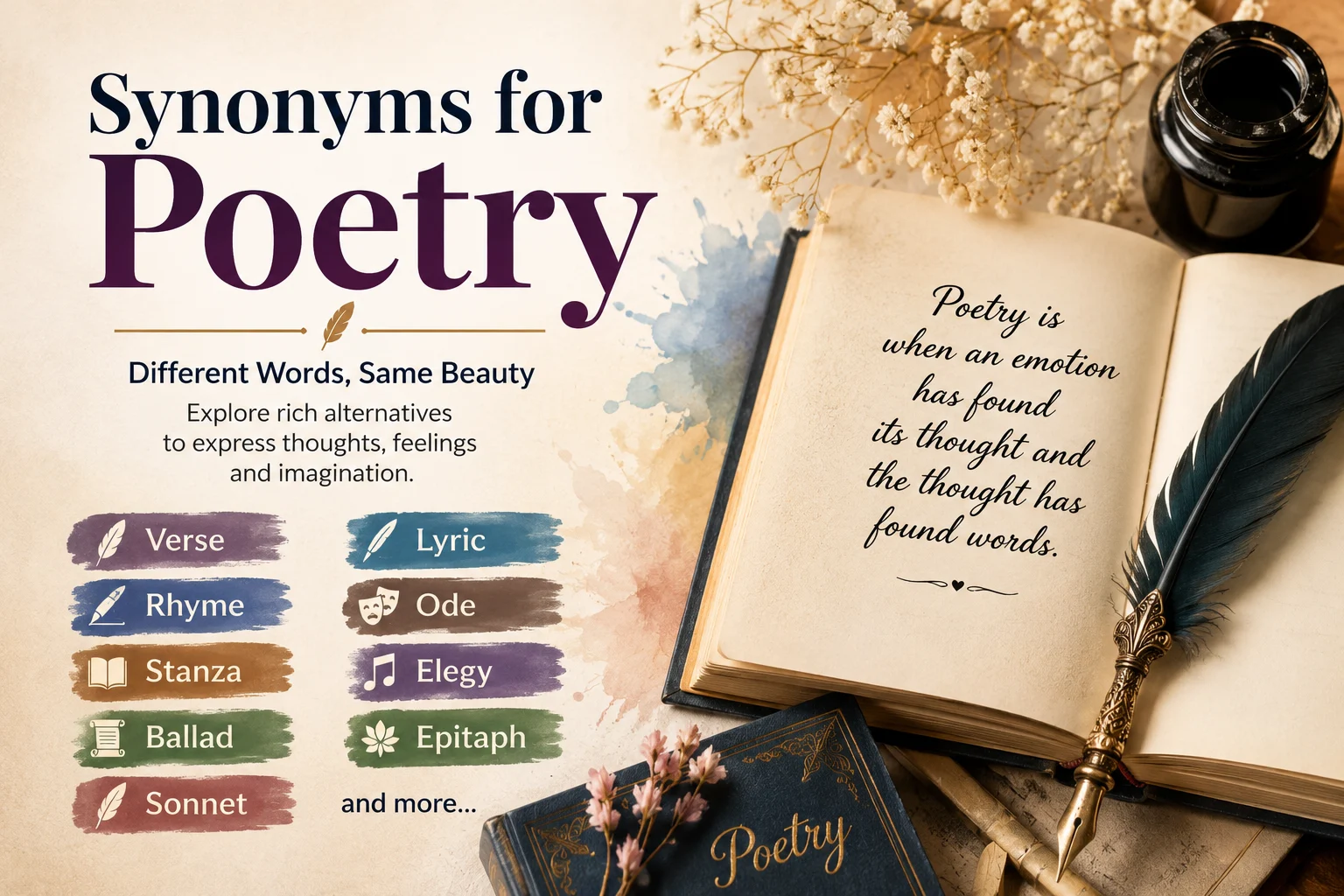
Finding the right synonyms for poetry can make your writing more varied, expressive, and precise. Whether you are a student writing an essay, an ESL learner building vocabulary, a poet looking for fresh language, or a content creator trying to avoid repetition, knowing related words can help you communicate your ideas more naturally.
The word poetry describes a form of literary expression that often uses rhythm, imagery, carefully chosen language, emotion, and sometimes rhyme. However, there is no single replacement that works in every situation. Words such as verse, poem, lyricism, and poetics have related meanings but are used differently.
In this guide, you will discover 30 useful synonyms and closely related terms for poetry, with simple definitions, examples, and usage notes. You will also find a separate vocabulary section on demure and 30 synonyms for demure, helping you understand how similar words can have different tones and meanings.
What Does “Poetry” Mean?
Poetry is a type of literature that uses creative and carefully arranged language to express thoughts, emotions, experiences, ideas, or stories.
Poetry may use rhyme and a regular rhythm, but it does not have to. Modern poetry, for example, often uses free verse without a fixed rhyme or meter.
Simple Definition of Poetry
Poetry: A form of literary writing that uses expressive language, rhythm, imagery, and other techniques to communicate ideas or emotions.
Example
The poet used images of rain, moonlight, and silence to express feelings of loneliness.
The sentence describes the way poetry can create an emotional experience through carefully selected language.
30 Synonyms and Related Words for Poetry
Not every word in this list is a perfect dictionary synonym for poetry. Some are closely related literary terms or specific forms of poetry. Understanding that difference will help you choose the most accurate word.
1. Verse
Meaning: Poetry written in lines, especially when referring to poetry as a literary form.
Example:
She enjoys reading classical verse.
Best usage: Use verse as one of the closest general alternatives to poetry.
2. Poem
Meaning: One individual piece of poetry.
Example:
He wrote a short poem about his childhood.
Best usage: Use poem when referring to a specific work rather than poetry as a whole.
3. Lyric
Meaning: A short poem or poetic expression that focuses on personal feelings or emotions.
Example:
The writer created a beautiful lyric about lost love.
Best usage: Best for emotional or song-like poetry.
4. Ballad
Meaning: A poem or song that tells a story.
Example:
The poet wrote a ballad about a brave sailor.
Best usage: Use for narrative poetry, especially poetry that tells a memorable story.
5. Ode
Meaning: A poem written to express admiration, praise, or strong feelings about someone or something.
Example:
The poet wrote an ode to the beauty of spring.
Best usage: Ideal for poetry that celebrates or praises a subject.
6. Elegy
Meaning: A poem that expresses sadness, grief, or remembrance, especially after a death.
Example:
The writer composed an elegy for his childhood friend.
Best usage: Use when discussing poetry about loss or mourning.
7. Epic
Meaning: A long poem that tells a grand story, often involving heroes, adventures, or historical events.
Example:
The ancient epic describes the adventures of a legendary warrior.
Best usage: Best for long narrative and heroic poetry.
8. Sonnet
Meaning: A traditional poetic form commonly consisting of 14 lines.
Example:
The class studied a famous Shakespearean sonnet.
Best usage: Use when referring specifically to this structured form of poetry.
9. Haiku
Meaning: A short Japanese poetic form traditionally associated with nature and concise imagery.
Example:
She wrote a haiku about falling snow.
Best usage: Best when referring specifically to Japanese-style haiku.
10. Limerick
Meaning: A short, humorous poem with a distinctive rhythm and rhyme pattern.
Example:
The children enjoyed writing funny limericks.
Best usage: Use for playful and humorous poetry.
11. Rhyme
Meaning: A pattern in which words have similar sounds, especially at the ends of lines.
Example:
The poem uses rhyme to create a musical effect.
Best usage: Use when discussing sound patterns in poetry rather than poetry itself.
12. Lyricism
Meaning: An emotional, expressive, or musical quality in writing.
Example:
The novel is known for its beautiful lyricism.
Best usage: Use when describing writing that has poetic or musical qualities.
13. Poetics
Meaning: The study or theory of poetry and poetic techniques.
Example:
The literature course introduced students to classical poetics.
Best usage: Best for academic and literary discussions.
14. Prosody
Meaning: The study or use of rhythm, stress, meter, and sound patterns in language.
Example:
The professor explained how prosody affects the rhythm of a poem.
Best usage: Use in academic discussions about poetic structure and sound.
15. Composition
Meaning: A written or artistic work created by an author or artist.
Example:
Her poetic composition explored the theme of nature.
Best usage: Useful when discussing a poem as a crafted literary work.
16. Literary Art
Meaning: Art created through written language.
Example:
Poetry is an important form of literary art.
Best usage: Suitable for academic or descriptive writing.
17. Poetic Writing
Meaning: Writing that uses expressive, imaginative, or artistic language.
Example:
His poetic writing made the landscape feel alive.
Best usage: Useful when describing prose or other writing with poetic qualities.
18. Expression
Meaning: The communication of thoughts, emotions, or ideas.
Example:
The poem became an expression of the writer’s deepest feelings.
Best usage: Use when focusing on poetry as emotional communication.
19. Wordcraft
Meaning: Skillful and creative use of words.
Example:
The poet’s wordcraft made the simple scene memorable.
Best usage: Best when emphasizing a writer’s skill with language.
20. Imagery
Meaning: Descriptive language that creates mental pictures or sensory experiences.
Example:
The poet uses vivid imagery to describe the ocean.
Best usage: Use when discussing a major poetic technique.
21. Narrative Verse
Meaning: Poetry that tells a story.
Example:
The author used narrative verse to describe the hero’s journey.
Best usage: Best for story-based poetry.
22. Free Verse
Meaning: Poetry that does not follow a fixed rhyme scheme or regular meter.
Example:
The modern poet prefers free verse because it allows greater creative freedom.
Best usage: Use for poetry without traditional rhythmic or rhyming rules.
23. Poem Cycle
Meaning: A group of connected poems that share a theme, subject, or story.
Example:
The collection is a poem cycle about the changing seasons.
Best usage: Useful when several related poems form one larger work.
24. Verse Writing
Meaning: The practice or style of creating poetry in lines.
Example:
She became interested in verse writing at university.
Best usage: Useful when talking about the craft of writing poetry.
25. Poetic Form
Meaning: The structure or pattern used to create a poem.
Example:
The writer experimented with an unusual poetic form.
Best usage: Use when discussing how a poem is structured.
26. Chant
Meaning: Words or phrases repeated rhythmically, sometimes with poetic or musical qualities.
Example:
The ancient chant used repeated words and rhythmic sounds.
Best usage: Appropriate for ceremonial, religious, or rhythmic language.
27. Rhapsody
Meaning: An enthusiastic or emotionally expressive piece of writing, speech, or music.
Example:
The poet created a rhapsody celebrating the beauty of the countryside.
Best usage: Use when describing highly emotional or enthusiastic expression.
28. Literary Verse
Meaning: Poetry considered as a form of serious or artistic literature.
Example:
The course focused on literary verse from different historical periods.
Best usage: Useful in formal literary discussions.
29. Poetic Expression
Meaning: The use of artistic language to communicate feelings, thoughts, or images.
Example:
The poem is a powerful form of poetic expression.
Best usage: Best when emphasizing creativity and emotion.
30. Verse Literature
Meaning: Literature written in poetic or rhythmic form.
Example:
The library contains important examples of ancient verse literature.
Best usage: Useful in historical or academic discussions of poetry.
Quick Comparison of Synonyms for Poetry
| Word | Main Meaning | Best Context |
| Verse | Poetry in lines | General literary use |
| Poem | One piece of poetry | Everyday writing |
| Lyric | Emotional poetic expression | Feelings and music |
| Ballad | Storytelling poem | Narrative poetry |
| Ode | Poem of praise | Celebration |
| Elegy | Poem about grief or loss | Mourning |
| Epic | Long heroic poem | Legends and adventures |
| Sonnet | Structured poetic form | Traditional poetry |
| Haiku | Short Japanese poetic form | Nature and simplicity |
| Limerick | Humorous rhyming poem | Humor |
| Lyricism | Emotional or musical quality | Literary description |
| Poetics | Theory of poetry | Academic study |
| Prosody | Rhythm and sound patterns | Literary analysis |
| Imagery | Descriptive mental pictures | Poetic techniques |
| Free verse | Poetry without fixed meter | Modern poetry |
Poetry vs. Poem: What Is the Difference?
Although poetry and poem are closely related, they are not exactly the same.
Poetry is the broader literary form or art.
A poem is an individual work created within that form.
For example:
I enjoy reading poetry.
This refers to poetry in general.
I read a beautiful poem yesterday.
This refers to one specific piece.
A simple way to remember the difference is:
Poetry = the art or literary form.
Poem = one individual work.
Poetry vs. Verse
Verse is one of the closest alternatives to poetry, but it can have a slightly different use.
For example:
She writes poetry.
can become:
She writes verse.
Both are natural.
However, verse can also refer to a section of a poem, song, or other structured work. Therefore, context determines whether it can replace poetry.
Poetry vs. Lyricism
Poetry refers to a literary form.
Lyricism refers to an emotional, musical, or poetic quality.
For example:
The collection contains poetry about nature.
But:
The author’s prose is full of lyricism.
The second sentence does not mean that the prose is literally poetry. It means the prose has qualities associated with poetry.
What Does “Demure” Mean?
The word demure is different from poetry. It describes a person’s appearance, behavior, or manner rather than a literary form.
Demure means quiet, modest, reserved, and well-mannered in appearance or behavior.
Simple Definition of Demure
Demure: Quiet, modest, and reserved, often in a way that appears polite or elegant.
Example Sentence
She gave a demure smile when her teacher praised her work.
The word often has a gentle, formal, elegant, or slightly old-fashioned tone.
Tone and Usage of Demure
Demure can suggest:
- Modesty
- Quietness
- Shyness
- Restraint
- Politeness
- Elegance
Context is important. Sometimes demure describes genuine modesty, while in other situations it can suggest someone is deliberately presenting themselves as shy or reserved.
30 Synonyms of Demure
1. Modest
Meaning: Not showing off or trying to attract attention.
Example:
She chose a modest dress for the ceremony.
Best usage: Clothing, behavior, appearance, or personality.
2. Reserved
Meaning: Quiet and not openly expressing feelings.
Example:
He was reserved when he first met his classmates.
Best usage: Personality and social behavior.
3. Shy
Meaning: Nervous or uncomfortable around other people.
Example:
The shy student avoided speaking in front of the class.
Best usage: Social behavior and personality.
4. Bashful
Meaning: Easily embarrassed or shy.
Example:
She became bashful when everyone complimented her.
Best usage: Gentle descriptions of shy behavior.
5. Retiring
Meaning: Quiet and unlikely to seek attention.
Example:
The retiring writer preferred to work away from the public eye.
Best usage: Formal descriptions of personality.
6. Unassuming
Meaning: Not trying to appear important or impressive.
Example:
Despite his success, he remained unassuming.
Best usage: Humble personalities and behavior.
7. Humble
Meaning: Not believing that you are better or more important than others.
Example:
The successful author remained humble.
Best usage: Character, attitude, and achievement.
8. Mild
Meaning: Gentle, calm, or not aggressive.
Example:
She had a mild and pleasant manner.
Best usage: Personality and behavior.
9. Gentle
Meaning: Kind, calm, and soft in manner.
Example:
His gentle personality made everyone feel comfortable.
Best usage: Character and behavior.
10. Quiet
Meaning: Not speaking much or making much noise.
Example:
She was quiet during the meeting.
Best usage: General behavior.
11. Soft-Spoken
Meaning: Speaking in a quiet and gentle voice.
Example:
The soft-spoken teacher answered every question patiently.
Best usage: Voice and communication style.
12. Subdued
Meaning: Quiet, restrained, or less noticeable than usual.
Example:
She gave a subdued response to the announcement.
Best usage: Mood, emotions, appearance, or behavior.
13. Coy
Meaning: Shy in a playful or sometimes flirtatious way.
Example:
She gave him a coy smile.
Best usage: Playful or romantic contexts.
14. Discreet
Meaning: Careful not to attract unnecessary attention.
Example:
She made a discreet exit from the room.
Best usage: Actions, behavior, and privacy.
15. Dignified
Meaning: Calm, serious, and worthy of respect.
Example:
She remained dignified despite the criticism.
Best usage: Formal behavior and public situations.
16. Decorous
Meaning: Proper and socially acceptable.
Example:
The guests maintained decorous behavior throughout the dinner.
Best usage: Formal writing and social conduct.
17. Proper
Meaning: Appropriate or socially acceptable.
Example:
Her proper behavior impressed the guests.
Best usage: Manners and conduct.
18. Prim
Meaning: Very proper, neat, and traditionally well-behaved.
Example:
She gave a prim smile during the formal ceremony.
Best usage: Formal descriptions; sometimes slightly critical.
19. Refined
Meaning: Elegant, polished, and cultured.
Example:
She has a refined sense of style.
Best usage: Appearance, manners, taste, and culture.
20. Elegant
Meaning: Graceful, attractive, and sophisticated.
Example:
She looked elegant in her simple dress.
Best usage: Appearance, clothing, and style.
21. Graceful
Meaning: Attractive and smooth in movement or behavior.
Example:
The dancer made a graceful entrance.
Best usage: Movement, appearance, and manners.
22. Mild-Mannered
Meaning: Calm, gentle, and not easily angered.
Example:
The mild-mannered professor rarely raised his voice.
Best usage: Personality and temperament.
23. Unobtrusive
Meaning: Not attracting attention or interfering with others.
Example:
The assistant remained unobtrusive during the ceremony.
Best usage: People, actions, and objects.
24. Self-Effacing
Meaning: Avoiding attention or praise for yourself.
Example:
Her self-effacing personality made her easy to work with.
Best usage: Humility and personality.
25. Meek
Meaning: Quiet, gentle, and unlikely to challenge others.
Example:
The meek child rarely argued with anyone.
Best usage: Gentle behavior, although it can sometimes suggest excessive submissiveness.
26. Unpretentious
Meaning: Simple and not designed to impress others.
Example:
The restaurant had a warm and unpretentious atmosphere.
Best usage: People, places, lifestyles, and style.
27. Composed
Meaning: Calm and in control of your emotions.
Example:
She remained composed during the difficult conversation.
Best usage: Emotional control and formal situations.
28. Demure-Looking
Meaning: Having a quiet, modest, or reserved appearance.
Example:
She chose a demure-looking outfit for the formal occasion.
Best usage: Informal descriptions of appearance.
29. Unobtrusive
Meaning: Not noticeable or attention-seeking.
Example:
His unobtrusive manner made him comfortable in formal settings.
Best usage: Behavior, presence, and design.
30. Modest-Looking
Meaning: Having a simple, restrained, or non-showy appearance.
Example:
The modest-looking outfit was appropriate for the ceremony.
Best usage: Clothing and physical appearance.
Demure Synonyms: Quick Comparison Guide
| Synonym | Main Idea | Tone |
| Modest | Not showing off | Positive |
| Reserved | Emotionally private | Neutral |
| Shy | Socially nervous | Neutral |
| Bashful | Easily embarrassed | Gentle |
| Unassuming | Not self-important | Positive |
| Humble | Not boastful | Positive |
| Coy | Playfully shy | Playful |
| Dignified | Calm and respectable | Formal |
| Decorous | Proper behavior | Formal |
| Refined | Cultured and polished | Positive |
| Elegant | Sophisticated and graceful | Positive |
| Meek | Quiet and submissive | Can be negative |
| Composed | Calm and controlled | Positive |
| Self-effacing | Avoiding praise | Positive |
| Unobtrusive | Not attracting attention | Neutral |
How to Choose the Right Synonym for Poetry
The best synonym depends on the exact meaning you want to communicate.
For Poetry in General
Use:
- Poetry
- Verse
- Poetic writing
- Literary art
Example:
She enjoys reading poetry.
For One Individual Poem
Use:
- Poem
- Verse
- Composition
Example:
He wrote a poem about his hometown.
For Emotional Poetry
Use:
- Lyric
- Lyricism
- Poetic expression
Example:
The poem is full of lyricism and emotion.
For Storytelling Poetry
Use:
- Ballad
- Narrative verse
- Epic
Example:
The poet created a ballad about a mysterious traveler.
For Specific Traditional Forms
Use:
- Sonnet
- Ode
- Elegy
- Haiku
- Limerick
These terms are more precise than simply using poetry.
How to Choose the Right Synonym for Demure
The same approach works when choosing alternatives to demure.
For Quiet Personality
Choose:
- Reserved
- Shy
- Retiring
- Soft-spoken
For Modest Behavior
Choose:
- Modest
- Proper
- Decorous
- Unassuming
For Elegance
Choose:
- Refined
- Elegant
- Graceful
- Dignified
For Calm Behavior
Choose:
- Composed
- Mild
- Mild-mannered
- Subdued
For Playful Shyness
Choose:
- Coy
- Bashful
For Humility
Choose:
- Humble
- Self-effacing
- Unpretentious
Common Mistakes When Using Synonyms
A common vocabulary mistake is assuming that every synonym can replace another word in every sentence.
For example, poem and poetics are related, but they do not have the same meaning.
You can say:
I wrote a poem.
But you would normally say:
I studied poetics.
Likewise, shy and demure overlap in meaning but are not identical.
A person may be shy because they feel nervous in social situations. Someone may appear demure because they behave in a quiet, modest, or restrained manner.
Choosing words based on context makes your writing more accurate and natural.
Why Learning Synonyms Matters for Students and ESL Learners
Learning synonyms is an effective way to build a stronger vocabulary.
First, synonyms help you avoid unnecessary repetition. Repeating the same word too often can make an essay or article sound dull.
Second, they allow you to communicate more precise meanings. For example, verse may be appropriate when discussing poetic lines, while sonnet is better when referring to a particular poetic form.
Third, learning related vocabulary improves reading comprehension. Academic books, literature, essays, and online articles often use words that learners may not encounter in everyday conversation.
Finally, understanding word differences helps you become a more confident writer. Instead of choosing a word simply because it looks familiar, you can select one that matches your intended tone.
Frequently Asked Questions About Synonyms for Poetry
What is the closest synonym for poetry?
Verse is one of the closest general alternatives to poetry. However, the best word depends on context.
Is “poem” a synonym for poetry?
Poem is closely related to poetry, but the two words are not exactly interchangeable. Poetry refers to the broader literary form, while a poem is one individual work.
What is another word for poetic writing?
Depending on context, alternatives include verse, poetic expression, literary art, lyricism, and poetic writing.
What is a synonym for poetry in academic writing?
Terms such as verse, poetics, prosody, poetic form, and literary art may be appropriate, depending on what you are discussing.
What are the most common synonyms for demure?
Common alternatives include modest, reserved, shy, bashful, unassuming, retiring, coy, refined, elegant, and composed.
Is demure a positive word?
Usually, demure has a positive or neutral tone and suggests modesty, quietness, restraint, or elegance. However, its meaning can change slightly depending on the context.
What is the difference between demure and shy?
Shy usually describes discomfort or nervousness around other people. Demure focuses more on a quiet, modest, restrained, or well-mannered appearance or behavior.
Final Thoughts
Learning synonyms for poetry is not simply about memorizing alternative words. The real goal is to understand how related words differ and when each one sounds natural.
Words such as verse, poem, lyric, ballad, ode, elegy, sonnet, epic, and haiku can describe different forms or aspects of poetry. Terms such as poetics, prosody, lyricism, imagery, and poetic expression are especially useful when discussing poetry in an academic or analytical context.
The same principle applies to demure. Words such as modest, reserved, shy, unassuming, refined, and composed share some of its meaning, but each carries its own tone and purpose.
The best vocabulary choice is therefore not always the word that looks most similar in a dictionary. Choose the word that matches your exact meaning, tone, audience, and situation. This approach will make your writing clearer, more natural, and more effective.

I am Jace Thomas, a passionate synonym writer dedicated to making word choices simple and meaningful. I enjoy exploring language, discovering synonyms, and helping readers express ideas clearly and creatively.