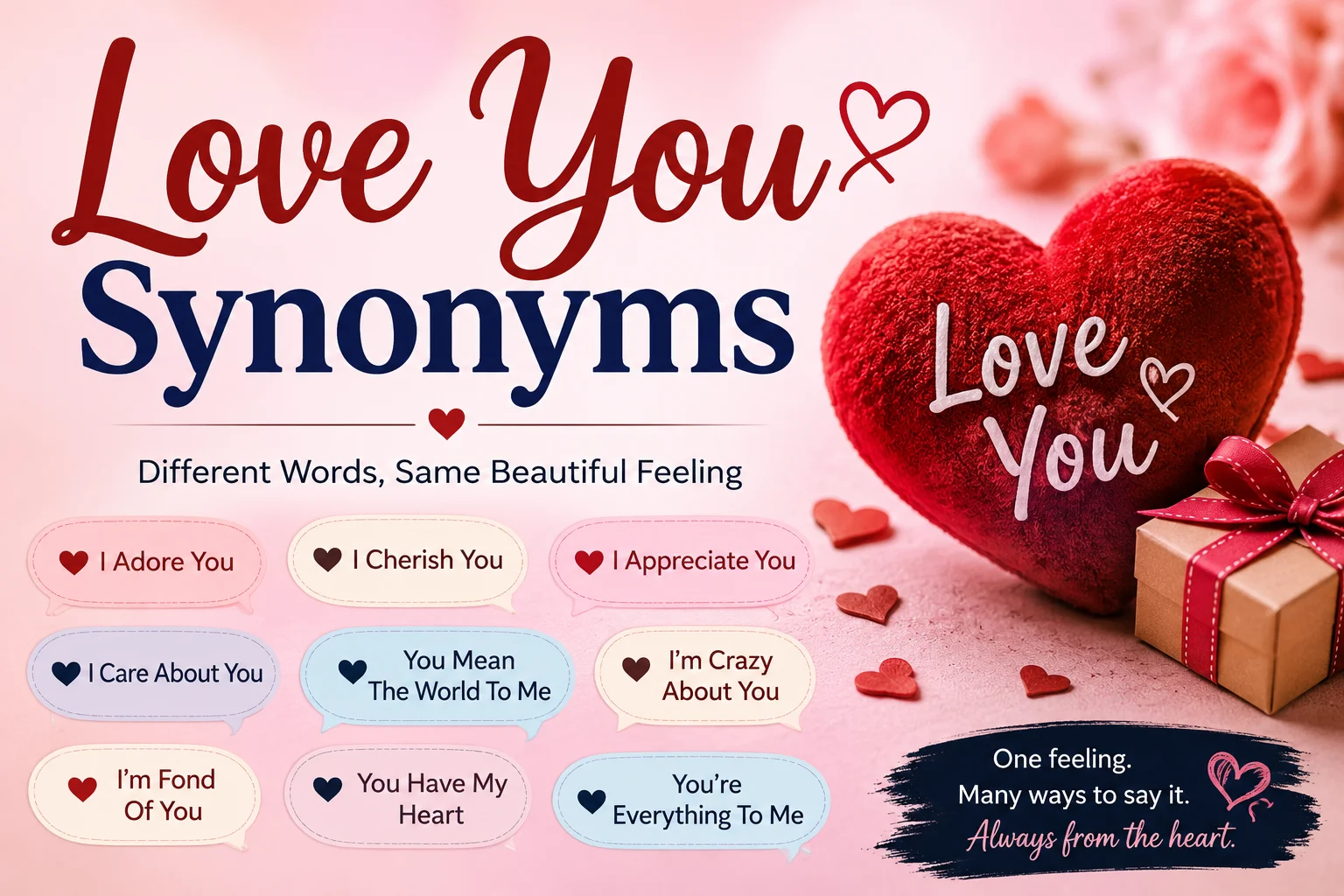
Finding the right words to express love is not always easy. The phrase “I love you” is powerful, but sometimes you may want a different expression that sounds more romantic, friendly, heartfelt, poetic, or natural. Learning love you synonyms can help you communicate your feelings more clearly and choose words that match the relationship and situation.
Whether you are writing a romantic message, creating a social media caption, writing a poem, or simply looking for a warmer way to express affection, having a wider vocabulary gives you more choices. For students, ESL learners, writers, and content creators, understanding these expressions also helps improve everyday English.
In this guide, you will discover useful alternatives to “I love you,” along with their meanings, examples, and best usage contexts. You will also find a detailed explanation of the word demure and 30 synonyms for it, as well as a practical guide for choosing the right word for the tone you want.
What Does “I Love You” Mean?
“I love you” is a direct expression of deep affection, emotional attachment, care, or romantic love. It is commonly used between romantic partners, family members, and sometimes close friends.
The exact meaning depends on the relationship and context. For example, saying “I love you” to a romantic partner expresses romantic affection, while saying it to a parent may express family love and appreciation.
Because the phrase is so common, speakers sometimes look for more natural or creative alternatives. This is where love you synonyms and similar expressions become useful.
Love You Synonyms and Alternative Expressions
Below are natural ways to express love or strong affection without always repeating “I love you.”
| Expression | Simple Meaning | Example Sentence | Best Usage |
| I adore you | I love and admire you deeply. | “I adore you more every day.” | Romantic and affectionate |
| I care about you | Your well-being matters to me. | “I want you to know that I really care about you.” | Warm and general |
| You mean so much to me | You are extremely important to me. | “You mean so much to me, and I never want you to forget that.” | Emotional |
| You mean the world to me | You are extremely valuable to me. | “You mean the world to me.” | Romantic or heartfelt |
| I cherish you | I value you deeply. | “I cherish every moment we spend together.” | Deep and romantic |
| I treasure you | I consider you very precious. | “I treasure you more than words can explain.” | Romantic and poetic |
| I’m crazy about you | I like or love you very strongly. | “I’m absolutely crazy about you.” | Casual and romantic |
| I’m devoted to you | I am deeply loyal and committed to you. | “I’m devoted to you and our future together.” | Serious relationships |
| I’m deeply in love with you | My romantic love for you is very strong. | “I’m deeply in love with you.” | Strong romantic feeling |
| You have my heart | My love and affection belong to you. | “You have my heart forever.” | Romantic and poetic |
| You’re my everything | You are extremely important in my life. | “You’re my everything.” | Intense romantic expression |
| I’m fond of you | I like you warmly and affectionately. | “I’ve become very fond of you.” | Gentle and less intense |
| I’m attached to you | I have a strong emotional connection with you. | “I’ve grown deeply attached to you.” | Emotional |
| I’m drawn to you | I naturally feel attracted to you. | “I’ve always felt drawn to you.” | Romantic |
| I’m crazy about you | I have very strong feelings for you. | “You know I’m crazy about you.” | Informal and playful |
| I’m passionate about you | I feel strong romantic attraction toward you. | “I’m passionate about you and our relationship.” | Intense romance |
| I’m devoted to you | I am strongly committed to you. | “She is completely devoted to him.” | Long-term relationships |
| You have a special place in my heart | You are emotionally important to me. | “You’ll always have a special place in my heart.” | Heartfelt |
| I’m grateful for you | I deeply appreciate having you in my life. | “I’m grateful for you every single day.” | Appreciation |
| I appreciate you | I recognize and value you. | “I appreciate everything you do for me.” | Everyday affection |
| I’m here for you | I will support you. | “Whatever happens, I’m here for you.” | Supportive |
| I’ll always care about you | My concern and affection will continue. | “No matter what happens, I’ll always care about you.” | Emotional |
| You’re precious to me | You are very valuable to me. | “You’re incredibly precious to me.” | Tender |
| You’re special to me | You are important in a unique way. | “You’re very special to me.” | Gentle and versatile |
| I hold you dear | I value you deeply. | “I hold you very dear to my heart.” | Formal or poetic |
| I’m yours | I express emotional or romantic commitment. | “My heart is yours.” | Romantic |
| My heart belongs to you | I am deeply devoted to you. | “My heart belongs to you.” | Poetic |
| You complete me | You make my life feel whole. | “Being with you makes me feel like you complete me.” | Romantic |
| I can’t imagine life without you | Your presence is extremely important to me. | “I can’t imagine my life without you.” | Deeply emotional |
| You make me happy | Your presence brings me happiness. | “You make me happier than you know.” | Natural and sincere |
| I’m happiest with you | I feel especially happy when I am with you. | “I’m happiest when I’m with you.” | Romantic |
| I feel lucky to have you | I feel fortunate because you are in my life. | “I feel so lucky to have you.” | Appreciation |
| I’m grateful that I found you | I am thankful that we met. | “I’m grateful that life brought us together.” | Romantic |
| You’re the one for me | I believe you are my ideal partner. | “I feel like you’re the one for me.” | Romantic |
| I choose you | I intentionally choose to love and support you. | “Every day, I choose you.” | Deep commitment |
| I’m all yours | I am completely committed to you. | “My heart is all yours.” | Romantic |
| I’m falling for you | I am beginning to fall in love with you. | “I think I’m falling for you.” | New romance |
| I’ve fallen for you | I have developed strong romantic feelings. | “Somehow, I’ve completely fallen for you.” | Romantic |
| You’ve stolen my heart | You have made me fall deeply in love. | “You’ve completely stolen my heart.” | Playful and romantic |
| You make my heart smile | You bring me deep happiness. | “You make my heart smile every day.” | Cute and affectionate |
| I’m crazy in love with you | I love you extremely strongly. | “I’m completely crazy in love with you.” | Intense and informal |
| I’m head over heels for you | I am deeply and enthusiastically in love. | “I’m head over heels for you.” | Romantic and playful |
| I’m smitten with you | I am strongly attracted to you. | “He was completely smitten with her.” | Playful or literary |
| You’re my person | You are the person I feel closest to. | “You’re my person, today and always.” | Modern and intimate |
| I love having you in my life | Your presence makes my life better. | “I love having you in my life.” | Warm and sincere |
| You make my life better | Your presence improves my life. | “You make my life better just by being here.” | Genuine |
| I’m thankful for your love | I deeply appreciate your affection. | “I’m thankful for your love every day.” | Appreciative |
| I’ll always have love for you | My affection for you will remain. | “No matter where life takes us, I’ll always have love for you.” | Emotional |
| You are deeply loved | You are loved very strongly. | “Never forget that you are deeply loved.” | Comforting |
| I love you with all my heart | I love you completely and sincerely. | “I love you with all my heart.” | Deeply romantic |
| You are my whole heart | You are central to my emotional life. | “You are my whole heart.” | Poetic |
| I love you more than words can say | My love is difficult to describe. | “I love you more than words can say.” | Emotional and poetic |
Love You Synonyms by Tone
Not every expression of love has the same emotional strength. Choosing the right phrase depends on what you want to communicate.
| Tone | Best Expressions |
| Romantic | I adore you, I cherish you, I’m deeply in love with you |
| Cute | You make my heart smile, You’re my person, You’ve stolen my heart |
| Poetic | My heart belongs to you, You have my heart, You are my whole heart |
| Casual | I’m crazy about you, I’m fond of you, I care about you |
| Deep | You mean the world to me, I’m devoted to you, I can’t imagine life without you |
| Supportive | I’m here for you, I appreciate you, I’m grateful for you |
| New relationship | I’m falling for you, I’m drawn to you, I’m smitten with you |
| Long-term relationship | I choose you, I cherish you, I’m devoted to you |
What Does “Demure” Mean?
Demure is an adjective used to describe someone who appears quiet, modest, reserved, and well-mannered.
The word often describes a person’s behavior, appearance, or manner. It can suggest a calm and modest personality, especially when someone does not want to attract too much attention.
For example:
“She gave him a demure smile.”
Here, demure suggests that her smile was modest, gentle, and somewhat shy.
The tone of demure is usually polite, refined, and somewhat old-fashioned. In modern English, it is often used in descriptions of someone’s appearance, manner, or behavior.
30 Synonyms of Demure
1. Modest
Meaning: Not showing off or seeking attention.
Example: “She wore a modest dress to the ceremony.”
Best usage: Clothing, behavior, or personality.
2. Reserved
Meaning: Quiet and not very expressive.
Example: “He is reserved around people he does not know.”
Best usage: Personality and social behavior.
3. Shy
Meaning: Nervous or uncomfortable around other people.
Example: “The shy student avoided speaking in front of the class.”
Best usage: Social behavior.
4. Bashful
Meaning: Easily embarrassed or shy.
Example: “She became bashful when everyone complimented her.”
Best usage: Gentle or youthful descriptions.
5. Retiring
Meaning: Avoiding attention and preferring a quiet life.
Example: “He had a retiring personality.”
Best usage: Formal descriptions of personality.
6. Unassuming
Meaning: Not trying to appear important or impressive.
Example: “Despite his success, he remained unassuming.”
Best usage: Personality and character.
7. Quiet
Meaning: Making little noise or not talking much.
Example: “She was quiet during the meeting.”
Best usage: Everyday English.
8. Mild
Meaning: Gentle and not aggressive.
Example: “He has a mild and pleasant manner.”
Best usage: Personality and behavior.
9. Gentle
Meaning: Kind, calm, and soft in behavior.
Example: “She has a gentle personality.”
Best usage: Personality and manner.
10. Meek
Meaning: Very quiet and unlikely to challenge others.
Example: “He was meek and rarely argued.”
Best usage: Personality, though it can sometimes sound negative.
11. Timid
Meaning: Lacking confidence or easily frightened.
Example: “The timid child stayed close to her mother.”
Best usage: Shyness or lack of confidence.
12. Coy
Meaning: Pretending to be shy or hesitant, often in a playful way.
Example: “She gave him a coy smile.”
Best usage: Romantic or playful situations.
13. Proper
Meaning: Behaving according to accepted social standards.
Example: “She was always proper and polite.”
Best usage: Formal or social behavior.
14. Decorous
Meaning: Behaving in a socially appropriate and respectable way.
Example: “His decorous behavior impressed the guests.”
Best usage: Formal writing.
15. Ladylike
Meaning: Traditionally considered graceful and well-mannered for a woman.
Example: “Her ladylike manners were admired by everyone.”
Best usage: Traditional descriptions.
16. Refined
Meaning: Polished, elegant, and socially graceful.
Example: “She has a refined sense of style.”
Best usage: Appearance, manners, and taste.
17. Dignified
Meaning: Calm, serious, and worthy of respect.
Example: “She remained dignified throughout the difficult situation.”
Best usage: Behavior and character.
18. Discreet
Meaning: Careful not to attract attention or reveal private information.
Example: “He was discreet about their private conversation.”
Best usage: Privacy and behavior.
19. Subdued
Meaning: Quiet, restrained, or not intense.
Example: “She wore subdued colors.”
Best usage: Appearance, mood, and behavior.
20. Demurely
Meaning: In a quiet, modest, or reserved manner.
Example: “She smiled demurely at the compliment.”
Best usage: Adverbial descriptions.
21. Innocent
Meaning: Showing little experience of the world or lacking harmful intentions.
Example: “She had an innocent expression.”
Best usage: Character and appearance.
22. Unobtrusive
Meaning: Not attracting attention.
Example: “He chose an unobtrusive seat at the back.”
Best usage: People, objects, and behavior.
23. Unpretentious
Meaning: Simple and not designed to impress others.
Example: “Her unpretentious personality made everyone comfortable.”
Best usage: Personality and lifestyle.
24. Modest-minded
Meaning: Not overly proud or focused on personal importance.
Example: “She remained modest-minded despite her achievements.”
Best usage: Character descriptions.
25. Restrained
Meaning: Controlled and not overly expressive.
Example: “His response was calm and restrained.”
Best usage: Emotions and behavior.
26. Composed
Meaning: Calm and in control of your emotions.
Example: “She remained composed during the interview.”
Best usage: Professional and formal contexts.
27. Soft-spoken
Meaning: Speaking quietly and gently.
Example: “The soft-spoken teacher was easy to approach.”
Best usage: Speech and personality.
28. Courteous
Meaning: Polite and respectful toward others.
Example: “He was courteous to every guest.”
Best usage: Manners and social situations.
29. Well-mannered
Meaning: Behaving politely and appropriately.
Example: “The children were polite and well-mannered.”
Best usage: Everyday descriptions.
30. Unpretending
Meaning: Natural and without an attempt to appear impressive.
Example: “Her unpretending manner made her easy to trust.”
Best usage: Character and personality.
Demure Synonyms: Quick Comparison Guide
Some synonyms of demure are close in meaning, but they are not interchangeable in every situation.
| Word | Main Idea | Tone |
| Demure | Modest and reserved | Elegant |
| Modest | Not showing off | Neutral |
| Reserved | Not openly expressive | Neutral |
| Shy | Uncomfortable with attention | Informal |
| Bashful | Easily embarrassed | Warm |
| Coy | Playfully shy | Romantic |
| Timid | Lacking confidence | Sometimes negative |
| Refined | Elegant and polished | Positive |
| Dignified | Calm and respectable | Formal |
| Unassuming | Not trying to impress | Positive |
| Composed | Calm and controlled | Professional |
| Soft-spoken | Speaking gently | Positive |
How to Choose the Right Love You Synonym
Choosing the best alternative to “I love you” depends on the emotion behind your words.
For Deep Romantic Love
Use expressions such as:
- I’m deeply in love with you.
- You mean the world to me.
- You have my heart.
- I love you with all my heart.
- My heart belongs to you.
These work well when you want to communicate serious emotional commitment.
For New Love
If a relationship is still developing, stronger expressions may feel too intense. Try:
- I’m falling for you.
- I’m drawn to you.
- I’m smitten with you.
- You’re becoming very special to me.
- I really care about you.
These expressions communicate affection without necessarily sounding overwhelming.
For Cute and Playful Messages
For texts, captions, or light romantic conversations, consider:
- I’m mistaken about you.
- You’ve stolen my heart.
- You make my heart smile.
- You’re my person.
- I’m head over heels for you.
These phrases sound warm, modern, and conversational.
For Family and Close Friends
Romantic expressions are not always appropriate for family or friendship. Instead, use:
- I care about you.
- You mean so much to me.
- I appreciate you.
- I’m grateful for you.
- I’m always here for you.
These communicate affection without creating romantic ambiguity.
Love You Synonyms for Text Messages
Text messages often sound best when they are short and natural. Instead of repeatedly writing “I love you,” you could say:
- “You mean everything to me.”
- “I’m so lucky to have you.”
- “You make every day better.”
- “I’m grateful for you.”
- “You have my whole heart.”
- “I’m always here for you.”
- “You make my heart smile.”
- “I’m crazy about you.”
- “You’re so special to me.”
- “I cherish you.”
The best message does not have to be complicated. A simple, sincere sentence can be more meaningful than a dramatic phrase.
Love You Synonyms for Writers and Content Creators
Writers often need different expressions to avoid repetition. The best choice depends on the character, genre, and emotional intensity.
For romance writing, phrases such as “I cherish you,” “my heart belongs to you,” and “I’m deeply in love with you” can create emotional depth.
For poetry, expressions such as “you have my heart,” “you are my whole heart,” and “I treasure you” can sound more lyrical.
For casual dialogue, “I’m crazy about you,” “I’m falling for you,” and “you mean so much to me” usually sound more natural.
For professional or general writing, use less emotionally intense expressions such as “I appreciate you,” “I care about you,” or “you are important to me.”
Common Mistakes When Using Love You Synonyms
Choosing an Expression That Is Too Strong
“I’m deeply in love with you” can sound very serious. It may not be the best choice when you have only recently met someone.
Using Romantic Language With the Wrong Audience
“You have my heart” is romantic. It may sound inappropriate when addressing a teacher, colleague, or casual acquaintance.
Focusing Too Much on Fancy Words
Natural English is usually better than unnecessarily complicated vocabulary. A simple “You mean so much to me” can be more powerful than an elaborate sentence.
Ignoring Context
Words such as “fond,” “cherish,” “adore,” and “devoted” have different emotional strengths. Always consider who you are speaking to and what relationship you share.
Why Learning Love You Synonyms Improves Your English
Learning alternative expressions does more than help you avoid repetition. It teaches you how English speakers communicate different levels of emotion.
For ESL learners, these expressions provide useful vocabulary for conversations, writing, messages, and storytelling. They also demonstrate an important language skill: understanding tone and context, not just dictionary definitions.
For writers and content creators, a broader vocabulary makes descriptions more natural and emotionally precise. Instead of using “love” repeatedly, you can show whether a character feels affection, admiration, devotion, attraction, appreciation, or deep emotional attachment.
Frequently Asked Questions About Love You Synonyms
What is another way to say “I love you”?
Some natural alternatives include “I adore you,” “I cherish you,” “you mean the world to me,” “I care deeply about you,” and “you have my heart.”
What is a romantic synonym for “I love you”?
“I adore you,” “I’m deeply in love with you,” “you have my heart,” and “my heart belongs to you” are strongly romantic alternatives.
What is a cute way to say “I love you”?
You can say “I’m crazy about you,” “you make my heart smile,” “you’re my person,” or “you’ve stolen my heart.”
What is a deeper way to say “I love you”?
Try “You mean the world to me,” “I cherish you,” “I’m devoted to you,” or “I love you with all my heart.”
Is “adore” stronger than “like”?
Usually, yes. Adore expresses very strong affection or admiration, while like can describe a much broader range of positive feelings.
Conclusion
Knowing different love you synonyms gives you more ways to express affection naturally and meaningfully. Instead of relying on the same phrase every time, you can choose words that match the emotion, relationship, and situation.
Expressions such as “I adore you,” “I cherish you,” “you mean the world to me,” and “you have my heart” can add warmth and variety to everyday communication. For new relationships, softer phrases such as “I’m falling for you” may feel more natural, while deeper expressions such as “I’m devoted to you” can suit long-term relationships.
The same principle applies to vocabulary in general. Understanding synonyms is not simply about finding different words—it is about understanding their tone, strength, context, and emotional meaning. That is what makes your English more natural, precise, and expressive.

I am Axel James, a passionate writer who loves exploring synonyms and alternative words. I enjoy helping readers improve their vocabulary and express ideas clearly.