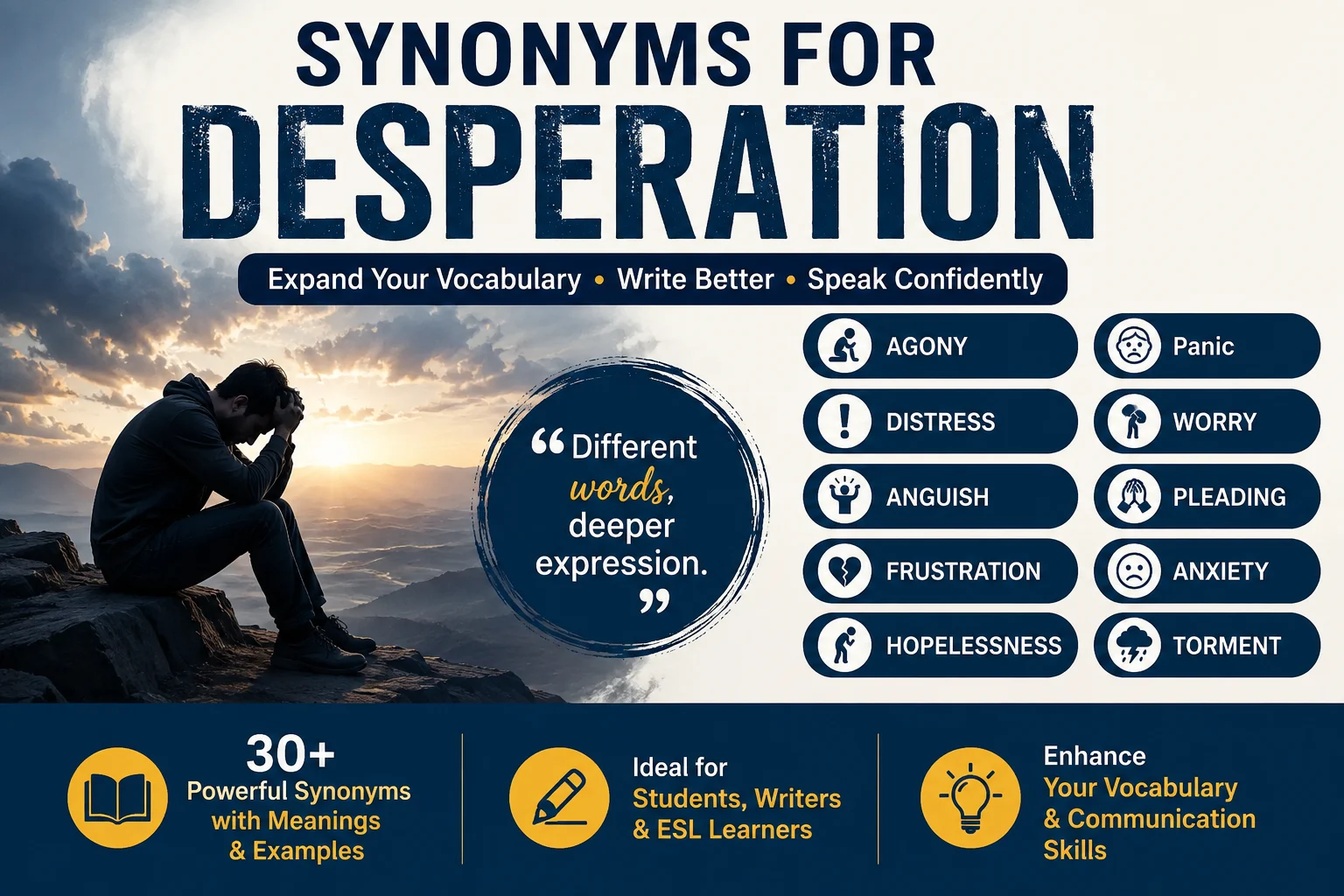
Understanding synonyms for desperation can help you choose stronger, more precise words in essays, stories, conversations, and everyday writing. The word desperation describes a powerful state in which someone feels trapped, hopeless, or intensely in need of a change. It can also describe a very strong need or desire for something.
However, there is an important vocabulary distinction in this guide. The requested keyword is “synonyms for desperation,” while the detailed vocabulary task asks for the meaning and synonyms of “demure.” These are completely different words. Desperation relates to extreme need, hopelessness, or risk-taking, whereas demure generally describes someone or something that appears quiet, modest, reserved, or well behaved.
Because both terms have different meanings and usage patterns, this article explains the distinction clearly and then gives you 30 useful synonyms for demure, with simple definitions, example sentences, and practical notes about when each word works best.
What Does “Desperation” Mean?
Desperation is a noun used for an intense feeling that a situation is so bad that someone may be willing to take risks to change it. It can also describe an extremely strong need or desire.
For example:
“In desperation, he accepted the first job he could find.”
Here, the person feels that the situation has become serious enough to force a difficult choice.
Useful related words include hopelessness, despair, urgency, distress, panic, need, and helplessness. The best choice depends on the exact emotion or situation you want to describe.
What Does “Demure” Mean?
Demure is an adjective that usually describes someone who behaves in a quiet, reserved, modest, or well-mannered way. It is especially common when describing a person’s appearance, behavior, smile, clothing, or manner. Cambridge defines it as quiet and well behaved, particularly in descriptions of women, while learner-oriented definitions emphasize being quiet and shy.
In simple English, you can think of demure as:
quiet + modest + reserved + well behaved
For example:
“She gave him a demure smile.”
The word does not normally suggest sadness or desperation. It suggests controlled, restrained, or modest behavior.
The tone can vary. In some contexts, demure is complimentary and suggests elegance or modesty. In others, it can sound old-fashioned, formal, or slightly stereotypical, particularly when applied to women.
30 Synonyms for Demure
No two synonyms are exactly identical. Some emphasize quietness, while others focus on modesty, shyness, restraint, elegance, or politeness.
1. Modest
Meaning: Not showing off; behaving or dressing in a reserved way.
Example:
“She wore a modest dress to the formal dinner.”
Best usage context: Clothing, behavior, appearance, or personality.
Why it works: Modest is one of the closest everyday alternatives to demure.
2. Reserved
Meaning: Quiet and not likely to show your feelings openly.
Example:
“He was reserved during the first few meetings.”
Best usage context: Personality, social behavior, or formal descriptions.
Why it works: Use reserved when the focus is on emotional restraint rather than appearance.
3. Shy
Meaning: Nervous or uncomfortable around other people.
Example:
“The shy student rarely spoke in class.”
Best usage context: Personality and social situations.
Why it works: Shy is simpler and more common than demure, but it suggests nervousness more strongly.
4. Modest
Meaning: Quietly respectful and not seeking attention.
Example:
“She was modest about her achievements.”
Best usage context: Personality, success, appearance, or behavior.
Why it works: It is useful when demure means humble rather than merely quiet.
5. Coy
Meaning: Pretending to be shy, especially in a playful or flirtatious way.
Example:
“She gave him a coy smile before looking away.”
Best usage context: Romance, flirting, teasing, or playful writing.
Why it works: Coy overlaps with demure, but it can imply deliberate behavior rather than natural shyness.
6. Bashful
Meaning: Easily embarrassed or shy.
Example:
“The bashful child hid behind her mother.”
Best usage context: Children, informal writing, and gentle descriptions.
Why it works: It sounds warmer and more innocent than demure.
7. Retiring
Meaning: Quiet and avoiding attention.
Example:
“Though talented, the artist had a retiring personality.”
Best usage context: Formal or literary writing.
Why it works: Retiring is an elegant choice when describing someone who prefers to remain in the background.
8. Unassuming
Meaning: Not trying to impress others or attract attention.
Example:
“She had an unassuming manner despite her success.”
Best usage context: Personality, professionals, leaders, and everyday descriptions.
Why it works: It emphasizes humility more than shyness.
9. Meek
Meaning: Quiet, gentle, and unlikely to challenge others.
Example:
“The meek student listened carefully instead of arguing.”
Best usage context: Character descriptions and formal writing.
Why it works: It can overlap with demure, but meek may suggest weakness or lack of confidence.
10. Mild
Meaning: Gentle and not extreme in behavior or manner.
Example:
“She had a mild and pleasant manner.”
Best usage context: Personality and temperament.
Why it works: Choose mild when the person seems gentle rather than specifically shy.
11. Gentle
Meaning: Calm, kind, and soft in manner.
Example:
“He spoke in a gentle voice.”
Best usage context: Personality, voice, behavior, and interactions.
Why it works: Gentle carries a positive emotional tone that demure does not always have.
12. Quiet
Meaning: Not loud, talkative, or attention-seeking.
Example:
“She was quiet throughout the ceremony.”
Best usage context: Everyday English.
Why it works: It is the simplest replacement when you only need the idea of low-key behavior.
13. Subdued
Meaning: Calm, restrained, or less noticeable than usual.
Example:
“She wore subdued colors to the formal event.”
Best usage context: Clothing, emotions, voices, design, and atmosphere.
Why it works: It focuses on restraint rather than personality.
14. Restrained
Meaning: Controlled and not openly emotional or expressive.
Example:
“His response was restrained but polite.”
Best usage context: Formal writing, emotions, reactions, and behavior.
Why it works: Use it when someone is deliberately controlling their expression.
15. Proper
Meaning: Behaving in a socially acceptable or respectable way.
Example:
“She was always careful to remain proper in formal situations.”
Best usage context: Manners, traditional settings, and formal descriptions.
Why it works: It can capture the traditional sense of demure, although it is broader.
16. Ladylike
Meaning: Traditionally feminine, polite, graceful, and well behaved.
Example:
“Her ladylike manners impressed the older guests.”
Best usage context: Historical, traditional, or literary writing.
Why it works: It may fit old-fashioned uses of demure, but modern writers should use it carefully because it can carry traditional gender expectations.
17. Prim
Meaning: Very proper, neat, and carefully controlled in behavior.
Example:
“She sat with a prim expression during the formal meeting.”
Best usage context: Formal or slightly humorous descriptions.
Why it works: Prim can suggest excessive concern with proper behavior.
18. Sedate
Meaning: Calm, serious, and not energetic or noisy.
Example:
“The restaurant had a sedate atmosphere.”
Best usage context: People, places, events, and styles.
Why it works: It is useful when demure describes a calm, sophisticated mood.
19. Composed
Meaning: Calm and in control of your emotions.
Example:
“She remained composed during the difficult interview.”
Best usage context: Professional, emotional, or stressful situations.
Why it works: Use composed when the main idea is self-control.
20. Dignified
Meaning: Calm, serious, and worthy of respect.
Example:
“She maintained a dignified appearance throughout the ceremony.”
Best usage context: Formal writing, public behavior, ceremonies, and professional settings.
Why it works: Dignified sounds more mature and respectable than demure.
21. Refined
Meaning: Elegant, polished, and socially graceful.
Example:
“She had a refined sense of style.”
Best usage context: Fashion, manners, taste, and sophisticated writing.
Why it works: This synonym is better when demure describes elegance rather than shyness.
22. Decorous
Meaning: Polite, appropriate, and socially respectable.
Example:
“The audience remained decorous throughout the debate.”
Best usage context: Formal, academic, and professional writing.
Why it works: Decorous is especially useful when proper behavior is the main point.
23. Demure
Meaning: Quiet, reserved, modest, and well behaved.
Example:
“She looked demure in the simple evening dress.”
Best usage context: Appearance, manner, fashion, and literary descriptions.
Why it works: This is the original word, included as a useful reference point when comparing related vocabulary.
24. Diffident
Meaning: Lacking confidence and feeling unsure of yourself.
Example:
“He was diffident when speaking to senior colleagues.”
Best usage context: Formal writing and descriptions of confidence.
Why it works: Diffident is more about self-confidence than appearance.
25. Unobtrusive
Meaning: Not attracting attention or standing out.
Example:
“She chose an unobtrusive outfit for the ceremony.”
Best usage context: People, design, clothing, objects, and style.
Why it works: It emphasizes being discreet rather than shy.
26. Discreet
Meaning: Careful not to attract attention or reveal too much.
Example:
“He gave her a discreet nod from across the room.”
Best usage context: Social behavior, communication, and professional situations.
Why it works: Discreet is about tact and privacy rather than modest appearance alone.
27. Tame
Meaning: Quiet, controlled, or not exciting.
Example:
“The performance was unusually tame compared with last year’s show.”
Best usage context: Informal writing and situations rather than personal character.
Why it works: It only works as a loose synonym and often carries a more negative or humorous tone.
28. Well-mannered
Meaning: Polite and respectful in behavior.
Example:
“The well-mannered child thanked every guest.”
Best usage context: Children, manners, schools, families, and everyday English.
Why it works: It captures the “well behaved” part of demure very clearly.
29. Soft-spoken
Meaning: Speaking quietly and gently.
Example:
“She was soft-spoken but very confident.”
Best usage context: Voice, conversation, and personality.
Why it works: It is especially useful when demure refers to a person’s manner of speaking.
30. Modest-looking
Meaning: Having an appearance that is simple, restrained, or not attention-seeking.
Example:
“The actress chose a modest-looking outfit for the ceremony.”
Best usage context: Clothing, fashion, and physical appearance.
Why it works: This phrase is natural when you want to explain the visual side of demure in simple English.
Quick Comparison: Which Synonym Should You Use?
Choosing the right synonym depends on the exact meaning you want.
| Synonym | Main idea | Tone | Best use |
| Modest | Not showy | Neutral/positive | Clothing, behavior |
| Reserved | Emotionally quiet | Neutral | Personality |
| Shy | Nervous around others | Friendly/common | Social situations |
| Coy | Playfully shy | Flirtatious | Romance |
| Bashful | Easily embarrassed | Warm | Children, casual writing |
| Unassuming | Not seeking attention | Positive | Personality |
| Meek | Quiet and submissive | Sometimes negative | Character descriptions |
| Subdued | Restrained or low-key | Neutral | Appearance, mood |
| Restrained | Emotionally controlled | Formal | Reactions |
| Sedate | Calm and serious | Formal | People, places |
| Composed | Emotionally controlled | Positive | Professional settings |
| Dignified | Calm and respectable | Formal/positive | Public behavior |
| Refined | Elegant and polished | Sophisticated | Fashion, manners |
| Decorous | Proper and socially acceptable | Formal | Academic/professional writing |
| Diffident | Lacking confidence | Formal | Personality |
| Unobtrusive | Avoiding attention | Neutral | Style, appearance |
| Discreet | Tactful and private | Positive | Behavior, communication |
| Soft-spoken | Quiet voice | Positive | Speech, personality |
| Well-mannered | Polite and respectful | Positive | Children, social behavior |
How to Choose the Right Synonym
The easiest way to choose a synonym for demure is to decide what aspect of the word matters most.
When you mean “quiet”
Choose:
quiet, reserved, soft-spoken, retiring
These words work when a person does not talk much or prefers to stay in the background.
Example:
“She was quiet and reserved during the discussion.”
When you mean “shy”
Choose:
shy, bashful, diffident
These words suggest some level of uncertainty, embarrassment, or low confidence.
Example:
“The bashful child smiled and looked away.”
Use diffident in more formal writing because it is strongly connected to a lack of confidence.
When you mean “modest”
Choose:
modest, unassuming, unobtrusive
These words are helpful when someone does not want to attract attention.
Example:
“She preferred an unassuming style rather than a flashy one.”
When you mean “proper and polite”
Choose:
well-mannered, proper, decorous, dignified
These are especially useful for formal or social situations.
Example:
“The guests remained decorous during the ceremony.”
When you mean “elegant”
Choose:
refined, dignified, sedate
These words work particularly well for fashion, public behavior, or sophisticated settings.
Example:
“Her refined style was simple but elegant.”
When you mean “playfully shy”
Choose:
coy
This is a special case. Coy can describe someone who appears shy in a deliberate, playful, or flirtatious way.
Example:
“She gave him a coy smile.”
Demure vs. Shy: What Is the Difference?
These words are close, but they are not always interchangeable.
Shy usually means that someone feels nervous, uncomfortable, or lacking in confidence around other people.
Demure focuses more on outward behavior and appearance. Someone may look demure without actually feeling shy.
Compare:
“She was shy at the party.”
This suggests she felt uncomfortable socially.
“She looked demure in her simple dress.”
This describes her appearance or manner.
In other words, a person can be demure but confident, while a shy person may not necessarily look demure.
Demure vs. Modest
Demure and modest often overlap, especially when discussing clothing or behavior.
However, modest is broader.
A person may be modest because they do not brag about achievements. Clothing can also be modest because it is not revealing.
Demure, by contrast, often creates an image of quiet, reserved, traditional, or understated behavior or appearance.
Compare:
“She was modest about her academic success.”
and:
“She gave a demure smile.”
The first sentence is about humility. The second is about manner and expression.
Demure vs. Coy
These words are particularly easy to confuse.
Demure usually suggests quiet modesty or reserve.
Coy often suggests deliberate shyness, especially in a romantic or teasing situation.
For example:
“She looked demure at the formal dinner.”
This sounds elegant and restrained.
“She gave him a coy smile.”
This sounds more playful or flirtatious.
Cambridge also places coy in comparison with demure, highlighting their close relationship while keeping their meanings distinct.
Common Mistakes When Using “Demure”
Mistake 1: Treating “demure” as a synonym for desperation
This is incorrect.
Desperation describes an extreme emotional state involving hopelessness, urgency, or intense need. Demure describes quiet or modest behavior.
Mistake 2: Assuming “demure” always means shy
Not necessarily.
A person can behave in a demure way without being nervous or lacking confidence.
Mistake 3: Using “demure” for every kind of quiet person
Sometimes reserved, soft-spoken, or unassuming is more accurate.
Good vocabulary is not about finding a word that is technically similar. It is about finding the word that matches the meaning and tone.
Mistake 4: Using “meek” as a perfect replacement
Meek can suggest passivity or weakness. That meaning is stronger than the usual meaning of demure.
Mistake 5: Ignoring context
A word that works in a fashion article may sound unnatural in an academic essay.
For example, refined fits style and elegance, while diffident fits confidence and personality.
Synonyms for Desperation: A Quick Vocabulary Guide
Since “synonyms for desperation” is the target phrase for this article, it is useful to understand the related vocabulary as well.
Here are several common alternatives:
| Word | Main meaning | Example |
| Despair | Complete loss of hope | “He fell into despair after the loss.” |
| Hopelessness | Feeling that nothing will improve | “She struggled with a sense of hopelessness.” |
| Distress | Severe worry, pain, or difficulty | “The family was in obvious distress.” |
| Panic | Sudden overwhelming fear | “Panic spread through the crowd.” |
| Urgency | Need for immediate action | “The problem requires urgent attention.” |
| Helplessness | Feeling unable to change a situation | “He experienced a sense of helplessness.” |
| Need | Lack of something important | “There is an urgent need for food.” |
| Despairing | Showing little hope | “Her despairing expression worried him.” |
| Frustration | Distress caused by being unable to achieve something | “Repeated delays caused frustration.” |
| Frenzy | Wild, uncontrolled excitement or activity | “The news sent fans into a frenzy.” |
These are not perfect replacements in every sentence. Despair is closer to hopelessness, urgency emphasizes the need for immediate action, and panic focuses on fear.
That is why understanding nuance is more useful than simply memorizing a synonym list.
How to Improve Your Vocabulary with Synonyms
Learning synonyms works best when you learn them in groups rather than as isolated words.
For example, instead of memorizing only:
demure = quiet
learn the related ideas:
demure → reserved → modest → soft-spoken → restrained → refined
Then ask yourself:
- Is the person shy?
- Is the person simply quiet?
- Is the person modest?
- Is the person elegant?
- Is the person deliberately avoiding attention?
- Is the setting formal or casual?
This approach helps ESL learners build a stronger sense of meaning.
For writers, it also prevents repetition. Instead of using quiet in every sentence, you can select reserved, soft-spoken, unassuming, or restrained, depending on what the character is actually doing.
Practical Examples for Students and Writers
Basic sentence
“She was demure.”
More precise alternatives
“She was reserved during the meeting.”
“She gave a shy smile.”
“She wore a modest dress.”
“She spoke in a soft-spoken manner.”
“She remained composed under pressure.”
“She had a refined sense of style.”
These sentences look similar at first, but each communicates a different idea. That difference is exactly what makes precise vocabulary valuable.
Frequently Asked Questions
What is the closest synonym for demure?
Modest, reserved, and shy are among the closest common alternatives, but the best choice depends on context.
Is demure a positive word?
Often, yes. It can suggest modesty, elegance, calmness, and good manners. However, its tone can sometimes feel traditional or old-fashioned.
Is demure the same as shy?
No. Shy usually focuses on nervousness or lack of confidence, while demure focuses more on outwardly quiet or modest behavior.
What is the difference between demure and coy?
Demure usually suggests modest reserve. Coy often suggests deliberate, playful, or flirtatious shyness.
Can demure describe clothing?
Yes. Clothing can be described as demure when it appears modest, understated, or not designed to attract excessive attention.
What are good synonyms for desperation?
Depending on the context, useful related words include despair, hopelessness, distress, panic, urgency, helplessness, and extreme need. They are not interchangeable in every sentence because each highlights a different aspect of desperation.
Final Takeaway
The most important lesson is that synonyms are not exact copies of one another. A good synonym preserves the main idea while changing the tone, intensity, or context.
For demure, the closest useful alternatives include modest, reserved, shy, coy, bashful, unassuming, restrained, refined, dignified, decorous, and soft-spoken. The right choice depends on whether you want to emphasize appearance, personality, confidence, manners, elegance, or emotional restraint.
At the same time, remember that demure and desperation are unrelated words. Desperation describes an extreme state of need, hopelessness, or urgency, while demure describes a quiet, modest, and reserved manner. Keeping that distinction clear will help you write more naturally and accurately.
For students and ESL learners, the best strategy is to learn synonyms by meaning and context, not by memorizing long lists. For writers and content creators, choosing the exact word can make a sentence clearer, more vivid, and more natural.
In vocabulary, precision matters. The strongest word is not simply the one that looks most similar in a dictionary—it is the one that communicates exactly what you mean.

I am Ace Michael, an author passionate about words, language, and vocabulary. I enjoy exploring synonyms and finding simple, useful alternatives that help readers express their ideas clearly, naturally, and creatively. At Synoloop, I share helpful word choices to make writing easier and more effective.