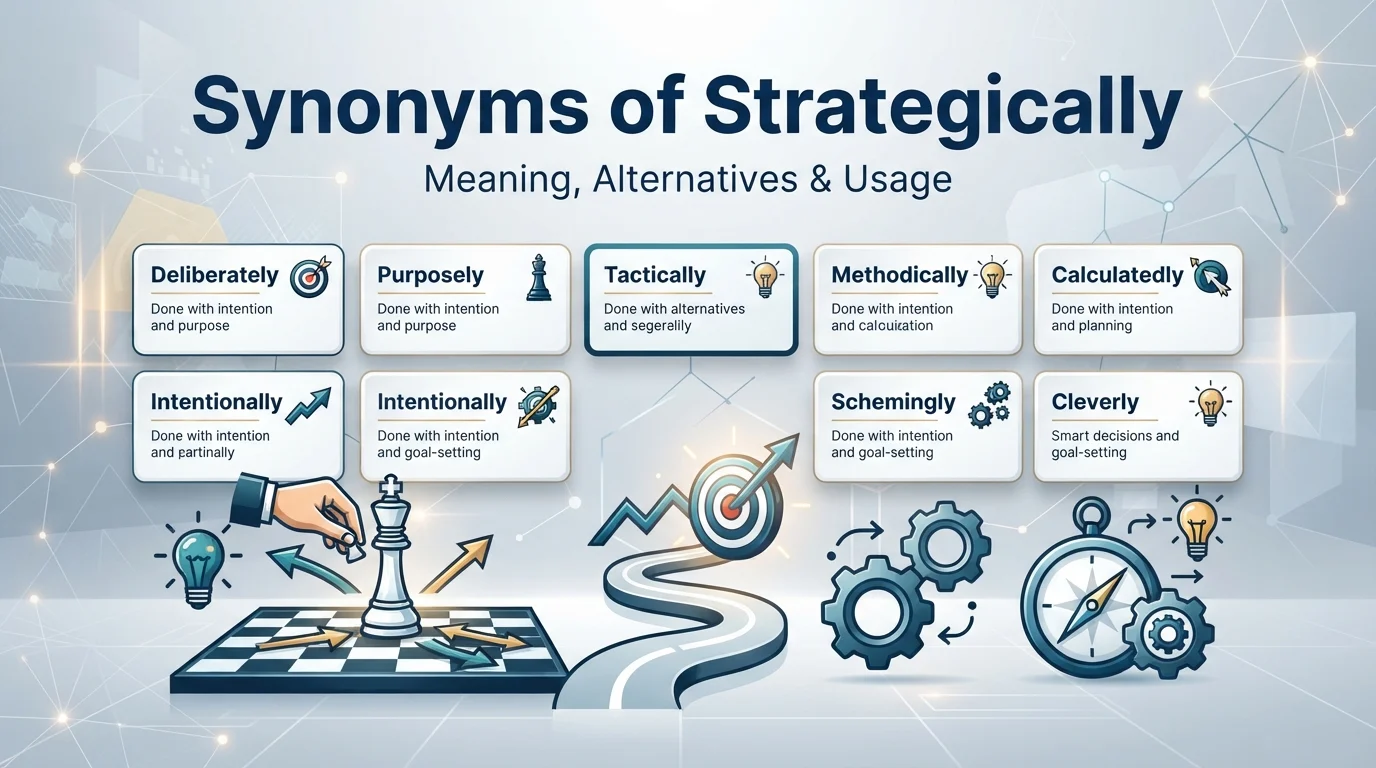
Understanding synonyms of strategically can help you make your writing more precise, professional, and engaging. The word strategically describes doing something with a clear plan, purpose, or long-term goal in mind. It is common in business, education, marketing, leadership, sports, and everyday communication.
Choosing the right alternative depends on the meaning you want to express. For example, deliberately focuses on conscious choice, while tactically often refers to a specific action designed to achieve an immediate advantage. Learning these differences helps students, ESL learners, writers, and content creators avoid repetitive language and communicate ideas more clearly.
One important note: the prompt also asks for the meaning and synonyms of demure, which is a separate vocabulary word. To keep the article useful for learners, that section is included after the discussion of strategically.
What Does “Strategically” Mean?
Strategically means doing something according to a carefully considered plan designed to achieve a particular goal.
In simple English, if you do something strategically, you think about the best way to reach a desired result before taking action.
Example:
The company strategically entered new markets to increase its long-term growth.
Here, strategically suggests that the company did not enter those markets randomly. It made a thoughtful decision based on its goals.
Strategically in Different Contexts
The meaning can change slightly depending on the situation.
- Business: making decisions that support long-term success.
- Marketing: placing content, products, or advertisements where they can have the greatest effect.
- Sports: using a planned approach to gain an advantage.
- Education: organizing study time or resources effectively.
- Writing: placing information carefully to improve clarity or impact.
- Everyday life: making thoughtful choices to reach a particular goal.
30 Synonyms of Strategically
Below are 30 useful alternatives. Some are direct synonyms, while others are context-dependent alternatives that express a closely related idea. This distinction matters because no synonym works perfectly in every sentence.
1. Deliberately
Meaning: Done intentionally and with careful thought.
Example:
She deliberately chose the most experienced team members for the project.
Best usage: Use this when you want to emphasize intention rather than planning alone.
2. Tactically
Meaning: In a way designed to achieve a specific short-term advantage.
Example:
The coach tactically changed the team’s formation during the second half.
Best usage: Especially useful in sports, negotiations, military contexts, and competitive situations.
3. Purposefully
Meaning: With a clear purpose or goal.
Example:
The organization purposefully focused its resources on underserved communities.
Best usage: Good for emphasizing clear intention and direction.
4. Calculatedly
Meaning: In a carefully planned way, often after considering possible results.
Example:
He calculatedly avoided making a decision until he had more information.
Best usage: Useful when the action involves careful calculation; it can sometimes sound slightly negative.
5. Thoughtfully
Meaning: With careful consideration and attention.
Example:
The manager thoughtfully assigned responsibilities according to each employee’s strengths.
Best usage: Best when planning involves consideration of people, needs, or consequences.
6. Carefully
Meaning: With attention and caution.
Example:
The company carefully selected the location for its new office.
Best usage: A simple, natural alternative for everyday writing.
7. Systematically
Meaning: Following an organized method or process.
Example:
The researchers systematically examined the available evidence.
Best usage: Ideal for academic, scientific, technical, and professional writing.
8. Methodically
Meaning: In a careful and orderly way.
Example:
She methodically reviewed every section of the report.
Best usage: Use when an action follows a structured sequence.
9. Intentionally
Meaning: Done on purpose.
Example:
The teacher intentionally included practical examples in the lesson.
Best usage: Strong choice when the key idea is conscious intention.
10. Purposefully
Meaning: In a determined way directed toward a specific objective.
Example:
The team moved purposefully toward its annual growth target.
Best usage: Useful for goals, actions, movement, and determined behavior.
11. Prudently
Meaning: In a sensible and careful way, especially when considering risks.
Example:
The board prudently limited spending during the uncertain economic period.
Best usage: Excellent for financial, business, legal, and risk-related contexts.
12. Wisely
Meaning: In a sensible way based on good judgment.
Example:
The company wisely invested in employee training.
Best usage: Appropriate when the decision demonstrates sound judgment.
13. Astutely
Meaning: In a clever and perceptive way.
Example:
The executive astutely identified an opportunity that competitors had overlooked.
Best usage: Use when emphasizing intelligence, insight, or sharp judgment.
14. Cunningly
Meaning: In a clever way, especially to gain an advantage.
Example:
The negotiator cunningly used the competitor’s hesitation to strengthen his position.
Best usage: Often carries a negative or morally questionable tone.
15. Shrewdly
Meaning: In a clever and practical way, especially when making decisions.
Example:
The investor shrewdly recognized the company’s growth potential.
Best usage: Common in business, finance, negotiation, and leadership writing.
16. Foresightedly
Meaning: With awareness of future needs or consequences.
Example:
The city foresightedly invested in public transportation before congestion became severe.
Best usage: Best when emphasizing long-term thinking.
17. Proactively
Meaning: Acting in advance instead of waiting for a problem to happen.
Example:
The company proactively addressed customer concerns before they became major complaints.
Best usage: Very useful in business, management, customer service, and workplace communication.
18. Intelligently
Meaning: In a sensible or clever way.
Example:
The organization intelligently allocated its limited resources.
Best usage: General-purpose writing when highlighting smart decision-making.
19. Deliberatively
Meaning: With careful consideration and discussion.
Example:
The committee deliberatively evaluated each proposal.
Best usage: More formal and suitable for institutional or academic contexts.
20. Organically
Meaning: In a naturally developing or integrated way rather than through forced action.
Example:
The brand strategically and organically expanded its online community.
Best usage: Useful in marketing and growth discussions, but it is not a direct synonym in every context.
21. Logically
Meaning: According to clear reasoning.
Example:
The team logically prioritized the projects with the highest potential returns.
Best usage: Use when the emphasis is on reasoning rather than strategy itself.
22. Rationally
Meaning: Based on reason rather than emotion.
Example:
The leadership team rationally assessed the risks before investing.
Best usage: Appropriate when describing objective decision-making.
23. Consciously
Meaning: With awareness and intention.
Example:
She consciously developed relationships with people in her industry.
Best usage: Best when emphasizing awareness and intentional behavior.
24. Intuitively
Meaning: Based on instinct or an immediate understanding rather than detailed analysis.
Example:
The designer intuitively positioned the main message at the center of the page.
Best usage: Useful when strategic-looking decisions are guided by experience or instinct.
25. Skillfully
Meaning: In a way that shows ability and expertise.
Example:
The manager skillfully handled the difficult negotiation.
Best usage: Use when emphasizing how well an action was performed.
26. Effectively
Meaning: In a way that produces the desired result.
Example:
The company effectively used social media to reach new customers.
Best usage: Good when the focus is on successful results rather than planning.
27. Optimally
Meaning: In the best possible way under the circumstances.
Example:
The team optimally distributed its resources across the three departments.
Best usage: Useful in technical, business, mathematical, and analytical writing.
28. Deliberately Planned
Meaning: Carefully designed before being carried out.
Example:
The campaign was deliberately planned to reach younger customers.
Best usage: Helpful when you want to make the planning element especially clear.
29. Goal-Orientedly
Meaning: In a way focused strongly on achieving a particular goal.
Example:
The department worked goal-orientedly toward improving customer satisfaction.
Best usage: Better expressed as in a goal-oriented way in polished English; useful when discussing objectives.
30. With Foresight
Meaning: With consideration of future developments and consequences.
Example:
The company invested in renewable energy with foresight.
Best usage: Excellent when describing long-term planning and preparation.
Quick Comparison of Synonyms for Strategically
| Synonym | Main Idea | Tone | Best Context |
| Deliberately | Intentional action | Neutral | General writing |
| Tactically | Specific advantage | Professional | Sports, competition |
| Purposefully | Clear purpose | Positive | Goals, leadership |
| Systematically | Organized process | Formal | Research, analysis |
| Methodically | Step-by-step action | Formal | Projects, procedures |
| Prudently | Careful risk management | Professional | Finance, business |
| Astutely | Sharp judgment | Positive | Leadership, business |
| Shrewdly | Clever practical judgment | Professional | Negotiation, finance |
| Proactively | Acting ahead | Positive | Workplace, management |
| Foresightedly | Future-focused thinking | Formal | Planning, policy |
| Effectively | Producing results | Neutral | Business, general |
| Skillfully | Showing expertise | Positive | Leadership, performance |
| Intentionally | Done on purpose | Neutral | General |
| Wisely | Good judgment | Positive | Decisions, advice |
| Optimally | Best possible result | Technical | Business, systems |
Strategically vs. Deliberately
These words are related but not identical.
Strategically emphasizes a plan designed to achieve a goal.
Deliberately emphasizes that something was done intentionally.
Compare:
The company strategically opened an office in the region.
This suggests the location was chosen as part of a larger plan.
The company deliberately opened an office in the region.
This mainly tells us that the decision was intentional.
Strategically vs. Tactically
These two words are especially common in business and competitive environments.
Strategically usually refers to the bigger picture and long-term objectives.
Tactically usually refers to individual actions used to achieve a specific or immediate advantage.
Example:
The company strategically expanded into international markets.
The sales team tactically offered discounts to attract hesitant customers.
The first sentence concerns a broad direction. The second describes a specific action.
Strategically vs. Systematically
Strategically focuses on why and where you are going.
Systematically focuses more on how you carry out a process in an organized manner.
For example:
The organization strategically selected its priorities.
The researchers systematically analyzed the data.
The first concerns priorities and goals. The second concerns a structured method.
What Does “Demure” Mean?
Demure is an adjective used to describe someone who behaves in a quiet, modest, reserved, or somewhat shy way.
In simple English, a demure person usually does not try to attract attention. The word can describe someone’s behavior, appearance, or manner.
Example:
She gave a demure smile when the audience complimented her.
The tone of demure is usually gentle, modest, and reserved. Depending on context, it can sound complimentary, old-fashioned, literary, or slightly formal.
It is important not to confuse demure with words such as sad or unfriendly. A demure person may simply be quiet and modest rather than unhappy or distant.
30 Synonyms of Demure
1. Modest
Meaning: Not showing off or seeking attention.
Example:
She remained modest despite receiving several awards.
Best usage: General descriptions of humble behavior or appearance.
2. Reserved
Meaning: Quiet and not openly expressive.
Example:
He was reserved during the first meeting.
Best usage: Personality and social behavior.
3. Shy
Meaning: Nervous or uncomfortable around other people.
Example:
The shy student avoided speaking in front of the class.
Best usage: Informal everyday English.
4. Retiring
Meaning: Avoiding attention and preferring a quiet life.
Example:
She had a retiring personality and rarely spoke about herself.
Best usage: Formal or literary descriptions of personality.
5. Unassuming
Meaning: Not trying to appear important or impressive.
Example:
Despite his success, he remained unassuming.
Best usage: Positive descriptions of humble people.
6. Quiet
Meaning: Not loud or highly expressive.
Example:
She was quiet during the discussion.
Best usage: Simple everyday descriptions.
7. Mild
Meaning: Gentle and not aggressive or extreme.
Example:
He has a mild and friendly personality.
Best usage: General personality descriptions.
8. Gentle
Meaning: Kind, calm, and soft in manner.
Example:
She spoke in a gentle voice.
Best usage: Behavior, voice, and personality.
9. Subdued
Meaning: Quiet and restrained.
Example:
Her subdued manner made her seem thoughtful.
Best usage: Formal or descriptive writing.
10. Coy
Meaning: Shy or pretending to be shy, sometimes in a playful way.
Example:
She gave a coy smile before answering.
Best usage: Social or romantic contexts; use carefully because it can imply affected shyness.
11. Bashful
Meaning: Easily embarrassed or shy.
Example:
The bashful child hid behind her mother.
Best usage: Informal, friendly descriptions.
12. Timid
Meaning: Lacking confidence and easily frightened or nervous.
Example:
The timid puppy stayed close to its owner.
Best usage: Animals, children, or people lacking confidence.
13. Meek
Meaning: Quiet, gentle, and unlikely to argue or resist.
Example:
He had a meek personality and rarely challenged anyone.
Best usage: Use carefully because it can suggest excessive passivity.
14. Unobtrusive
Meaning: Not attracting attention.
Example:
The designer chose an unobtrusive style for the room.
Best usage: Appearance, behavior, design, and objects.
15. Self-effacing
Meaning: Not drawing attention to your own abilities or achievements.
Example:
Her self-effacing humor made her easy to work with.
Best usage: Professional and personal descriptions.
16. Humble
Meaning: Not believing you are better or more important than others.
Example:
He remained humble after becoming successful.
Best usage: Character and attitude.
17. Demurely
Meaning: In a quiet, modest, or reserved manner.
Example:
She smiled demurely at the compliment.
Best usage: Directly describes an action performed in a demure manner.
18. Discreet
Meaning: Careful not to attract attention or reveal information.
Example:
She made a discreet exit from the event.
Best usage: Situations involving privacy or avoiding attention.
19. Modest-Mannered
Meaning: Behaving in a humble and restrained way.
Example:
The modest-mannered speaker thanked the audience without boasting.
Best usage: Descriptive writing; more natural alternatives may be preferable in everyday English.
20. Unpretentious
Meaning: Simple and without an attempt to impress others.
Example:
The restaurant had an unpretentious atmosphere.
Best usage: People, places, styles, and lifestyles.
21. Soft-Spoken
Meaning: Speaking quietly and gently.
Example:
The soft-spoken teacher immediately put the students at ease.
Best usage: Voice and communication style.
22. Unassertive
Meaning: Not strongly expressing opinions or demands.
Example:
His unassertive manner made it difficult for him to lead the discussion.
Best usage: Workplace and personality contexts.
23. Withdrawn
Meaning: Avoiding social interaction or keeping away from others.
Example:
The normally cheerful student became withdrawn after the incident.
Best usage: Use when someone actively keeps away from social interaction; it is not always a positive synonym for demure.
24. Bashful
Meaning: Shy, especially when receiving attention or praise.
Example:
The bashful performer looked down after receiving applause.
Best usage: Friendly and informal descriptions.
25. Unobtrusive
Meaning: Designed or behaving in a way that does not attract notice.
Example:
She chose an unobtrusive outfit for the formal occasion.
Best usage: Appearance and surroundings.
26. Restrained
Meaning: Controlled and not overly emotional or expressive.
Example:
He maintained a restrained manner throughout the interview.
Best usage: Formal writing and descriptions of behavior.
27. Composed
Meaning: Calm and in control of one’s emotions.
Example:
She remained composed despite the unexpected question.
Best usage: Professional and formal contexts.
28. Ladylike
Meaning: Traditionally associated with polite, graceful, and restrained feminine behavior.
Example:
The novel portrays her as graceful and ladylike.
Best usage: Historical or traditional contexts; modern usage can sound dated or prescriptive.
29. Demure-looking
Meaning: Having a modest, quiet, or reserved appearance.
Example:
She wore a demure-looking dress to the ceremony.
Best usage: Informal descriptions of appearance.
30. Proper
Meaning: Behaving according to accepted social standards of politeness or respectability.
Example:
The character was portrayed as proper and reserved.
Best usage: Formal, traditional, or social contexts.
How to Choose the Right Synonym
Choosing the best synonym is not simply about finding a word with a similar dictionary definition. You should consider meaning, tone, context, audience, and strength.
For Long-Term Planning
Choose:
- Strategically
- Foresightedly
- Prudently
- Purposefully
These work well when discussing future goals, business plans, investments, or organizational decisions.
For Specific Actions
Choose:
- Tactically
- Deliberately
- Intentionally
- Calculatedly
These emphasize a particular action or decision.
For Organized Processes
Choose:
- Systematically
- Methodically
- Carefully
- Deliberatively
These are particularly useful in academic, professional, and analytical writing.
For Smart Decision-Making
Choose:
- Astutely
- Shrewdly
- Wisely
- Intelligently
These emphasize good judgment or clever thinking.
For Future-Focused Decisions
Choose:
- Strategically
- Proactively
- Foresightedly
- With foresight
These are useful when someone prepares for future opportunities or problems.
Common Mistakes When Using Synonyms of Strategically
Using “Deliberately” When You Mean “Strategically”
Deliberately means intentionally, but it does not automatically suggest a broader strategy.
Less precise:
The business deliberately entered the new market.
More strategic:
The business strategically entered the new market to strengthen its international position.
Using “Tactically” for Long-Term Planning
Tactically usually describes specific moves rather than an overall strategy.
If you are discussing a company’s five-year expansion plan, strategically is usually more appropriate.
Assuming Every Related Word Is Interchangeable
Words such as effectively, systematically, intentionally, and wisely overlap with strategically, but they emphasize different ideas.
A good writer chooses a synonym based on the exact relationship between the action and its goal.
Synonyms of Strategically in Business Writing
Professional writing often requires precise vocabulary.
Instead of repeatedly writing:
The company strategically invested in technology.
You might write:
- The company prudently invested in technology.
- The company deliberately invested in technology.
- The company proactively invested in technology.
- The company wisely invested in technology.
- The company foresightedly invested in technology.
However, each version changes the emphasis.
Prudently highlights risk management.
Proactively highlights preparation.
Wisely highlights good judgment.
Foresightedly highlights future consequences.
Synonyms of Strategically in Academic Writing
Academic writing benefits from precise and objective language.
Consider these examples:
- Researchers systematically reviewed previous studies.
- The study deliberately focused on a specific population.
- The researchers methodically examined the available evidence.
- The authors purposefully selected particular variables.
In academic contexts, systematically and methodically are often more precise than simply using strategically.
Synonyms of Strategically in Marketing
Marketing often uses strategically to describe decisions about positioning, content, audiences, and timing.
For example:
The brand strategically placed its products near the checkout.
Possible alternatives include:
- Purposefully placed — emphasizes intention.
- Deliberately placed — emphasizes conscious choice.
- Effectively placed — emphasizes results.
- Tactically placed — emphasizes a specific competitive action.
The best choice depends on what you want the reader to notice.
Why Learning Synonyms Matters
Learning synonyms is valuable because it improves more than vocabulary.
It helps you:
- Avoid repetitive writing.
- Express subtle differences in meaning.
- Adapt your tone to different audiences.
- Write more naturally.
- Improve academic and professional communication.
- Understand native English usage.
- Make content more engaging.
- Choose stronger words for specific situations.
For ESL learners especially, understanding the difference between related words is often more useful than memorizing long vocabulary lists.
Frequently Asked Questions
What is the best synonym for strategically?
There is no single best synonym. Deliberately, purposefully, tactically, systematically, prudently, and proactively can all work in different contexts.
For general writing, deliberately or purposefully may be suitable. For long-term planning, foresightedly can be more precise. For specific competitive actions, tactically may be better.
What is another word for strategically in business?
Depending on the sentence, you can use purposefully, prudently, proactively, deliberately, astutely, or foresightedly.
Is “strategically” the same as “deliberately”?
Not exactly. Both can describe intentional actions, but strategically usually includes the idea of planning around a goal or desired outcome.
Is “tactically” a synonym for strategically?
They are closely related, especially in competitive settings. Strategically usually refers to the broader plan, while tactically refers to specific actions used to achieve that plan.
What is the simplest synonym for strategically?
Purposefully is often a simple and useful alternative, although deliberately may be better when you only want to emphasize intention.
Final Thoughts on Synonyms of Strategically
Learning synonyms of strategically gives you more control over your writing. The word itself usually suggests planning, purpose, and a desired result, but related words can highlight different parts of that meaning.
Use strategically when you want to emphasize an overall plan. Choose tactically for specific competitive actions, systematically for organized processes, deliberately for intentional decisions, prudently for careful risk management, and proactively when someone acts before a problem or opportunity requires a response.
The same principle applies to demure and its related vocabulary. Words such as modest, reserved, shy, unassuming, and restrained overlap with demure, but each carries its own tone and meaning.
The strongest vocabulary is not about using the fanciest word. It is about choosing the most accurate word for the situation. That is what makes your English clearer, more natural, and more effective.

I am Ace Michael, an author passionate about words, language, and vocabulary. I enjoy exploring synonyms and finding simple, useful alternatives that help readers express their ideas clearly, naturally, and creatively. At Synoloop, I share helpful word choices to make writing easier and more effective.