When you are learning English, finding the right synonym can make your writing clearer, more natural, and more expressive. A synonym is a word that has the same or nearly the same meaning as another word, but the two words are not always interchangeable. Small differences in tone, formality, emotion, and context often matter.
The phrase “synonyms of volunteer” is especially useful for students, ESL learners, writers, and content creators because volunteer can describe both a person and an action. A volunteer may be someone who helps without being paid, while to volunteer can mean offering to do something willingly. Cambridge Dictionary, for example, defines a volunteer as someone who does something willingly and without being forced or paid, and defines the verb as offering to do something that you do not have to do.
There is one important wording difference in this article: the requested keyword is “synonyms of volunteer,” but the requested vocabulary explanation and 30-word list are specifically about “demure.
What Does “Demure” Mean?
Demure is an adjective used to describe someone who appears quiet, modest, shy, reserved, or well behaved. It can also describe a look, smile, manner, style, or appearance that seems restrained rather than bold.
Cambridge Dictionary explains demure as especially referring to someone who is quiet and well behaved. Its learner definition also emphasizes being quiet and shy.
Demure in simple English
In very simple English:
Demure = quiet, modest, and not openly bold or attention-seeking.
For example:
She gave him a demure smile.
This suggests a soft, modest, slightly shy smile rather than a large, confident, or playful one.
What tone does “demure” have?
The word demure is usually more literary or descriptive than everyday words such as quiet or shy. It can sound elegant, old-fashioned, formal, or slightly romantic depending on the sentence.
It is also important to remember that demure is not exactly the same as shy. A person can be quiet and modest without feeling afraid or nervous. Someone described as demure may simply choose to behave in a restrained or reserved way.
Another useful point is that demure has historically been used more often to describe women or girls, although modern writing can use the word more broadly for appearances, clothing, expressions, and styles. Cambridge’s dictionary examples also show that demure can describe garments, colors, and overall appearance.
30 Synonyms of Demure
The following words are near-synonyms, not perfect replacements in every sentence. Each one carries a slightly different feeling or level of formality.
1. Modest
Meaning: Not showing off and not trying to attract too much attention.
Example:
She wore a modest dress to the formal dinner.
Best usage context: Clothing, behavior, personality, and appearance.
How it differs from demure: Modest focuses strongly on avoiding excess or self-display, while demure often emphasizes quietness and reserved behavior.
2. Shy
Meaning: Nervous or uncomfortable when speaking to or meeting other people.
Example:
The shy student spoke quietly during the presentation.
Best usage context: Social situations and personality.
How it differs from demure: Shy can suggest nervousness or lack of confidence; demure does not necessarily suggest fear.
3. Reserved
Meaning: Not showing your thoughts, feelings, or personality openly.
Example:
He was reserved when meeting his new classmates.
Best usage context: Personality and social behavior.
How it differs from demure: Reserved is often neutral and can apply to anyone, while demure has a more delicate or traditionally feminine tone.
4. Quiet
Meaning: Making little noise or speaking very little.
Example:
She was quiet throughout the meeting.
Best usage context: Everyday English.
How it differs from demure: Quiet only describes low activity or little speech; demure also suggests modest or restrained behavior.
5. Retiring
Meaning: Avoiding attention and preferring not to be socially prominent.
Example:
Despite her success, she remained retiring and humble.
Best usage context: Formal or literary writing.
How it differs from demure: Retiring strongly suggests avoiding the spotlight.
6. Unassuming
Meaning: Not acting as if you are important or better than others.
Example:
The famous author was surprisingly unassuming.
Best usage context: Personality and behavior.
How it differs from demure: Unassuming focuses on humility rather than shyness.
7. Coy
Meaning: Pretending to be shy or unwilling to reveal your feelings, often in a playful way.
Example:
She gave a coy smile when he asked whether she liked the song.
Best usage context: Romantic, playful, or teasing situations.
How it differs from demure: Coy can imply deliberate behavior, while demure usually sounds more naturally reserved.
8. Bashful
Meaning: Easily embarrassed, especially when receiving attention.
Example:
The bashful child hid behind her mother.
Best usage context: Friendly, gentle, and informal descriptions.
How it differs from demure: Bashful has a stronger connection to embarrassment or self-consciousness.
9. Timid
Meaning: Lacking confidence or courage and easily frightened or nervous.
Example:
The timid puppy stayed close to its owner.
Best usage context: Personality, animals, and situations involving fear.
How it differs from demure: Timid usually suggests weakness or fear, which demure does not necessarily imply.
10. Mild
Meaning: Gentle and not extreme in behavior, appearance, or manner.
Example:
He has a mild personality and rarely argues.
Best usage context: General descriptions.
How it differs from demure: Mild is broader and less specifically connected to modesty or reserved elegance.
11. Gentle
Meaning: Kind, calm, and not rough or aggressive.
Example:
Her gentle manner made everyone feel comfortable.
Best usage context: Personality and behavior.
How it differs from demure: Gentle emphasizes kindness and softness rather than modest reserve.
12. Subdued
Meaning: Quiet, controlled, or less noticeable than usual.
Example:
The room had a subdued atmosphere after the announcement.
Best usage context: Mood, appearance, colors, voices, and behavior.
How it differs from demure: Subdued focuses on reduced intensity, not necessarily shyness.
13. Restrained
Meaning: Controlled and not overly emotional, loud, or expressive.
Example:
She gave a restrained response to the criticism.
Best usage context: Formal writing, behavior, emotions, and style.
How it differs from demure: Restrained suggests self-control, while demure suggests modest reserve.
14. Proper
Meaning: Behaving in a socially acceptable, respectable, or suitable way.
Example:
Her grandparents expected proper behavior at the ceremony.
Best usage context: Social manners and formal situations.
How it differs from demure: Proper is about standards of behavior; demure is about a particular quiet and modest manner.
15. Decent
Meaning: Respectable, appropriate, and socially acceptable.
Example:
He chose a decent outfit for the interview.
Best usage context: Clothing, behavior, and social standards.
How it differs from demure: Decent often means acceptable or respectable, while demure carries a more specific sense of quiet modesty.
16. Dignified
Meaning: Calm, serious, and worthy of respect.
Example:
She remained dignified during the difficult discussion.
Best usage context: Formal, professional, or serious situations.
How it differs from demure: Dignified emphasizes seriousness and self-respect rather than shyness.
17. Composed
Meaning: Calm and in control of your emotions.
Example:
Even under pressure, he remained composed.
Best usage context: Professional and formal writing.
How it differs from demure: Someone can be composed while being confident and outspoken; demure is generally more restrained and quiet.
18. Ladylike
Meaning: Traditionally associated with polite, graceful, and refined behavior in a woman.
Example:
Her ladylike manners impressed the guests.
Best usage context: Traditional or descriptive writing.
How it differs from demure: Ladylike carries stronger cultural and traditional expectations about feminine behavior.
19. Refined
Meaning: Elegant, polished, and socially sophisticated.
Example:
The restaurant had a refined atmosphere.
Best usage context: Style, manners, taste, and appearance.
How it differs from demure: Refined suggests sophistication, while demure suggests modest restraint.
20. Sedate
Meaning: Calm, quiet, and not exciting or energetic.
Example:
The town has a sedate atmosphere on winter evenings.
Best usage context: Formal or literary descriptions.
How it differs from demure: Sedate usually describes calmness or lack of excitement rather than social modesty.
21. Meek
Meaning: Very quiet and unwilling to argue, resist, or demand attention.
Example:
He was meek and rarely challenged anyone.
Best usage context: Describing a very passive personality.
How it differs from demure: Meek can imply weakness or submission, making it a poor replacement when you want a positive or elegant tone.
22. Humble
Meaning: Not believing that you are better or more important than other people.
Example:
Despite winning the award, she remained humble.
Best usage context: Character, achievements, and social behavior.
How it differs from demure: Humble is about one’s attitude toward status and success rather than quiet appearance.
23. Unobtrusive
Meaning: Not attracting attention or getting in the way.
Example:
The designer chose an unobtrusive pattern for the wall.
Best usage context: Design, appearance, objects, and behavior.
How it differs from demure: Unobtrusive is especially useful when describing things that do not stand out.
24. Modulated
Meaning: Controlled and carefully adjusted rather than extreme.
Example:
She spoke in a modulated voice during the ceremony.
Best usage context: Voice, speech, emotion, and formal communication.
How it differs from demure: Modulated describes controlled expression, not necessarily modest personality.
25. Soft-spoken
Meaning: Speaking in a quiet and gentle voice.
Example:
The soft-spoken teacher quickly earned the students’ trust.
Best usage context: Speech and personality.
How it differs from demure: Soft-spoken specifically concerns the way someone speaks.
26. Gentle-mannered
Meaning: Having a calm, polite, and gentle way of behaving.
Example:
The gentle-mannered guest thanked everyone before leaving.
Best usage context: Descriptive writing and character descriptions.
How it differs from demure: It emphasizes kindness and politeness more than modest reserve.
27. Quietly elegant
Meaning: Attractive or stylish without being flashy or attention-seeking.
Example:
The room was quietly elegant, with simple furniture and soft lighting.
Best usage context: Fashion, design, interiors, and descriptive writing.
How it differs from demure: This phrase focuses on understated elegance rather than personality.
28. Self-effacing
Meaning: Deliberately avoiding praise or attention for yourself.
Example:
His self-effacing manner made it difficult to realize how successful he was.
Best usage context: Personality and professional writing.
How it differs from demure: Self-effacing is about minimizing oneself, while demure often concerns outward behavior or appearance.
29. Discreet
Meaning: Careful not to attract attention or reveal private information.
Example:
She was discreet about her personal life.
Best usage context: Privacy, social behavior, and professional situations.
How it differs from demure: Discreet means careful and tactful, not necessarily shy or modest.
30. Unpretentious
Meaning: Simple and natural, without trying to appear impressive.
Example:
The café has an unpretentious style that makes people feel at home.
Best usage context: People, places, writing, food, design, and lifestyle.
How it differs from demure: Unpretentious focuses on simplicity rather than reserved behavior.
Quick Comparison: Which Synonym Should You Use?
Choosing among synonyms is easier when you focus on the exact quality you want to describe.
| Word | Main idea | Tone | Best for |
| Demure | Quiet and modest | Elegant, literary | Appearance, manner, expression |
| Modest | Not showing off | Neutral/positive | Clothing, behavior |
| Shy | Nervous around people | Everyday | Personality |
| Reserved | Not openly expressive | Neutral/formal | Personality |
| Coy | Playfully shy | Flirtatious | Romantic situations |
| Bashful | Easily embarrassed | Warm, informal | People and children |
| Timid | Lacking confidence | Often negative | Personality |
| Subdued | Low-key or restrained | Neutral/formal | Mood, color, behavior |
| Restrained | Emotionally controlled | Formal | Writing and behavior |
| Dignified | Calm and respectable | Positive/formal | Serious situations |
| Refined | Polished and elegant | Positive/formal | Style and manners |
| Soft-spoken | Speaks gently | Positive/neutral | Voice and personality |
| Self-effacing | Avoids praise | Formal | Character and professional writing |
| Unassuming | Humble and low-key | Positive | Personality |
| Unpretentious | Simple and natural | Positive | Style and lifestyle |
The most important lesson is that synonyms are not always interchangeable. Replacing demure with timid, for example, can change a sentence from a description of quiet elegance to one that suggests a lack of confidence.
How to Choose the Right Synonym
A useful way to select the best synonym is to decide what you actually want to communicate.
When you mean “quiet and modest”
Choose:
demure, modest, reserved, quiet, subdued
Example:
She gave a demure smile.
This creates a more elegant image than simply saying:
She gave a quiet smile.
When you mean “nervous or shy”
Choose:
shy, bashful, timid
Example:
The bashful student avoided looking directly at the audience.
Here, bashful suggests embarrassment, while demure would sound more like a description of outward manner.
When you mean “calm and controlled”
Choose:
composed, restrained, dignified, sedate
Example:
She remained composed during the interview.
Using demure here would not be as natural because the main idea is emotional control rather than modest appearance.
When you mean “elegant but not flashy”
Choose:
refined, unpretentious, quietly elegant, demure
Example:
The bride chose a demure gown with a simple design.
Here, demure suggests that the style is modest and understated.
When you mean “playfully shy”
Choose:
coy
Example:
She gave him a coy smile before walking away.
This is more playful and suggestive than demure.
When you mean “humble”
Choose:
humble, unassuming, self-effacing, unpretentious
Example:
Despite his success, he remained unassuming.
Calling him demure would not communicate the idea of humility as clearly.
Demure vs. Similar Words
Understanding the differences between related words is particularly useful for ESL learners.
Demure vs. Shy
Shy describes someone who may feel nervous or uncomfortable around other people.
Demure describes a quiet, modest, or restrained outward manner.
She was shy around strangers.
She gave a demure smile.
The first sentence focuses more on personality and feelings. The second focuses on visible behavior.
Demure vs. Modest
These two words are often close.
Modest can describe clothing, behavior, achievements, or personality.
Demure is more closely associated with quiet, restrained appearance or manner.
She wore a modest dress.
She gave a demure smile.
Demure vs. Reserved
Reserved means someone does not easily express thoughts or feelings.
Demure adds a sense of quiet modesty.
He is reserved in large groups.
She has a demure manner.
Demure vs. Coy
Coy can suggest artificial or deliberate shyness, particularly in romantic situations.
Demure is generally broader and less playful.
She gave a coy smile.
She looked demure in the simple dress.
Demure vs. Timid
Timid often means lacking confidence or courage.
Demure does not necessarily suggest weakness.
This difference is important because describing a confident person as demure can make sense if they have a quiet or modest public manner.
How “Demure” Works in Real Sentences
Here are a few practical patterns that can help you use the word naturally.
Describing a person
She appeared demure and polite at the reception.
This describes a person whose outward behavior is quiet and modest.
Describing a smile
He noticed her demure smile.
This suggests a restrained, modest expression.
Describing clothing
She chose a demure outfit for the ceremony.
Here, the clothing is likely conservative, understated, or not overly revealing.
Describing style
The room has a demure, traditional elegance.
This is a more creative use. It suggests restraint and understated beauty.
Describing behavior
Her demure manner surprised everyone because she was very confident in private.
This sentence demonstrates an important point: a demure appearance does not automatically mean a person lacks confidence.
Are All These Words True Synonyms?
Not exactly.
In vocabulary learning, it is useful to distinguish between exact synonyms, near-synonyms, and related words.
An exact synonym would have almost the same meaning and could replace another word in nearly every sentence. English has relatively few perfect synonyms.
Most of the words in this list are near-synonyms. They overlap with demure in one or more ways—such as quietness, modesty, restraint, gentleness, or lack of attention-seeking—but each has its own nuance.
This is why a good thesaurus is more useful when it gives context rather than simply presenting a long list of words.
A Note About “Synonyms of Volunteer”
Because “synonyms of volunteer” is the stated target keyword, it is also useful to understand what volunteer itself means.
As a noun, volunteer can mean a person who willingly performs an activity without being forced or paid, especially when helping other people or an organization. As a verb, volunteer can mean offering to do something willingly, often without being asked.
Common near-synonyms and related alternatives include:
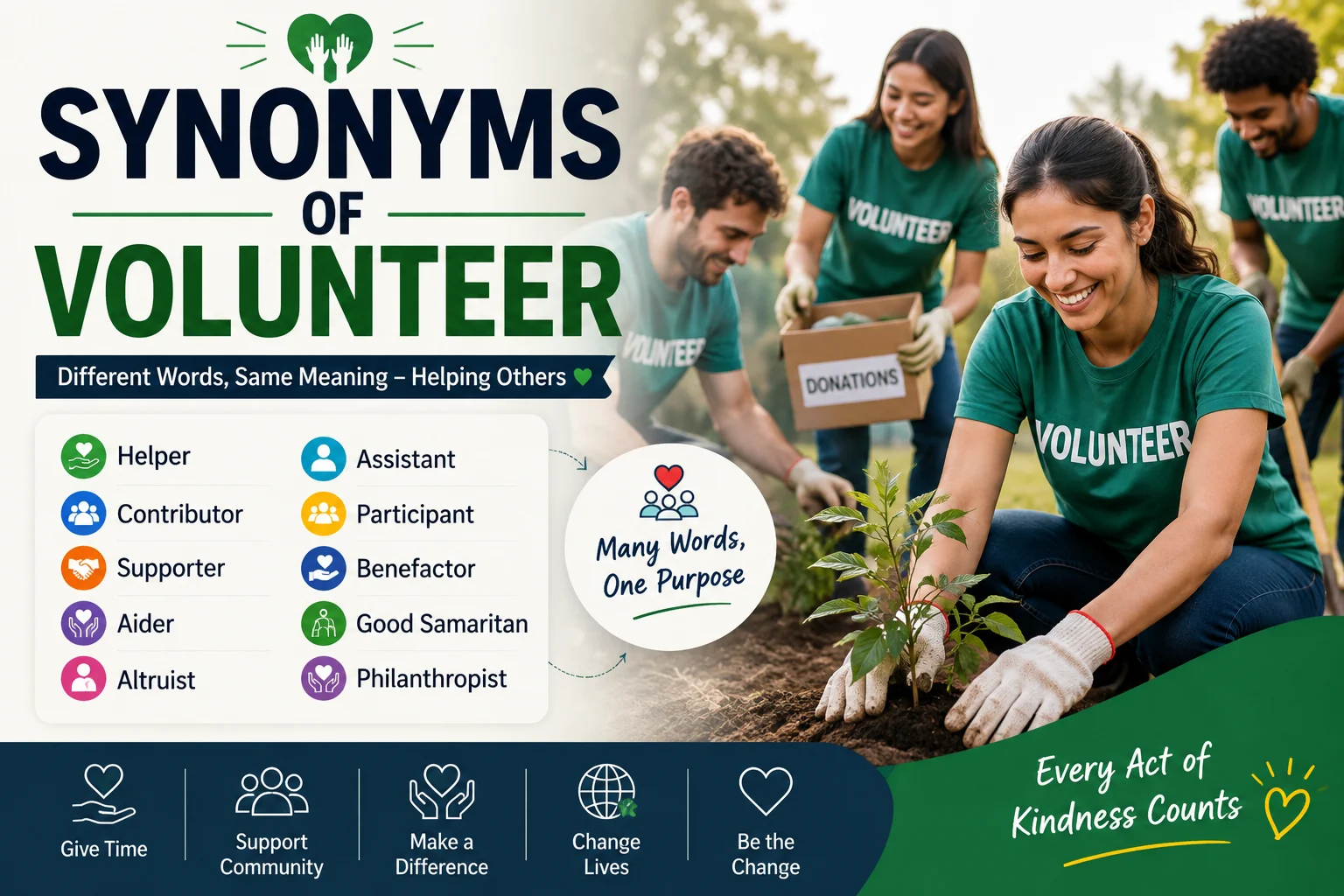
helper, participant, contributor, worker, supporter, aid worker, unpaid worker, volunteer worker, offer, offer to help, step forward, assist, donate one’s time, serve, and contribute.
The correct alternative depends on the sentence.
For example:
She volunteered to organize the event.
Possible alternatives include:
She offered to organize the event.
She agreed to organize the event.
She stepped forward to organize the event.
But these words are not identical. Offered emphasizes willingness, while stepped forward suggests taking initiative.
Likewise:
The charity needs more volunteers.
Possible alternatives include:
The charity needs more helpers.
The charity needs more unpaid workers.
The charity needs more supporters.
Again, context determines the best choice.
Common Mistakes When Using “Demure”
Mistake 1: Treating “demure” as exactly the same as “shy”
A demure person may appear shy, but the word does not always mean nervousness.
Better:
She looked demure in her simple dress.
Not:
She was demure because she was terrified.
The second sentence may be possible in a particular context, but timid, frightened, or shy would communicate fear more directly.
Mistake 2: Using “demure” for every quiet person
Someone can be quiet because they are tired, serious, thoughtful, professional, or simply not talkative.
Demure usually adds the idea of modesty or restrained appearance.
Mistake 3: Using a synonym without considering tone
Words such as meek and timid can sound negative.
Words such as refined, dignified, and unassuming are generally more positive.
Words such as coy can introduce a playful or romantic meaning.
Always choose the word based on the message you want the reader to receive.
Why Synonyms Matter for Students and Writers
Knowing synonyms is not just about making writing sound more sophisticated.
For students, synonyms can help avoid repetition and make essays more precise.
For ESL learners, understanding small differences between related words helps improve natural English usage.
For writers, synonym choice can shape a character, mood, setting, or emotional tone.
Compare these sentences:
She was quiet.
She was shy.
She was reserved.
She was demure.
She was dignified.
All five sentences describe some form of controlled or low-key behavior, but they create different impressions.
That is the real value of vocabulary: the right word does more than define an idea—it creates a specific image.
Frequently Asked Questions
What is the simplest meaning of demure?
Demure means quiet, modest, and somewhat reserved in appearance or behavior.
Is demure a positive word?
Usually, yes, especially when describing a graceful or modest appearance. However, the tone can change depending on context.
Is demure the same as shy?
No. Shy often suggests nervousness or discomfort around people. Demure usually describes quiet, modest, or restrained outward behavior.
What is a strong synonym for demure?
Modest, reserved, and quiet are useful general alternatives. However, each one emphasizes a different part of the meaning.
What is the difference between demure and coy?
Demure usually describes quiet modesty. Coy can suggest deliberately playful or flirtatious shyness.
Can demure describe clothing?
Yes. Demure can describe clothing or a style that is modest, restrained, or not flashy. Cambridge’s examples also show this broader use beyond describing people.
Is demure formal English?
It is not extremely formal, but it is more descriptive and literary than very basic words such as quiet or shy. It is common in writing about appearance, style, personality, and behavior.
Final Takeaway
The best way to learn synonyms is not to memorize a long list and assume every word means exactly the same thing. Instead, pay attention to tone, emotion, formality, and context.
Demure generally describes someone or something that is quiet, modest, restrained, or understated. Words such as modest, reserved, shy, coy, bashful, dignified, refined, unassuming, and soft-spoken overlap with its meaning, but each adds its own shade of meaning.
For students, ESL learners, and writers, this distinction is valuable. A stronger vocabulary is not simply a collection of more words. It is the ability to choose the right word for the exact idea.
And when working with a search phrase such as “synonyms of volunteer,” the same principle applies. Helper, supporter, participant, contributor, and unpaid worker may all relate to volunteer, but the most natural choice depends on whether you are talking about a person, an action, paid versus unpaid work, or willingness to help.
The goal of good vocabulary is therefore simple: use fewer generic words and more precise ones when precision improves the meaning.

I am Jace Thomas, a passionate synonym writer dedicated to making word choices simple and meaningful. I enjoy exploring language, discovering synonyms, and helping readers express ideas clearly and creatively.