Looking for synonyms for swim can help you make your writing more descriptive, natural, and precise. The word swim is simple and common, but English offers many alternatives that describe different ways of moving through water, from gently floating to moving quickly and powerfully.
For students, ESL learners, writers, and content creators, learning these alternatives is useful because the best word depends on the situation. You might paddle across a lake, float on the surface, dive into a pool, or glide smoothly through the water. These words are related to swimming, but they do not always mean exactly the same thing.
This guide explains 30 synonyms and closely related alternatives to swim in simple English. Each word includes an easy definition, an example sentence, and a note explaining when it works best.
What Does “Swim” Mean?
Swim means to move through water by using your arms, legs, body, or swimming equipment.
Example:
She likes to swim in the pool every morning.
The word can describe casual swimming, competitive swimming, or simply moving through water.
Swim can also be used figuratively:
- My head was swimming with ideas.
- The room seemed to swim before his eyes.
The most appropriate synonym depends on whether you are describing physical movement, a particular swimming technique, or figurative language.
30 Synonyms for Swim
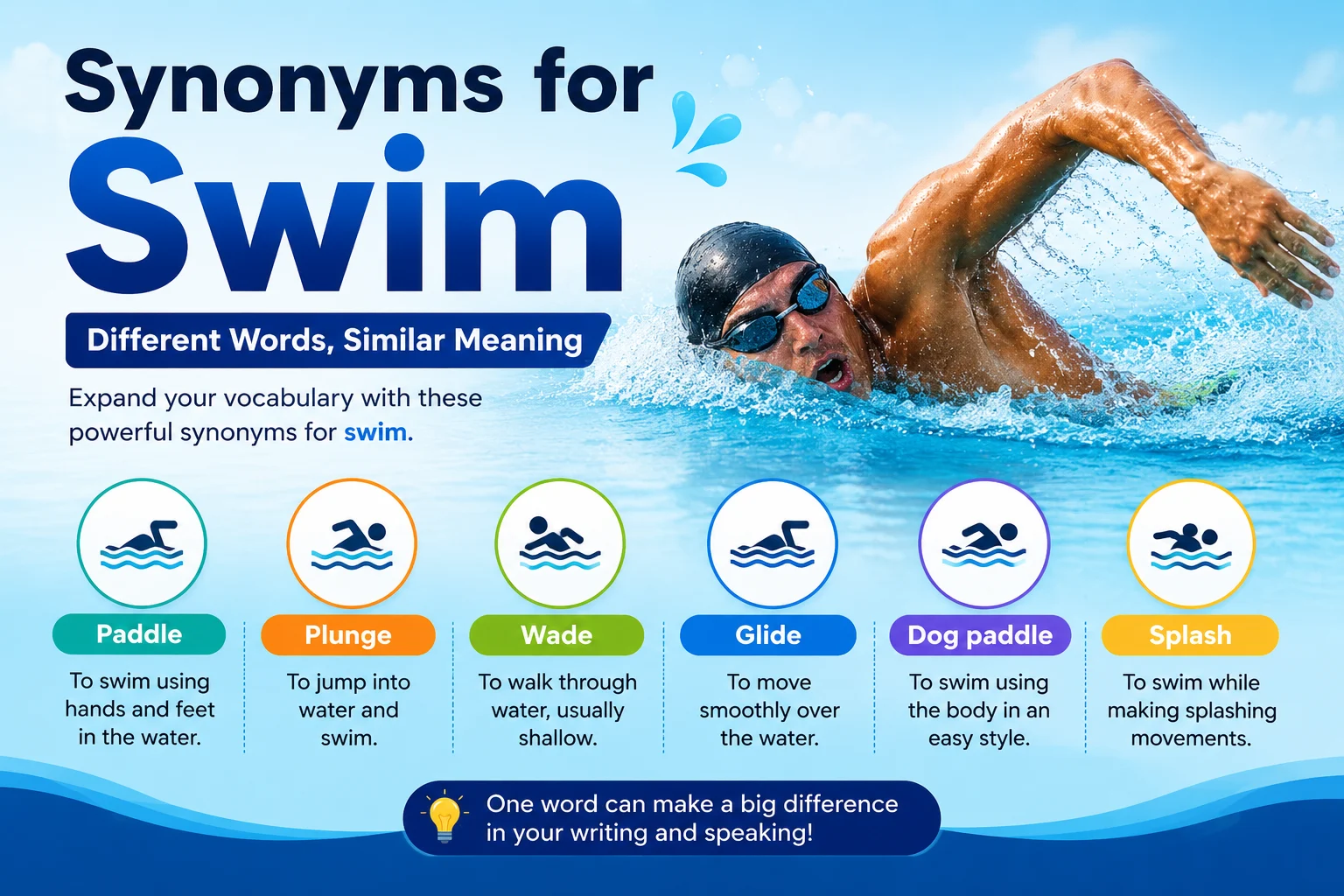
1. Paddle
Meaning: To move through water using your hands, feet, or a paddle.
Example:
We paddled across the shallow part of the lake.
Best usage: Use paddle for slow or gentle movement, especially in a small boat or shallow water.
2. Float
Meaning: To stay on the surface of water without sinking.
Example:
The children floated peacefully in the pool.
Best usage: Use float when someone or something remains on the water rather than actively swimming.
3. Glide
Meaning: To move smoothly and easily through water.
Example:
The swimmer glided effortlessly across the pool.
Best usage: Excellent for elegant, smooth, and graceful swimming.
4. Dive
Meaning: To jump or move quickly into water, usually headfirst.
Example:
He dived into the deep end of the pool.
Best usage: Use dive when entering or moving beneath the surface of water.
5. Plunge
Meaning: To enter water suddenly and forcefully.
Example:
She plunged into the cold lake without hesitation.
Best usage: Use plunge for dramatic or sudden movement into water.
6. Bathe
Meaning: To wash or spend time in water.
Example:
They bathed in the warm river.
Best usage: Bathe can describe being in water, but it is not normally a direct replacement for swim in modern everyday English.
7. Wade
Meaning: To walk through water that is not deep enough to swim in.
Example:
We waded through the shallow stream.
Best usage: Use wade when a person is walking through water.
8. Splash
Meaning: To move through water while causing water to scatter or spray.
Example:
The children splashed around in the shallow pool.
Best usage: Ideal for playful or energetic movement in water.
9. Stroke
Meaning: To move through water using a particular swimming movement.
Example:
She stroked steadily toward the other side of the pool.
Best usage: Useful when describing swimming technique or repeated arm movements.
10. Row
Meaning: To move a boat through water using oars.
Example:
They rowed across the quiet lake.
Best usage: Use row for moving a boat, not for swimming with your body.
11. Cruise
Meaning: To move smoothly and comfortably through water.
Example:
The dolphin cruised through the clear blue water.
Best usage: Good for relaxed, effortless movement, especially in descriptive writing.
12. Drift
Meaning: To move slowly without controlling your direction strongly.
Example:
The swimmer drifted toward the edge of the pool.
Best usage: Use drift when movement is gentle and partly controlled by water or currents.
13. Bob
Meaning: To move gently up and down on the surface of water.
Example:
The swimmer bobbed in the waves.
Best usage: Best when describing repeated upward and downward movement.
14. Tread Water
Meaning: To stay in one place in water by continuously moving your arms and legs.
Example:
He had to tread water while waiting for help.
Best usage: Use this phrase when someone remains in roughly the same position while staying afloat.
15. Breaststroke
Meaning: A swimming style in which the arms and legs move outward and then inward.
Example:
She used the breaststroke to cross the pool.
Best usage: Use when referring specifically to a recognized swimming stroke.
16. Backstroke
Meaning: A swimming style performed while lying on your back.
Example:
He practiced his backstroke for the competition.
Best usage: Best for sports, swimming lessons, and technical descriptions.
17. Freestyle
Meaning: A swimming style commonly performed with alternating arm movements and a flutter kick.
Example:
The athlete finished the freestyle race in record time.
Best usage: Particularly useful in competitive swimming contexts.
18. Dog-Paddle
Meaning: A simple swimming style using short arm and leg movements.
Example:
The puppy dog-paddled across the shallow water.
Best usage: Often used for beginners, children, animals, or simple swimming movements.
19. Paddle Along
Meaning: To move gradually through water using small movements.
Example:
The ducks paddled along the pond.
Best usage: Useful for gentle, slow movement through water.
20. Propel
Meaning: To push or drive yourself or something forward.
Example:
The swimmer used powerful kicks to propel himself forward.
Best usage: More formal and useful when focusing on the force that creates movement.
21. Navigate
Meaning: To find and follow a route through water.
Example:
The experienced swimmer navigated the strong current carefully.
Best usage: Best when direction, route, or difficult water conditions are important.
22. Traverse
Meaning: To travel across or through an area.
Example:
The swimmer traversed the narrow channel.
Best usage: A formal word that works well in descriptive, academic, or literary writing.
23. Aquaplane
Meaning: To move across water while being pulled or supported by a board or similar device.
Example:
They aquaplaned across the lake behind the boat.
Best usage: Use in water-sports contexts rather than ordinary swimming.
24. Dive Under
Meaning: To move beneath the surface of water.
Example:
The children dived under the waves.
Best usage: Useful when the important action is going below the water.
25. Submerge
Meaning: To go completely under water.
Example:
He submerged himself in the cool water.
Best usage: More formal than go underwater and useful when emphasizing complete coverage by water.
26. Immerse
Meaning: To put yourself or something completely into water or another substance.
Example:
She immersed herself in the warm water.
Best usage: Often used in formal, descriptive, or figurative writing.
27. Plow Through
Meaning: To move forcefully through water or another difficult substance.
Example:
The swimmer plowed through the rough waves.
Best usage: Strong descriptive language for determined or powerful movement.
28. Cut Through
Meaning: To move through water quickly and smoothly.
Example:
The swimmer cut through the water with powerful strokes.
Best usage: Excellent for vivid sports writing and energetic descriptions.
29. Glide Along
Meaning: To move smoothly and gently through water.
Example:
The swan glided along the surface of the lake.
Best usage: Best for graceful, peaceful, and visually descriptive writing.
30. Make One’s Way Through the Water
Meaning: To move through water, without specifying exactly how.
Example:
The rescue team made its way through the flooded street.
Best usage: Useful when the exact swimming technique is not important.
Synonyms for Swim: Quick Comparison Guide
Not every alternative to swim can be used in exactly the same sentence. Choosing the right word depends on the movement, speed, and tone you want to express.
| Word | Main Idea | Tone | Best Context |
| Swim | Move through water | Neutral | General use |
| Paddle | Move with small movements | Casual | Lakes, shallow water |
| Float | Stay on the surface | Relaxed | Pools, oceans |
| Glide | Move smoothly | Elegant | Descriptive writing |
| Dive | Enter or move into water | Active | Pools, sports |
| Plunge | Enter suddenly | Dramatic | Stories, descriptions |
| Wade | Walk through water | Neutral | Shallow water |
| Splash | Move playfully | Casual | Children, recreation |
| Drift | Move without strong control | Calm | Rivers, oceans |
| Bob | Move up and down | Descriptive | Waves, water surface |
| Tread water | Stay in one place | Practical | Swimming and rescue |
| Propel | Push forward | Formal | Sports and technical writing |
| Traverse | Travel across | Formal | Academic/literary writing |
| Submerge | Go completely underwater | Formal | Technical/descriptive writing |
| Plow through | Move forcefully | Strong | Rough water, dramatic writing |
How to Choose the Right Synonym for Swim
The easiest way to choose the right synonym is to think about what the swimmer is actually doing.
For General Swimming
Use:
- Swim
- Stroke
- Freestyle
- Backstroke
- Breaststroke
These are useful for everyday conversations, swimming lessons, and sports writing.
Example:
She swims every Saturday.
For Gentle or Relaxed Movement
Use:
- Float
- Glide
- Drift
- Bob
- Glide along
These words create a calm and peaceful image.
Example:
The swan glided across the lake.
For Fast or Powerful Movement
Use:
- Propel
- Cut through
- Plow through
- Cruise
These choices make movement sound more energetic or forceful.
Example:
The athlete cut through the water at incredible speed.
For Entering the Water
Use:
- Dive
- Plunge
- Dive under
- Submerge
These words focus on going into or beneath the water.
Example:
He plunged into the river to save the child.
For Shallow Water
Use:
- Wade
- Paddle
- Splash
These are particularly useful when a person is not fully swimming.
Example:
The children waded through the shallow stream.
For Formal or Literary Writing
Use:
- Traverse
- Navigate
- Propel
- Submerge
- Immerse
These words can make writing sound more formal, technical, or descriptive.
Example:
The swimmer navigated the turbulent waters carefully.
Swim vs. Paddle
These words are related but not identical.
Swim means to move through water using your body.
Paddle usually suggests smaller movements with the hands, feet, or a paddle.
Compare:
- The athlete swam across the pool.
- The children paddled in the shallow water.
If the person is moving efficiently through deeper water, swim is usually the better choice.
Swim vs. Float
Swim involves active movement.
Float means staying on or near the surface without sinking.
Compare:
- I swam across the pool.
- I floated on my back.
Someone can float without swimming.
Swim vs. Wade
The depth of the water is the key difference.
Swim means moving through water when your body is supported by the water.
Wade means walking through relatively shallow water.
Compare:
- We swam across the river.
- We waded across the shallow part of the river.
Swim vs. Dive
A dive usually describes entering the water or moving beneath its surface.
It does not necessarily describe continuous movement through water.
Compare:
- She swam across the pool.
- She dived into the pool.
A person might dive first and then swim.
Why Using the Right Synonym Matters
Using different words for swimming can make your writing much more precise.
Compare these two sentences:
The swimmer moved through the water.
This sentence is correct, but it gives the reader little detail.
Now consider:
The swimmer glided through the calm water.
The second sentence immediately suggests smooth, controlled, graceful movement.
Similarly:
He went into the river.
is less vivid than:
He plunged into the river.
The right synonym does more than avoid repetition. It helps readers understand speed, direction, effort, mood, and style.
Common Related Words for Swimming
If you are expanding your vocabulary around swim, these related words are also useful:
- Swimming — the activity of moving through water
- Swimmer — a person or animal that swims
- Swimming stroke — a particular swimming technique
- Pool — a place designed for swimming
- Current — water moving in a particular direction
- Wave — a moving ridge of water
- Shore — the land beside a body of water
- Deep — having a large distance from the surface to the bottom
- Shallow — having a small distance from the surface to the bottom
- Aquatic — related to water
These related terms can help students and writers build a stronger vocabulary around swimming.
Frequently Asked Questions
What is the closest synonym for swim?
There is no single perfect synonym in every situation. Paddle, glide, and stroke can work in particular contexts, but swim remains the most general and natural word.
What is a synonym for swim slowly?
Depending on the exact meaning, you can use paddle, glide, drift, or float. These words describe different kinds of slow movement.
What is a synonym for swim quickly?
Words such as race, propel, cut through, and cruise can describe fast movement, depending on the context.
What is a synonym for swim underwater?
Dive, submerge, and dive under are useful alternatives when the movement takes place beneath the surface.
What is a formal synonym for swim?
Traverse and navigate can work in formal contexts when the meaning involves traveling across or through water. Propel is useful when emphasizing forward movement.
What is a synonym for swimming in shallow water?
Wade, paddle, and splash are common choices, depending on the action.
Can “float” replace “swim”?
Not always. Float means to remain on the surface of water, while swim means to actively move through water. The two words describe different actions.
Final Takeaway
Learning synonyms for swim is a simple way to make your English more accurate and expressive. While swim is the best general word, alternatives such as paddle, float, glide, dive, wade, drift, stroke, tread water, propel, and navigate can communicate much more specific meanings.
The most important point is to choose a synonym based on the action you want to describe. Use float for staying on the surface, wade for walking through shallow water, dive for entering or going beneath water, glide for smooth movement, and plow through for powerful movement.
For ESL learners and students, understanding these small differences can make vocabulary more natural. For writers and content creators, they can add variety, imagery, and precision without making the language unnecessarily complicated.
In short, don’t simply replace swim with another word. Choose the word that tells your reader exactly how the movement happens.

I am Evelyn Marie, the Administrator of Synoloop. I enjoy helping readers discover useful synonyms, alternative words, and better ways to express their ideas. I focus on keeping Synoloop simple, reliable, informative, and helpful for everyone.