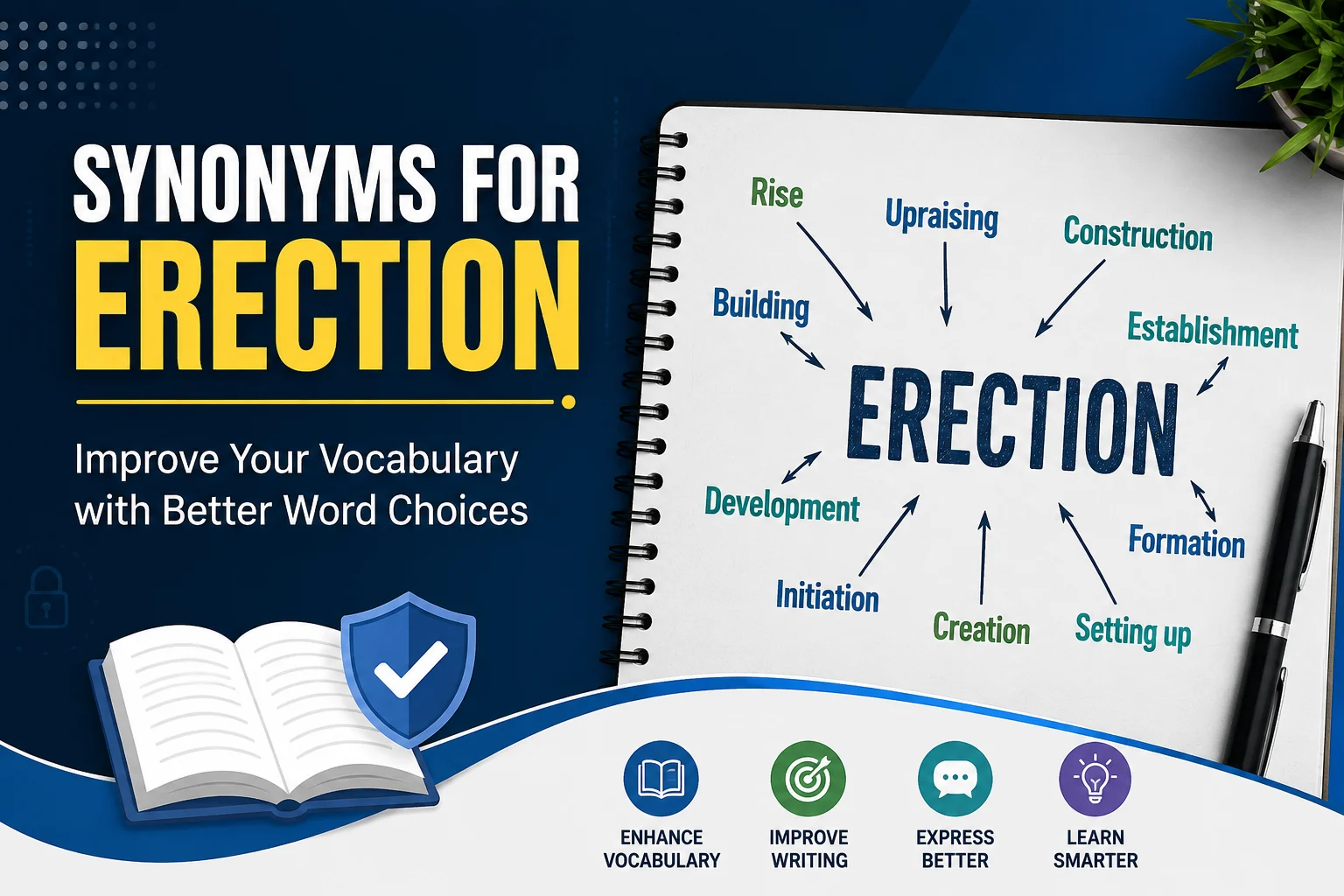
Finding the right word can make your writing clearer, more natural, and more appropriate for the situation. The phrase “synonyms for erection” can refer to different meanings depending on context. In everyday English, “erection” may describe a physical state, while in other contexts it can refer to the act of building or putting something upright. Choosing an alternative therefore depends on what you actually mean.
For students, ESL learners, writers, and content creators, understanding these differences is especially useful. Some alternatives are formal, some are medical, and others are better suited to construction or technical writing. Using the correct word helps you communicate accurately without making your sentence sound awkward or unclear.
This guide also explores the word demure, including 30 useful synonyms, simple definitions, example sentences, and advice about when each word works best. The goal is to give you practical vocabulary you can use confidently in everyday, academic, and professional writing.
What Does “Erection” Mean?
The noun erection has more than one meaning in English.
In a physical or medical context, it commonly refers to a state in which the penis becomes firm because of increased blood flow. In health-related writing, erection is the standard and neutral term.
The word also has a completely different meaning related to building or constructing something. For example, “the erection of a new building” means the process of putting up or constructing that building.
Because the meaning changes according to context, there is no single synonym that works in every sentence.
Synonyms for Erection in a Medical or Physical Context
When “erection” refers to the physical state, alternatives should be chosen carefully. Many are informal or descriptive rather than exact dictionary synonyms.
1. Rigidity
Meaning: A state of being firm or stiff.
Example: The medication may affect penile rigidity.
Best usage: Medical, scientific, or clinical writing.
2. Firmness
Meaning: The quality of being firm rather than soft.
Example: The treatment can influence firmness.
Best usage: General health or educational writing.
3. Hardness
Meaning: The condition of being hard or firm.
Example: Changes in hardness can occur naturally.
Best usage: Informal or descriptive contexts.
4. Tumescence
Meaning: The process of becoming swollen or enlarged, especially because of increased blood flow.
Example: Penile tumescence is a normal physiological response.
Best usage: Medical and scientific writing.
5. Penile rigidity
Meaning: The degree of firmness of an erect penis.
Example: The study measured penile rigidity during treatment.
Best usage: Clinical and research contexts.
6. Engorgement
Meaning: A condition in which an area becomes enlarged because it fills with blood or another fluid.
Example: Increased blood flow can cause vascular engorgement.
Best usage: Medical or biological explanations.
7. Sexual arousal response
Meaning: A physical response associated with sexual excitement.
Example: An erection can be part of the body’s sexual arousal response.
Best usage: Educational and health-related writing.
8. Penile engorgement
Meaning: Increased fullness or firmness of the penis caused by increased blood flow.
Example: Penile engorgement is associated with changes in blood circulation.
Best usage: Medical or educational contexts.
9. Physical arousal
Meaning: A bodily response connected with sexual stimulation or excitement.
Example: Physical arousal can involve several changes in the body.
Best usage: General educational writing.
10. Erectile response
Meaning: The body’s physiological response that produces an erection.
Example: Certain medications may influence the erectile response.
Best usage: Medical, health, and scientific writing.
Synonyms for Erection in a Construction Context
“Erection” can also mean the act of constructing, assembling, or putting something upright. In this context, the following words may work as alternatives.
11. Construction
Meaning: The process of building something.
Example: Construction of the new bridge began in June.
Best usage: Buildings, infrastructure, and general construction.
12. Building
Meaning: The process of creating or putting up a structure.
Example: The building of the new facility took two years.
Best usage: General writing.
13. Assembly
Meaning: The process of putting separate parts together.
Example: The assembly of the steel framework was completed quickly.
Best usage: Machines, structures, furniture, and manufactured components.
14. Installation
Meaning: The process of putting equipment or a system into its intended position.
Example: Installation of the new equipment begins tomorrow.
Best usage: Equipment, technology, and structural components.
15. Raising
Meaning: The act of lifting something into an upright position.
Example: The raising of the tower required several cranes.
Best usage: Poles, towers, structures, and large objects.
16. Building-up
Meaning: The process of gradually creating or developing something.
Example: The building-up of the structure continued throughout the summer.
Best usage: General or descriptive writing.
17. Establishment
Meaning: The act of setting something up or creating it.
Example: The establishment of the new facility created several jobs.
Best usage: Organizations, institutions, and broader projects.
18. Formation
Meaning: The process of creating or developing something.
Example: The formation of the structure required careful planning.
Best usage: General, academic, and technical writing.
19. Development
Meaning: The process of creating, improving, or expanding something.
Example: Development of the new complex is expected to continue next year.
Best usage: Projects, buildings, communities, and systems.
20. Assembly work
Meaning: Work involving the joining of separate parts into a complete structure.
Example: The assembly work was completed according to the project schedule.
Best usage: Industrial and technical contexts.
What Does “Demure” Mean?
Demure is an adjective used to describe someone who behaves or appears quiet, modest, reserved, and somewhat shy.
It often describes a person’s manner, facial expression, clothing, or behavior. The word can suggest a gentle and controlled appearance rather than an outgoing or attention-seeking personality.
For example:
She gave a demure smile when the compliment was offered.
The tone of demure is usually polite and somewhat elegant. Depending on the context, it can sound complimentary, old-fashioned, literary, or playful.
30 Synonyms of Demure
Below are 30 useful alternatives to demure, with simple meanings and examples.
1. Modest
Meaning: Not showing off or trying to attract too much attention.
Example: She wore a modest dress to the formal event.
Best usage: Clothing, behavior, personality, and general descriptions.
2. Reserved
Meaning: Quiet and not openly expressing feelings.
Example: He was reserved when meeting new people.
Best usage: Personality and social behavior.
3. Shy
Meaning: Nervous or uncomfortable around other people.
Example: The shy student rarely spoke during class discussions.
Best usage: Everyday English and personality descriptions.
4. Bashful
Meaning: Easily embarrassed or shy.
Example: She became bashful when everyone praised her work.
Best usage: Friendly, informal, or literary writing.
5. Retiring
Meaning: Avoiding attention and preferring a quiet life.
Example: Her retiring nature made her uncomfortable in large crowds.
Best usage: Formal or literary descriptions.
6. Unassuming
Meaning: Not trying to appear important or impressive.
Example: Despite his success, he remained unassuming.
Best usage: Professional and personality descriptions.
7. Meek
Meaning: Gentle and quiet, sometimes without showing much confidence.
Example: The meek child spoke softly during the meeting.
Best usage: Personality descriptions; may sometimes imply weakness.
8. Mild
Meaning: Gentle and not strong, aggressive, or extreme.
Example: She had a mild and pleasant manner.
Best usage: Personality and behavior.
9. Gentle
Meaning: Kind, calm, and not harsh.
Example: Her gentle manner made everyone feel comfortable.
Best usage: Personality, behavior, and tone.
10. Quiet
Meaning: Making little noise or not talking much.
Example: She was quiet and thoughtful during the discussion.
Best usage: Everyday English.
11. Unobtrusive
Meaning: Not attracting attention or interfering with others.
Example: He chose an unobtrusive seat at the back of the room.
Best usage: Formal writing and descriptions.
12. Coy
Meaning: Pretending to be shy or reluctant, often in a playful way.
Example: She gave a coy smile before answering the question.
Best usage: Playful, literary, or social contexts.
13. Modest-looking
Meaning: Having a simple and restrained appearance.
Example: The modest-looking outfit was suitable for the occasion.
Best usage: Clothing and appearance.
14. Soft-spoken
Meaning: Speaking in a quiet and gentle voice.
Example: The soft-spoken teacher explained the lesson patiently.
Best usage: Voice and personality.
15. Subdued
Meaning: Quiet, restrained, or not very noticeable.
Example: She maintained a subdued expression throughout the ceremony.
Best usage: Emotions, colors, atmosphere, and behavior.
16. Restrained
Meaning: Controlled and not overly emotional or expressive.
Example: His restrained response surprised everyone.
Best usage: Formal writing and emotional behavior.
17. Self-effacing
Meaning: Avoiding praise or attention for yourself.
Example: Her self-effacing personality made her easy to work with.
Best usage: Professional and personality descriptions.
18. Humble
Meaning: Not believing that you are better or more important than others.
Example: The humble athlete thanked her entire team for the victory.
Best usage: Character, achievement, and personality.
19. Demurely
Meaning: In a quiet, modest, or reserved manner.
Example: She smiled demurely at the audience.
Best usage: As an adverb when describing an action.
20. Timid
Meaning: Lacking confidence because of fear or nervousness.
Example: The timid puppy stayed close to its owner.
Best usage: People, animals, and behavior.
21. Unassertive
Meaning: Not strongly expressing opinions or demanding attention.
Example: His unassertive manner sometimes made it difficult for him to speak up.
Best usage: Workplace and personality discussions.
22. Docile
Meaning: Calm and easy to control or manage.
Example: The docile horse followed the trainer’s instructions.
Best usage: Animals and behavior; not always suitable for describing people.
23. Composed
Meaning: Calm and in control of your emotions.
Example: She remained composed during the difficult interview.
Best usage: Professional, formal, and emotional situations.
24. Dignified
Meaning: Calm, serious, and worthy of respect.
Example: She maintained a dignified appearance throughout the ceremony.
Best usage: Formal events, behavior, and appearance.
25. Proper
Meaning: Behaving in a socially acceptable or appropriate way.
Example: The children were expected to maintain proper behavior at the event.
Best usage: Social behavior and formal situations.
26. Ladylike
Meaning: Traditionally associated with polite, graceful, and socially conventional feminine behavior.
Example: Her ladylike manners impressed the guests.
Best usage: Traditional or historical descriptions.
27. Refined
Meaning: Polished, elegant, and socially graceful.
Example: She had a refined sense of style.
Best usage: Style, manners, taste, and appearance.
28. Graceful
Meaning: Elegant and attractive in movement or behavior.
Example: Her graceful manner made a strong impression.
Best usage: Movement, appearance, and social behavior.
29. Demure-looking
Meaning: Appearing quiet, modest, or reserved.
Example: Her demure-looking style suited the formal occasion.
Best usage: Appearance and descriptive writing.
30. Unpretentious
Meaning: Simple and not designed to impress others.
Example: The restaurant had an unpretentious atmosphere.
Best usage: People, places, style, and general descriptions.
Quick Comparison of Demure Synonyms
| Synonym | Main Idea | Tone | Best Context |
| Modest | Not attention-seeking | Neutral | Clothing, behavior |
| Reserved | Emotionally quiet | Neutral/Formal | Personality |
| Shy | Nervous around others | Casual | Everyday speech |
| Bashful | Easily embarrassed | Warm | Informal |
| Coy | Playfully shy | Playful | Social/literary |
| Unassuming | Not self-important | Positive | Personality |
| Meek | Gentle and submissive | Neutral/Negative | Character |
| Soft-spoken | Quiet voice | Positive | Personality |
| Restrained | Emotionally controlled | Formal | Behavior |
| Humble | Not boastful | Positive | Character |
| Timid | Lacking confidence | Often negative | Personality |
| Composed | Calm and controlled | Positive/Formal | Difficult situations |
| Dignified | Calm and respectable | Formal | Events/behavior |
| Refined | Elegant and polished | Positive | Style/manners |
| Graceful | Elegant and smooth | Positive | Movement/behavior |
Erection vs. Similar Words: Choosing the Right Term
The best synonym depends on the intended meaning.
If you are writing about health or medicine, terms such as erectile response, penile rigidity, tumescence, and erectile function are more appropriate than casual expressions.
If you are discussing construction, words such as construction, assembly, installation, raising, and building may be better choices.
For example:
- Medical: “The study examined changes in penile rigidity.”
- General health: “The treatment may affect erectile function.”
- Construction: “The assembly of the framework began early.”
- Construction: “The raising of the tower required specialized equipment.”
This distinction is important because replacing “erection” with a synonym without considering context can change the meaning of the sentence.
How to Choose the Right Synonym
For Medical or Scientific Writing
Choose precise terms such as:
- Penile rigidity
- Tumescence
- Erectile response
- Penile engorgement
- Erectile function
These terms are useful when accuracy matters.
For General Health Writing
Use clearer expressions such as:
- Firmness
- Physical arousal
- Sexual arousal response
- Erectile response
These are generally easier for non-specialist readers to understand.
For Construction Writing
Choose words based on the exact action:
- Construction
- Assembly
- Installation
- Raising
- Building
- Development
For example, assembly is especially useful when separate parts are joined together, while construction is broader.
For Describing a Quiet Personality
When looking for an alternative to demure, consider:
- Reserved
- Shy
- Modest
- Bashful
- Unassuming
- Soft-spoken
- Composed
The best option depends on the exact quality you want to emphasize.
For Elegant or Formal Descriptions
Words such as these can work well:
- Dignified
- Refined
- Graceful
- Restrained
- Modest
These alternatives often sound more polished than simple everyday words.
Common Mistakes When Using Synonyms
One common mistake is assuming that two words with similar dictionary meanings are interchangeable in every situation. They are not.
For example, shy usually suggests nervousness or discomfort, while reserved suggests someone who simply does not express much. Similarly, meek can suggest submissiveness, while composed suggests confidence and emotional control.
The same principle applies to “erection.” A medical synonym may not work in a construction sentence, and a construction-related synonym would obviously be inappropriate in a medical context.
Another mistake is choosing an unnecessarily complicated word. If firmness communicates the idea clearly, there may be no reason to use a highly technical term such as tumescence unless your audience needs scientific precision.
Why Context Matters in Vocabulary
Good vocabulary is not simply about knowing many words. It is about knowing which word fits a particular situation.
A formal medical article needs terminology that is precise and objective. A blog written for general readers may benefit from simpler explanations. Similarly, creative writing may use words such as demure, coy, graceful, or bashful to create a particular mood.
Understanding tone is therefore just as important as understanding dictionary definitions.
Frequently Asked Questions About Synonyms for Erection
What is the closest medical synonym for erection?
Depending on the sentence, penile rigidity, tumescence, or erectile response may be appropriate. These terms are more specialized and should be selected according to the exact medical meaning.
Is “rigidity” the same as “erection”?
Not exactly. Rigidity describes firmness, while an erection refers to the physiological state itself. In medical writing, the two concepts can be closely related but are not always interchangeable.
What is a simple word for erection?
The best simple alternative depends on the meaning. In a medical context, firmness may be easier for general readers. In a construction context, building or construction may be appropriate.
What does demure mean?
Demure means quiet, modest, reserved, and sometimes shy in appearance or behavior. It is often used to describe a person’s manner, expression, or style.
What is the best synonym for demure?
There is no single perfect synonym. Modest, reserved, shy, bashful, unassuming, and composed can all work, but each emphasizes a slightly different quality.
Is demure a positive word?
Usually, yes. Demure often has a positive or elegant tone, although its meaning can change slightly depending on the context. In some modern writing, it may also sound playful or old-fashioned.
Final Thoughts
Understanding synonyms for erection requires attention to context because the word has more than one important meaning. In medical writing, terms such as penile rigidity, tumescence, and erectile response can provide greater precision. In construction writing, alternatives such as construction, assembly, installation, and raising may be more suitable.
The word demure offers another useful vocabulary lesson. Its closest alternatives are not identical: shy emphasizes nervousness, reserved emphasizes quiet behavior, modest emphasizes restraint, unassuming emphasizes a lack of self-importance, and refined emphasizes elegance.
The most effective synonym is therefore not always the most complicated one. Choose the word that matches your meaning, audience, tone, and context. This approach makes your writing clearer, more natural, and more precise.

I am Axel James, a passionate writer who loves exploring synonyms and alternative words. I enjoy helping readers improve their vocabulary and express ideas clearly.