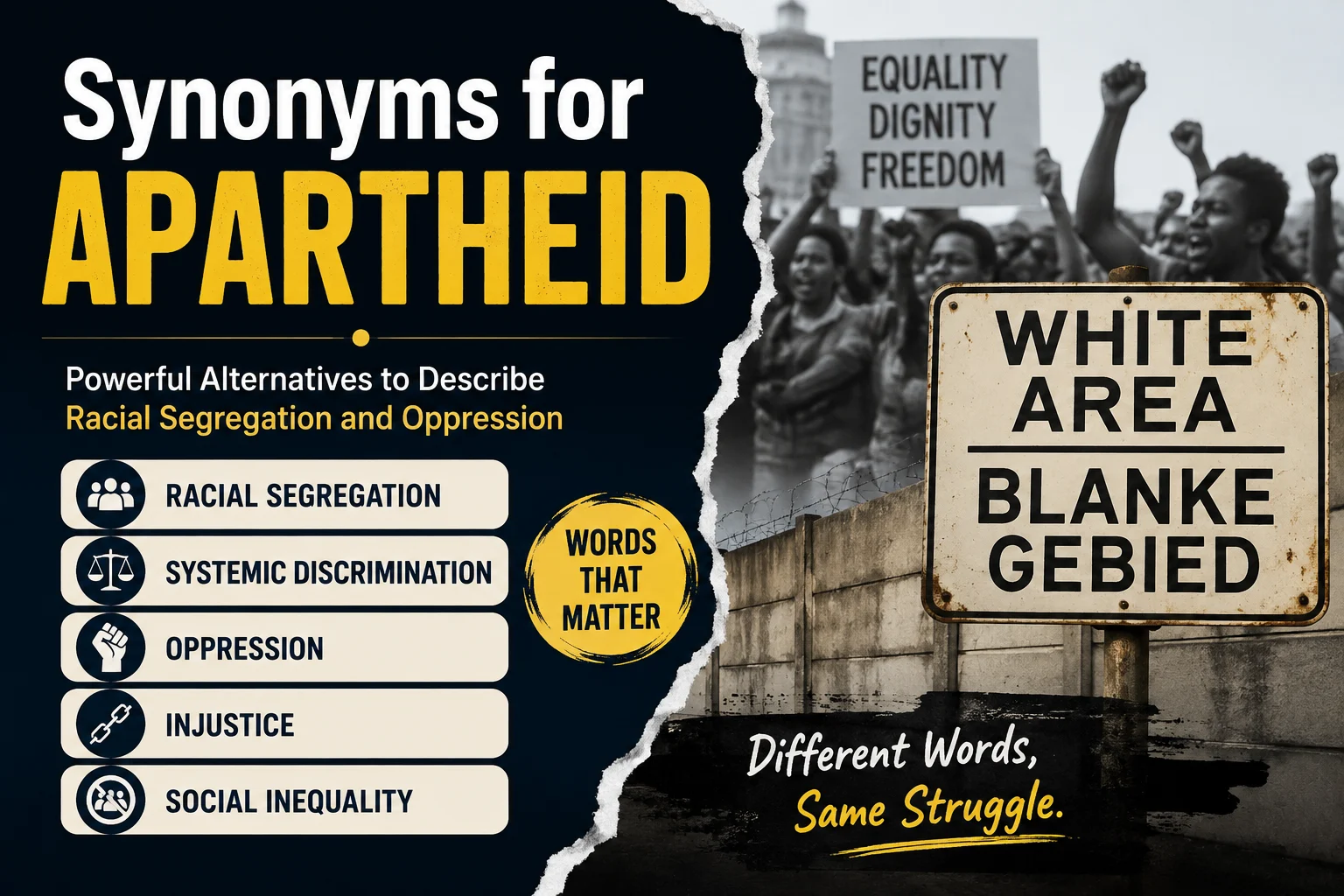
Apartheid is a powerful historical and political term. It refers to a system of institutionalized racial segregation and discrimination, most famously associated with South Africa from 1948 until the early 1990s. Because the word carries a very specific historical meaning, finding an exact synonym is not always simple.
However, writers, students, journalists, and ESL learners may sometimes need related words or phrases to explain the idea of apartheid without repeating the same term. Depending on the context, expressions such as racial segregation, institutional racism, racial discrimination, separation, and segregationist policies can communicate parts of the concept.
This guide explains useful synonyms for apartheid, their meanings, examples, and appropriate contexts. It also explains why some alternatives are close in meaning but should not be treated as perfect replacements.
What Does Apartheid Mean?
Apartheid was a legally enforced system of racial segregation and discrimination in South Africa. Under apartheid, the government classified people by race and imposed different rights, restrictions, and living conditions on different racial groups.
The term comes from Afrikaans and broadly means “apartness” or “separateness.” In modern English, however, apartheid usually refers specifically to the South African system or, in broader political discussions, to a system of institutionalized racial separation and unequal treatment.
Because apartheid describes more than ordinary separation, choosing a synonym requires attention to context. For example, racial segregation may describe one major feature of apartheid, while institutional racism emphasizes discrimination built into laws and institutions.
Synonyms for Apartheid
There is no single word that perfectly replaces apartheid in every situation. The following terms are useful alternatives or closely related expressions.
1. Racial Segregation
Meaning: The enforced separation of people according to race.
Example: The government introduced laws enforcing racial segregation in public spaces.
Best usage: Use this when emphasizing the physical or social separation of racial groups.
2. Institutionalized Racism
Meaning: Racism that is built into laws, policies, organizations, or social institutions.
Example: Critics argued that the country’s policies had created institutionalized racism.
Best usage: Useful when discussing discrimination embedded within institutions.
3. Racial Discrimination
Meaning: Treating people unfairly because of their race or racial background.
Example: The legislation was condemned as a form of racial discrimination.
Best usage: A broad and accessible phrase suitable for academic and general writing.
4. Racial Separation
Meaning: Keeping different racial groups apart.
Example: The policy promoted racial separation in schools and residential areas.
Best usage: Helpful when explaining the basic concept in simple English.
5. Segregation
Meaning: The forced or deliberate separation of groups of people.
Example: Segregation prevented different communities from using the same public facilities.
Best usage: A concise alternative when the racial context is already clear.
6. Segregationist System
Meaning: A system organized around the separation of racial or social groups.
Example: The country eventually dismantled its segregationist system.
Best usage: Appropriate for historical and political discussions.
7. Segregationist Policies
Meaning: Rules or policies designed to separate different groups.
Example: Segregationist policies restricted where people could live and work.
Best usage: Best when discussing specific government rules rather than an entire political system.
8. Institutional Racism
Meaning: Discrimination or unequal treatment that operates through established institutions.
Example: The report examined how institutional racism affected access to education.
Best usage: Useful in modern discussions of systemic inequality.
9. Systemic Racism
Meaning: Racism that operates throughout a society or across multiple institutions.
Example: Researchers studied the effects of systemic racism on different communities.
Best usage: Best for broader social and institutional analysis.
10. Racial Oppression
Meaning: The unfair and harmful control or mistreatment of one racial group by another.
Example: The movement sought to end decades of racial oppression.
Best usage: Strong wording for discussions of injustice and unequal power.
11. Racial Subjugation
Meaning: The control and domination of one racial group by another.
Example: The struggle was aimed at ending racial subjugation.
Best usage: Appropriate for historical, political, and academic writing.
12. Discriminatory Rule
Meaning: Government or institutional control based on unfair discrimination.
Example: The population resisted discriminatory rule for many years.
Best usage: Useful when focusing on government authority and unequal treatment.
13. Racial Domination
Meaning: A situation in which one racial group holds dominant power over another.
Example: The movement challenged decades of racial domination.
Best usage: Strong academic or political language emphasizing power.
14. Institutionalized Segregation
Meaning: Separation between groups that is formally established through institutions or laws.
Example: Institutionalized segregation affected housing, education, and employment.
Best usage: Useful when emphasizing that segregation was officially organized.
15. Legal Segregation
Meaning: Separation enforced through laws or legal rules.
Example: Legal segregation denied certain communities equal access to public services.
Best usage: Best when discussing discrimination formally established by legislation.
16. Racially Divided System
Meaning: A social or political system in which people are separated according to race.
Example: The country struggled to move beyond its racially divided system.
Best usage: A neutral explanatory phrase for students and general readers.
17. System of Racial Control
Meaning: A system designed to control people’s rights, movement, opportunities, or status according to race.
Example: Activists opposed the system of racial control imposed by the government.
Best usage: Useful when discussing political power and restrictions.
18. Racial Hierarchy
Meaning: A social structure that ranks racial groups unequally.
Example: The laws reinforced a racial hierarchy that favored one group over others.
Best usage: Best when emphasizing unequal social status rather than physical separation alone.
19. Segregation Regime
Meaning: A government or political system that enforces segregation.
Example: Opposition to the segregation regime grew over several decades.
Best usage: Appropriate for historical and political writing.
20. Racially Discriminatory Regime
Meaning: A system of government characterized by racial discrimination.
Example: International pressure increased against the racially discriminatory regime.
Best usage: Useful in formal political or historical writing.
21. Racial Oppression System
Meaning: An organized system that maintains unequal treatment and control based on race.
Example: The reform movement challenged the existing racial oppression system.
Best usage: Best for explanatory or academic contexts.
22. Forced Racial Separation
Meaning: The compulsory separation of people based on race.
Example: The law imposed forced racial separation in several areas of public life.
Best usage: Particularly useful for explaining apartheid to ESL learners.
Quick Comparison of Synonyms for Apartheid
| Term | Main Idea | Tone | Best Context |
| Racial segregation | Separation by race | Neutral | General writing |
| Institutionalized racism | Racism within institutions | Academic | Social analysis |
| Racial discrimination | Unfair racial treatment | Neutral | General/academic |
| Racial oppression | Harmful racial control | Strong | Human rights |
| Racial subjugation | Domination of one group | Strong | Historical writing |
| Systemic racism | Racism across society | Academic | Modern social issues |
| Legal segregation | Separation enforced by law | Formal | Historical/legal |
| Racial hierarchy | Unequal racial ranking | Academic | Sociology |
| Segregation regime | Government-enforced segregation | Formal | Politics/history |
| Racial domination | Unequal control and power | Strong | Political writing |
| Racial separation | Groups kept apart | Simple | ESL/general readers |
| Institutionalized segregation | Segregation embedded in institutions | Formal | Academic/history |
Apartheid vs. Racial Segregation: Are They the Same?
Not exactly.
Racial segregation is a broader concept. It can describe any system or practice in which people are separated according to race.
Apartheid, on the other hand, has a much more specific historical meaning. It most directly refers to the South African system of legally enforced racial discrimination and segregation.
For example:
Apartheid was a form of institutionalized racial segregation.
This sentence is accurate because it identifies segregation as a major feature of apartheid without suggesting that every form of racial segregation is apartheid.
Apartheid vs. Institutional Racism
These terms overlap, but they are not interchangeable.
Institutional racism describes discriminatory practices, policies, or structures within institutions. It can exist in many societies and does not necessarily involve the comprehensive legal racial separation associated with apartheid.
Use apartheid when the specific historical or political system is relevant.
Use institutional racism when you are discussing discriminatory structures within institutions more generally.
Apartheid vs. Systemic Racism
Systemic racism is another broader term. It refers to racial inequality that can operate across multiple parts of society, including education, employment, housing, healthcare, law enforcement, and government.
Apartheid can be discussed as an extreme example of institutionalized and systemic racial discrimination, but the two terms should not automatically be treated as exact synonyms.
The Meaning of “Demure”
The word demure is unrelated to apartheid, but it is useful vocabulary for students and ESL learners.
Demure means quiet, modest, reserved, and not wanting to attract too much attention.
It is often used to describe someone’s appearance, behavior, or manner.
Example:
“She gave a demure smile when the teacher praised her work.”
The tone of demure is usually gentle or positive, although the exact meaning depends on context. It can describe someone who behaves in a calm, modest, or somewhat shy way.
30 Synonyms of Demure
| Word | Simple Meaning | Example Sentence | Best Usage |
| Modest | Not showing off | She wore a modest dress to the ceremony. | Appearance/behavior |
| Reserved | Quiet and not very expressive | He was reserved around strangers. | Personality |
| Shy | Nervous around other people | The shy student avoided speaking first. | Personality |
| Bashful | Easily embarrassed or shy | She became bashful when everyone applauded. | Friendly/casual |
| Unassuming | Not trying to appear important | He was successful but remained unassuming. | Personality |
| Quiet | Not speaking much | She was quiet during the meeting. | General behavior |
| Retiring | Avoiding attention | He had a retiring personality. | Formal writing |
| Coy | Shy in a playful or indirect way | She gave him a coy smile. | Social/romantic |
| Mild | Gentle and not aggressive | She has a mild and pleasant manner. | Personality |
| Gentle | Kind and calm | He spoke in a gentle voice. | Behavior |
| Soft-spoken | Speaking quietly and politely | The professor was soft-spoken. | Communication |
| Subdued | Quiet and restrained | She wore a subdued expression. | Mood/appearance |
| Unobtrusive | Not attracting attention | The decoration was simple and unobtrusive. | Style/design |
| Self-effacing | Avoiding praise or attention | He was self-effacing despite his achievements. | Personality |
| Humble | Not thinking you are better than others | She remained humble after winning the award. | Character |
| Discreet | Careful not to attract attention | He was discreet about his personal affairs. | Conduct |
| Dignified | Calm and worthy of respect | She remained dignified under pressure. | Formal behavior |
| Proper | Behaving according to accepted standards | Her behavior was proper and respectful. | Formal/social |
| Well-mannered | Polite and respectful | The children were well-mannered guests. | Social behavior |
| Demure-looking | Appearing modest or reserved | Her demure-looking style suited the occasion. | Appearance |
| Unpretentious | Simple and without showing off | The restaurant had an unpretentious atmosphere. | Style/personality |
| Timid | Lacking confidence | The timid child stood quietly beside her mother. | Personality |
| Meek | Very gentle and not forceful | He had a meek and peaceful manner. | Character |
| Docile | Easy to manage or control | The animal was surprisingly docile. | Animals/behavior |
| Composed | Calm and controlled | She remained composed during the interview. | Formal situations |
| Serene | Peaceful and calm | Her serene manner made everyone comfortable. | Mood/personality |
| Polite | Showing good manners | He was polite to everyone he met. | General |
| Respectful | Showing consideration for others | The students were respectful during the discussion. | Social behavior |
| Decorous | Proper and socially appropriate | The guests maintained a decorous atmosphere. | Formal writing |
| Unassertive | Not forceful about expressing opinions | Her unassertive style made her easy to overlook. | Personality/workplace |
How to Choose the Right Synonym for Apartheid
Choosing the best alternative depends on what you want to emphasize.
For Simple Explanations
Choose:
- Racial segregation
- Racial separation
- Segregation
- Forced racial separation
These are easy for ESL learners and general readers to understand.
For Academic Writing
Choose:
- Institutionalized racism
- Systemic racism
- Institutionalized segregation
- Racial hierarchy
- Racial subjugation
These terms work well in essays, research papers, and social science discussions.
For Historical Writing
Choose:
- Segregationist system
- Legal segregation
- Segregation regime
- Racially discriminatory regime
- System of racial control
These phrases help describe government structures and historical policies.
For Human Rights Discussions
Choose:
- Racial oppression
- Racial domination
- Racial subjugation
- Institutional racism
- Racial discrimination
These expressions emphasize injustice, unequal treatment, and power.
How to Use “Synonyms for Apartheid” Naturally in Writing
If you are writing an essay, article, or educational resource, avoid replacing apartheid with a different term every time simply to avoid repetition.
Accuracy is more important than repetition.
For example:
Apartheid was a system of racial segregation in South Africa.
Then you might write:
This institutionalized racism affected housing, education, employment, and political participation.
This approach creates natural variation while keeping the meaning accurate.
Example for an Academic Essay
Apartheid was an extensive system of racial segregation and discrimination. Its laws created a racial hierarchy and restricted the rights and opportunities of non-white South Africans.
Example for a General Article
The apartheid system enforced racial separation through law. These segregationist policies affected almost every area of daily life.
Example for ESL Learners
Apartheid was a system in which people were separated and treated differently because of their race.
Common Mistakes When Using Apartheid Synonyms
Treating Every Synonym as an Exact Replacement
Words such as segregation, racism, and discrimination describe important parts of apartheid, but they do not always carry the same historical meaning.
Using “Apartheid” for Ordinary Separation
The word should not normally be used for simple separation that has nothing to do with racial discrimination or institutionalized inequality.
Ignoring Historical Context
When discussing South Africa, apartheid is usually the most precise term because it identifies the specific historical system.
Overusing Strong Terms
Words such as racial oppression and racial subjugation have strong emotional and political implications. Use them when the context supports that meaning.
Frequently Asked Questions
What is the closest synonym for apartheid?
Racial segregation is one of the closest general alternatives because apartheid was fundamentally based on legally enforced racial segregation. However, it is broader than apartheid and should not always be treated as an exact synonym.
What is another word for apartheid?
Depending on context, alternatives include racial segregation, institutionalized racism, racial discrimination, racial oppression, racial separation, segregationist system, and racial subjugation.
Is segregation the same as apartheid?
No. Segregation is a broader concept involving the separation of groups. Apartheid specifically refers to the South African system of institutionalized racial discrimination and segregation, although the word can sometimes be used more broadly in political discourse.
What is a simple synonym for apartheid?
For beginners, racial segregation or racial separation is easier to understand than many technical alternatives.
What is the opposite of apartheid?
Depending on context, possible contrasting concepts include racial equality, integration, inclusion, equal rights, and non-discrimination.
Why are there different synonyms for apartheid?
Different alternatives highlight different aspects of the concept. Racial segregation emphasizes separation, institutional racism emphasizes discriminatory institutions, and racial oppression emphasizes unequal power and harm.
Final Thoughts
The best synonyms for apartheid depend on the exact idea you want to communicate. Racial segregation is a clear general alternative, while institutionalized racism, systemic racism, and racial oppression highlight different dimensions of the broader concept.
For historical writing about South Africa, however, apartheid is usually the most precise word. When you need variety, choose a related expression based on whether you are emphasizing segregation, discrimination, institutional power, racial hierarchy, or oppression.
For students, ESL learners, writers, and content creators, understanding these distinctions is more useful than simply memorizing a list of synonyms. The right word is the one that communicates the intended meaning accurately, naturally, and clearly.

I am Evelyn Marie, the Administrator of Synoloop. I enjoy helping readers discover useful synonyms, alternative words, and better ways to express their ideas. I focus on keeping Synoloop simple, reliable, informative, and helpful for everyone.