Lore is a fascinating word used for traditional knowledge, beliefs, stories, customs, and information passed down through generations. You may see it in discussions about folklore, mythology, history, legends, culture, or even specialized knowledge within a particular community or profession. Understanding the synonyms of lore can help you choose a more precise word for the context you are writing about.
Whether you are a student, ESL learner, writer, researcher, or content creator, learning related words can make your writing more expressive. Some alternatives emphasize stories and legends, while others focus on knowledge, tradition, cultural beliefs, or accumulated wisdom.
What Does “Lore” Mean?
In simple English, lore means traditional knowledge, stories, beliefs, or information that people have learned and passed down over time.
For example:
“The village is rich in ancient lore about the forest.”
Here, lore refers to the old stories, beliefs, and knowledge associated with the forest.
Lore can be based on real experiences, cultural traditions, legends, myths, or specialized knowledge. It does not always mean that something is historically proven to be true.
Tone and Usage of “Lore”
The word lore usually has a traditional, literary, historical, or cultural tone. It often makes writing sound thoughtful or descriptive.
You might use lore when discussing:
- Ancient traditions
- Cultural beliefs
- Folklore
- Legends and myths
- Historical stories
- Local customs
- Traditional knowledge
- Specialized knowledge
- Stories associated with a particular place or group
For example:
- “The region has a rich body of lore.”
- “Local lore tells of a hidden treasure.”
- “The book explores the lore surrounding ancient heroes.”
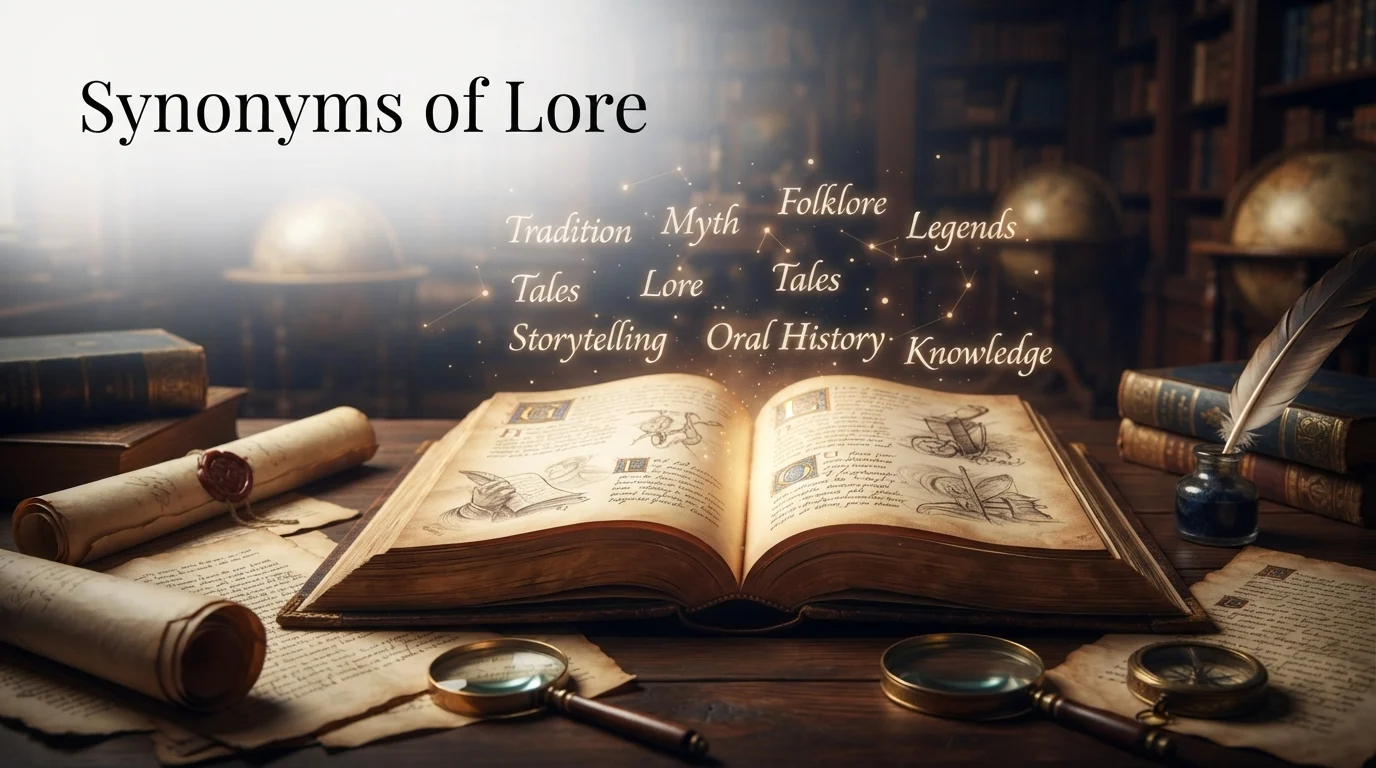
30 Synonyms of Lore
The best synonym depends on what kind of lore you mean. Some words are close in meaning, while others overlap with only one particular sense of the word.
1. Folklore
Meaning: Traditional stories, beliefs, customs, and traditions of a particular community.
Example:
“The museum preserves the folklore of the mountain villages.”
Best usage context: Use this when talking specifically about traditional culture and community traditions.
2. Tradition
Meaning: A custom, belief, or practice passed from one generation to another.
Example:
“Making special bread during the festival is a family tradition.”
Best usage context: Best for customs, practices, and beliefs that are passed down over time.
3. Mythology
Meaning: A collection of traditional myths and stories, especially about gods, heroes, and supernatural events.
Example:
“Greek mythology contains stories about powerful gods and legendary heroes.”
Best usage context: Use it when discussing organized collections of myths.
4. Legend
Meaning: A traditional story that may be based partly on historical events but has often been changed over time.
Example:
“According to local legend, the castle was built by a mysterious king.”
Best usage context: Useful for traditional stories connected to people, places, or historical events.
5. Myth
Meaning: A traditional story, often involving supernatural beings or events, that explains beliefs or cultural ideas.
Example:
“The ancient myth explains how the world was created.”
Best usage context: Use this for individual traditional or symbolic stories.
6. Knowledge
Meaning: Information, understanding, or awareness gained through learning or experience.
Example:
“Her knowledge of traditional medicine came from her grandparents.”
Best usage context: A broad alternative when lore refers to accumulated information rather than stories.
7. Wisdom
Meaning: Good judgment and understanding gained through experience.
Example:
“The elder shared the wisdom of many generations.”
Best usage context: Best when lore emphasizes valuable lessons and experience.
8. Learning
Meaning: Knowledge gained through study, experience, or teaching.
Example:
“His learning included a deep understanding of ancient customs.”
Best usage context: Suitable for formal or academic contexts involving accumulated knowledge.
9. Heritage
Meaning: The traditions, culture, history, and values inherited from previous generations.
Example:
“The festival is an important part of the region’s cultural heritage.”
Best usage context: Use it for cultural traditions and historical inheritance.
10. Custom
Meaning: A traditional way of behaving or doing something.
Example:
“It is an old custom to welcome guests with a special meal.”
Best usage context: Best when lore refers to a particular traditional practice.
11. Culture
Meaning: The beliefs, customs, arts, values, and way of life of a group of people.
Example:
“Stories and music are important parts of the community’s culture.”
Best usage context: Use this when discussing a society or community more broadly.
12. Oral Tradition
Meaning: Stories, knowledge, and beliefs passed from person to person by speaking rather than writing.
Example:
“The history survived through oral tradition for centuries.”
Best usage context: Especially useful when information has been transmitted through spoken storytelling.
13. Storytelling
Meaning: The activity of telling stories, especially traditional or cultural stories.
Example:
“Storytelling played an important role in preserving the community’s history.”
Best usage context: Use it when focusing on the process of sharing stories.
14. Tales
Meaning: Stories, especially interesting, traditional, or imaginative ones.
Example:
“The old tales describe mysterious creatures living in the mountains.”
Best usage context: Good for collections of traditional or imaginative stories.
15. Stories
Meaning: Accounts of events, people, or imagined situations.
Example:
“Her grandmother told stories about life in the village.”
Best usage context: A simple and familiar alternative when lore means traditional stories.
16. Beliefs
Meaning: Ideas that people accept as true or hold as important.
Example:
“Ancient beliefs influenced many of the region’s customs.”
Best usage context: Use this when the focus is on traditional ideas rather than stories.
17. Teachings
Meaning: Ideas, lessons, or principles passed from one person or generation to another.
Example:
“The teachings of the elders continue to influence the community.”
Best usage context: Appropriate when lore contains lessons or guidance.
18. Folktales
Meaning: Traditional stories that have been passed through generations within a culture.
Example:
“The children enjoyed listening to folktales about clever animals.”
Best usage context: Best for traditional fictional or semi-fictional stories.
19. Legends
Meaning: Traditional stories about people, places, or events that may contain both historical and imaginative elements.
Example:
“The region is famous for its legends of hidden treasure.”
Best usage context: Useful when discussing multiple traditional stories.
20. Annals
Meaning: Historical records describing events year by year or over a period of time.
Example:
“The event was recorded in the annals of the ancient kingdom.”
Best usage context: More formal and historical; use it when lore refers to recorded history.
21. Chronicles
Meaning: Detailed records or accounts of events in historical order.
Example:
“The chronicles describe the rise of the medieval kingdom.”
Best usage context: Suitable for documented historical information rather than purely traditional stories.
22. History
Meaning: The study or record of past events.
Example:
“The town has a long history of trade and migration.”
Best usage context: Use this when the information concerns documented past events.
23. Folkloric Tradition
Meaning: The collection of traditional stories, customs, beliefs, and practices within a culture.
Example:
“The dance has deep roots in the region’s folkloric tradition.”
Best usage context: Useful in cultural, academic, and anthropological writing.
24. Cultural Knowledge
Meaning: Information and understanding about the customs, beliefs, values, and practices of a culture.
Example:
“Elders play an important role in preserving cultural knowledge.”
Best usage context: A strong choice for educational and cultural discussions.
25. Ancestral Knowledge
Meaning: Knowledge inherited from earlier generations of a family or community.
Example:
“The community continues to protect its ancestral knowledge of local plants.”
Best usage context: Use this when emphasizing knowledge passed down through ancestors.
26. Oral History
Meaning: Historical information preserved through spoken accounts and personal memories.
Example:
“The researchers collected oral history from elderly residents.”
Best usage context: Best for historical research based on people’s spoken memories and accounts.
27. Traditionary Knowledge
Meaning: Knowledge or information associated with traditions passed through generations.
Example:
“Traditional knowledge helped the community understand the local environment.”
Best usage context: Useful when discussing inherited practical or cultural knowledge.
28. Repository of Knowledge
Meaning: A source or collection that contains a large amount of information.
Example:
“The village elder was considered a repository of knowledge.”
Best usage context: Good for formal writing when emphasizing accumulated information.
29. Collective Memory
Meaning: Shared memories and understanding held by a community or group.
Example:
“The story remains part of the community’s collective memory.”
Best usage context: Useful for cultural studies, history, and discussions about shared experiences.
30. Cultural Memory
Meaning: Shared knowledge, stories, symbols, and memories preserved by a culture.
Example:
“The festival helps preserve the cultural memory of the region.”
Best usage context: Particularly useful in academic and cultural writing.
Comparison Table: Synonyms of Lore
| Synonym | Main Meaning | Best Context | Tone |
| Folklore | Traditional culture and stories | Cultural traditions | Neutral |
| Tradition | Passed-down practices | Customs and practices | Neutral |
| Mythology | Collection of myths | Gods, heroes, ancient beliefs | Literary |
| Legend | Traditional story | Famous people or places | Storytelling |
| Myth | Traditional or symbolic story | Ancient beliefs | Literary |
| Knowledge | Information and understanding | General information | Neutral |
| Wisdom | Experience-based understanding | Lessons and advice | Reflective |
| Heritage | Inherited culture and history | Cultural identity | Formal |
| Custom | Traditional practice | Social behavior | Neutral |
| Culture | Way of life and beliefs | Communities | Broad |
| Oral tradition | Spoken inherited knowledge | Story transmission | Academic |
| Folktales | Traditional stories | Children’s and cultural stories | Storytelling |
| Annals | Historical records | Documented history | Formal |
| Chronicles | Historical accounts | Recorded events | Formal |
| Collective memory | Shared memories | Communities and history | Academic |
Lore vs. Folklore
Lore is a broad term for traditional knowledge, stories, and beliefs.
Folklore usually focuses more specifically on the traditional stories, customs, beliefs, and practices of a particular community or culture.
For example:
- “The lore surrounding the ancient temple is fascinating.”
- “The region’s folklore includes hundreds of traditional stories.”
Folklore can therefore be considered a more specific word in many contexts.
Lore vs. Myth
A myth is generally an individual traditional story, often involving supernatural or symbolic elements.
Lore can include myths but is broader.
For example:
- A story about a particular god may be a myth.
- The collection of stories, beliefs, customs, and knowledge surrounding that culture may be its lore.
Lore vs. Legend
A legend is a traditional story, often connected to a particular person, place, or event.
Lore can include legends along with beliefs, customs, knowledge, and other traditional information.
So, a legend can be part of a larger body of lore.
Lore vs. Tradition
Tradition usually refers to something passed down from one generation to another, such as a custom, practice, belief, or ceremony.
Lore is broader and often includes traditional stories and knowledge.
For example:
- “Lighting candles during the festival is a tradition.”
- “The stories surrounding the festival are part of its lore.”
Lore vs. Heritage
Heritage focuses on what a person or community inherits from previous generations.
It can include language, architecture, customs, traditions, art, and historical identity.
Lore focuses more strongly on traditional knowledge, stories, and beliefs.
How to Choose the Right Synonym
Choosing the right synonym depends on exactly what you want to describe.
When You Mean Traditional Stories
Choose words such as:
- Legend
- Myth
- Folktale
- Tale
- Story
- Folklore
These are useful when your sentence focuses on narratives passed down over time.
When You Mean Traditional Knowledge
Choose:
- Knowledge
- Cultural knowledge
- Ancestral knowledge
- Learning
- Wisdom
These work better when lore refers to information rather than storytelling.
When You Mean Cultural Practices
Consider:
- Tradition
- Custom
- Culture
- Heritage
- Folklore
These words are appropriate when discussing how people live, celebrate, behave, or preserve cultural practices.
When You Mean Historical Information
Use:
- History
- Annals
- Chronicles
- Oral history
- Collective memory
These are more suitable when the subject involves records, memories, or accounts of the past.
When You Want an Academic Tone
For academic or research writing, consider:
- Cultural knowledge
- Oral tradition
- Oral history
- Collective memory
- Cultural memory
- Heritage
These expressions can provide greater precision than the general word lore.
When You Want a Literary Tone
For creative or descriptive writing, words such as these can work well:
- Lore
- Legend
- Myth
- Tales
- Folklore
- Mythology
They can create a sense of history, mystery, tradition, or imagination.
Examples of Lore in Different Contexts
Cultural Lore
“The village has preserved its cultural lore for generations.”
Here, lore refers to the traditional knowledge and beliefs of the community.
Historical Lore
“Local lore says that the old building was once a meeting place for travelers.”
Here, the word refers to a traditional story about a historical place.
Fantasy Lore
“The novel introduces readers to the ancient lore of the magical kingdom.”
In fantasy writing, lore often means the background history, traditions, stories, and knowledge of an imaginary world.
Professional Lore
“Experienced sailors often share a great deal of maritime lore.”
Here, lore means specialized knowledge and traditions developed within a profession or community.
Common Related Words for Lore
When searching for alternatives to lore, you may also encounter related terms such as:
- Traditional knowledge
- Folk knowledge
- Cultural traditions
- Ancient wisdom
- Historical traditions
- Oral traditions
- Cultural stories
- Traditional beliefs
- Folk beliefs
- Community knowledge
- Ancestral traditions
- Shared knowledge
- Historical accounts
- Cultural heritage
These terms are not always exact synonyms, but they can be useful depending on the meaning you need.
Frequently Asked Questions About Synonyms of Lore
What is the closest synonym for lore?
There is no single synonym that works in every situation. Folklore, tradition, traditional knowledge, legend, and cultural knowledge can be close alternatives depending on the context.
What is a simple synonym for lore?
Knowledge, stories, tradition, and folklore are simple alternatives, although each emphasizes a slightly different meaning.
Is folklore the same as lore?
Not exactly. Lore is a broad term for traditional knowledge, stories, and beliefs. Folklore more specifically refers to the traditional culture, stories, beliefs, and customs of a community.
Is mythology a synonym for lore?
Mythology can be a synonym for lore in contexts involving traditional myths, but it is more specific. Lore can include mythology as well as customs, knowledge, beliefs, and traditions.
What is the difference between lore and legend?
A legend is usually a traditional story associated with a person, place, or event. Lore is broader and can include legends along with other traditional knowledge and beliefs.
Can lore mean knowledge?
Yes. Lore can refer to accumulated knowledge, especially knowledge traditionally passed from one generation or group to another.
Is lore formal or informal?
Lore has a somewhat literary, traditional, or descriptive tone. It is common in cultural, historical, fantasy, academic, and creative contexts.
Why Is Learning Synonyms of Lore Useful?
Learning the synonyms of lore helps you communicate more precisely. Instead of repeatedly using the same word, you can select an alternative that tells readers exactly what you mean.
For example, folklore is useful when discussing traditional culture, while mythology is more precise for a collection of myths. Heritage works well when discussing cultural inheritance, while wisdom emphasizes lessons gained through experience.
For ESL learners and students, understanding these distinctions is especially valuable because synonyms are rarely interchangeable in every sentence. Knowing the subtle difference between related words leads to more natural and accurate English.
Final Takeaways
The word lore describes traditional knowledge, stories, beliefs, customs, and information passed through generations. It is a flexible word that can be used in cultural, historical, literary, professional, and fictional contexts.
Some of the most useful synonyms of lore include folklore, tradition, mythology, legend, myth, knowledge, wisdom, heritage, custom, culture, oral tradition, and cultural knowledge.
The best synonym depends on your intended meaning. If you mean traditional stories, consider legend, myth, or folktale. If you mean inherited cultural practices, tradition, custom, or heritage may fit better. If you mean accumulated information, knowledge, wisdom, or cultural knowledge can provide greater precision.
Using the right synonym not only makes your vocabulary stronger but also makes your writing clearer, more natural, and more expressive.

I am Axel James, a passionate writer who loves exploring synonyms and alternative words. I enjoy helping readers improve their vocabulary and express ideas clearly.