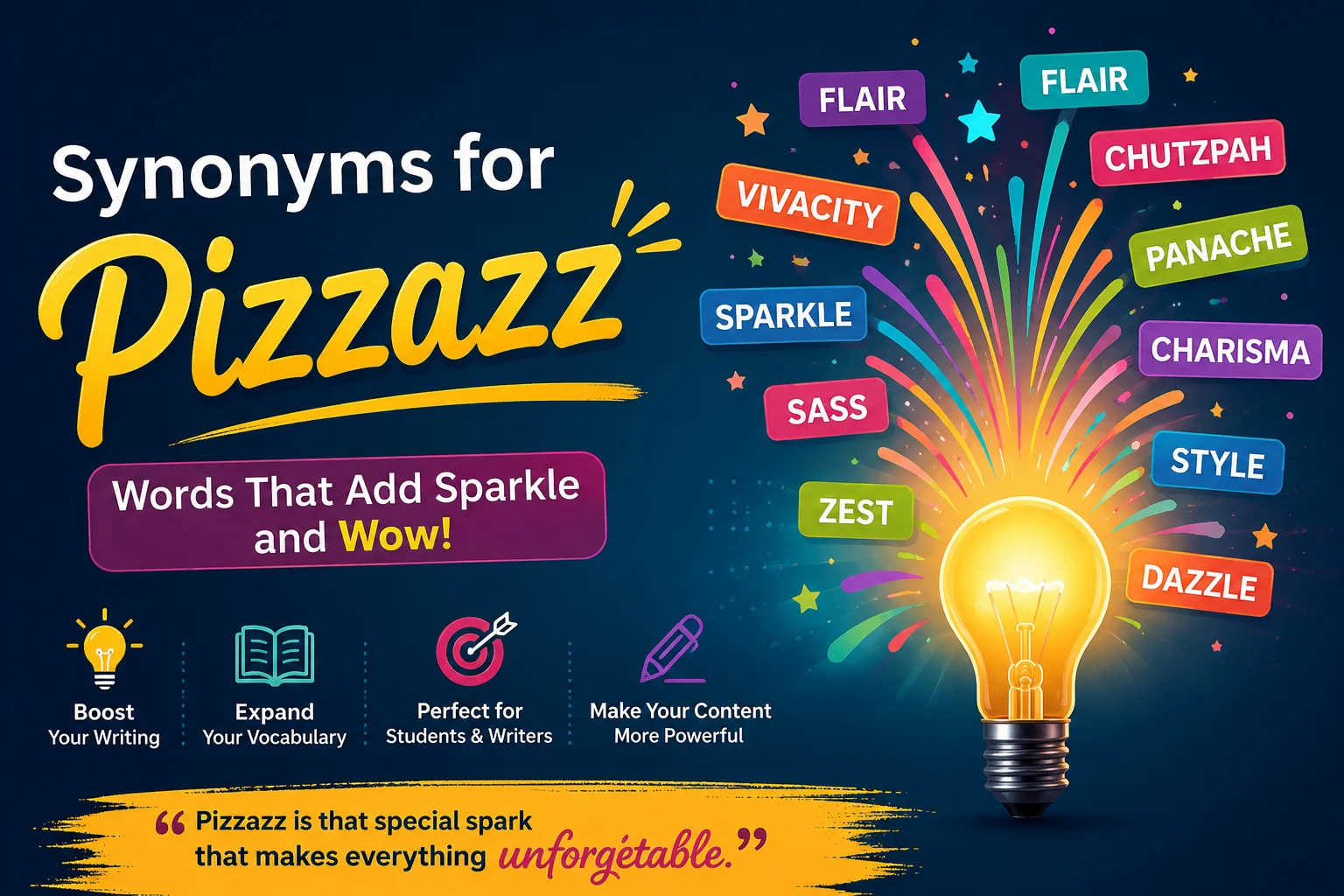
Finding the right synonyms for pizzazz can make your writing more colorful, expressive, and precise. The word pizzazz describes an exciting quality that makes someone or something stand out. It can refer to style, energy, charm, confidence, or a special touch that grabs attention.
Whether you are a student, ESL learner, writer, blogger, marketer, or content creator, knowing alternative words for pizzazz can help you avoid repetition. Instead of using the same word again and again, you can choose a synonym that matches the exact tone you want.
This guide explains the meaning of pizzazz, provides useful alternatives, and shows how different words work in real sentences. It also includes a detailed section on demure, along with 30 synonyms for that word, so you can understand the difference between expressive and reserved language.
What Does “Pizzazz” Mean?
Pizzazz is an informal noun meaning an exciting, attractive, stylish, or energetic quality that makes something interesting or memorable.
In simple English, pizzazz means extra sparkle, excitement, or personality.
For example:
“The designer added some pizzazz to the plain room.”
Here, pizzazz means something extra that makes the room more attractive or lively.
The word is usually positive and informal. It works especially well when talking about fashion, entertainment, presentations, advertising, performances, personalities, food, or creative work.
Pizzazz in Different Contexts
- Fashion: “Her outfit has plenty of pizzazz.”
- Personality: “He brings pizzazz to every conversation.”
- Writing: “The introduction needs more pizzazz.”
- Business: “The new campaign adds pizzazz to the brand.”
- Entertainment: “The performer delivered the show with pizzazz.”
30 Best Synonyms for Pizzazz
The best synonym depends on what you mean by pizzazz. Some alternatives emphasize energy, while others focus on style, charm, excitement, or visual appeal.
1. Flair
Meaning: A natural talent or stylish quality that makes someone or something noticeable.
Example: “She decorated the room with great flair.”
Best usage: Fashion, design, writing, performance, and personal style.
2. Panache
Meaning: A confident and stylish way of doing something.
Example: “He presented his ideas with impressive panache.”
Best usage: Formal or polished writing about confidence and style.
3. Sparkle
Meaning: A lively, bright, or attractive quality.
Example: “Her sense of humor added sparkle to the conversation.”
Best usage: Personality, writing, conversations, and entertainment.
4. Zest
Meaning: Great energy, enthusiasm, or enjoyment.
Example: “She approaches every project with zest.”
Best usage: Enthusiasm, personality, activities, and life experiences.
5. Energy
Meaning: A lively or powerful quality.
Example: “The singer filled the stage with energy.”
Best usage: Performances, people, events, and activities.
6. Vitality
Meaning: Strong life, energy, and enthusiasm.
Example: “The new design gives the website a sense of vitality.”
Best usage: Professional and descriptive writing.
7. Vibrancy
Meaning: A strong, lively, colorful, or energetic quality.
Example: “The artwork brings vibrancy to the otherwise quiet room.”
Best usage: Art, fashion, cities, design, and visual subjects.
8. Charisma
Meaning: A special personal quality that attracts and influences people.
Example: “The speaker’s charisma kept the audience interested.”
Best usage: People, leaders, performers, and public speakers.
9. Charm
Meaning: A pleasant quality that makes someone or something appealing.
Example: “The small café has a unique charm.”
Best usage: People, places, writing, products, and experiences.
10. Appeal
Meaning: The quality of being attractive or interesting.
Example: “The simple design has broad appeal.”
Best usage: Products, ideas, entertainment, marketing, and general writing.
11. Excitement
Meaning: A strong feeling of enthusiasm or interest.
Example: “The announcement created excitement among the students.”
Best usage: Events, news, entertainment, and experiences.
12. Enthusiasm
Meaning: Strong interest and eagerness.
Example: “Her enthusiasm made the entire team more motivated.”
Best usage: Work, education, hobbies, and personal qualities.
13. Verve
Meaning: Energetic enthusiasm and lively style.
Example: “The author writes with remarkable verve.”
Best usage: Literature, performance, creative writing, and sophisticated prose.
14. Dynamism
Meaning: Energy and the ability to create movement or change.
Example: “The company is known for its dynamism.”
Best usage: Business, leadership, organizations, and professional writing.
15. Pep
Meaning: Lively energy and enthusiasm.
Example: “The new coach brought pep to the team.”
Best usage: Informal writing and conversations.
16. Gusto
Meaning: Great enthusiasm and enjoyment.
Example: “He tackled the challenge with gusto.”
Best usage: Actions, activities, food, work, and enthusiastic behavior.
17. Spirit
Meaning: Enthusiasm, courage, or lively character.
Example: “The team showed plenty of spirit during the competition.”
Best usage: Teams, people, celebrations, and difficult situations.
18. Liveliness
Meaning: A quality of being energetic, active, and interesting.
Example: “Her liveliness made the workshop enjoyable.”
Best usage: People, conversations, events, and writing.
19. Excitement
Meaning: A feeling or quality that creates strong interest and enthusiasm.
Example: “The colorful decorations added excitement to the party.”
Best usage: Events, entertainment, celebrations, and experiences.
20. Glamour
Meaning: An attractive, exciting, or sophisticated quality.
Example: “The lighting added glamour to the event.”
Best usage: Fashion, celebrities, events, beauty, and luxury.
21. Style
Meaning: A distinctive way of looking, behaving, designing, or doing something.
Example: “The restaurant has plenty of style.”
Best usage: Fashion, design, writing, branding, and personality.
22. Charisma
Meaning: An appealing personal quality that attracts attention.
Example: “Her charisma made her an unforgettable presenter.”
Best usage: Speakers, performers, leaders, and personalities.
23. Brilliance
Meaning: Exceptional brightness, talent, or impressive quality.
Example: “The performance displayed remarkable brilliance.”
Best usage: Talent, achievement, creativity, and intellectual ability.
24. Magnetism
Meaning: A powerful quality that attracts people.
Example: “The actor’s magnetism was obvious from the moment he entered the room.”
Best usage: Personal attraction, celebrities, leaders, and performers.
25. Allure
Meaning: A mysterious or attractive quality that draws people in.
Example: “The old town has an unusual allure.”
Best usage: Places, people, fashion, beauty, and sophisticated writing.
26. Glam
Meaning: A fashionable, exciting, or glamorous quality.
Example: “A few accessories gave the outfit extra glam.”
Best usage: Informal writing, fashion, beauty, and entertainment.
27. Spark
Meaning: A small but noticeable quality of energy, creativity, or excitement.
Example: “The new idea added a spark to the discussion.”
Best usage: Ideas, relationships, conversations, creativity, and writing.
28. Sizzle
Meaning: An exciting or attention-grabbing quality.
Example: “The advertisement needs more sizzle.”
Best usage: Marketing, advertising, entertainment, and informal writing.
29. Showmanship
Meaning: The ability to entertain or impress an audience through performance and presentation.
Example: “The performer demonstrated excellent showmanship.”
Best usage: Entertainment, sports, presentations, and public performances.
30. Fizz
Meaning: A lively, exciting, or energetic quality.
Example: “The conversation had plenty of fizz.”
Best usage: Informal writing, conversations, creative descriptions, and entertainment.
Quick Comparison of Synonyms for Pizzazz
| Synonym | Main Idea | Tone | Best Context |
| Flair | Stylish skill | Neutral | Design, fashion, writing |
| Panache | Confident style | Sophisticated | Performance, presentation |
| Sparkle | Lively appeal | Friendly | Personality, writing |
| Zest | Enthusiasm | Positive | Life, activities |
| Charisma | Personal attraction | Neutral | People, leaders |
| Charm | Pleasant appeal | Warm | People, places |
| Verve | Energetic style | Literary | Writing, performance |
| Vitality | Life and energy | Professional | Health, design, business |
| Vibrancy | Lively quality | Descriptive | Art, fashion, places |
| Glamour | Attractive sophistication | Stylish | Fashion, events |
| Sizzle | Excitement | Informal | Advertising, media |
| Showmanship | Entertainment skill | Neutral | Performance |
| Allure | Attractive mystery | Sophisticated | Fashion, beauty, places |
| Dynamism | Powerful energy | Professional | Business, leadership |
| Gusto | Enthusiastic action | Informal | Activities, work |
What Is the Difference Between Pizzazz, Flair, Panache, and Zest?
These words are related, but they are not always interchangeable.
Pizzazz is a broad and informal word for an exciting or attractive quality.
Flair often suggests natural talent combined with stylish execution.
Panache emphasizes confidence and sophistication.
Zest focuses more strongly on enthusiasm and enjoyment.
For example:
- “The presentation needs more pizzazz.” → It needs more excitement or appeal.
- “She has a flair for design.” → She has a natural talent for stylish design.
- “He spoke with panache.” → He spoke confidently and stylishly.
- “She works with zest.” → She works with enthusiasm and enjoyment.
Pizzazz Synonyms for Different Situations
For Style and Fashion
Choose:
- Flair
- Panache
- Style
- Glamour
- Glam
- Allure
These words work well when describing clothing, appearance, design, or presentation.
For Energy and Enthusiasm
Choose:
- Zest
- Pep
- Verve
- Gusto
- Vitality
- Enthusiasm
- Liveliness
These are better when pizzazz refers to energy rather than appearance.
For Personal Attraction
Choose:
- Charisma
- Charm
- Magnetism
- Allure
- Appeal
These words are especially useful when describing a person’s ability to attract attention or interest.
For Entertainment
Choose:
- Showmanship
- Sparkle
- Sizzle
- Fizz
- Excitement
- Flair
These alternatives are useful for performances, presentations, advertising, and media.
What Does “Demure” Mean?
Demure has almost the opposite feeling from pizzazz in many contexts.
In simple English, demure means quiet, modest, reserved, and not wanting to attract too much attention.
It is commonly used to describe someone’s appearance, behavior, or manner.
For example:
“She gave a demure smile during the introduction.”
The word often suggests a calm, modest, or restrained style. It can describe clothing as well as behavior, although its exact tone depends on context.
Tone and Usage of Demure
Demure is generally more literary or formal than everyday words such as quiet or shy. It can sound elegant when used to describe someone’s manner or appearance.
For example:
- Demure: “She wore a demure dress.”
- Quiet: “She was quiet during the meeting.”
- Shy: “He was shy around strangers.”
These words overlap, but they are not identical. Demure often carries an idea of modesty and reserved elegance, while shy focuses more on a lack of confidence in social situations.
30 Synonyms of Demure
1. Modest
Meaning: Not showing off or attracting unnecessary attention.
Example: “She chose a modest outfit for the ceremony.”
Best usage: Clothing, behavior, and appearance.
2. Reserved
Meaning: Quiet and not openly expressing feelings.
Example: “He is reserved when meeting new people.”
Best usage: Personality and social behavior.
3. Shy
Meaning: Nervous or uncomfortable around other people.
Example: “The shy student rarely spoke in class.”
Best usage: Personality and social situations.
4. Bashful
Meaning: Easily embarrassed or shy.
Example: “She became bashful when everyone praised her.”
Best usage: Personal reactions and informal descriptions.
5. Retiring
Meaning: Quiet and avoiding attention.
Example: “His retiring nature made him uncomfortable on stage.”
Best usage: Personality descriptions.
6. Unassuming
Meaning: Modest and not trying to appear important.
Example: “Despite her success, she remained unassuming.”
Best usage: Personality, professionals, and achievements.
7. Quiet
Meaning: Not loud, energetic, or attention-seeking.
Example: “She has a quiet and thoughtful personality.”
Best usage: General descriptions.
8. Mild
Meaning: Gentle and not extreme.
Example: “He has a mild manner.”
Best usage: Personality and behavior.
9. Gentle
Meaning: Kind, calm, and soft in manner.
Example: “She has a gentle personality.”
Best usage: People and behavior.
10. Meek
Meaning: Very quiet, gentle, and unlikely to challenge others.
Example: “The meek child rarely argued with anyone.”
Best usage: Personality; be careful because it can suggest weakness.
11. Unobtrusive
Meaning: Not attracting attention or causing disturbance.
Example: “The decoration was simple and unobtrusive.”
Best usage: Design, behavior, and appearance.
12. Subdued
Meaning: Quiet, restrained, or not very noticeable.
Example: “She wore subdued colors to the formal event.”
Best usage: Colors, fashion, moods, and behavior.
13. Restrained
Meaning: Controlled and not excessive.
Example: “His restrained response surprised everyone.”
Best usage: Emotions, behavior, design, and writing.
14. Modest-mannered
Meaning: Behaving in a humble and reserved way.
Example: “The modest-mannered guest avoided unnecessary attention.”
Best usage: Formal descriptions of people.
15. Unpretentious
Meaning: Simple and not designed to impress others.
Example: “She has an unpretentious style.”
Best usage: People, homes, fashion, and lifestyles.
16. Humble
Meaning: Not believing that you are better or more important than others.
Example: “The award-winning author remained humble.”
Best usage: Character and achievements.
17. Demurely
Meaning: In a quiet, modest, and reserved manner.
Example: “She smiled demurely at the compliment.”
Best usage: As an adverb in literary or descriptive writing.
18. Coy
Meaning: Shy or pretending to be shy in an attractive or playful way.
Example: “She gave him a coy smile.”
Best usage: Social behavior and expressions; often has a playful tone.
19. Diffident
Meaning: Lacking confidence, especially around other people.
Example: “His diffident manner made public speaking difficult.”
Best usage: Formal descriptions of confidence.
20. Timid
Meaning: Easily frightened or lacking confidence.
Example: “The timid child stayed close to her parents.”
Best usage: Personality and behavior.
21. Soft-spoken
Meaning: Speaking quietly and gently.
Example: “The soft-spoken teacher created a peaceful classroom.”
Best usage: Voice and personality.
22. Calm
Meaning: Peaceful and not easily excited.
Example: “She remained calm throughout the interview.”
Best usage: Behavior, emotions, and situations.
23. Gentle-mannered
Meaning: Having a polite and calm way of behaving.
Example: “He was gentle-mannered and respectful.”
Best usage: Formal personal descriptions.
24. Proper
Meaning: Respectable and socially appropriate.
Example: “She maintained a proper and respectful manner.”
Best usage: Formal or traditional contexts.
25. Decorous
Meaning: Polite, respectable, and appropriate.
Example: “The guests maintained a decorous atmosphere.”
Best usage: Formal writing and social behavior.
26. Sedate
Meaning: Calm, quiet, and serious.
Example: “The restaurant had a sedate atmosphere.”
Best usage: Formal descriptions of people, places, or moods.
27. Serene
Meaning: Peaceful and calm.
Example: “Her serene manner put everyone at ease.”
Best usage: Personality, places, and moods.
28. Unassuming
Meaning: Modest and without a desire for attention.
Example: “The unassuming artist preferred working quietly.”
Best usage: People, professionals, and personalities.
29. Quiet-mannered
Meaning: Having a calm and reserved way of behaving.
Example: “The quiet-mannered student listened carefully.”
Best usage: Descriptive writing.
30. Self-effacing
Meaning: Avoiding praise or attention for yourself.
Example: “His self-effacing nature made him easy to work with.”
Best usage: Professional and personality descriptions.
Demure Synonyms: Quick Comparison
| Word | Main Meaning | Tone | Best Context |
| Modest | Not attention-seeking | Neutral | Appearance, behavior |
| Reserved | Emotionally controlled | Neutral | Personality |
| Shy | Socially uncomfortable | Common | People |
| Bashful | Easily embarrassed | Friendly | Social situations |
| Unassuming | Not showing importance | Positive | Personality |
| Subdued | Restrained or quiet | Neutral | Colors, mood, style |
| Restrained | Carefully controlled | Formal | Emotions, behavior |
| Coy | Playfully shy | Suggestive | Expressions, behavior |
| Timid | Lacking confidence | Often negative | Personality |
| Diffident | Lacking self-confidence | Formal | Personality |
| Soft-spoken | Quiet and gentle voice | Positive | Speech, personality |
| Decorous | Proper and respectable | Formal | Social settings |
| Serene | Peaceful and calm | Positive | People, atmosphere |
| Self-effacing | Avoiding praise | Positive | Personality, work |
How to Choose the Right Synonym
Choosing the right synonym is not simply about finding a word with the same dictionary definition. You should also consider tone, context, strength, and intended meaning.
If You Mean “Stylish”
Use:
- Flair
- Panache
- Style
- Glamour
- Glam
These are especially useful for fashion, design, branding, and presentation.
If You Mean “Energetic”
Use:
- Zest
- Verve
- Pep
- Vitality
- Gusto
- Liveliness
These words emphasize enthusiasm and active energy.
If You Mean “Attractive”
Use:
- Charm
- Appeal
- Allure
- Magnetism
- Charisma
These work well when something or someone naturally attracts attention.
If You Mean “Exciting”
Use:
- Spark
- Sizzle
- Fizz
- Excitement
- Sparkle
These are particularly effective in informal, creative, and promotional writing.
If You Mean “Reserved”
For demure, choose:
- Reserved
- Modest
- Subdued
- Unassuming
- Quiet
- Restrained
If You Mean “Shy”
Choose:
- Bashful
- Timid
- Coy
- Diffident
- Retiring
Remember that these words can carry different emotional meanings. Timid, for example, may suggest weakness or lack of confidence, while demure can suggest elegant modesty.
How to Use Pizzazz in a Sentence
Here are several natural examples:
- “The colorful illustrations give the book some pizzazz.”
- “Her presentation had plenty of pizzazz.”
- “The designer added pizzazz without making the room feel crowded.”
- “A little pizzazz can make an ordinary headline more memorable.”
- “The performer brought energy and pizzazz to the stage.”
- “The recipe needs a little extra pizzazz.”
- “The marketing campaign has style, energy, and pizzazz.”
Is Pizzazz Formal or Informal?
Pizzazz is mainly an informal word.
It is excellent for blogs, conversations, advertisements, lifestyle writing, entertainment articles, and creative content.
In formal academic or professional writing, alternatives such as appeal, vitality, dynamism, distinction, sophistication, or visual impact may be more appropriate.
For example:
Informal:
“The presentation needs more pizzazz.”
More formal:
“The presentation needs greater visual appeal and energy.”
Pizzazz vs. Flair: Are They the Same?
Not exactly.
Pizzazz refers broadly to an exciting or attractive quality.
Flair often means a natural ability to do something in a distinctive or stylish way.
Compare:
- “The website needs more pizzazz.” → It needs more excitement or visual appeal.
- “She has a flair for web design.” → She has a natural talent for stylish web design.
Pizzazz vs. Charisma
Pizzazz can describe people, products, writing, designs, performances, and many other things.
Charisma is mainly associated with a person’s ability to attract or influence others.
For example:
“The advertisement has pizzazz.”
But:
“The speaker has charisma.”
This distinction is useful for ESL learners because the two words may seem interchangeable in some contexts but have different natural uses.
Pizzazz vs. Zest
Pizzazz emphasizes excitement, style, or special appeal.
Zest emphasizes enthusiasm, energy, and enjoyment.
For example:
“The new logo has pizzazz.”
This means the logo has extra visual appeal.
“She approaches her work with zest.”
This means she works with enthusiasm and enjoyment.
Frequently Asked Questions About Synonyms for Pizzazz
What is the best synonym for pizzazz?
Flair is one of the closest general alternatives, especially when you mean style or distinctive quality. Other strong choices include sparkle, panache, zest, verve, charm, charisma, and vibrancy, depending on the context.
What is a simple word for pizzazz?
Simple alternatives include style, energy, excitement, charm, spark, appeal, and enthusiasm.
What is a professional synonym for pizzazz?
For professional writing, consider appeal, vitality, dynamism, distinction, visual impact, or energy.
What is a synonym for pizzazz in writing?
Depending on the meaning, you can use sparkle, flair, verve, energy, style, vibrancy, or creativity.
What is a synonym for pizzazz in fashion?
Good choices include flair, style, glamour, glam, panache, and allure.
Is pizzazz a positive word?
Yes. Pizzazz is normally positive and suggests that something has extra energy, excitement, attractiveness, or personality.
What is the opposite of pizzazz?
Possible opposites include dullness, blandness, plainness, lifelessness, monotony, and drabness, depending on the context.
Final Thoughts on Synonyms for Pizzazz
The best synonyms for pizzazz depend on the exact quality you want to describe. If you mean stylish confidence, panache or flair may be ideal. If you mean enthusiasm, choose zest, verve, or gusto. For personal attraction, charisma, charm, or magnetism can be more precise.
Learning these distinctions can make your vocabulary stronger and your writing more natural. Instead of relying on one word, you can choose an alternative that communicates the exact feeling, style, or level of energy you have in mind.
And while pizzazz suggests sparkle and attention, demure describes a more reserved and modest quality. Understanding both kinds of vocabulary helps students, ESL learners, writers, and content creators express subtle differences with greater confidence.

I am Evelyn Marie, the Administrator of Synoloop. I enjoy helping readers discover useful synonyms, alternative words, and better ways to express their ideas. I focus on keeping Synoloop simple, reliable, informative, and helpful for everyone.