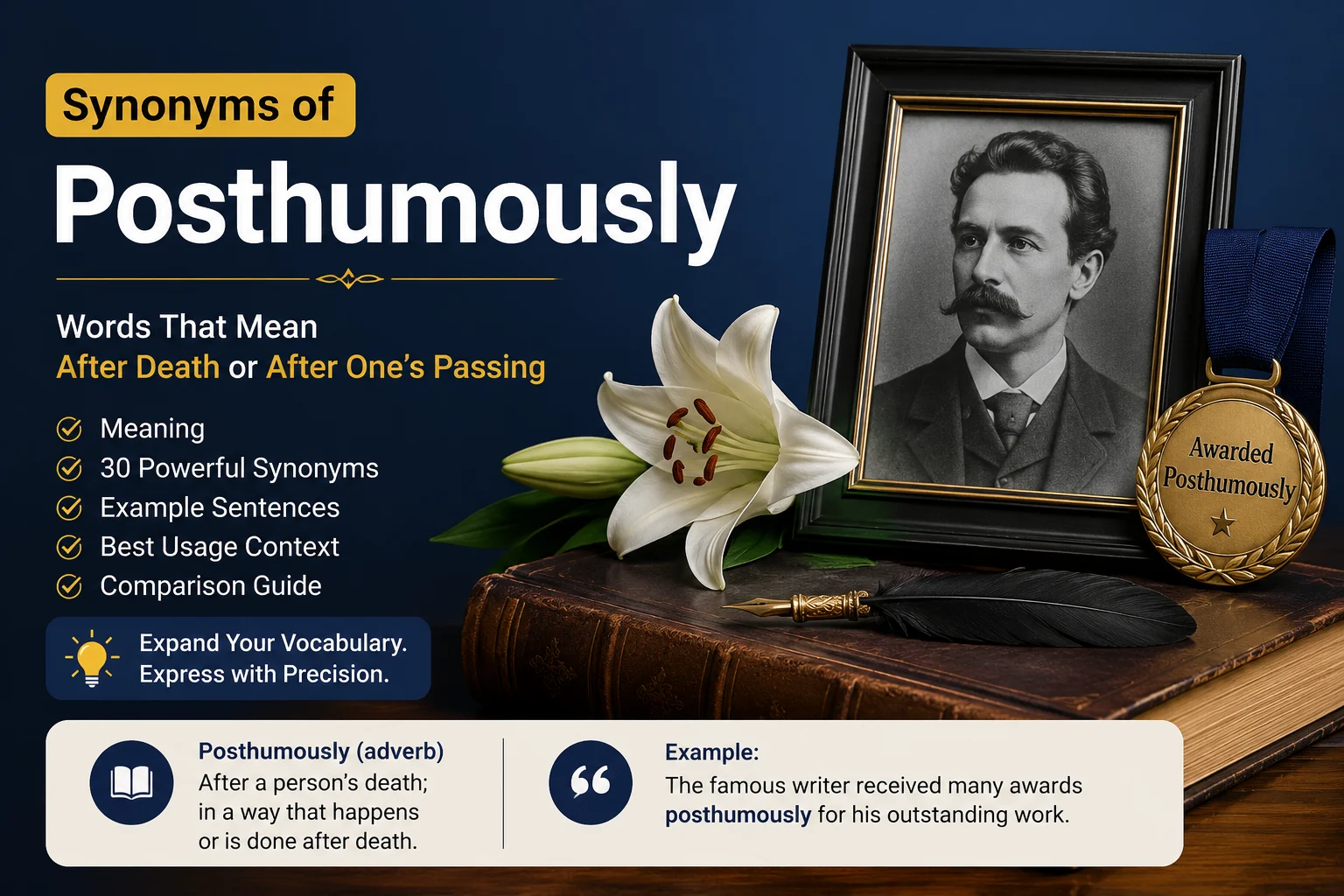
If you are looking for synonyms of posthumously, you may want a word or phrase that describes something recognized, published, awarded, discovered, or completed after a person’s death. The word is common in biographies, history, literature, journalism, awards, and academic writing.
Understanding alternatives to posthumously can make your writing more precise and natural. Some alternatives are formal and suitable for academic writing, while others are simple phrases that are easier for ESL learners and general readers to understand.
What Does “Posthumously” Mean?
Posthumously means after someone has died.
It is an adverb used when something happens, is given, published, recognized, or discovered after a person’s death.
Simple definition
Posthumously = after a person’s death
Examples
- The author was posthumously awarded a major literary prize.
- Her final novel was published posthumously.
- The scientist received recognition posthumously for his discovery.
- The artist became famous posthumously.
The word comes from posthumous, which means occurring or existing after a person’s death.
30 Synonyms and Alternatives for “Posthumously”
There is not always a single-word synonym for posthumously. In many situations, a short phrase such as after his death or after her death sounds more natural.
Here are 30 useful alternatives and closely related expressions.
1. After death
Meaning: Something happened after a person died.
Example:
The writer became famous after death.
Best usage: Simple, general writing.
2. After his death
Meaning: Something happened after a male person’s death.
Example:
The book was published after his death.
Best usage: Clear writing when the person is male.
3. After her death
Meaning: Something happened after a female person’s death.
Example:
Her paintings became valuable after her death.
Best usage: Clear, natural writing when the person is female.
4. After their death
Meaning: Something happened after a person’s death without specifying gender.
Example:
The research gained attention after their death.
Best usage: Modern, gender-neutral writing.
5. Following his death
Meaning: Something occurred after a man died.
Example:
Several previously unknown letters were discovered following his death.
Best usage: Formal biographies and historical writing.
6. Following her death
Meaning: Something occurred after a woman died.
Example:
The museum displayed her private collection following her death.
Best usage: Formal writing.
7. Following their death
Meaning: Something occurred after a person’s death.
Example:
The organization continued its work following their death.
Best usage: Formal and gender-neutral writing.
8. After passing away
Meaning: After someone died.
Example:
His memoir was released after he passed away.
Best usage: Polite and softer everyday language.
9. After the person died
Meaning: Something happened once the person was no longer alive.
Example:
The documents were found after the person died.
Best usage: Very simple ESL-friendly writing.
10. After the author’s death
Meaning: Something happened after an author died.
Example:
The novel was published after the author’s death.
Best usage: Literature and publishing.
11. After the artist’s death
Meaning: Something happened after an artist died.
Example:
The paintings received international attention after the artist’s death.
Best usage: Art criticism and biographies.
12. After the writer’s death
Meaning: Something happened after a writer died.
Example:
Several poems appeared after the writer’s death.
Best usage: Literary contexts.
13. After the scholar’s death
Meaning: Something happened after an academic or scholar died.
Example:
The scholar’s research was published after his death.
Best usage: Academic and historical writing.
14. After the deceased person’s death
Meaning: Something happened after a person who has died passed away.
Example:
The estate was distributed after the deceased person’s death.
Best usage: Legal or administrative contexts, although it can sound repetitive.
15. Afterward, following death
Meaning: Something occurred later, after the person’s death.
Example:
The work was completed afterward, following the author’s death.
Best usage: Explanatory writing; less common as a direct replacement.
16. After the individual’s death
Meaning: Something happened after a particular individual died.
Example:
The documents became public after the individual’s death.
Best usage: Formal, neutral writing.
17. After the subject’s death
Meaning: Something occurred after the person being discussed died.
Example:
New evidence emerged after the subject’s death.
Best usage: Research, biographies, and academic writing.
18. In the period after death
Meaning: During the time that followed someone’s death.
Example:
His reputation grew in the period after his death.
Best usage: Historical and analytical writing.
19. In the years after death
Meaning: During several years following someone’s death.
Example:
Her influence increased in the years after her death.
Best usage: Historical analysis and biographies.
20. In the aftermath of death
Meaning: During the period immediately or relatively soon after someone’s death.
Example:
Several important decisions were made in the aftermath of his death.
Best usage: Formal, serious, or historical contexts.
21. After the individual’s passing
Meaning: After the person died.
Example:
The family donated his papers after the individual’s passing.
Best usage: Respectful and formal writing.
22. Following the person’s passing
Meaning: After someone died.
Example:
The foundation was established following the person’s passing.
Best usage: Respectful, formal communication.
23. After the person’s passing
Meaning: After someone’s death.
Example:
The collection was donated after the person’s passing.
Best usage: Obituaries, memorial writing, and respectful communication.
24. Once the person had died
Meaning: After the person was no longer alive.
Example:
The family discovered the letters once the person had died.
Best usage: Simple storytelling and explanatory writing.
25. Once he had died
Meaning: After a male person died.
Example:
His unfinished manuscript was found once he had died.
Best usage: Narrative writing.
26. Once she had died
Meaning: After a female person died.
Example:
Her unpublished poems were discovered once she had died.
Best usage: Narrative and biographical writing.
27. In later years after his death
Meaning: During later years following a man’s death.
Example:
His work became influential in later years after his death.
Best usage: Historical discussion.
28. In later years after her death
Meaning: During later years following a woman’s death.
Example:
Her contribution was better understood in later years after her death.
Best usage: Biographical and historical writing.
29. After the death of the individual
Meaning: Following the death of a particular person.
Example:
The archive was opened after the death of the individual.
Best usage: Highly formal or academic writing.
30. After the person’s lifetime
Meaning: After the period during which a person was alive.
Example:
The importance of his work became clearer after the person’s lifetime.
Best usage: Historical or analytical writing. It is related to posthumously but is not always an exact replacement.
Comparison Guide: Which Alternative Should You Use?
| Alternative | Tone | Best Context | Simple Meaning |
| After death | Neutral | General writing | After someone died |
| After his death | Neutral | Biographies | After a man died |
| After her death | Neutral | Biographies | After a woman died |
| After their death | Neutral | Modern writing | After a person died |
| Following his death | Formal | History | After he died |
| Following her death | Formal | History | After she died |
| After passing away | Polite | General writing | After someone died |
| After the author’s death | Formal | Literature | After an author died |
| After the artist’s death | Formal | Art | After an artist died |
| In the aftermath of death | Formal | History/news | During the period after death |
| In the years after death | Formal | Historical writing | During later years |
| Once the person had died | Simple | Storytelling | After the person died |
| After the person’s passing | Respectful | Memorial writing | After someone died |
| Following the person’s passing | Respectful/formal | Public communication | After someone died |
| After the individual’s death | Formal | Academic writing | After an individual died |
How to Choose the Right Synonym for “Posthumously”
Choosing the right alternative depends mainly on tone, clarity, and context.
For simple English
Use:
- After death
- After his death
- After her death
- After their death
- Once the person had died
- After the person died
These expressions are especially useful for ESL learners, students, and readers who may not know the word posthumously.
Example:
The author’s final book was published after her death.
This is easier to understand than:
The author’s final book was published posthumously.
Both sentences have essentially the same meaning.
For academic writing
Prefer:
- Following his death
- Following her death
- After the individual’s death
- After the subject’s death
- In the years after his death
- In the period after death
These expressions work well in research papers, historical studies, biographies, and scholarly articles.
Example:
His theories received greater attention following his death.
For respectful writing
Use:
- After passing away
- After the person’s passing
- Following the person’s passing
- After their passing
These expressions can sound gentler than directly saying after death.
They are often appropriate in memorials, announcements, biographies, and personal writing.
For literature and publishing
The most useful choices include:
- Posthumously
- After the author’s death
- After the writer’s death
- Following the author’s death
- Once the author had died
Example:
The poet’s final collection was published posthumously.
Or:
The poet’s final collection was published after the poet’s death.
The first version is shorter and more polished, while the second is more immediately understandable.
For historical writing
Good alternatives include:
- Following his death
- Following her death
- In the years after his death
- In the aftermath of his death
- After the individual’s death
These phrases make it easy to describe how a person’s influence, reputation, work, or legacy changed after death.
Posthumously vs. “After Death”
Although these expressions are closely related, they are not always interchangeable in style.
Posthumously is concise and formal.
The composer was awarded the prize posthumously.
After his death is more conversational and explicit.
The composer was awarded the prize after his death.
For academic, journalistic, or professional writing, posthumously can make a sentence more concise.
For beginner-friendly writing, after his death may be easier for readers to understand.
Examples of “Posthumously” in Real Sentences
Here are several common sentence patterns:
- The author was posthumously recognized for her contribution to literature.
- His final album was released posthumously.
- The scientist received the award posthumously.
- The unfinished novel was published posthumously.
- Her work became widely appreciated posthumously.
- The actor received a posthumous award for his performance.
Notice the difference between posthumously and posthumous:
- Posthumously is an adverb: “The award was given posthumously.”
- Posthumous is an adjective: “He received a posthumous award.”
Related Words and Phrases
When learning synonyms of posthumously, it is also useful to understand related vocabulary.
Posthumous
Means happening or appearing after someone’s death.
Example:
She received a posthumous award.
Posthumous award
An award given to someone after they have died.
Example:
The actor received a posthumous award for his contribution to cinema.
Posthumous publication
A book, article, poem, or other work published after its author’s death.
Example:
The author’s final novel was a posthumous publication.
Posthumous recognition
Recognition received after someone’s death.
Example:
The scientist gained posthumous recognition for the discovery.
Legacy
The influence, achievements, ideas, or works a person leaves behind.
Example:
Her legacy continues to influence young writers.
Keep in mind that legacy is not a direct synonym for posthumously. It refers to what someone leaves behind, rather than specifically describing something that happens after death.
Common Mistakes to Avoid
Mistake 1: Using “posthumously” when you mean “before death”
Posthumously always relates to something that happens after death.
Incorrect:
He posthumously published his first book while he was alive.
Better:
His first book was published posthumously.
Mistake 2: Confusing “posthumous” and “posthumously”
Use posthumous to describe a noun.
She received a posthumous award.
Use posthumously to describe an action.
She was posthumously awarded the prize.
Mistake 3: Assuming every alternative has exactly the same meaning
Phrases such as after the person’s lifetime and in the aftermath of death are related but may not work in every sentence.
The safest direct alternatives are usually:
- After death
- After his death
- After her death
- After their death
- Following his death
- Following her death
- After the person’s death
- Following the person’s passing
Frequently Asked Questions
What is the simplest synonym for “posthumously”?
The simplest alternatives are after death, after his death, after her death, or after their death.
What does “posthumously” mean in simple English?
It means after a person has died.
Is “after death” exactly the same as “posthumously”?
They are very similar, but posthumously is generally more concise and formal. The phrase after death is often easier for beginners to understand.
What is a synonym for “posthumously awarded”?
You can say awarded after his death, awarded after her death, or given after the person’s death.
Is “posthumous” the same as “posthumously”?
No. Posthumous is an adjective, while posthumously is an adverb.
For example:
He received a posthumous award.
He was posthumously awarded the prize.
Can “posthumously” be used for books?
Yes. A book can be published posthumously if it is released after its author’s death.
Can “posthumously” be used for awards?
Yes. A person can receive an award posthumously when the award is given after their death.
Final Takeaway
The best synonyms of posthumously depend on the audience and writing situation. For simple English, after death, after his death, after her death, and after their death are clear and easy to understand. For formal writing, following his death, following her death, and after the individual’s death can sound more polished.
For respectful contexts, phrases such as after the person’s passing may be more appropriate. In literature, history, journalism, and academic writing, however, posthumously remains one of the most precise and concise choices.
The key idea is simple: posthumously means something happens after a person’s death. Once you understand that meaning, you can choose an alternative based on tone, audience, and context rather than simply replacing the word mechanically.
Whether you are an ESL learner building vocabulary, a student writing an assignment, or a content creator looking for clearer wording, understanding these distinctions will help you write with greater accuracy and confidence.

I am Axel James, a passionate writer who loves exploring synonyms and alternative words. I enjoy helping readers improve their vocabulary and express ideas clearly.