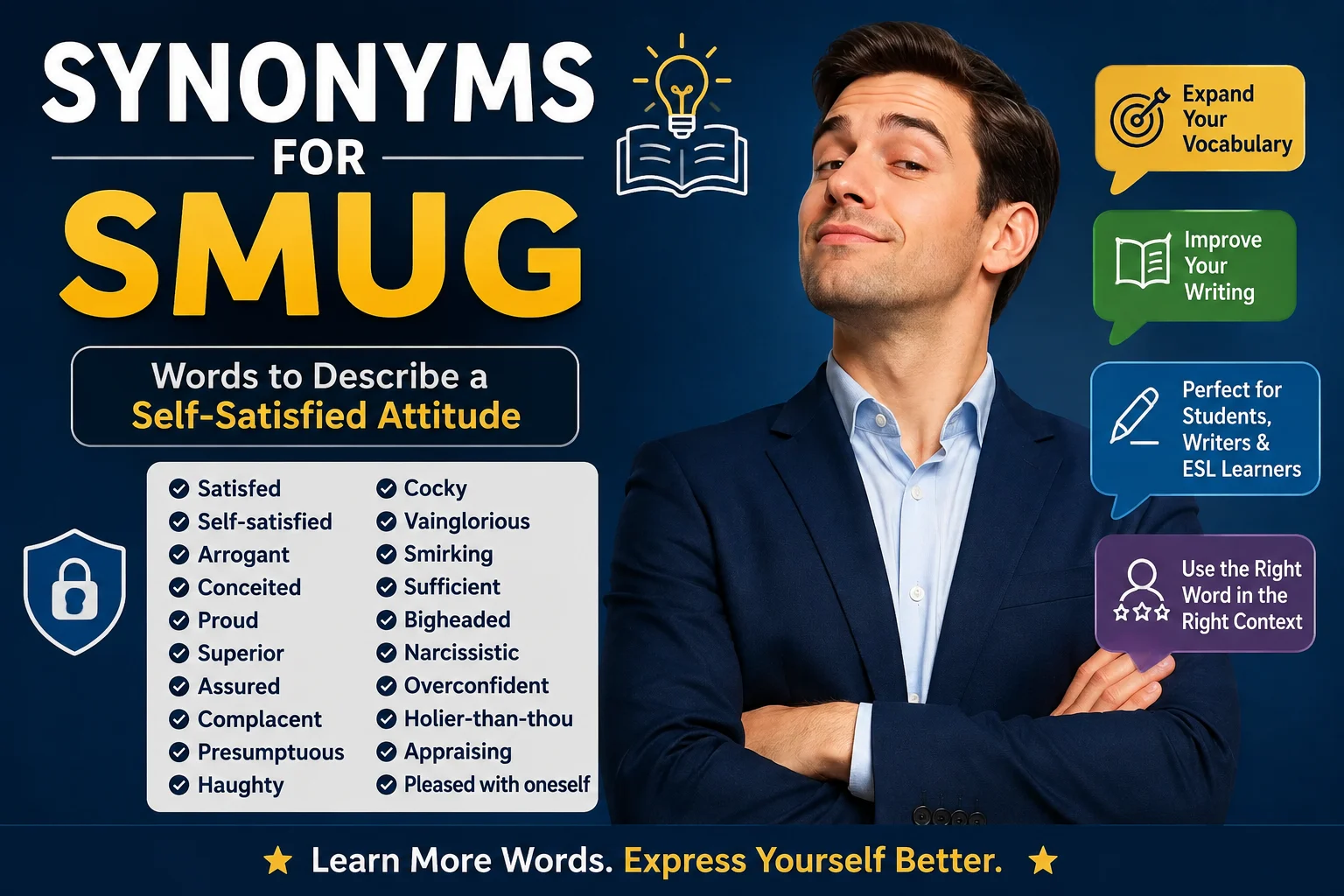
If you are looking for synonyms for smug, you probably want a word that describes someone who seems too pleased with themselves, overly confident, or satisfied with their own abilities or achievements. However, not every synonym for smug has exactly the same meaning or emotional tone.
Understanding the differences between similar words can make your English more precise. This is especially useful for students, ESL learners, writers, bloggers, and content creators who want to describe personality, attitude, or behavior naturally.
In this guide, you will find 30 synonyms for smug, each with a simple meaning, an example sentence, and a short note explaining when the word works best. You will also learn how to choose the right synonym based on tone and context.
What Does “Smug” Mean?
Smug is an adjective used to describe someone who is too pleased with themselves or their own success, abilities, or decisions.
A smug person often believes they are clever, successful, or superior to others. The word usually has a negative or critical tone.
Simple definition
Smug = overly pleased with yourself, especially in a way that annoys or looks down on others.
Example
After winning the competition, he gave everyone a smug smile.
The sentence suggests that he was not simply happy. His expression showed that he felt superior or especially satisfied with himself.
Smug vs. confident
It is important not to confuse smug with confident.
- Confident usually means you believe in yourself in a positive or reasonable way.
- Smug suggests excessive self-satisfaction and often makes the person seem arrogant or irritating.
For example:
She felt confident before the interview.
This is positive.
She looked smug after telling everyone that she had predicted the result.
This suggests an unpleasant sense of superiority.
30 Synonyms for Smug
Below are 30 useful alternatives to smug. Some are close synonyms, while others describe a particular shade of the same attitude.
1. Self-satisfied
Meaning: Very pleased with yourself or what you have achieved.
Example:
He looked self-satisfied after proving his point.
Best usage: Use this when someone seems overly pleased with their own success.
2. Self-congratulatory
Meaning: Showing too much pride in your own achievements.
Example:
Her self-congratulatory speech made some of her coworkers uncomfortable.
Best usage: Useful for formal writing and situations where someone praises themselves too much.
3. Conceited
Meaning: Having an exaggerated opinion of your own abilities or importance.
Example:
He was so conceited that he believed nobody could do the job better than him.
Best usage: Strong choice when smugness comes from excessive self-importance.
4. Arrogant
Meaning: Believing that you are better, more important, or more capable than other people.
Example:
His arrogant attitude quickly annoyed the rest of the team.
Best usage: Use this when smug behavior also involves treating others as inferior.
5. Pompous
Meaning: Acting as though you are more important, intelligent, or impressive than you really are.
Example:
The speaker’s pompous manner made the simple discussion seem unnecessarily complicated.
Best usage: Especially useful for describing speech, writing, or formal behavior.
6. Egotistical
Meaning: Having an excessively high opinion of yourself.
Example:
His egotistical behavior made every conversation about him.
Best usage: Use it when a person’s pride centers strongly on themselves.
7. Vain
Meaning: Having too much pride in your appearance, abilities, or achievements.
Example:
She was too vain to admit that she had made a mistake.
Best usage: Common when someone’s pride involves appearance or personal qualities.
8. Overconfident
Meaning: Having more confidence than is reasonable or justified.
Example:
His overconfident attitude caused him to underestimate the competition.
Best usage: Good when someone has excessive confidence rather than simply being proud.
9. Haughty
Meaning: Acting as though you are better or more important than other people.
Example:
She gave him a haughty look when he questioned her decision.
Best usage: A stronger, more formal word for superior or dismissive behavior.
10. Snobbish
Meaning: Believing that you are better than people because of social status, wealth, education, taste, or background.
Example:
His snobbish attitude made new employees feel unwelcome.
Best usage: Best when smugness is connected to social status or supposedly superior taste.
11. Superior
Meaning: Acting as though you are better than other people.
Example:
He spoke in a superior tone during the meeting.
Best usage: Useful when describing someone’s attitude, tone, or behavior toward others.
12. Patronizing
Meaning: Treating someone as though they are less intelligent or less important than you.
Example:
Her patronizing explanation made the experienced employee feel insulted.
Best usage: Choose this when smugness appears through a condescending manner.
13. Condescending
Meaning: Behaving as though you are more intelligent or important than someone else.
Example:
The manager’s condescending comments discouraged the junior staff.
Best usage: Particularly useful for speech, comments, explanations, and interactions.
14. Cocky
Meaning: Too confident and proud of yourself.
Example:
The young player became cocky after scoring three goals.
Best usage: Informal English, especially for people who show excessive confidence.
15. Self-important
Meaning: Thinking that you are more important than you really are.
Example:
His self-important attitude irritated everyone at the office.
Best usage: Good for describing someone who takes themselves too seriously.
16. Full of oneself
Meaning: Extremely pleased with yourself and your own qualities.
Example:
Ever since she won the award, she has been completely full of herself.
Best usage: Informal and conversational English.
17. Narcissistic
Meaning: Showing an extreme interest in yourself and an exaggerated sense of your own importance.
Example:
His narcissistic behavior made it difficult for him to accept criticism.
Best usage: Stronger than smug; use carefully when describing extreme self-focus.
18. Pretentious
Meaning: Trying to appear more intelligent, important, cultured, or sophisticated than you really are.
Example:
His pretentious comments about art annoyed the other guests.
Best usage: Best when someone tries to impress others by appearing superior or sophisticated.
19. Boastful
Meaning: Talking too proudly about your achievements, abilities, or possessions.
Example:
His boastful stories about his success became tiresome.
Best usage: Use when someone openly talks about how great they are.
20. Bragging
Meaning: Talking with too much pride about something you have done or own.
Example:
Her constant bragging about her new car annoyed her friends.
Best usage: Informal and direct; especially useful for describing speech.
21. Triumphant
Meaning: Showing great happiness or pride after winning or succeeding.
Example:
He wore a triumphant smile after defeating his strongest rival.
Best usage: Not always negative, but useful when describing a victorious expression that may resemble smugness.
22. Satisfied
Meaning: Feeling pleased because something has gone well.
Example:
He looked satisfied after completing the difficult project.
Best usage: Usually neutral or positive, so use it when you do not want the negative meaning of smug.
23. Pleased with oneself
Meaning: Feeling especially happy about your own actions or achievements.
Example:
She seemed very pleased with herself after solving the puzzle.
Best usage: A softer alternative to smug.
24. Self-assured
Meaning: Confident in your abilities and decisions.
Example:
The speaker appeared calm and self-assured during the presentation.
Best usage: Usually positive, unlike smug.
25. Overbearing
Meaning: Too controlling, forceful, or confident in dealing with others.
Example:
His overbearing personality made it difficult for others to express their opinions.
Best usage: Choose this when excessive confidence becomes controlling or domineering.
26. Domineering
Meaning: Trying to control other people in an aggressive or confident way.
Example:
Her domineering attitude discouraged the team from sharing ideas.
Best usage: Best when smugness is connected to controlling behavior.
27. Imperious
Meaning: Behaving as though you have authority and expect others to obey you.
Example:
He gave an imperious command and expected everyone to follow it immediately.
Best usage: Formal writing, especially when describing commanding or superior behavior.
28. Uppity
Meaning: Acting as though you are more important than you really are.
Example:
His coworkers thought he had become rather uppity after his promotion.
Best usage: Informal English; it can sound judgmental, so use it carefully.
29. Self-satisfied-looking
Meaning: Appearing extremely pleased with yourself, especially after success.
Example:
He walked into the room with a self-satisfied-looking smile.
Best usage: Useful in descriptive writing when focusing on facial expression or appearance.
30. Self-admiring
Meaning: Excessively pleased with or impressed by yourself.
Example:
His self-admiring attitude made him unwilling to accept advice.
Best usage: Useful when describing excessive admiration of one’s own qualities.
Quick Comparison of Synonyms for Smug
Not all synonyms for smug have the same strength or meaning. This comparison can help you select the most accurate word.
| Word | Tone | Main Idea | Best For |
| Self-satisfied | Negative/neutral | Too pleased with yourself | General situations |
| Conceited | Negative | Excessive opinion of yourself | Personality |
| Arrogant | Strong negative | Believes they are better than others | Behavior |
| Cocky | Informal negative | Excessively confident | Casual conversation |
| Haughty | Strong negative | Looks down on others | Formal descriptions |
| Snobbish | Negative | Feels socially superior | Status and taste |
| Patronizing | Negative | Treats others as inferior | Conversations |
| Condescending | Negative | Acts intellectually superior | Speech and interactions |
| Boastful | Negative | Talks proudly about achievements | Conversation |
| Vain | Negative | Excessively proud of yourself | Appearance or qualities |
| Overconfident | Negative | Too much confidence | Skills and decisions |
| Pompous | Negative | Acts overly important | Speech or personality |
| Self-important | Negative | Thinks too highly of own importance | Personality |
| Self-assured | Positive | Calmly confident | Professional situations |
| Satisfied | Positive/neutral | Simply pleased | General situations |
Smug vs. Arrogant vs. Conceited
These three words are closely related, but they are not identical.
Smug
Smug focuses on being overly pleased with yourself, often after success.
He had a smug smile after winning the argument.
Arrogant
Arrogant focuses more on believing you are better or more important than others.
The arrogant manager refused to listen to his employees.
Conceited
Conceited focuses on having an exaggerated opinion of your own abilities or qualities.
She is too conceited to believe that she could be wrong.
Easy way to remember the difference
Smug = “I knew I was right.”
Arrogant = “I’m better than you.”
Conceited = “I’m amazing.”
The three ideas can overlap, but the emphasis is different.
How to Choose the Right Synonym for Smug
The best synonym depends on what kind of smugness you want to describe.
If the person is simply too pleased with themselves
Choose:
- Self-satisfied
- Pleased with oneself
- Full of oneself
- Self-admiring
Example:
He looked self-satisfied after receiving praise.
These choices focus on personal satisfaction.
If the person thinks they are better than others
Choose:
- Arrogant
- Haughty
- Superior
- Conceited
- Self-important
Example:
His arrogant behavior made the rest of the team uncomfortable.
These words are stronger and more clearly negative.
If the person talks down to others
Choose:
- Condescending
- Patronizing
- Haughty
- Superior
Example:
Her condescending tone made the explanation sound insulting.
These are particularly useful for conversations and interactions.
If the person is excessively confident
Choose:
- Cocky
- Overconfident
- Self-assured
- Egotistical
Remember that self-assured is usually positive, while cocky and overconfident are generally negative.
If the person constantly talks about achievements
Choose:
- Boastful
- Bragging
- Self-congratulatory
- Conceited
Example:
His boastful comments about his promotion quickly became annoying.
If the person acts socially superior
Choose:
- Snobbish
- Haughty
- Pretentious
- Pompous
These words work particularly well when someone believes their lifestyle, education, wealth, taste, or status makes them superior.
Positive Alternatives to Smug
Sometimes you may not actually want a negative synonym.
If you mean that someone is confident and happy with their achievements without suggesting arrogance, consider:
- Confident
- Self-assured
- Pleased
- Satisfied
- Content
- Secure
- Proud
For example:
She felt confident after completing the project.
This sounds positive.
Compare it with:
She felt smug after completing the project.
This suggests that she may have been overly pleased or superior toward others.
Choosing a positive alternative can completely change the tone of your sentence.
Stronger Synonyms for Smug
When you need a stronger negative impression, these words are useful:
- Arrogant
- Haughty
- Condescending
- Conceited
- Narcissistic
- Self-important
- Pompous
- Patronizing
- Imperious
- Domineering
These words should be used carefully because they can make a description sound quite critical.
Informal Synonyms for Smug
For casual conversation, these expressions often sound more natural:
- Cocky
- Full of oneself
- Bragging
- Boastful
- Uppity
For example:
Don’t get too cocky just because you won one game.
This sounds much more conversational than:
Don’t become overly self-satisfied because you won one game.
Formal Alternatives to Smug
For academic, professional, or descriptive writing, consider:
- Self-satisfied
- Conceited
- Arrogant
- Haughty
- Pompous
- Self-important
- Self-congratulatory
- Condescending
- Patronizing
The best choice depends on exactly what the person is doing.
For example, self-congratulatory is particularly useful when someone publicly praises their own achievements.
Synonyms for Smug in Different Situations
Describing a facial expression
Use:
- Smug
- Self-satisfied
- Triumphant
- Pleased with oneself
He gave her a smug smile.
Describing someone’s personality
Use:
- Conceited
- Arrogant
- Egotistical
- Self-important
- Vain
His conceited personality made him difficult to work with.
Describing someone’s speech
Use:
- Pompous
- Condescending
- Patronizing
- Boastful
- Self-congratulatory
Her self-congratulatory speech lasted nearly twenty minutes.
Describing social behavior
Use:
- Snobbish
- Haughty
- Superior
- Imperious
- Pretentious
His snobbish behavior made other guests feel uncomfortable.
Common Mistakes When Using Synonyms for Smug
Mistake 1: Treating every synonym as identical
Words such as confident, arrogant, conceited, and smug are related but have different meanings.
A confident person may have healthy self-belief. A smug person usually appears excessively pleased with themselves.
Mistake 2: Using strong words unnecessarily
Narcissistic, imperious, and haughty can sound much stronger than smug.
If you only mean that someone looks pleased after winning, self-satisfied may be more appropriate.
Mistake 3: Ignoring the context
The best synonym depends on what the person is doing.
If they are talking proudly about an achievement, choose boastful.
If they are talking down to someone, choose condescending.
If they believe they are socially superior, choose snobbish.
If they are simply too pleased with themselves, choose self-satisfied.
Frequently Asked Questions About Synonyms for Smug
What is the closest synonym for smug?
Self-satisfied is one of the closest general synonyms for smug. It describes someone who is excessively pleased with themselves or their achievements.
What is a stronger word for smug?
Arrogant, haughty, and conceited can be stronger alternatives depending on the situation. Condescending is especially strong when the person treats others as inferior.
Is “confident” a synonym for smug?
Not exactly. Confident is usually positive, while smug generally suggests excessive self-satisfaction and can sound negative.
Is “conceited” the same as “smug”?
They are similar but not identical. Conceited means having an exaggerated opinion of yourself, while smug emphasizes being overly pleased with yourself.
What is an informal synonym for smug?
Cocky and full of oneself are common informal alternatives.
What is a positive alternative to smug?
Depending on the meaning, confident, self-assured, satisfied, or pleased may work better when you want a positive or neutral tone.
What is the opposite of smug?
Possible opposites include:
- Humble
- Modest
- Unassuming
- Self-effacing
- Humble-minded
For example:
Instead of being smug after winning, she remained humble and thanked her teammates.
Final Takeaway
There are many useful synonyms for smug, but the right word depends on the exact attitude you want to describe.
Use self-satisfied for someone who is overly pleased with themselves. Choose conceited when they have an inflated opinion of their abilities. Use arrogant or haughty when they believe they are better than others. Choose condescending or patronizing when their superiority appears in the way they treat people. For casual English, cocky and full of oneself are natural choices.
The most important lesson is that synonyms are not always interchangeable. Understanding their tone, strength, and context will help you write more naturally and communicate your ideas more precisely.
Whether you are an ESL learner building vocabulary, a student improving your writing, or a content creator looking for more expressive language, learning these subtle differences can make your English clearer, richer, and more effective.

I am Ace Michael, an author passionate about words, language, and vocabulary. I enjoy exploring synonyms and finding simple, useful alternatives that help readers express their ideas clearly, naturally, and creatively. At Synoloop, I share helpful word choices to make writing easier and more effective.