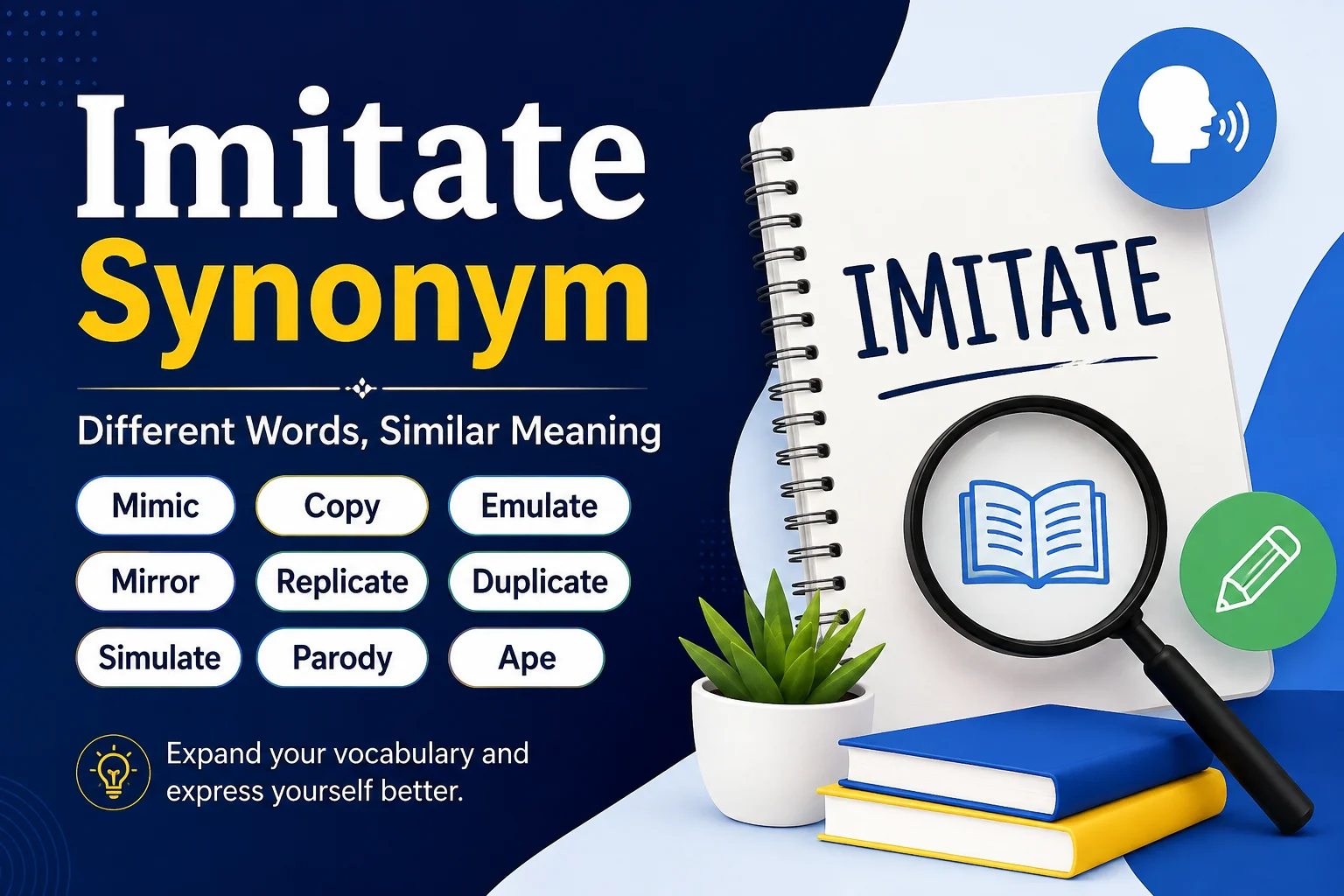
Finding the right imitate synonym can make your writing clearer, more natural, and more precise. The verb imitate is common in English, but it does not always express exactly what you mean. Depending on the situation, you may want to say copy, mimic, emulate, reproduce, or model.
Understanding these alternatives is especially useful for students, ESL learners, writers, and content creators. A good synonym can change the tone of a sentence and help you explain whether someone is copying another person’s behavior, trying to reach their level of success, reproducing a design, or simply acting like someone else.
This guide explains the meaning of imitate, provides useful synonyms with simple definitions and examples, and shows when each alternative works best. It also includes a separate explanation of demure and 30 synonyms for that word, as requested.
What Does “Imitate” Mean?
Imitate means to copy the way someone or something looks, behaves, sounds, or works.
For example:
The child tried to imitate her mother’s way of speaking.
In this sentence, imitate means the child copied the mother’s speaking style.
The word can be neutral, positive, or negative depending on the context. A student may imitate a successful writer to learn from their style, while a company may be criticized for imitating another brand’s design too closely.
Imitate as a Verb
Imitate is primarily a verb.
Simple definition:
To copy someone or something in appearance, behavior, sound, style, or action.
Examples:
- Young children often imitate their parents.
- The comedian can imitate famous actors.
- This machine imitates the movements of a human hand.
- Good leaders often have qualities that others want to imitate.
30 Useful Imitate Synonyms
Not every synonym for imitate has exactly the same meaning. Some suggest simple copying, while others suggest admiration, reproduction, or even mockery.
Here are 30 useful alternatives.
1. Copy
Meaning: To make or do something in the same way as another person or thing.
Example:
She copied her friend’s drawing.
Best usage: Everyday English and simple situations involving reproduction or duplication.
2. Mimic
Meaning: To copy someone’s voice, movements, behavior, or manner, often for entertainment.
Example:
The comedian mimicked the politician’s voice.
Best usage: Speech, behavior, gestures, and humorous imitation.
3. Emulate
Meaning: To copy someone’s qualities or achievements because you admire them and want to reach a similar level.
Example:
Many young athletes try to emulate their favorite players.
Best usage: Positive imitation, especially involving success, skills, or personal qualities.
4. Mirror
Meaning: To closely reflect or reproduce someone’s behavior, actions, or appearance.
Example:
The student mirrored her teacher’s presentation style.
Best usage: Behavior, body language, communication, and patterns.
5. Reproduce
Meaning: To create something again so that it is very similar to the original.
Example:
The museum reproduced the famous painting for educational purposes.
Best usage: Art, documents, designs, scientific results, and physical objects.
6. Replicate
Meaning: To make an exact or very close copy of something.
Example:
Scientists replicated the experiment several times.
Best usage: Science, technology, research, manufacturing, and technical writing.
7. Duplicate
Meaning: To make an exact copy of something.
Example:
Please duplicate this document for all team members.
Best usage: Documents, files, objects, records, and administrative contexts.
8. Parrot
Meaning: To repeat someone’s words or ideas without showing much original thought.
Example:
He simply parroted the opinions he heard online.
Best usage: Critical or negative descriptions of repeated speech or ideas.
9. Echo
Meaning: To repeat or reflect another person’s words, opinions, or ideas.
Example:
The article echoed concerns expressed by local residents.
Best usage: Ideas, opinions, statements, and themes.
10. Follow
Meaning: To copy someone’s example, method, or behavior.
Example:
New employees often follow the example of experienced workers.
Best usage: General behavior, examples, methods, and habits.
11. Model
Meaning: To behave in a way that others can copy or learn from.
Example:
Parents should model respectful behavior for their children.
Best usage: Education, parenting, leadership, and professional development.
12. Reflect
Meaning: To show qualities, actions, or characteristics similar to something else.
Example:
Her leadership style reflects that of her former manager.
Best usage: Formal writing and descriptions of similarities.
13. Resemble
Meaning: To look or seem similar to someone or something.
Example:
The young artist’s style resembles that of her mentor.
Best usage: Appearance, style, characteristics, and similarities.
Note: Resemble is not always a direct synonym for imitate. It describes similarity rather than an intentional act of copying.
14. Simulate
Meaning: To reproduce the conditions, behavior, or appearance of something.
Example:
The software simulates real-world driving conditions.
Best usage: Technology, training, science, medicine, and controlled environments.
15. Re-create
Meaning: To make something again, often based on an original event, object, or experience.
Example:
The filmmakers re-created the historic battle for the documentary.
Best usage: History, film, art, events, and experiences.
16. Pattern
Meaning: To base something on a particular example or model.
Example:
The designer patterned the collection after traditional clothing.
Best usage: Formal writing, design, behavior, and structures.
17. Model after
Meaning: To create or develop something based on another example.
Example:
The school was modeled after a successful education program.
Best usage: Institutions, systems, products, and organized approaches.
18. Borrow
Meaning: To take an idea, style, feature, or technique from another source.
Example:
The designer borrowed elements from traditional architecture.
Best usage: Ideas, styles, artistic techniques, and creative work.
19. Adapt
Meaning: To change something so it works in a new situation while keeping some original features.
Example:
The director adapted the novel for the screen.
Best usage: Writing, film, education, technology, and creative work.
Important: Adapt means changing something for a new purpose, so it is not the same as copying exactly.
20. Reproduce
Meaning: To make something similar to the original again.
Example:
The printer can reproduce high-quality images.
Best usage: Printing, art, manufacturing, media, and technical contexts.
21. Imitate
Meaning: To copy the actions, appearance, sound, or style of someone or something.
Example:
The child tried to imitate the dancer’s movements.
Best usage: General-purpose English.
22. Appear like
Meaning: To act or look similar to another person or thing.
Example:
He tried to appear like a confident public speaker.
Best usage: Informal descriptions of appearance or behavior.
23. Take after
Meaning: To resemble a family member in appearance or behavior.
Example:
She takes after her mother in both appearance and personality.
Best usage: Family resemblance.
24. Reenact
Meaning: To perform an event again, usually as a representation of something that happened in the past.
Example:
The actors reenacted the historical ceremony.
Best usage: History, documentaries, museums, and educational performances.
25. Shadow
Meaning: To closely follow someone and copy or learn from their actions.
Example:
The trainee shadowed the experienced technician for a week.
Best usage: Workplace training and learning through observation.
26. Appropriate
Meaning: To take or use an idea, style, or feature for one’s own purpose.
Example:
The artist appropriated elements of traditional design.
Best usage: Formal, academic, artistic, and cultural discussions.
Note: Appropriate can have complex cultural and ethical meanings, so use it carefully.
27. Borrow from
Meaning: To use an idea, style, technique, or feature from another source.
Example:
The novelist borrowed from classical mythology.
Best usage: Literature, art, design, music, and creative writing.
28. Recast
Meaning: To present an existing idea, model, or concept in a different form.
Example:
The author recast the traditional story for a modern audience.
Best usage: Writing, storytelling, academic work, and communication.
29. Draw on
Meaning: To use an existing source, idea, experience, or influence as a basis.
Example:
The designer drew on historical fashion for inspiration.
Best usage: Formal and creative writing.
30. Echo
Meaning: To closely repeat or reflect an earlier idea, style, or statement.
Example:
The new campaign echoes the company’s earlier advertising style.
Best usage: Formal writing, media, marketing, and discussions of ideas or styles.
Imitate Synonyms Comparison Table
| Synonym | Main Meaning | Tone | Best Context |
| Copy | Make or do the same thing | Neutral | Everyday English |
| Mimic | Copy actions, voice, or manner | Neutral/Playful | Speech and behavior |
| Emulate | Copy someone you admire | Positive | Achievement and skills |
| Mirror | Closely reflect behavior or style | Neutral | Behavior and communication |
| Reproduce | Make something similar again | Neutral/Formal | Art and objects |
| Replicate | Make a close or exact copy | Formal | Science and technology |
| Duplicate | Make an exact copy | Formal | Documents and files |
| Parrot | Repeat without original thought | Negative | Opinions and speech |
| Model | Provide an example others can follow | Positive | Education and leadership |
| Simulate | Reproduce conditions or behavior | Formal | Technology and training |
| Re-create | Make something again | Neutral | History and media |
| Resemble | Be similar in appearance or qualities | Neutral | Appearance and style |
| Adapt | Change an original for a new purpose | Neutral | Books, film, ideas |
| Reenact | Perform a past event again | Neutral | History and education |
| Shadow | Follow someone to learn | Neutral | Training |
| Borrow from | Use elements from another source | Neutral | Creative work |
What Is the Difference Between Copy, Mimic, and Emulate?
These three words are among the most useful alternatives to imitate, but they have different shades of meaning.
Copy is the broadest and simplest option. It can refer to copying a drawing, answer, design, behavior, or idea.
Mimic usually focuses on copying someone’s voice, movements, expressions, or mannerisms. It can be playful, humorous, or critical.
Emulate usually has a positive meaning. It means trying to achieve the same qualities or success as someone you admire.
Compare:
- Copy: He copied his friend’s homework.
- Mimic: The comedian mimicked the actor’s accent.
- Emulate: She hopes to emulate her mentor’s success.
Positive Synonyms for Imitate
When imitation is connected with learning, admiration, or personal improvement, these words work especially well:
- Emulate
- Model
- Follow
- Mirror
- Draw on
- Learn from
- Pattern after
For example:
Students can emulate successful writers by studying how they organize their ideas.
Here, emulate sounds more positive than copy because it suggests learning and improvement.
Negative or Critical Synonyms for Imitate
When you want to suggest that someone is copying without originality, consider:
- Parrot
- Copy
- Mimic
- Duplicate
- Appropriate
The correct choice depends on what you want to criticize.
For example:
The speaker merely parroted someone else’s opinion.
This suggests that the speaker repeated an idea without thinking independently.
Formal Synonyms for Imitate
For academic, professional, or technical writing, these alternatives may be more precise:
- Replicate
- Reproduce
- Simulate
- Model
- Re-create
- Reflect
- Adapt
For example:
Researchers attempted to replicate the original experiment.
This is more precise than saying:
Researchers tried to copy the experiment.
Synonyms for Imitate in Different Situations
For copying someone’s behavior
Use:
- Mimic
- Mirror
- Follow
- Model
- Emulate
For copying someone’s success
Use:
- Emulate
- Follow
- Model
- Pattern after
For copying a physical object
Use:
- Copy
- Duplicate
- Reproduce
- Replicate
- Re-create
For copying a voice or accent
Use:
- Mimic
- Imitate
- Parrot
For reproducing scientific conditions
Use:
- Replicate
- Simulate
- Reproduce
- Model
For adapting an existing idea
Use:
- Adapt
- Borrow from
- Draw on
- Recast
How to Choose the Right Imitate Synonym
Choosing the best word depends on what is being copied and why it is being copied.
If the copying is simple
Choose copy.
He copied the design.
If the copying is humorous
Choose mimic.
She mimicked her teacher’s voice.
If the copying is motivated by admiration
Choose emulate.
He wants to emulate his coach.
If the copying is exact or technical
Choose replicate.
Scientists replicated the experiment.
If something is being reproduced
Choose reproduce.
The printer reproduced the image accurately.
If someone is repeating ideas without originality
Choose parrot.
The student parroted the same argument.
If something is being changed for a new purpose
Choose adapt.
The filmmaker adapted the story for television.
The key is to consider intention, accuracy, tone, and context before selecting a synonym.
What Does “Demure” Mean?
Although demure is unrelated to imitate, it is another useful English vocabulary word with several nuanced synonyms.
Demure describes someone who behaves in a quiet, modest, reserved, or shy manner. It is often used to describe a person’s appearance, behavior, or manner.
Simple Meaning of Demure
Demure: Quiet, modest, and not likely to attract attention.
Example:
She gave a demure smile during the introduction.
The word often has a gentle or slightly old-fashioned tone. Depending on the context, demure can suggest modesty, reserved behavior, or a carefully controlled appearance.
30 Synonyms of Demure
1. Modest
Meaning: Not overly proud or attention-seeking.
Example:
She was modest about her achievements.
Best usage: General descriptions of personality and behavior.
2. Shy
Meaning: Uncomfortable around attention or unfamiliar people.
Example:
The shy student avoided speaking in front of the class.
Best usage: Social situations and personality.
3. Reserved
Meaning: Quiet and not likely to express feelings openly.
Example:
He was reserved during the meeting.
Best usage: Personality and social behavior.
4. Quiet
Meaning: Not loud, energetic, or attention-seeking.
Example:
She has a quiet and gentle personality.
Best usage: Everyday English.
5. Bashful
Meaning: Shy or easily embarrassed.
Example:
The bashful child hid behind her mother.
Best usage: Friendly, informal descriptions.
6. Retiring
Meaning: Avoiding attention and preferring a private life.
Example:
The retiring artist rarely appeared in public.
Best usage: Formal or literary writing.
7. Unassuming
Meaning: Not trying to appear important or impressive.
Example:
Despite his success, he remained unassuming.
Best usage: Personality and character descriptions.
8. Meek
Meaning: Gentle and not aggressive or forceful.
Example:
The meek speaker rarely challenged others.
Best usage: Personality, especially when gentleness is emphasized.
9. Mild
Meaning: Gentle and not extreme in behavior.
Example:
She has a mild and pleasant manner.
Best usage: Personality and temperament.
10. Gentle
Meaning: Kind, calm, and soft in manner.
Example:
He spoke in a gentle voice.
Best usage: Personality, speech, and behavior.
11. Subdued
Meaning: Quiet, restrained, or less energetic than usual.
Example:
She wore a subdued expression during the ceremony.
Best usage: Mood, behavior, appearance, and style.
12. Restrained
Meaning: Controlled and not openly expressive.
Example:
His response was restrained and polite.
Best usage: Formal descriptions of behavior or emotion.
13. Unobtrusive
Meaning: Not attracting attention or disturbing others.
Example:
She chose an unobtrusive style for the event.
Best usage: Appearance, behavior, and design.
14. Discreet
Meaning: Careful not to attract attention or reveal private information.
Example:
He was discreet about the private conversation.
Best usage: Behavior, privacy, and professional settings.
15. Soft-spoken
Meaning: Speaking quietly and gently.
Example:
The soft-spoken teacher was easy to listen to.
Best usage: Voice and communication style.
16. Timid
Meaning: Lacking confidence or courage in social situations.
Example:
The timid child was afraid to answer.
Best usage: Shyness and lack of confidence.
17. Coy
Meaning: Shy or pretending to be shy, sometimes in a playful way.
Example:
She gave a coy smile.
Best usage: Social behavior, especially when playfulness is intended.
18. Demure
Meaning: Quiet, modest, reserved, or shy.
Example:
She maintained a demure manner throughout the event.
Best usage: Modest appearance and reserved behavior.
19. Proper
Meaning: Behaving according to accepted social standards.
Example:
She maintained a proper manner at the formal dinner.
Best usage: Social behavior and etiquette.
20. Well-mannered
Meaning: Polite and respectful in behavior.
Example:
The well-mannered child thanked everyone.
Best usage: Children, social behavior, and etiquette.
21. Polite
Meaning: Showing good manners and respect.
Example:
He was polite to every guest.
Best usage: Everyday and professional English.
22. Decent
Meaning: Respectable and appropriate in behavior or appearance.
Example:
She chose a decent outfit for the formal event.
Best usage: Behavior, appearance, and social standards.
23. Decorous
Meaning: Behaving in a socially appropriate and respectable way.
Example:
The guests maintained a decorous atmosphere.
Best usage: Formal and literary writing.
24. Composed
Meaning: Calm and in control of one’s emotions.
Example:
She remained composed during the difficult conversation.
Best usage: Professional and formal situations.
25. Calm
Meaning: Peaceful and not emotionally excited.
Example:
He remained calm throughout the discussion.
Best usage: Everyday English.
26. Serene
Meaning: Very calm and peaceful.
Example:
She had a serene expression on her face.
Best usage: Literary descriptions and emotional states.
27. Dignified
Meaning: Calm, respectable, and worthy of respect.
Example:
She maintained a dignified presence throughout the ceremony.
Best usage: Formal occasions and character descriptions.
28. Demure-looking
Meaning: Having a quiet, modest, or reserved appearance.
Example:
The character had a demure-looking style.
Best usage: Describing appearance informally.
29. Modest-looking
Meaning: Having a simple and restrained appearance.
Example:
She chose a modest-looking dress.
Best usage: Clothing and appearance.
30. Unpretentious
Meaning: Simple and not designed to impress others.
Example:
He had an unpretentious personality.
Best usage: Personality, lifestyle, and appearance.
Demure Synonyms Comparison Guide
| Word | Main Idea | Tone | Best Context |
| Modest | Not attention-seeking | Positive | Personality and appearance |
| Shy | Uncomfortable with attention | Neutral | Social situations |
| Reserved | Emotionally private | Neutral | Personality |
| Bashful | Easily embarrassed | Gentle | Informal descriptions |
| Unassuming | Not self-important | Positive | Character |
| Meek | Gentle and passive | Neutral/Negative | Personality |
| Soft-spoken | Quiet voice | Positive | Speech |
| Timid | Lacking confidence | Negative/Neutral | Personality |
| Coy | Shy in a playful way | Playful | Social behavior |
| Restrained | Emotionally controlled | Formal | Behavior |
| Discreet | Careful and private | Positive | Professional situations |
| Decorous | Proper and respectable | Formal | Social settings |
| Composed | Calm and controlled | Positive | Difficult situations |
| Serene | Peaceful and calm | Positive | Literary descriptions |
| Dignified | Respectable and composed | Formal | Ceremonies and character |
How to Choose the Right Demure Synonym
If you mean quiet and shy, choose shy, bashful, or timid.
If you mean modest and not attention-seeking, choose modest, unassuming, or unpretentious.
If you mean quiet in social situations, choose reserved or retiring.
If you mean calm and emotionally controlled, choose composed or restrained.
If you mean polite and socially appropriate, choose proper, polite, decorous, or well-mannered.
If you mean quietly attractive or playfully shy, coy may be appropriate.
The best word depends on the exact quality you want to emphasize.
Common Mistakes When Using Imitate Synonyms
Using “Resemble” When You Mean Intentional Copying
Resemble describes similarity, but it does not necessarily mean that someone deliberately copied something.
The two buildings resemble each other.
This does not tell us that one architect copied the other.
Using “Emulate” for Exact Copying
Emulate usually involves trying to match someone’s qualities or achievements rather than making an exact duplicate.
She emulates her favorite author.
This means she tries to learn from or match the author’s qualities.
Using “Mimic” in Formal Technical Writing
Mimic can sound informal or suggest playful copying. In technical contexts, replicate, reproduce, or simulate may be more accurate.
Using “Copy” Everywhere
Although copy is easy and correct in many situations, repeating it throughout an article can make writing feel basic or repetitive. More precise alternatives improve vocabulary and communication.
Imitate Synonym Examples in Everyday English
Here are a few natural examples showing how different words work:
- Children often imitate the adults around them.
- The comedian mimicked the actor’s voice.
- She emulated her teacher’s dedication.
- The researcher replicated the experiment.
- The program simulated a real driving environment.
- The artist reproduced the historical painting.
- He copied the design.
- The student parroted the same argument.
- The new building resembles the original.
- The company adapted the successful business model.
Each sentence communicates a slightly different idea. This is why choosing the right synonym matters.
Why Learning Synonyms Improves Your English
Learning synonyms is not simply about memorizing long word lists. The real benefit is understanding meaning and context.
For ESL learners, synonyms help make communication more flexible. Instead of using copy repeatedly, you can choose mimic when talking about behavior, emulate when discussing admiration, or replicate when discussing scientific research.
For writers, precise vocabulary also improves clarity. A carefully chosen word tells readers exactly what you mean without requiring a long explanation.
For students and content creators, understanding these distinctions can make essays, articles, presentations, and other forms of writing sound more natural and professional.
Frequently Asked Questions About Imitate Synonyms
What is the best synonym for imitate?
There is no single best synonym. Copy is the simplest general alternative, while mimic, emulate, replicate, and reproduce are better in specific contexts.
What is a positive synonym for imitate?
Emulate is one of the best positive alternatives. It usually suggests copying someone because you admire their qualities or achievements.
What is a synonym for imitate in academic writing?
Depending on the context, replicate, reproduce, model, or simulate can work well in academic writing.
What is a synonym for imitate someone?
Useful choices include mimic, emulate, copy, mirror, and model yourself after.
Is “copy” the same as “imitate”?
They are closely related, but they are not always identical. Copy often suggests making something the same, while imitate can involve copying someone’s behavior, style, appearance, or manner.
What is the difference between imitate and emulate?
Imitate is a broad term for copying. Emulate usually means copying someone because you admire them and want to achieve a similar level of success or quality.
What is the difference between imitate and mimic?
Mimic commonly refers to copying a person’s voice, movements, expressions, or behavior. It can have a humorous or critical meaning, while imitate is more neutral.
Final Thoughts on Imitate Synonyms
The best imitate synonym depends on your intended meaning. Use copy for simple everyday situations, mimic for voices and behavior, emulate for positive admiration, replicate for exact technical reproduction, and reproduce when creating something similar to an original.
Other alternatives such as mirror, model, simulate, duplicate, reenact, adapt, and borrow from can provide even greater precision. The important point is not to replace imitate with a random synonym. Instead, choose the word that accurately expresses the action, intention, and tone.
For English learners and writers, this approach builds stronger vocabulary and more natural communication. Learning the difference between closely related words is one of the easiest ways to make your English more precise, confident, and effective.

I am Axel James, a passionate writer who loves exploring synonyms and alternative words. I enjoy helping readers improve their vocabulary and express ideas clearly.