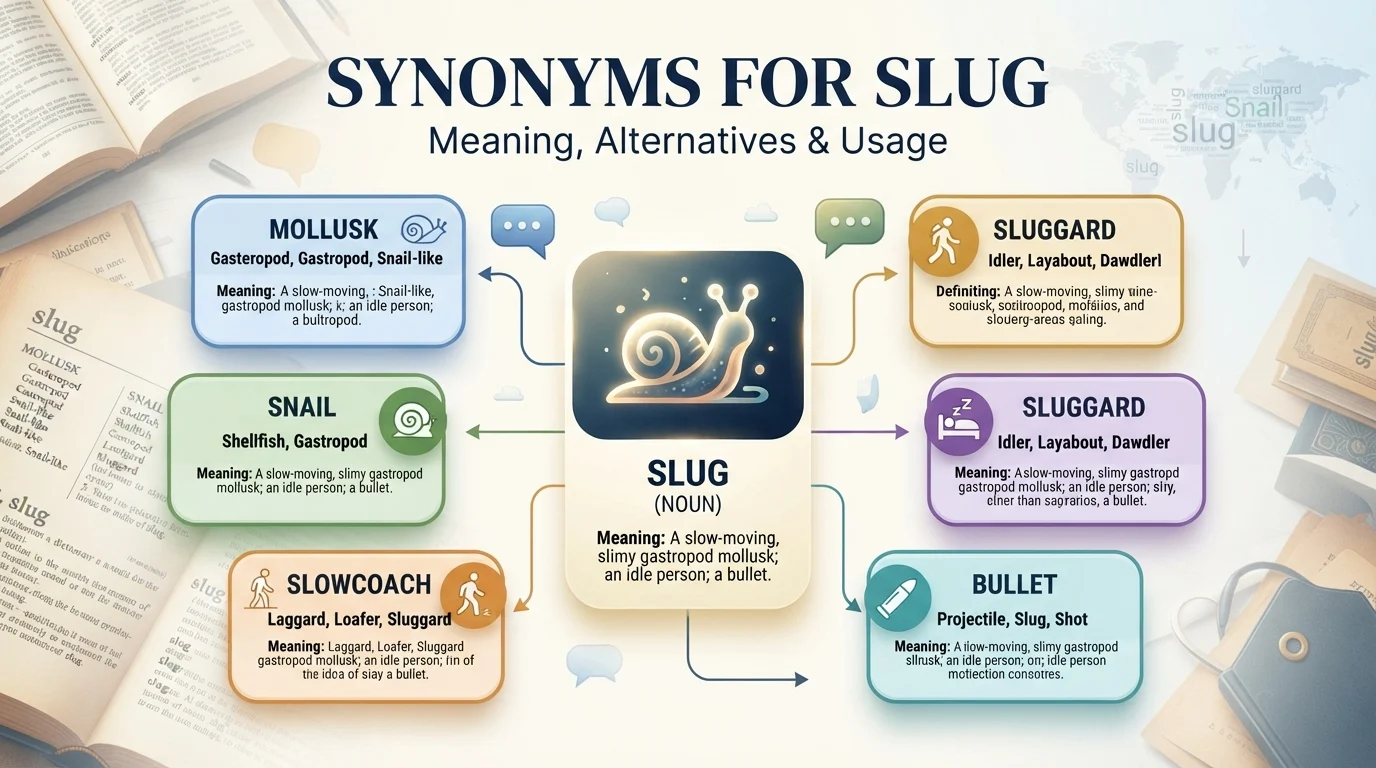
If you are looking for synonyms for slug, the right replacement depends on what you mean by the word. “Slug” can describe a slow-moving person, a soft-bodied garden creature, a heavy hit, a drink of liquid, or even a short piece of text used in publishing and web development. Because the word has several meanings, there is no single synonym that works in every situation.
Understanding the different meanings of “slug” can help you choose a more accurate word. For example, you might use snail when talking about a garden animal, blow when describing a hard hit, or sip when referring to a small amount of a drink. In writing, choosing the right synonym makes your sentences clearer and more natural.
This guide explains 30 useful synonyms and related words for “slug” in simple English. It also shows example sentences, usage contexts, and tips for selecting the best alternative depending on your meaning and tone.
What Does “Slug” Mean?
The word slug has several common meanings in English.
As a noun, a slug can mean a soft-bodied animal similar to a snail but without a visible shell.
Example:
The slug moved slowly across the wet garden path.
“Slug” can also mean a strong hit or punch.
Example:
He took a slug to the shoulder during the fight.
In informal English, slug can refer to a small amount of a drink, especially alcohol.
Example:
He added a slug of whiskey to his coffee.
As a verb, to slug can mean to hit someone hard.
Example:
The two players began to slug each other.
In publishing, journalism, and web development, a slug can also refer to a short identifying piece of text, often used in a URL or as an internal label.
Because of these different meanings, the best synonym depends on the context.
30 Synonyms for Slug
Below are 30 useful synonyms and related words for “slug.” Some are direct synonyms, while others are context-specific alternatives that work better for particular meanings.
1. Snail
Meaning: A slow-moving, soft-bodied animal that usually has a shell.
Example:
The snail crawled slowly across the leaf.
Best usage context: Use “snail” when discussing a similar garden creature. Remember that a slug technically does not have the visible shell associated with most snails.
2. Mollusk
Meaning: A soft-bodied animal belonging to the mollusk family.
Example:
The slug is a type of land mollusk.
Best usage context: Use this in scientific, educational, or biological writing.
3. Gastropod
Meaning: A type of mollusk that moves using a muscular foot.
Example:
The slug is a common terrestrial gastropod.
Best usage context: Best for biology, science, and technical contexts.
4. Creature
Meaning: A living animal or being.
Example:
A tiny creature was hiding beneath the flowerpot.
Best usage context: Use “creature” when you want a general, neutral description rather than a scientific term.
5. Animal
Meaning: A living organism that is not a plant.
Example:
The small animal moved slowly through the grass.
Best usage context: Suitable for general writing when the exact species is not important.
6. Crawler
Meaning: Something that moves by crawling.
Example:
The children watched the little crawler move across the ground.
Best usage context: Informal or descriptive writing, especially when focusing on movement.
7. Creeper
Meaning: Something that moves slowly or close to the ground.
Example:
A small creeper appeared under the garden stones.
Best usage context: Useful in descriptive or informal writing, although it is not a precise biological synonym.
8. Punch
Meaning: A forceful hit made with the hand.
Example:
The boxer landed a powerful punch.
Best usage context: Use “punch” when “slug” means a hard physical hit.
9. Blow
Meaning: A strong hit or strike.
Example:
He suffered a painful blow to the head.
Best usage context: Useful in sports, fights, accidents, and figurative descriptions.
10. Hit
Meaning: An act of striking someone or something.
Example:
The player took a hard hit during the game.
Best usage context: One of the simplest and most general alternatives to “slug.”
11. Strike
Meaning: A deliberate or forceful hit.
Example:
The fighter delivered a quick strike.
Best usage context: Suitable for formal, sports, military, or action-related writing.
12. Smack
Meaning: A sharp or forceful hit.
Example:
The ball gave him a smack on the arm.
Best usage context: Informal writing and conversational English.
13. Wallop
Meaning: A very strong hit.
Example:
The boxer gave his opponent a powerful wallop.
Best usage context: Informal and expressive writing. It emphasizes strength.
14. Bash
Meaning: A hard hit or violent strike.
Example:
He gave the old door a bash with his shoulder.
Best usage context: Informal English, especially when describing a forceful action.
15. Thump
Meaning: A heavy or dull hit.
Example:
He gave the punching bag a heavy thump.
Best usage context: Good when you want to emphasize the sound or heaviness of a hit.
16. Knock
Meaning: A hit or strike, often relatively light.
Example:
He gave the door a knock before entering.
Best usage context: Use when “slug” refers to striking something, particularly in less violent situations.
17. Strike Down
Meaning: To hit someone or something hard enough to bring them down.
Example:
The powerful blow struck him down.
Best usage context: More dramatic or literary writing.
18. Clobber
Meaning: To hit someone hard or defeat them decisively.
Example:
The team clobbered its opponents in the final match.
Best usage context: Informal English. It can describe physical fighting or a decisive defeat.
19. Assault
Meaning: To attack someone physically.
Example:
The suspect was accused of assault.
Best usage context: Formal or legal contexts. It is stronger and more serious than the casual word “slug.”
20. Hit Hard
Meaning: To strike someone or something with considerable force.
Example:
The player hit the ball hard.
Best usage context: Everyday English, especially sports and physical actions.
21. Sip
Meaning: A small amount of liquid taken into the mouth.
Example:
She took a sip of her coffee.
Best usage context: Use “sip” when “slug” means a small drink or amount of liquid.
22. Swig
Meaning: A large or quick drink.
Example:
He took a swig of water after running.
Best usage context: Informal English when describing a quick or fairly large drink.
23. Gulp
Meaning: To swallow a large amount quickly.
Example:
He took a gulp of water.
Best usage context: Use this when the drinking action is quick or involves a larger mouthful.
24. Draught
Meaning: A measured amount of liquid that is drunk at one time.
Example:
He took a draught of cold water.
Best usage context: Literary, traditional, or formal writing. “Draft” is the common American spelling in some contexts, but meanings can differ.
25. Mouthful
Meaning: An amount of food or drink that can fit in the mouth.
Example:
She took a mouthful of juice.
Best usage context: Everyday descriptions of eating and drinking.
26. Drink
Meaning: A general term for taking liquid into the mouth and swallowing it.
Example:
He took a drink of water.
Best usage context: The simplest replacement when the exact size or style of the drink is not important.
27. Portion
Meaning: A particular amount of something.
Example:
He added a small portion of the liquid to the mixture.
Best usage context: Useful when “slug” means an amount rather than the act of drinking.
28. Amount
Meaning: A quantity of something.
Example:
Add a small amount of milk to the coffee.
Best usage context: Neutral and general-purpose writing.
29. Label
Meaning: A short name or identifying text attached to something.
Example:
The editor gave the story a temporary label.
Best usage context: Useful when explaining the publishing or editorial meaning of “slug.”
30. Identifier
Meaning: A word, name, or code used to identify something.
Example:
The article uses a short identifier in its web address.
Best usage context: Technical, publishing, and web-development contexts.
Synonyms for Slug by Meaning
Because “slug” has multiple meanings, it helps to group its alternatives according to context.
| Meaning of “Slug” | Best Synonyms or Alternatives | Common Context |
| Garden animal | snail, mollusk, gastropod | Biology and gardening |
| General creature | animal, creature, crawler | Everyday descriptions |
| Hard hit | punch, blow, strike, hit | Sports and physical conflict |
| Strong hit | wallop, bash, clobber, thump | Informal English |
| Small drink | sip, drink, draught | Food and beverages |
| Large drink | swig, gulp | Informal conversation |
| Amount of liquid | amount, portion, mouthful | General descriptions |
| Web/publishing text | label, identifier | SEO, URLs, publishing |
Synonyms for Slug When You Mean a Garden Animal
If you are talking about the slimy creature commonly found in gardens, the most useful alternatives are mollusk, gastropod, creature, and, in some contexts, snail.
However, “snail” is not always an exact synonym because snails generally have visible shells while slugs do not.
For scientific writing, gastropod is more precise. For everyday writing, creature or animal may sound more natural.
Synonyms for Slug When You Mean a Hit
When “slug” describes a physical hit, you have many alternatives.
Punch is the clearest choice when someone is hit with a fist.
Blow is broader and can describe many types of physical impact.
Strike sounds more formal and works well in sports or action writing.
Wallop and bash are informal and emphasize force.
For example:
- He threw a punch.
- He suffered a heavy blow.
- The boxer delivered a powerful strike.
- He gave the bag a hard thump.
- The fighter landed a tremendous wallop.
Synonyms for Slug When You Mean a Drink
In informal English, “slug” can describe an amount of a drink.
The best alternative depends on how much liquid you mean.
Use sip for a small amount.
Use swig for a larger or quick drink.
Use gulp when someone swallows quickly.
Use drink when you want a simple, neutral expression.
For example:
- She took a sip of tea.
- He took a swig of water.
- She had a quick gulp of juice.
- He took a drink before continuing.
Synonyms for Slug in Publishing and SEO
“Slug” also has a specialized meaning in publishing, content management, and web development.
A URL slug is the readable part of a web address that identifies a particular page. For example, a website might use a URL ending in something like:
/synonyms-for-slug/
In this context, words such as identifier, label, or URL identifier can help explain the concept, although they are not always exact technical synonyms.
A good URL slug is usually short, descriptive, readable, and relevant to the page. For SEO purposes, it is generally better to use meaningful words instead of unnecessary numbers or complicated characters.
How to Choose the Right Synonym for Slug
Choosing the right synonym depends first on identifying which meaning of “slug” you are using.
For an Animal
Choose:
- Gastropod for scientific writing
- Mollusk for biological explanations
- Creature for general descriptions
- Crawler for informal descriptive writing
For a Physical Hit
Choose:
- Punch for a fist strike
- Blow for a general physical impact
- Strike for formal or sports writing
- Wallop for an especially strong hit
- Bash for informal descriptions
For a Drink
Choose:
- Sip for a small amount
- Swig for a quick or larger drink
- Gulp for rapid swallowing
- Drink for a neutral expression
- Mouthful for a specific amount
For Web Publishing
Choose:
- Identifier for technical explanations
- Label for general editorial descriptions
- URL slug when referring specifically to the web address component
Slug Synonyms: Formal vs. Informal
Some alternatives to “slug” are more appropriate for formal writing, while others are strongly conversational.
| Formal or Neutral | Informal or Expressive |
| gastropod | crawler |
| mollusk | creeper |
| strike | smack |
| blow | wallop |
| assault | bash |
| amount | swig |
| identifier | gulp |
For academic or professional writing, prefer precise terms such as gastropod, strike, blow, or identifier.
For casual writing, words such as wallop, bash, swig, and smack can make the language more vivid.
Common Mistakes When Using Slug Synonyms
One common mistake is assuming that every synonym can replace “slug” in every sentence.
For example, “gastropod” works when “slug” refers to an animal, but it cannot replace “slug” when the word means a punch.
Similarly, “sip” can describe a small drink, but it cannot describe a physical hit.
Another mistake is ignoring tone. Words such as assault have much stronger and more serious meanings than casual words such as smack or thump.
Always consider both the meaning and the tone before choosing a replacement.
Slug Synonyms in Example Sentences
Here are some quick examples showing how different alternatives work naturally.
- The gastropod moved across the wet soil.
- The child found a small creature under a rock.
- The boxer landed a powerful punch.
- She suffered a heavy blow during the match.
- The player delivered a quick strike.
- He gave the punching bag a hard thump.
- The fighter landed a tremendous wallop.
- She took a small sip of tea.
- He took a quick swig of water.
- The article uses a short URL identifier.
- The editor created a descriptive label for the story.
Frequently Asked Questions About Synonyms for Slug
What is the best synonym for slug?
There is no single best synonym because “slug” has several meanings. For an animal, gastropod is precise. For a hit, punch or blow may work. For a drink, sip or swig may be appropriate.
What is a synonym for slug meaning punch?
Common alternatives include punch, blow, hit, strike, smack, wallop, bash, and thump.
What is another word for a slug animal?
Depending on context, you can use gastropod, mollusk, creature, or animal. “Snail” may be used in general comparisons, but it is not always technically precise.
What is a synonym for slug meaning drink?
Depending on the amount and manner of drinking, possible alternatives include sip, swig, gulp, drink, and draught.
Is “snail” a synonym for “slug”?
“Snail” can sometimes be used as a related everyday term, but it is not an exact synonym. Slugs and snails are both gastropods, but snails generally have a visible shell while slugs do not.
What is the opposite of slug?
The opposite depends on the meaning. If “slug” means moving slowly, possible contrasting ideas include hurry, rush, or speed. If it means a hit, the opposite might be protect, avoid, or defend, depending on the sentence.
Final Thoughts on Synonyms for Slug
The word slug is more versatile than it may first appear. It can describe a garden animal, a powerful hit, an amount of liquid, or a technical term used in publishing and web development. That is why selecting the right synonym requires attention to context.
For an animal, words such as gastropod, mollusk, and creature can work well. For a physical hit, consider punch, blow, strike, bash, or wallop. When referring to a drink, sip, swig, and gulp may be more natural choices. In SEO and publishing, identifier or label can help explain the specialized meaning.
The most effective synonym is not always the most complicated word. Choose the word that communicates your exact meaning, matches your tone, and sounds natural in the sentence. This approach will make your writing clearer, more precise, and easier for readers to understand.

I am Axel James, a passionate writer who loves exploring synonyms and alternative words. I enjoy helping readers improve their vocabulary and express ideas clearly.