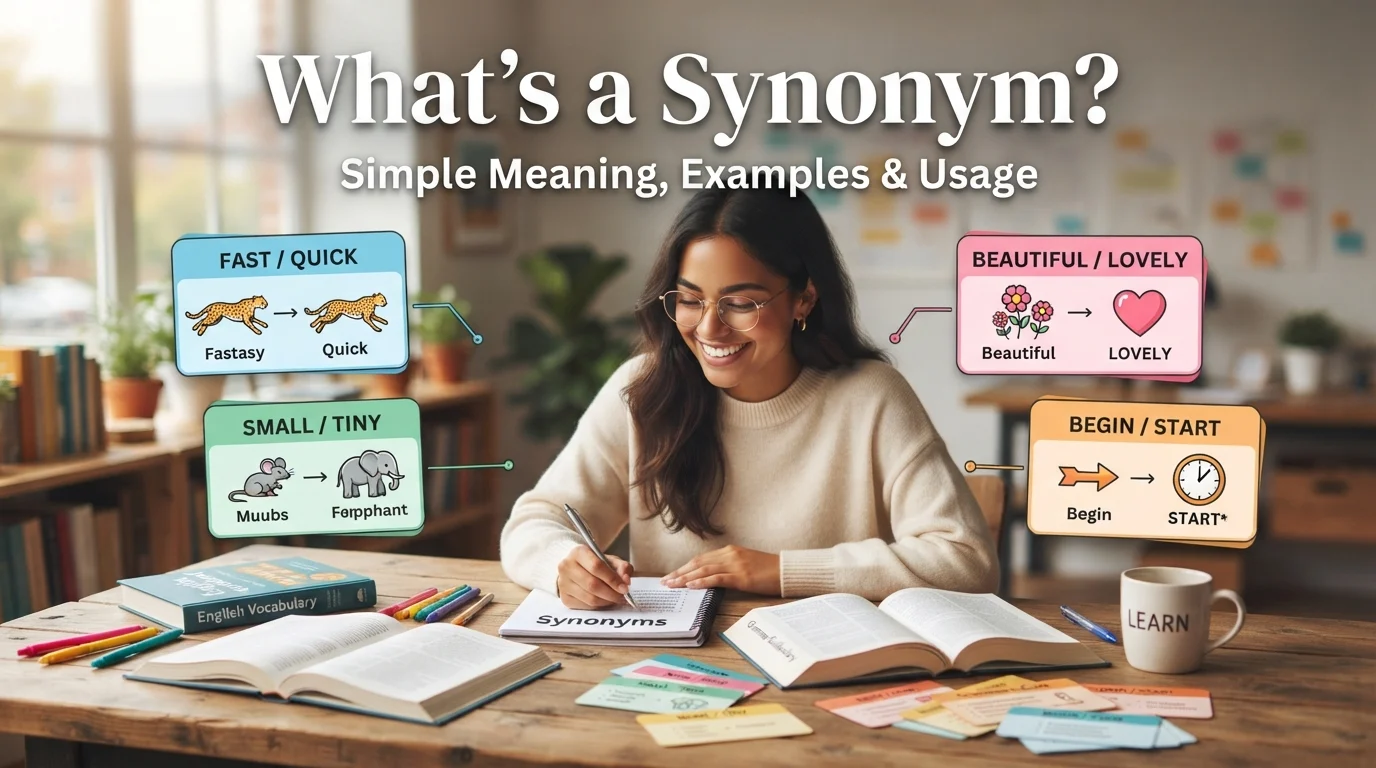
If you have ever asked, “what’s a synonym?”, you are looking for a word that has the same or nearly the same meaning as another word. Synonyms are an important part of English because they help you avoid repetition, choose more precise words, and make your writing sound natural.
Understanding synonyms is especially useful for students, ESL learners, writers, and content creators. For example, instead of repeating “happy” several times, you might use words such as “joyful,” “cheerful,” or “delighted.” The best synonym depends on the exact meaning, tone, and situation.
In this guide, we will answer what’s a synonym in simple English, explain how synonyms work, and then explore 30 useful synonyms for demure. Each word includes a simple meaning, an example sentence, and guidance on when it is most appropriate.
What’s a Synonym?
A synonym is a word that has the same or a similar meaning as another word.
For example:
- Big → large, huge, enormous
- Happy → joyful, cheerful, pleased
- Fast → quick, rapid, speedy
- Quiet → silent, peaceful, still
Synonyms are not always perfectly interchangeable. Two words may have similar meanings but differ in strength, formality, emotion, or context.
For instance, “quiet” and “silent” are related, but “silent” usually suggests a complete absence of sound. This is why choosing the right synonym requires more than simply finding a word with a similar dictionary definition.
Why Are Synonyms Important?
Synonyms make communication more flexible and precise. They allow you to express an idea in a way that matches your intended tone.
For students, synonyms can expand vocabulary and improve essays. ESL learners can use them to understand the subtle differences between similar English words. Writers and content creators can use synonyms to make their work more varied and engaging.
Using the right synonym can also prevent repetitive writing. However, a more complicated word is not automatically a better word. The goal is to select the word that communicates your meaning most clearly.
What Does Demure Mean?
Demure is an adjective used to describe someone who behaves in a quiet, modest, reserved, or somewhat shy way.
A demure person may appear calm and well-mannered rather than loud, bold, or attention-seeking. The word is often associated with modest behavior, appearance, or manner.
For example:
“She gave a demure smile when everyone complimented her.”
Here, “demure” suggests that her smile was modest, restrained, and somewhat shy.
The tone of demure is usually gentle and positive, although its meaning can change slightly depending on context. In modern English, it can describe someone’s behavior, expression, style, or appearance.
30 Synonyms of Demure
Below are 30 useful words related to demure. Some are close synonyms, while others overlap with particular aspects of the word, such as modesty, shyness, quietness, or reserve.
1. Modest
Meaning: Not overly proud, showy, or attention-seeking.
Example:
“She wore a modest dress to the formal event.”
Best usage context: Use “modest” when emphasizing restrained behavior, appearance, or self-presentation.
2. Reserved
Meaning: Quiet and not very open about your feelings or thoughts.
Example:
“He was reserved when meeting the new members of the team.”
Best usage context: Best for someone who is socially quiet or emotionally restrained.
3. Shy
Meaning: Nervous or uncomfortable around other people, especially strangers.
Example:
“The shy student spoke softly during the presentation.”
Best usage context: Use it when nervousness or lack of confidence is important.
4. Retiring
Meaning: Quiet and unwilling to attract attention.
Example:
“She had a retiring personality and preferred small gatherings.”
Best usage context: A more literary or formal choice for a quiet, withdrawn person.
5. Unassuming
Meaning: Not trying to impress others or appear important.
Example:
“Despite his success, he remained unassuming.”
Best usage context: Excellent for describing humble, low-key personalities.
6. Meek
Meaning: Gentle and unlikely to argue, challenge, or demand attention.
Example:
“The meek child waited patiently for her turn.”
Best usage context: Use carefully because “meek” can sometimes suggest weakness or a lack of assertiveness.
7. Mild
Meaning: Gentle, calm, or not extreme.
Example:
“She has a mild and pleasant manner.”
Best usage context: Useful when focusing on a gentle personality rather than modest appearance.
8. Gentle
Meaning: Kind, calm, and soft in manner.
Example:
“Her gentle nature made everyone feel comfortable.”
Best usage context: Best when the person’s kindness and calm behavior are more important than shyness.
9. Quiet
Meaning: Making little noise or not speaking much.
Example:
“She was quiet during the long meeting.”
Best usage context: Use when focusing mainly on lack of speech or noise.
10. Soft-spoken
Meaning: Speaking in a quiet and gentle voice.
Example:
“The soft-spoken teacher explained the lesson patiently.”
Best usage context: Particularly useful for describing someone’s voice or speaking style.
11. Bashful
Meaning: Easily embarrassed or shy, especially when receiving attention.
Example:
“She became bashful when her friends praised her.”
Best usage context: A warm, often playful word for shy behavior.
12. Unobtrusive
Meaning: Not noticeable or not drawing attention to yourself.
Example:
“He chose an unobtrusive position near the back of the room.”
Best usage context: Good for people, actions, designs, or objects that do not attract attention.
13. Self-effacing
Meaning: Not drawing attention to your own abilities or achievements.
Example:
“Her self-effacing attitude made her easy to work with.”
Best usage context: Particularly useful when describing humility about personal accomplishments.
14. Humble
Meaning: Not believing that you are better or more important than others.
Example:
“Even after winning the award, she remained humble.”
Best usage context: Best when modesty relates to achievements, status, or personal qualities.
15. Unpretentious
Meaning: Simple and natural rather than fancy or designed to impress.
Example:
“His unpretentious style made him approachable.”
Best usage context: Useful for people, places, clothing, lifestyles, or writing styles.
16. Subdued
Meaning: Quiet, restrained, or not very strong or noticeable.
Example:
“She wore subdued colors to the ceremony.”
Best usage context: Particularly useful for appearance, emotions, colors, or behavior.
17. Demurely
Meaning: In a modest, reserved, or shy manner.
Example:
“She smiled demurely at the compliment.”
Best usage context: Use as an adverb when describing how someone performs an action.
18. Coy
Meaning: Shy or pretending to be shy, sometimes in a playful or flirtatious way.
Example:
“She gave a coy smile before answering the question.”
Best usage context: Useful when there is a playful, teasing, or flirtatious element.
19. Modest-looking
Meaning: Having a simple, restrained, or not attention-seeking appearance.
Example:
“She chose a modest-looking outfit for the interview.”
Best usage context: Helpful when describing physical appearance or clothing.
20. Dignified
Meaning: Calm, serious, and worthy of respect.
Example:
“She maintained a dignified manner throughout the ceremony.”
Best usage context: Best when composure and self-respect are more important than shyness.
21. Composed
Meaning: Calm and in control of your emotions.
Example:
“Although she was nervous, she remained composed.”
Best usage context: Use when someone stays calm under pressure.
22. Restrained
Meaning: Controlled and not excessive in emotion, behavior, or expression.
Example:
“His restrained response showed remarkable self-control.”
Best usage context: Good for formal writing and situations involving controlled emotions or behavior.
23. Proper
Meaning: Behaving in a socially acceptable, appropriate, or respectable way.
Example:
“She maintained a proper manner during the formal dinner.”
Best usage context: Use when social manners or expected behavior are central.
24. Prim
Meaning: Very proper, formal, or carefully controlled in appearance or behavior.
Example:
“She sat with a prim expression during the meeting.”
Best usage context: Often used for deliberately formal or overly proper behavior and can carry a slightly critical tone.
25. Demure
Meaning: Quiet, modest, reserved, and somewhat shy in manner or appearance.
Example:
“Her demure expression made her seem calm and reserved.”
Best usage context: Use when several qualities—modesty, reserve, and quietness—come together.
26. Introverted
Meaning: More comfortable focusing inward or spending time alone than seeking social stimulation.
Example:
“He is introverted and enjoys working independently.”
Best usage context: Use when describing personality and social preferences rather than manners or appearance.
27. Withdrawn
Meaning: Avoiding social interaction or keeping away from other people.
Example:
“She became withdrawn after moving to the new city.”
Best usage context: Best when someone actively pulls away from social interaction; it can sound more negative than “demure.”
28. Discreet
Meaning: Careful not to attract attention or reveal private information.
Example:
“She was discreet when discussing the sensitive matter.”
Best usage context: Best for careful behavior, privacy, or avoiding unnecessary attention.
29. Unassertive
Meaning: Not strongly expressing opinions, needs, or demands.
Example:
“His unassertive communication style sometimes made his ideas difficult to notice.”
Best usage context: Use when describing someone who does not strongly push their opinions or wishes.
30. Ladylike
Meaning: Traditionally associated with polite, graceful, and socially respectable feminine behavior.
Example:
“Her graceful and ladylike manner attracted positive attention.”
Best usage context: Use cautiously because the term is traditional and can reflect older ideas about feminine behavior.
Demure Synonyms Comparison Table
| Synonym | Main idea | Tone | Best for |
| Modest | Not showy | Positive/neutral | Appearance and behavior |
| Reserved | Emotionally or socially quiet | Neutral | Personality |
| Shy | Nervous around others | Neutral | Social situations |
| Retiring | Avoids attention | Formal/literary | Personality |
| Unassuming | Not trying to impress | Positive | Personality |
| Meek | Gentle and submissive | Neutral/negative | Behavior |
| Soft-spoken | Quiet voice | Positive | Speech |
| Bashful | Easily embarrassed | Warm/playful | Social reactions |
| Humble | Not proud | Positive | Achievements |
| Coy | Playfully shy | Playful | Expressions/social situations |
| Dignified | Calm and respectable | Positive/formal | Behavior |
| Composed | Calm under pressure | Positive | Emotional control |
| Restrained | Controlled | Formal | Emotions/behavior |
| Subdued | Quiet or understated | Neutral | Appearance/emotions |
| Withdrawn | Socially distant | Often negative | Personality |
| Unassertive | Not forceful | Neutral/negative | Communication |
Demure vs. Modest
Demure and modest are closely related, but they are not identical.
“Modest” often describes clothing, behavior, achievements, or attitude. “Demure” usually focuses more on a person’s quiet, reserved, and modest manner or appearance.
For example:
Modest: “She chose modest clothing.”
Demure: “She gave a demure smile.”
The first sentence focuses on appearance. The second focuses on behavior and expression.
Demure vs. Shy
A shy person may feel nervous or uncomfortable around other people. A demure person may simply behave in a quiet, modest, and reserved way.
Someone can therefore be demure without being genuinely shy.
For example, a confident person might deliberately use a quiet and modest manner in a formal situation. Calling that person “shy” would not necessarily be accurate.
Demure vs. Reserved
Reserved describes someone who does not openly express thoughts or emotions.
Demure adds an idea of modesty and sometimes graceful or traditionally proper behavior.
A person can be reserved without appearing demure, particularly if they are simply private or emotionally distant.
Demure vs. Coy
These words can both describe a shy-looking manner, but coy often suggests deliberate or playful shyness.
Demure is generally more neutral and emphasizes modesty and reserve.
For example, a demure smile may appear modest and restrained, while a coy smile may suggest teasing or flirtation.
How to Choose the Right Synonym
Choosing the right synonym depends on what you actually want to communicate.
When You Mean “Not Showy”
Choose:
- Modest
- Unassuming
- Unpretentious
- Humble
These words work well when someone does not try to impress others.
When You Mean “Quiet or Private”
Choose:
- Reserved
- Quiet
- Retiring
- Withdrawn
- Introverted
These are useful when the main idea is limited social interaction or self-expression.
When You Mean “Shy”
Choose:
- Shy
- Bashful
- Coy
These words emphasize shyness, although “coy” can also suggest playful or intentional behavior.
When You Mean “Calm and Controlled”
Choose:
- Composed
- Restrained
- Dignified
- Subdued
These are particularly useful when describing someone’s reaction, emotions, or behavior in a serious situation.
When You Mean “Gentle”
Choose:
- Gentle
- Mild
- Meek
- Soft-spoken
These words work when a person’s manner is calm, kind, or non-aggressive.
When You Mean “Careful About Attention”
Choose:
- Discreet
- Unobtrusive
- Unassuming
- Reserved
These words are useful when someone avoids unnecessary attention.
How to Use Synonyms Naturally in Writing
Finding a synonym is only the first step. You should also check whether the word fits the sentence.
First, consider meaning. Make sure the synonym expresses the exact idea you want.
Next, consider tone. Some words sound friendly, some formal, and others may sound negative. For example, “humble” is usually positive, while “meek” can sometimes suggest weakness.
Finally, consider context. A word that works well in conversation may sound unusual in academic writing. Similarly, a literary word may not be the best choice for everyday speech.
The strongest vocabulary is not the vocabulary with the most difficult words. It is vocabulary that communicates an idea accurately and naturally.
Common Mistakes When Using Synonyms
One common mistake is assuming that every synonym can replace the original word in every sentence.
For example, “shy,” “reserved,” and “demure” overlap in meaning, but they communicate different ideas. Replacing one with another without considering context can change the meaning of a sentence.
Another mistake is choosing an advanced synonym simply because it sounds more impressive. Clear language is usually more effective than unnecessarily complicated vocabulary.
It is also important to consider whether a word has a positive, negative, formal, informal, old-fashioned, or specialized tone.
Frequently Asked Questions About What’s a Synonym
What’s a synonym in simple English?
A synonym is a word that has the same or a similar meaning as another word. For example, “small” and “little” are synonyms in many situations.
Are synonyms always exactly the same?
No. Most synonyms have similar meanings rather than completely identical meanings. They may differ in tone, strength, context, or usage.
What is the synonym of demure?
Common synonyms or closely related words include modest, reserved, shy, retiring, unassuming, bashful, coy, subdued, composed, and restrained.
The best choice depends on which part of “demure” you want to emphasize.
Is “shy” a synonym for “demure”?
“Shy” can be a close synonym in some contexts, but the words are not identical. “Shy” emphasizes nervousness or discomfort around others, while “demure” emphasizes modesty, quietness, and reserve.
Is “modest” the same as “demure”?
They overlap, especially when describing appearance or behavior. However, “demure” more strongly suggests a quiet, reserved manner, while “modest” can refer to many different types of restraint.
Why should students learn synonyms?
Learning synonyms helps students build vocabulary, avoid repetition, improve reading comprehension, and express ideas more precisely.
Final Thoughts on What’s a Synonym
So, what’s a synonym? Simply put, it is a word with the same or a similar meaning as another word. But effective synonym use goes beyond finding two words in a dictionary. You need to understand their tone, strength, context, and subtle differences.
The word demure is a good example. Words such as modest, reserved, shy, unassuming, bashful, composed, and subdued can overlap with its meaning, but each highlights a slightly different quality.
Whether you are a student, ESL learner, writer, or content creator, learning these distinctions can make your English clearer and more natural. Instead of searching for the “fanciest” synonym, choose the word that expresses your intended meaning most accurately. That is what makes vocabulary powerful.

I am Axel James, a passionate writer who loves exploring synonyms and alternative words. I enjoy helping readers improve their vocabulary and express ideas clearly.