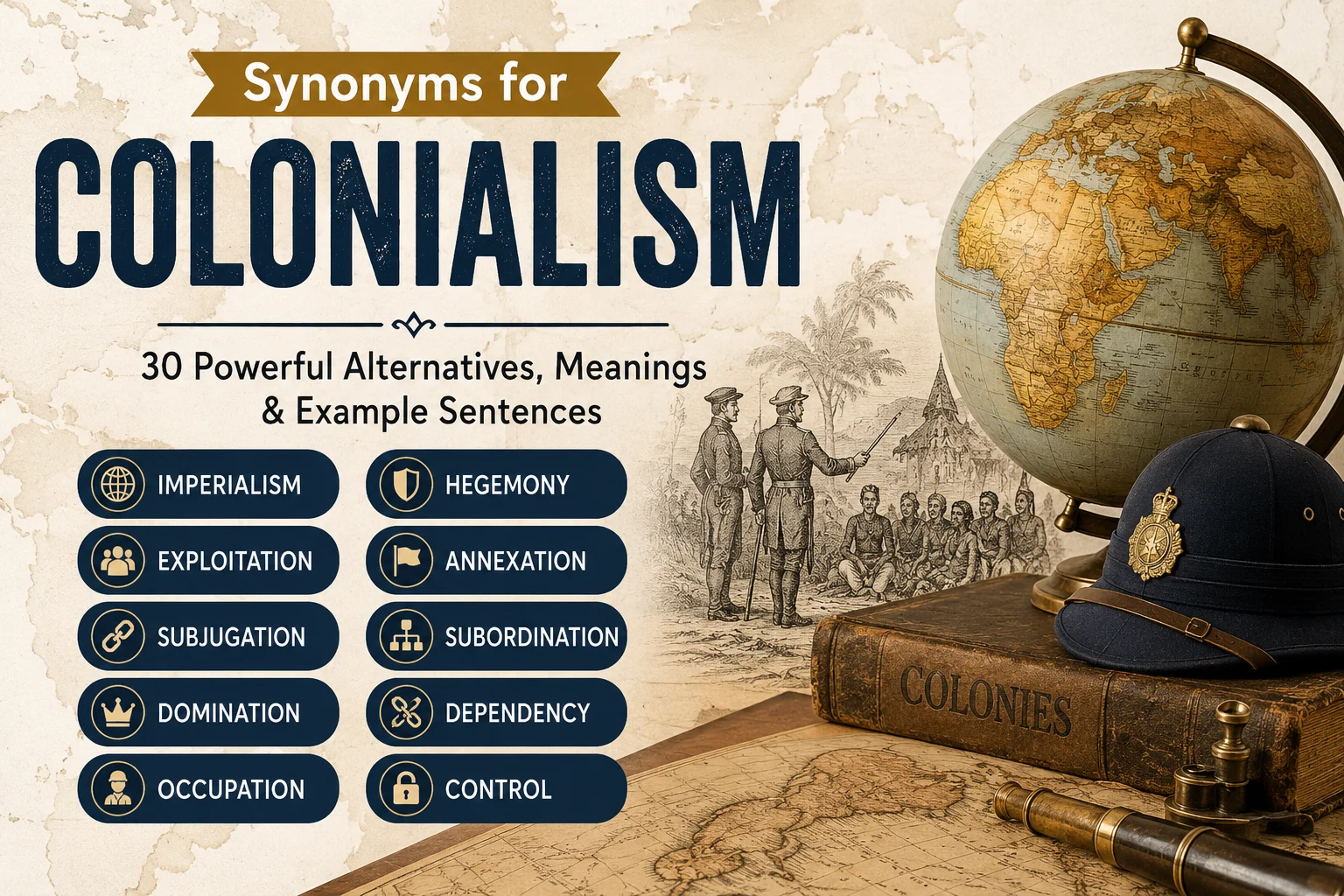
Finding the right synonyms for colonialism can be difficult because colonialism is a complex historical and political concept. It does not simply mean controlling another place. It usually involves one country or power taking control over another territory, its people, resources, institutions, or culture. Depending on the context, writers may need words that emphasize political control, foreign domination, exploitation, settlement, or cultural influence.
Understanding related terms can make writing more precise. A student writing a history essay, an ESL learner building vocabulary, or a content creator explaining imperial history may need a word that expresses a particular part of colonialism rather than treating every related term as an exact replacement.
This guide explains useful synonyms for colonialism, related expressions, their meanings, example sentences, and the contexts in which they work best. Because many of these words have different meanings, the guide also explains when a term is a true synonym, a close alternative, or a related concept.
What Does Colonialism Mean?
Colonialism is a system in which a powerful country or group establishes control over another territory and its people, often for political, economic, strategic, or settlement purposes.
Colonial powers have historically controlled territories far from their own borders. They may have governed local populations, taken natural resources, imposed laws or institutions, encouraged settlement, or attempted to reshape local cultures and economies.
For example:
European colonialism affected political systems, economies, languages, and cultures across many parts of Africa, Asia, and the Americas.
The word colonialism often carries a critical meaning because colonial systems frequently involved unequal power, exploitation, forced labor, displacement, discrimination, and the loss or restriction of local political autonomy.
Are Synonyms for Colonialism Always Exact Synonyms?
No. This is an important distinction.
Words such as imperialism, foreign domination, and territorial expansion can overlap with colonialism, but they do not always mean exactly the same thing.
For example, imperialism is broader than colonialism. A powerful state can exercise imperial influence without formally establishing a colony. Similarly, occupation can involve military control of a territory without creating the longer-term political and economic structures normally associated with colonial rule.
Therefore, choose a synonym based on the specific idea you want to communicate.
30 Synonyms and Related Terms for Colonialism
Below are 30 useful words and expressions related to colonialism. Some are close synonyms, while others describe specific aspects of colonial systems.
1. Imperialism
Meaning: A policy or practice in which a powerful country extends its authority or influence over other territories or peoples.
Example:
Imperialism changed the political landscape of many regions during the nineteenth century.
Best usage: Use this in historical, political, and academic writing when discussing expansion of power beyond national borders.
2. Foreign Domination
Meaning: Control of a country, territory, or population by an outside power.
Example:
The population resisted decades of foreign domination.
Best usage: Useful when emphasizing the loss of local political control.
3. Colonial Rule
Meaning: Government or control exercised by a colonial power over another territory.
Example:
Colonial rule transformed the region’s administrative system.
Best usage: One of the closest alternatives when specifically discussing government under a colonial power.
4. Colonial Domination
Meaning: Strong political, economic, or social control exercised by a colonial power.
Example:
The movement challenged decades of colonial domination.
Best usage: Good for academic writing when emphasizing unequal power relationships.
5. Imperial Rule
Meaning: Government or authority imposed by an empire over another territory or population.
Example:
The region remained under imperial rule for several generations.
Best usage: Best when discussing rule by an empire rather than colonialism in general.
6. Subjugation
Meaning: The act of bringing people or a territory under control by force or authority.
Example:
The subjugation of local communities changed the region’s political structure.
Best usage: Strong word for emphasizing loss of freedom or independence.
7. Conquest
Meaning: The act of taking control of a territory or people, usually through military force.
Example:
The conquest of the territory was followed by major political changes.
Best usage: Use when military victory or territorial takeover is the main focus.
8. Occupation
Meaning: Control of a territory by foreign military or political forces.
Example:
The foreign occupation created widespread political resistance.
Best usage: Appropriate when emphasizing physical or military control. It is not always a synonym for colonialism.
9. Expansionism
Meaning: A policy of increasing a country’s territory, influence, or power.
Example:
Expansionism encouraged the government to seek control over neighboring territories.
Best usage: Useful when discussing the motivation or policy behind territorial expansion.
10. Territorial Expansion
Meaning: The process of increasing control over additional land or territories.
Example:
Territorial expansion played an important role in the empire’s growth.
Best usage: Best for historical writing focused on geography and political expansion.
11. Empire Building
Meaning: The process of creating or expanding an empire by gaining control over territories or peoples.
Example:
Empire building shaped international politics during the period.
Best usage: Useful in history essays and general explanations of imperial expansion.
12. Imperial Expansion
Meaning: The extension of an empire’s political, economic, or military power.
Example:
Imperial expansion brought distant territories under the empire’s influence.
Best usage: Appropriate for formal historical and political discussions.
13. Exploitation
Meaning: The unfair use of people, land, labor, or resources for someone else’s benefit.
Example:
The exploitation of natural resources became a major source of wealth for the colonial power.
Best usage: Use when focusing specifically on economic or human exploitation.
14. Economic Exploitation
Meaning: The use of another region’s labor, resources, or economy primarily for outside benefit.
Example:
Economic exploitation affected local industries and agricultural communities.
Best usage: Particularly useful when discussing colonial economic systems.
15. Cultural Domination
Meaning: The process of one culture gaining power over or suppressing another culture.
Example:
Cultural domination affected local languages and educational traditions.
Best usage: Use when discussing language, education, religion, customs, or cultural identity.
16. Cultural Imperialism
Meaning: The spread or imposition of one culture’s values, practices, or beliefs over another culture.
Example:
Cultural imperialism can influence education, media, language, and social norms.
Best usage: Useful for discussing cultural influence rather than direct territorial control.
17. Political Domination
Meaning: Control of political decisions or institutions by a powerful group or state.
Example:
Political domination limited the territory’s ability to make independent decisions.
Best usage: Best when the main issue is political authority.
18. Economic Imperialism
Meaning: The use of economic power to control or strongly influence another country or region.
Example:
Economic imperialism can occur when outside powers gain extensive control over important industries.
Best usage: Use when discussing financial influence rather than formal colonial government.
19. Settler Colonialism
Meaning: A form of colonialism in which settlers from an outside population establish permanent communities while seeking lasting control over territory.
Example:
The historian examined how settler colonialism changed land ownership and population patterns.
Best usage: A precise academic term for colonial systems involving permanent settlement.
20. Colonial Expansion
Meaning: The process of establishing or extending colonies into new territories.
Example:
Colonial expansion accelerated during the nineteenth century.
Best usage: Useful when focusing on the growth of a colonial system.
21. Overseas Expansion
Meaning: The extension of a country’s territory or influence into distant regions.
Example:
Overseas expansion increased the country’s access to international trade routes.
Best usage: A somewhat broader and more neutral historical expression.
22. External Control
Meaning: Authority over a territory or organization exercised by an outside power.
Example:
The territory remained under external control for many years.
Best usage: Useful when you want neutral language without explicitly labeling the system colonialism.
23. Foreign Control
Meaning: Political, military, or economic control exercised by another country.
Example:
The independence movement sought to end foreign control.
Best usage: Good for discussions of political independence and sovereignty.
24. Political Subordination
Meaning: A condition in which one political community has less power and authority than another.
Example:
Political subordination restricted the region’s ability to govern itself.
Best usage: Formal and academic; useful when discussing unequal political relationships.
25. Territorial Domination
Meaning: Control over a particular geographical area and its population.
Example:
Territorial domination allowed the empire to control important trade routes.
Best usage: Useful in historical and geopolitical writing.
26. Annexation
Meaning: The formal incorporation of a territory into another state’s political boundaries.
Example:
The annexation of the territory created significant political controversy.
Best usage: Use only when a territory is formally incorporated. Annexation is not automatically colonialism.
27. Protectorate Rule
Meaning: A political arrangement in which a stronger state controls or supervises some affairs of a weaker territory while the territory may retain limited internal authority.
Example:
Under protectorate rule, the local government retained some administrative responsibilities.
Best usage: Useful when describing a specific historical political arrangement.
28. Hegemony
Meaning: Dominance or leadership by one group, state, or power over others.
Example:
The empire sought regional hegemony through military and economic influence.
Best usage: Best for broader discussions of power and influence; it is not limited to colonialism.
29. Domination
Meaning: Strong control or power over another person, group, or territory.
Example:
The system resulted in political and economic domination.
Best usage: A broad alternative when the exact type of control is clear from context.
30. Empire
Meaning: A political system or state that controls multiple territories or peoples, often through unequal relationships.
Example:
The empire governed territories across several continents.
Best usage: Use when referring to the political structure itself rather than the process or ideology of colonialism.
Quick Comparison of Synonyms for Colonialism
| Term | Main idea | Tone | Best context |
| Imperialism | Expansion of power or influence | Academic | History and politics |
| Colonial rule | Government of a colony | Neutral/formal | Historical writing |
| Foreign domination | Outside control | Strong | Political discussions |
| Subjugation | Loss of freedom through control | Strong | Human rights and history |
| Conquest | Taking territory by force | Strong | Military history |
| Occupation | Foreign control of territory | Formal | Military and political contexts |
| Expansionism | Policy of expansion | Academic | Political history |
| Exploitation | Unfair use of resources or people | Critical | Economic history |
| Cultural imperialism | Cultural influence or imposition | Critical/academic | Culture and society |
| Settler colonialism | Colonial settlement and territorial control | Academic | History and Indigenous studies |
| Annexation | Formal territorial incorporation | Formal | International law and history |
| Hegemony | Dominance or leadership | Academic | Geopolitics |
| Empire building | Creating or expanding an empire | General | History |
| Political subordination | Reduced political independence | Formal | Political analysis |
| Economic imperialism | Economic control or influence | Academic | Economics and politics |
Colonialism vs. Imperialism
Colonialism and imperialism are closely related, but they are not interchangeable in every sentence.
Colonialism generally refers to the establishment and maintenance of control over a territory and its population, often involving settlement, administration, and exploitation.
Imperialism is broader. It describes the pursuit or exercise of power over other territories or peoples and can include political, military, economic, or cultural influence without direct colonial administration.
For example:
- Colonialism: A foreign power establishes and governs a colony.
- Imperialism: A powerful state seeks to extend its influence over other countries or regions.
A useful rule is simple: colonialism is one important form or expression of imperial power, while imperialism can be broader than colonial rule.
Colonialism vs. Occupation
Occupation usually refers to foreign control of a territory, particularly through military forces.
Colonialism can involve occupation, but it generally describes a more developed and lasting system of political, economic, or social control.
Therefore, calling every foreign occupation “colonialism” may be inaccurate. Consider the historical circumstances before choosing the term.
Colonialism vs. Conquest
Conquest focuses on the act of defeating and taking control of another territory or people.
Colonialism focuses more broadly on the system that can follow or accompany territorial takeover, including administration, settlement, economic exploitation, and political control.
A conquest may contribute to the creation of a colonial system, but the two words describe different aspects of expansion.
Colonialism vs. Exploitation
Exploitation describes the unfair use of people, labor, land, or resources.
Colonial systems have often involved exploitation, but exploitation can happen outside colonialism as well.
For example, a writer discussing resource extraction might use economic exploitation, while a writer discussing the larger political system might use colonialism.
Colonialism vs. Cultural Imperialism
Cultural imperialism focuses specifically on cultural influence or dominance.
It can involve language, education, media, values, traditions, or social practices. Colonialism may contribute to cultural imperialism, but cultural imperialism does not necessarily require formal colonial rule.
This distinction is especially useful in essays about language, identity, education, and globalization.
Words to Use in Academic Writing
When writing a history or social science essay, precision is more important than simply replacing “colonialism” with another word.
Consider these choices:
- Use colonial rule when discussing government of a colony.
- Use imperialism when discussing broader expansion of power.
- Use economic exploitation when discussing labor and resources.
- Use cultural imperialism when discussing language and cultural influence.
- Use settler colonialism when permanent settlement is central to the discussion.
- Use political subordination when focusing on reduced political independence.
- Use foreign domination when emphasizing outside control.
- Use conquest when military takeover is the main event.
These distinctions make academic writing more accurate and convincing.
How to Choose the Right Synonym for Colonialism
Choosing the best alternative depends on what part of colonialism you want to emphasize.
For Political Control
Choose:
- Colonial rule
- Foreign control
- Foreign domination
- Political domination
- Political subordination
- Colonial domination
These words work well when discussing government, sovereignty, and political authority.
For Military Takeover
Choose:
- Conquest
- Occupation
- Subjugation
- Territorial domination
These terms are appropriate when force or military control is central to the discussion.
For Economic Control
Choose:
- Exploitation
- Economic exploitation
- Economic imperialism
- Imperialism
These are useful when discussing natural resources, labor, trade, markets, or financial influence.
For Cultural Influence
Choose:
- Cultural imperialism
- Cultural domination
- Imperialism
These terms work particularly well when discussing language, education, religion, media, traditions, and identity.
For Territorial Expansion
Choose:
- Colonial expansion
- Imperial expansion
- Territorial expansion
- Overseas expansion
- Expansionism
- Empire building
These alternatives are useful when the main focus is the growth of a state or empire.
For Formal Academic Writing
The strongest choices are usually:
- Colonial rule
- Imperialism
- Settler colonialism
- Political subordination
- Economic imperialism
- Cultural imperialism
- Foreign domination
Always select the term that accurately describes the historical situation rather than choosing a word simply because it sounds sophisticated.
Common Mistakes When Using Synonyms for Colonialism
One common mistake is treating every related word as a perfect synonym.
For example, empire, imperialism, and colonialism are connected but describe different things. An empire can be the political structure, imperialism can describe the policy or ideology of expansion, and colonialism can describe a system of territorial control and settlement.
Another mistake is using occupation whenever a foreign country controls territory. Occupation often has a specific military and legal meaning and does not necessarily describe a colonial relationship.
A third mistake is using exploitation as though it means colonialism. Exploitation describes a particular form of unfair use and can occur in many settings that are not colonial.
Precise vocabulary makes historical writing clearer.
Synonyms for Colonialism in a Sentence
Here are several examples showing how different terms change the emphasis:
Original:
Colonialism transformed the region’s political and economic institutions.
Using colonial rule:
Colonial rule transformed the region’s political and economic institutions.
Using imperialism:
Imperialism contributed to major changes in the region’s political structure.
Using foreign domination:
Foreign domination limited the region’s political independence.
Using economic exploitation:
Economic exploitation affected local workers and natural resources.
Using cultural imperialism:
Cultural imperialism influenced language and educational practices.
Using settler colonialism:
Settler colonialism changed patterns of land ownership and settlement.
Notice that each sentence highlights a slightly different aspect of the historical process.
Positive, Neutral, and Critical Alternatives
The tone of your writing also matters.
More Neutral or Descriptive
- Colonial rule
- Imperial expansion
- Territorial expansion
- Overseas expansion
- Foreign control
- Annexation
- Protectorate rule
These are useful when describing historical events without adding strong judgment through word choice.
More Critical
- Foreign domination
- Subjugation
- Exploitation
- Colonial domination
- Cultural domination
- Economic exploitation
These terms emphasize unequal power, coercion, or harm.
More Academic
- Imperialism
- Settler colonialism
- Cultural imperialism
- Economic imperialism
- Political subordination
- Hegemony
These are particularly useful in university essays, research writing, and scholarly discussions when their specific meanings fit the argument.
Meaning of “Demure”
Demure is unrelated to colonialism, but it is a useful vocabulary word with a very different meaning.
Demure describes someone who behaves in a quiet, modest, reserved, or somewhat shy way. It can also describe an appearance that is modest and understated.
For example:
She gave a demure smile during the formal introduction.
The word often suggests calmness, modesty, and restraint. Depending on the context, it can sound complimentary, old-fashioned, literary, or slightly playful.
Tone: Usually gentle, modest, reserved, or traditional.
Usage: It is commonly used to describe a person’s behavior, expression, manner, or appearance.
30 Synonyms of Demure
1. Modest
Meaning: Not overly confident, showy, or revealing.
Example:
She wore a modest dress to the formal event.
Best usage: Everyday descriptions of behavior, clothing, or personality.
2. Reserved
Meaning: Quiet and not likely to express feelings openly.
Example:
He was reserved during the first meeting.
Best usage: Personality and social behavior.
3. Shy
Meaning: Nervous or uncomfortable around other people.
Example:
The shy student avoided speaking in front of the class.
Best usage: Informal descriptions of personality.
4. Bashful
Meaning: Easily embarrassed or shy.
Example:
She became bashful when everyone complimented her.
Best usage: Friendly or affectionate descriptions.
5. Unassuming
Meaning: Not trying to attract attention or appear important.
Example:
Despite her success, she remained unassuming.
Best usage: Personality and professional writing.
6. Retiring
Meaning: Quiet and unwilling to attract attention.
Example:
His retiring personality made him uncomfortable in large groups.
Best usage: Formal or literary writing.
7. Quiet
Meaning: Not loud, talkative, or attention-seeking.
Example:
She was a quiet and thoughtful person.
Best usage: General everyday English.
8. Gentle
Meaning: Calm, kind, and soft in manner.
Example:
She had a gentle way of speaking.
Best usage: Personality, behavior, and manner.
9. Mild
Meaning: Calm and not aggressive or extreme.
Example:
He has a mild and pleasant personality.
Best usage: Personality and temperament.
10. Soft-Spoken
Meaning: Speaking quietly and gently.
Example:
The soft-spoken teacher quickly gained the students’ trust.
Best usage: Speech and communication style.
11. Meek
Meaning: Very quiet, gentle, and unlikely to challenge others.
Example:
The meek character rarely expressed disagreement.
Best usage: Literary or descriptive contexts; can sometimes sound negative.
12. Timid
Meaning: Lacking confidence or courage in social situations.
Example:
The timid child stayed close to her parents.
Best usage: Personality and behavior.
13. Unobtrusive
Meaning: Not attracting attention or interfering with others.
Example:
The unobtrusive design suited the simple room.
Best usage: Objects, designs, behavior, and style.
14. Demure-Looking
Meaning: Having a modest, quiet, or reserved appearance.
Example:
The outfit gave her a demure-looking style.
Best usage: Informal descriptions of appearance.
15. Dainty
Meaning: Small, delicate, and graceful.
Example:
She chose a dainty necklace for the occasion.
Best usage: Appearance, clothing, objects, and physical features.
16. Delicate
Meaning: Fine, gentle, or fragile in appearance or manner.
Example:
She had a delicate and elegant appearance.
Best usage: Appearance, style, and physical descriptions.
17. Subdued
Meaning: Quiet, restrained, or not very noticeable.
Example:
Her subdued style suited the formal setting.
Best usage: Clothing, colors, behavior, and atmosphere.
18. Restrained
Meaning: Controlled and not excessive in emotion or behavior.
Example:
He gave a restrained response to the criticism.
Best usage: Formal writing and emotional behavior.
19. Composed
Meaning: Calm and in control of one’s emotions.
Example:
She remained composed throughout the interview.
Best usage: Professional, academic, and formal contexts.
20. Poised
Meaning: Calm, confident, and controlled.
Example:
The speaker appeared poised before the audience.
Best usage: Professional and formal descriptions.
21. Sedate
Meaning: Calm, quiet, and unhurried.
Example:
The restaurant had a sedate atmosphere.
Best usage: Formal descriptions of people, places, or atmospheres.
22. Coy
Meaning: Shy or pretending to be shy, sometimes in a playful way.
Example:
She gave a coy smile when asked about the surprise.
Best usage: Social or playful contexts.
23. Unpretentious
Meaning: Simple and not designed to impress others.
Example:
The café had an unpretentious atmosphere.
Best usage: People, places, styles, and writing.
24. Self-Effacing
Meaning: Modest and likely to avoid drawing attention to one’s achievements.
Example:
His self-effacing humor made him easy to work with.
Best usage: Professional and personality descriptions.
25. Modest-Mannered
Meaning: Behaving in a quiet and restrained way.
Example:
The modest-mannered guest spoke politely throughout the evening.
Best usage: Descriptive writing.
26. Gentle-Mannered
Meaning: Having a calm, polite, and gentle way of behaving.
Example:
The gentle-mannered child was welcomed by everyone.
Best usage: Character descriptions.
27. Demure
Meaning: Quiet, modest, and reserved in behavior or appearance.
Example:
She gave a demure smile.
Best usage: The original word; useful when describing modest behavior or appearance.
28. Mild-Mannered
Meaning: Calm, gentle, and not aggressive.
Example:
The mild-mannered professor was known for his patience.
Best usage: Personality and character descriptions.
29. Unassertive
Meaning: Not forceful or strongly expressing one’s opinions.
Example:
His unassertive communication style made it difficult for others to know his preferences.
Best usage: Professional and personality contexts.
30. Proper
Meaning: Behaving according to accepted standards of manners or conduct.
Example:
Her proper behavior was appreciated at the formal gathering.
Best usage: Formal or traditional contexts.
Quick Comparison of Demure Synonyms
| Word | Main meaning | Tone |
| Modest | Not showy or revealing | Neutral |
| Reserved | Quiet and emotionally controlled | Neutral |
| Shy | Uncomfortable or nervous socially | Neutral |
| Bashful | Easily embarrassed | Friendly |
| Unassuming | Not seeking attention | Positive |
| Retiring | Avoiding attention | Formal |
| Timid | Lacking confidence | Often negative |
| Gentle | Calm and kind | Positive |
| Coy | Playfully shy | Playful |
| Subdued | Quiet or restrained | Neutral |
| Restrained | Emotionally controlled | Formal |
| Composed | Calm and controlled | Positive |
| Poised | Calm and confident | Positive |
| Self-effacing | Modest about oneself | Positive |
| Mild-mannered | Gentle and non-aggressive | Positive |
Frequently Asked Questions About Synonyms for Colonialism
What is the closest synonym for colonialism?
Colonial rule is one of the closest alternatives when you specifically mean the political administration of a colony. Imperialism is also closely related but has a broader meaning.
Is imperialism the same as colonialism?
No. The concepts overlap, but imperialism is broader. Imperialism can involve political, military, economic, or cultural influence without direct colonial administration.
What is another word for colonial domination?
Depending on the context, alternatives include foreign domination, foreign control, subjugation, political domination, and political subordination.
What is a synonym for colonial exploitation?
Useful alternatives include economic exploitation, resource exploitation, and, in broader contexts, economic imperialism.
What is a synonym for colonial rule?
Common alternatives include foreign rule, foreign control, imperial rule, and colonial domination. The best choice depends on the historical situation.
Is occupation a synonym for colonialism?
Not always. Occupation generally refers to foreign control of a territory, especially through military forces. Colonialism describes a broader system of control that may include settlement, administration, economic exploitation, and cultural transformation.
What is another word for imperial expansion?
Possible alternatives include territorial expansion, colonial expansion, overseas expansion, expansionism, and empire building.
What is the opposite of colonialism?
Depending on the context, possible contrasting concepts include self-government, independence, sovereignty, decolonization, and political autonomy.
Final Thoughts on Synonyms for Colonialism
The best synonyms for colonialism depend on the exact idea you want to express. Colonial rule works well for government of a colony, while imperialism describes a broader pursuit of power and influence. Conquest emphasizes military takeover, exploitation highlights unfair economic use, and cultural imperialism focuses on cultural influence or domination.
For academic and professional writing, accuracy is more valuable than simply choosing the most complicated-sounding word. Before replacing “colonialism,” ask what aspect of the concept you are discussing: political control, territorial expansion, settlement, economic exploitation, military conquest, or cultural influence.
Understanding these distinctions helps students, ESL learners, writers, and content creators produce clearer and more precise writing. It also prevents related historical terms from being treated as exact synonyms when their meanings are actually different.

I am Evelyn Marie, the Administrator of Synoloop. I enjoy helping readers discover useful synonyms, alternative words, and better ways to express their ideas. I focus on keeping Synoloop simple, reliable, informative, and helpful for everyone.