Finding the right native synonym can make your English sound more natural, precise, and confident. Whether you are a student, ESL learner, writer, or content creator, knowing alternative words helps you avoid repetition and choose language that fits the exact meaning and tone you want.
The word native can have different meanings depending on context. It may describe someone who was born in a particular country or region, something naturally belonging to a place, or a person who speaks a language as their first language. Because of these differences, choosing the right synonym requires attention to context.
This guide also explains the word demure, including 30 useful synonyms, simple meanings, example sentences, and the situations where each word works best. The goal is to help you build practical vocabulary rather than simply memorize a list of words.
What Does “Native” Mean?
The word native generally describes something or someone that originates from a particular place.
For example:
- She is a native of Canada.
This means she was born in Canada or comes from Canada. - The tiger is native to Asia.
This means the tiger naturally originated or occurs in parts of Asia. - He is a native English speaker.
This means English is his first language or the language he learned naturally from childhood.
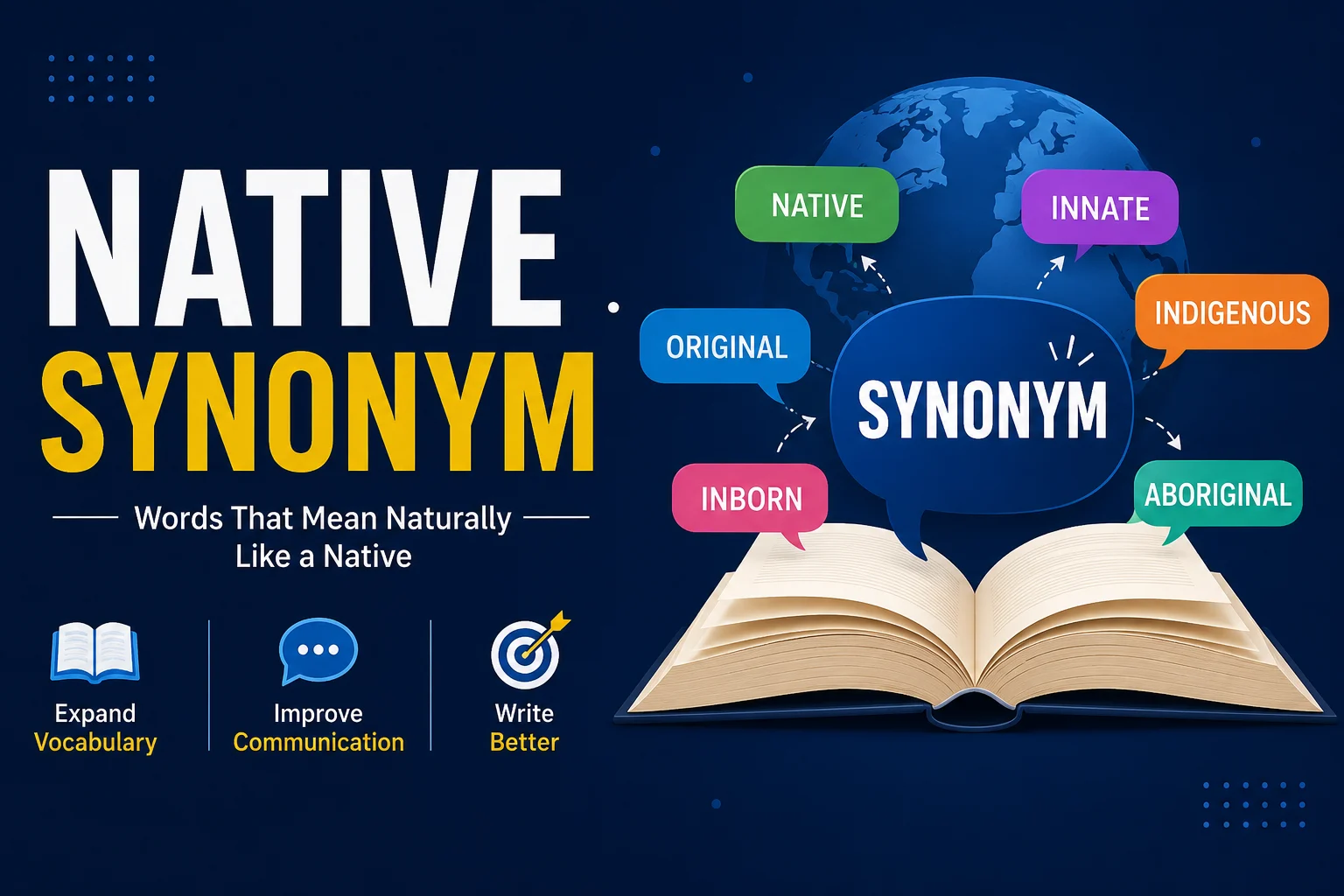
The best native synonym depends on which meaning of native you intend. Words such as indigenous, local, original, natural-born, resident, and first-language speaker can work in specific contexts, but they are not always interchangeable.
Native Synonym: Useful Alternatives
Here are some common alternatives to native, organized according to meaning and context.
| Synonym | Simple Meaning | Best Used For |
| Indigenous | Originally belonging to a place | People, animals, plants, cultures |
| Local | Connected with a particular area | People, businesses, customs |
| Aboriginal | Existing in a region from the earliest known times | Indigenous peoples and cultures |
| Original | Present from the beginning | People, ideas, things |
| Inborn | Present naturally from birth | Abilities or qualities |
| Innate | Naturally existing from birth | Qualities, talents, abilities |
| Natural | Existing or occurring without being learned or artificial | Abilities, characteristics |
| Homegrown | Developed or produced locally | Products, talent, businesses |
| Local-born | Born in a particular area | People |
| First-language | Learned as one’s first language | Language speakers |
| Mother-tongue | A person’s first language | Language |
| Autochthonous | Originating in the place where found | Formal academic contexts |
| Endemic | Naturally occurring in a particular area | Plants, animals, diseases |
| Regional | Associated with a particular region | Culture, language, products |
| Domestic | Belonging to one’s own country | Business, economy, products |
| Native-born | Born in a particular country or region | People |
| Original inhabitant | Someone who lived in a place originally | Historical contexts |
| Local inhabitant | A person who lives in an area | General contexts |
| Indigenous-born | Born among an indigenous population | Specific demographic contexts |
| Traditional | Passed down within a particular culture | Customs, practices |
| Localized | Adapted to a specific place | Products, services, content |
| Established | Existing in a place for a long time | Communities, institutions |
| Country-born | Born in a particular country | People |
| Regionally produced | Made in a particular region | Goods and products |
| Naturally occurring | Existing without artificial introduction | Nature and science |
| Place-based | Closely connected to a particular location | Culture, research, communities |
| Locally developed | Created within a particular area | Products, technology, ideas |
| Ethnic | Connected with a particular cultural group | Culture and identity |
| Heritage-based | Connected with inherited culture or traditions | Culture and traditions |
| First-language speaker | Someone who learned a language first | Language learning |
The important point is that these alternatives are context-dependent. For example, indigenous is often a better choice than native when discussing peoples or species that originally belong to a particular region, while local is more natural when discussing people, businesses, or products connected with an area.
What Does “Demure” Mean?
Demure is an adjective used to describe someone who behaves in a quiet, modest, reserved, or somewhat shy way.
A demure person usually does not try to attract a lot of attention. The word can describe someone’s appearance, manner, expression, or behavior.
For example:
She gave a demure smile when everyone complimented her.
Here, demure suggests that her smile was modest, gentle, and slightly shy.
The tone of demure is usually polite, refined, modest, and somewhat old-fashioned. It can be positive when describing graceful or reserved behavior, but depending on context, it can also suggest that someone is deliberately acting modest or shy.
30 Synonyms of Demure
Below are 30 useful synonyms and closely related alternatives to demure, with simple meanings, examples, and practical usage notes.
1. Modest
Meaning: Not overly confident, showy, or attention-seeking.
Example:
She wore a modest dress to the formal event.
Best usage: Clothing, behavior, personality, or appearance.
2. Shy
Meaning: Nervous or uncomfortable around other people or unfamiliar situations.
Example:
The shy student rarely spoke during class discussions.
Best usage: Everyday descriptions of personality and social behavior.
3. Reserved
Meaning: Quiet and not likely to openly express feelings or opinions.
Example:
He was reserved when meeting the new members of the team.
Best usage: Personality and social behavior.
4. Quiet
Meaning: Not loud, talkative, or attention-seeking.
Example:
She is a quiet person who enjoys reading.
Best usage: General everyday English.
5. Retiring
Meaning: Avoiding attention and preferring to stay in the background.
Example:
Although talented, the artist was naturally retiring.
Best usage: Formal or literary descriptions of personality.
6. Unassuming
Meaning: Not trying to appear important, impressive, or better than others.
Example:
Despite his success, he remained unassuming.
Best usage: Personality, especially when praising someone’s humility.
7. Bashful
Meaning: Shy or easily embarrassed.
Example:
The bashful child hid behind her mother.
Best usage: Gentle, warm, or slightly playful descriptions.
8. Meek
Meaning: Very gentle and unlikely to argue or challenge others.
Example:
He had a meek manner and rarely complained.
Best usage: Behavior where gentleness or lack of assertiveness is important.
9. Mild
Meaning: Gentle and not extreme in behavior or manner.
Example:
She has a mild personality and rarely loses her temper.
Best usage: General personality descriptions.
10. Gentle
Meaning: Kind, calm, and soft in manner.
Example:
Her gentle nature made everyone feel comfortable.
Best usage: Personality, behavior, voice, and manner.
11. Soft-spoken
Meaning: Speaking quietly and gently.
Example:
The soft-spoken teacher explained the lesson patiently.
Best usage: Voice and communication style.
12. Coy
Meaning: Shy or pretending to be shy, especially in a playful way.
Example:
She gave him a coy smile before looking away.
Best usage: Playful or flirtatious situations.
13. Bashful
Meaning: Easily embarrassed or shy, especially when receiving attention.
Example:
He became bashful when his friends praised his performance.
Best usage: Informal and warm descriptions.
14. Timid
Meaning: Lacking confidence and easily frightened or nervous.
Example:
The timid puppy stayed close to its owner.
Best usage: People or animals that lack confidence.
15. Subdued
Meaning: Quiet, restrained, or less energetic than usual.
Example:
She gave a subdued response to the unexpected news.
Best usage: Mood, behavior, reactions, and atmosphere.
16. Demure-looking
Meaning: Having a modest, quiet, or reserved appearance.
Example:
She had a demure-looking style that suited the formal occasion.
Best usage: Appearance and fashion descriptions.
17. Dainty
Meaning: Small, delicate, and graceful.
Example:
She carried a dainty handbag to the ceremony.
Best usage: Appearance, objects, gestures, and graceful qualities.
18. Refined
Meaning: Polished, elegant, and socially graceful.
Example:
Her refined manners impressed the guests.
Best usage: Manners, style, speech, and behavior.
19. Ladylike
Meaning: Traditionally considered graceful, polite, and well-mannered for a woman.
Example:
Her ladylike manners were noticeable at the formal dinner.
Best usage: Traditional or historical descriptions; can sound old-fashioned.
20. Proper
Meaning: Behaving according to accepted social standards.
Example:
She maintained a proper and respectful manner throughout the meeting.
Best usage: Behavior, manners, and formal situations.
21. Composed
Meaning: Calm and in control of one’s emotions.
Example:
She remained composed despite the stressful situation.
Best usage: Emotional control rather than shyness.
22. Self-effacing
Meaning: Avoiding praise or attention and not emphasizing one’s own achievements.
Example:
His self-effacing personality made him easy to work with.
Best usage: Humility and personality.
23. Unobtrusive
Meaning: Not attracting attention or disturbing others.
Example:
She chose an unobtrusive style for the professional event.
Best usage: Behavior, design, appearance, and presence.
24. Modest-mannered
Meaning: Having a quiet and humble way of behaving.
Example:
The modest-mannered student accepted the award without seeking attention.
Best usage: Describing polite and humble behavior.
25. Demure-mannered
Meaning: Behaving in a restrained, modest, and quiet way.
Example:
Her demure-mannered approach made her seem very reserved.
Best usage: Descriptive writing; less common than demure itself.
26. Restrained
Meaning: Controlled and not overly expressive.
Example:
His restrained reaction surprised everyone.
Best usage: Emotions, behavior, speech, and formal writing.
27. Unpretentious
Meaning: Simple and not designed to impress others.
Example:
She has an unpretentious personality despite her success.
Best usage: People, lifestyles, writing, places, and design.
28. Gentle-mannered
Meaning: Calm, polite, and gentle in behavior.
Example:
The gentle-mannered host welcomed every guest warmly.
Best usage: Character descriptions and literary writing.
29. Innocent
Meaning: Showing a lack of experience, sophistication, or harmful intention.
Example:
She gave him an innocent smile.
Best usage: Expressions, behavior, and situations where innocence is relevant.
30. Decorous
Meaning: Behaving in a socially appropriate, dignified, and respectable way.
Example:
The guests maintained a decorous atmosphere during the ceremony.
Best usage: Formal writing, manners, public behavior, and ceremonies.
Demure Synonyms: Quick Comparison Guide
Not every synonym of demure has exactly the same meaning. Choosing the right word depends on the quality you want to emphasize.
| Word | Main Idea | Tone |
| Demure | Quiet and modest | Refined |
| Modest | Not showy | Neutral/positive |
| Shy | Uncomfortable with attention | Everyday |
| Reserved | Emotionally private | Neutral |
| Coy | Playfully shy | Playful |
| Timid | Lacking confidence | Sometimes negative |
| Bashful | Easily embarrassed | Warm |
| Meek | Gentle and submissive | Can be negative |
| Refined | Elegant and polished | Positive |
| Composed | Calm and controlled | Positive |
| Unassuming | Humble and not attention-seeking | Positive |
| Soft-spoken | Quiet in speech | Positive |
| Restrained | Emotionally controlled | Formal |
| Decorous | Socially proper | Formal |
| Unpretentious | Simple and not showy | Positive |
Native Synonym vs. Similar Words
When looking for a native synonym, it is important not to replace a word simply because another word looks similar in a dictionary.
For example, native, indigenous, and local overlap, but they have different uses.
Native is broad:
She is a native New Yorker.
Indigenous emphasizes original connection to a place:
The region is home to several indigenous plant species.
Local usually emphasizes connection to a particular area:
We bought vegetables from a local farmer.
Similarly, native speaker should usually not be replaced with simply local speaker. A more precise alternative is first-language speaker or mother-tongue speaker, depending on the context.
How to Choose the Right Synonym
Choosing the best synonym is easier when you first identify the exact meaning you want.
For a Person From a Place
Use words such as:
- Native
- Native-born
- Local
- Local inhabitant
- Country-born
Example:
“She is a native of Lahore.”
If you simply mean that someone currently lives in an area, local or resident may be more appropriate.
For People or Cultures Originally Belonging to a Region
Use:
- Indigenous
- Aboriginal
- Autochthonous
- Original inhabitant
These words are more specific than the general word native.
For Animals and Plants
Use:
- Indigenous
- Native
- Endemic
- Naturally occurring
For example:
This plant is native to Australia.
If a species exists naturally only within a particular geographic area, endemic may be more precise.
For Language
Use:
- Native speaker
- First-language speaker
- Mother-tongue speaker
For example:
She is a native English speaker.
This is different from saying that someone is a local English speaker, which does not necessarily tell us that English is their first language.
For Natural Abilities
Use:
- Innate
- Inborn
- Natural
For example:
He has an innate ability to understand music.
In this context, native would not normally be the most natural choice.
Common Mistakes When Using Synonyms
A synonym is not always a perfect replacement. Words can have different levels of formality, emotional meanings, and grammatical uses.
For example, shy and demure are related but not identical. Someone can be shy because they feel nervous around people, while someone described as demure may simply behave in a quiet, modest, and restrained way.
Likewise, meek can suggest weakness or excessive submission, so it may not be a good replacement when you want to give someone a positive description.
Another common mistake is using indigenous and native as exact equivalents in every situation. Although they overlap, indigenous often carries a stronger meaning of original or traditional connection to a particular place.
Native Synonym for Different Writing Situations
The best word also depends on your writing style.
For academic writing:
Use precise words such as indigenous, endemic, innate, autochthonous, or first-language speaker when appropriate.
For everyday conversation:
Use simpler words such as local, native, natural, shy, quiet, or modest.
For creative writing:
Words such as demure, coy, bashful, retiring, dainty, and refined can create a more specific mood.
For professional writing:
Prefer clear and precise alternatives such as local, indigenous, first-language, innate, or regionally produced, depending on the intended meaning.
Frequently Asked Questions About Native Synonyms
What is the best synonym for native?
There is no single best synonym. Indigenous, local, original, native-born, and first-language speaker can all work in different contexts.
What is a synonym for native speaker?
Common alternatives include first-language speaker and mother-tongue speaker. The most natural choice depends on the context and the terminology preferred by the audience.
Is indigenous the same as native?
Not always. The two words overlap, especially when discussing species or peoples connected to a place, but indigenous often emphasizes an original or longstanding connection to a region.
What is the opposite of native?
Depending on context, possible opposites include foreign, non-native, imported, introduced, or artificial.
What does demure mean?
Demure means quiet, modest, reserved, or shy in appearance or behavior. It often has a refined or slightly old-fashioned tone.
What is the best synonym for demure?
It depends on the intended meaning. Modest, reserved, shy, unassuming, bashful, and composed are useful alternatives, but each emphasizes a slightly different quality.
Final Thoughts
Understanding a native synonym is not simply about finding another word with a similar dictionary definition. Good vocabulary choices depend on context, tone, audience, and the exact meaning you want to communicate.
Words such as indigenous, local, native-born, innate, endemic, and first-language speaker can replace native in specific situations, while words such as modest, reserved, shy, coy, refined, and unassuming help express different shades of demure.

I am Jace Thomas, a passionate synonym writer dedicated to making word choices simple and meaningful. I enjoy exploring language, discovering synonyms, and helping readers express ideas clearly and creatively.