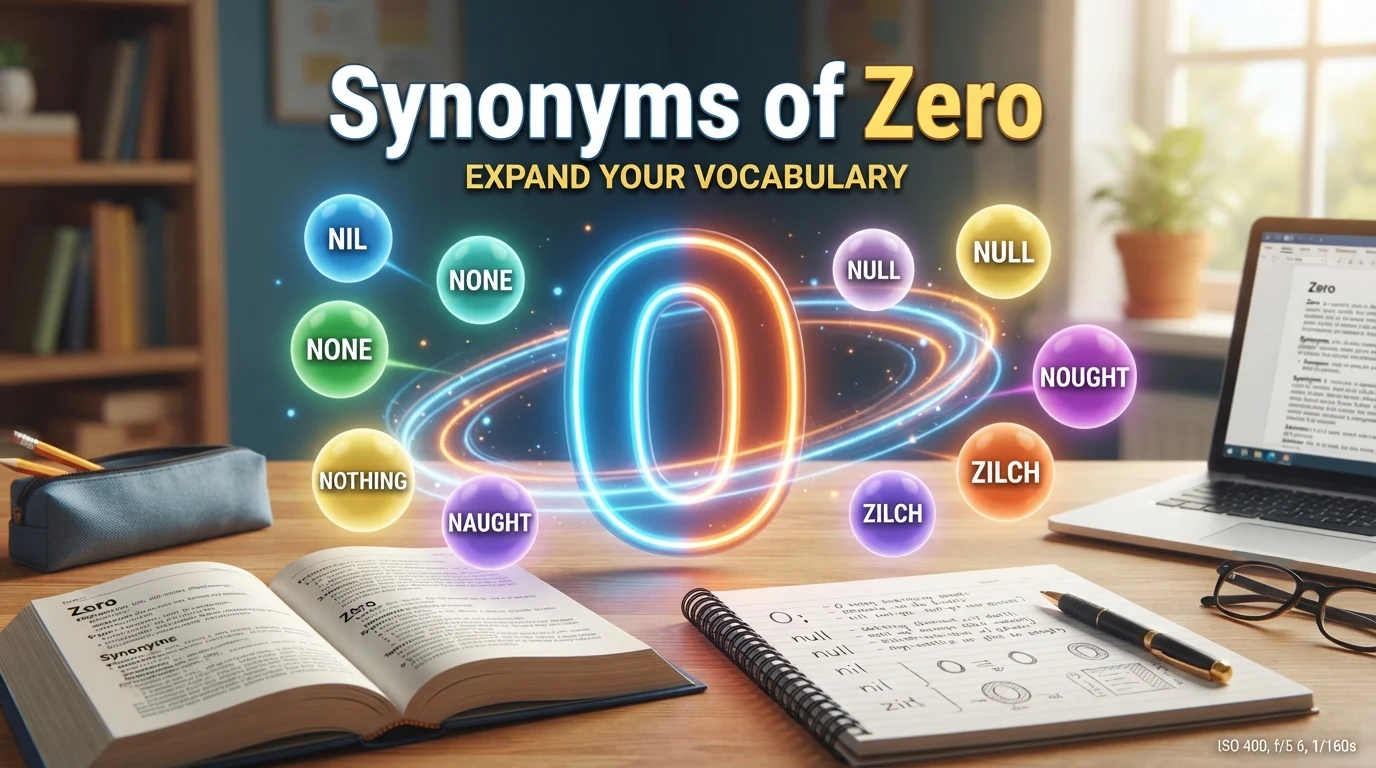
The word zero is one of the most useful words in the English language. It can describe the number 0, an absence of something, a complete lack of success, or a starting point on a scale. Because it has several meanings, choosing the right synonym depends on the situation and the tone you want to create.
Learning the synonyms of zero can help students, ESL learners, writers, and content creators express ideas more precisely. For example, “nothing,” “nil,” “nought,” “none,” and “zero” can all relate to the number 0, but they are not always interchangeable. Some are common in everyday English, while others are more formal, technical, or regional.
This guide explains 30 useful alternatives to zero in simple English. It also covers their meanings, example sentences, appropriate contexts, and differences in tone. At the end, you will have a practical guide for choosing the best word for your sentence.
What Does Zero Mean?
Zero is the number that represents no quantity or an absence of something. It comes between negative numbers and positive numbers on the number line.
For example:
- I have zero dollars in my wallet.
- The temperature dropped to zero degrees.
- She made zero mistakes on the test.
- The team scored zero points.
Zero can also be used figuratively. When someone says, “I have zero interest,” they mean they have no interest at all.
The exact synonym you choose should therefore depend on whether you are talking about mathematics, quantity, measurement, sports, achievement, or complete absence.
30 Synonyms of Zero
The following words and expressions can be used as synonyms or close alternatives to zero, depending on context.
1. Nothing
Meaning: Not anything; no amount or quantity.
Example: There was nothing left in the box.
Best usage context: Everyday English when you mean a complete absence of something.
2. Nil
Meaning: Zero, especially when talking about a score or result.
Example: The final score was three to nil.
Best usage context: Sports, competitions, and formal or British English.
3. Nought
Meaning: Another word for zero, especially in British English.
Example: The temperature fell to nought overnight.
Best usage context: British English, mathematics, measurements, and traditional usage.
4. O
Meaning: The spoken letter “O” is sometimes used to represent zero.
Example: The code is four-one-O-seven.
Best usage context: Spoken numbers, telephone numbers, codes, and identification numbers.
5. None
Meaning: Not one or not any.
Example: None of the students were absent.
Best usage context: Quantities, groups, people, objects, and situations where nothing is present.
6. Null
Meaning: Having no value, effect, or result.
Example: The experiment produced a null result.
Best usage context: Technical, scientific, mathematical, computing, and formal writing.
7. Void
Meaning: An empty space or complete absence of something.
Example: The failed agreement left a void in the organization.
Best usage context: Formal, legal, literary, and abstract situations.
8. Absence
Meaning: The state of something not being present.
Example: The absence of evidence made the claim difficult to support.
Best usage context: Formal and academic writing.
9. Lack
Meaning: The absence or shortage of something needed or expected.
Example: A lack of preparation caused problems during the presentation.
Best usage context: Everyday, academic, professional, and analytical writing.
10. Nothingness
Meaning: A state in which nothing exists or is present.
Example: The abandoned room seemed to disappear into nothingness.
Best usage context: Philosophical, literary, dramatic, or abstract writing.
11. Zilch
Meaning: Absolutely nothing.
Example: I know zilch about repairing cars.
Best usage context: Informal and conversational English.
12. Zip
Meaning: Nothing at all.
Example: The new campaign generated zip in sales.
Best usage context: Informal speech and casual writing.
13. Nada
Meaning: Nothing.
Example: We searched the entire room but found nada.
Best usage context: Very informal English, often used humorously.
14. Diddly
Meaning: Very little or nothing at all.
Example: He didn’t know diddly about the subject.
Best usage context: Highly informal or humorous conversation.
15. Sweet FA
Meaning: Absolutely nothing.
Example: The old equipment is worth sweet FA now.
Best usage context: Very informal British English; avoid it in formal writing.
16. Bugger All
Meaning: Very little or nothing.
Example: There was bugger all left to eat.
Best usage context: Strongly informal British English; it can sound rude or vulgar.
17. Scant
Meaning: Very small in amount; barely enough.
Example: The report provided scant evidence to support the argument.
Best usage context: Formal or literary writing when the amount is extremely small rather than literally zero.
18. Negligible
Meaning: So small that it can almost be treated as zero.
Example: The difference in cost was negligible.
Best usage context: Scientific, financial, technical, and professional writing.
19. Insignificant
Meaning: Too small or unimportant to have a meaningful effect.
Example: The change produced an insignificant improvement.
Best usage context: Academic, professional, analytical, and formal writing.
20. Empty
Meaning: Containing nothing.
Example: The account balance was empty after the payment.
Best usage context: Containers, spaces, accounts, lists, and everyday descriptions.
21. Blank
Meaning: Having nothing written, displayed, or filled in.
Example: He submitted a blank answer sheet.
Best usage context: Forms, documents, screens, pages, and answers.
22. Deficit
Meaning: An amount by which something is below what is required or expected.
Example: The company reported a budget deficit.
Best usage context: Finance, economics, business, and accounting.
23. Shortfall
Meaning: A shortage or amount that is less than required.
Example: The project faced a funding shortfall.
Best usage context: Business, finance, planning, and professional communication.
24. Drought
Meaning: A complete or serious lack of something, especially rain or a particular resource.
Example: The region experienced a severe rainfall drought.
Best usage context: Weather, agriculture, resources, and figurative descriptions.
25. Absence of
Meaning: The condition of having no particular thing.
Example: The absence of evidence prevented a final conclusion.
Best usage context: Academic, professional, legal, and analytical writing.
26. Zero quantity
Meaning: A mathematical or measurable amount of none.
Example: The experiment recorded a zero quantity of the substance.
Best usage context: Scientific, mathematical, and technical contexts.
27. No amount
Meaning: Not any quantity of something.
Example: No amount of money could replace the lost opportunity.
Best usage context: Everyday and figurative English.
28. Nonexistent
Meaning: Not existing at all.
Example: The chances of success were almost nonexistent.
Best usage context: Formal, descriptive, and figurative writing.
29. Complete lack
Meaning: A total absence of something.
Example: There was a complete lack of communication between the teams.
Best usage context: Formal, professional, academic, and emphatic writing.
30. Total absence
Meaning: A complete state of not having or not containing something.
Example: The investigation found a total absence of reliable evidence.
Best usage context: Formal reports, academic writing, research, and analytical contexts.
Quick Comparison of Synonyms of Zero
Not every synonym of zero has exactly the same meaning. Some refer directly to the number 0, while others describe an absence, shortage, or extremely small amount.
| Word or Expression | Main Meaning | Tone | Common Context |
| Zero | Number 0 or none | Neutral | General use |
| Nothing | Not anything | Neutral | Everyday English |
| Nil | Zero | Neutral/Formal | Sports and scores |
| Nought | Zero | Neutral | British English |
| None | Not one/any | Neutral | Quantities and groups |
| Null | No value/result | Formal | Technical and scientific |
| Void | Empty or absent | Formal | Legal, literary, abstract |
| Lack | Absence or shortage | Neutral/Formal | General and academic |
| Zilch | Nothing | Informal | Conversation |
| Zip | Nothing | Informal | Casual speech |
| Nada | Nothing | Very informal | Casual/humorous |
| Negligible | Almost zero | Formal | Science and business |
| Insignificant | Too small to matter | Formal | Academic/analytical |
| Empty | Contains nothing | Neutral | Objects, spaces, accounts |
| Blank | Nothing displayed/written | Neutral | Forms and documents |
| Deficit | Amount below requirement | Formal | Finance and economics |
| Shortfall | Amount missing | Formal | Business and planning |
| Nonexistent | Not existing | Formal/Neutral | General and figurative |
Zero vs. Nothing
Zero and nothing are closely related, but they are not always interchangeable.
Use zero when referring to a number, measurable amount, score, or numerical value.
- The temperature is zero degrees.
- He scored zero points.
- The answer is zero.
Use nothing when referring more generally to the absence of an object, event, idea, or thing.
- There is nothing in the bag.
- I heard nothing.
- Nothing happened yesterday.
A simple rule is: use zero for numbers and measurable quantities; use nothing for general absence.
Zero vs. Nil
Nil is especially common when describing scores.
For example:
- The team won five to nil.
- The final score was two to nil.
In mathematics, “zero” is usually more natural:
- Five minus five equals zero.
Therefore, nil works particularly well for sports and results, while zero is the standard choice for mathematics and general numerical information.
Zero vs. Nought
Nought means zero and is particularly associated with British English.
For example:
- The temperature reached nought degrees.
- Start at nought and work upward.
In American English, zero is generally more common.
For ESL learners, recognizing nought is useful because you may encounter it in British books, television programs, newspapers, and conversations.
Zero vs. None
None means “not one” or “not any,” so it often works with groups or quantities.
For example:
- None of the students answered correctly.
- None of the money was recovered.
“Zero” can sometimes be used in similar situations:
- Zero students answered correctly.
However, “none” often sounds more natural when referring to a group.
Zero vs. Null
Null is more specialized than zero.
In computing and databases, null can indicate that a value is missing or undefined rather than literally equal to the number 0.
For example:
- A field may contain a null value.
- The test returned a null result.
Because of this distinction, replacing “null” with “zero” in technical writing can change the meaning.
Zero vs. Negligible
Negligible does not necessarily mean exactly zero.
It means something is so small that it has little or no practical importance.
For example:
- The measurement error was negligible.
This means the error was extremely small, not necessarily nonexistent.
Use zero when the amount is exactly 0. Use negligible when the amount is tiny but may still exist.
Zero vs. Insignificant
Insignificant usually describes something that is too small or unimportant to have a meaningful effect.
For example:
- The difference was insignificant.
This does not necessarily mean the difference was zero. It simply means the difference was not important enough to matter.
Informal Synonyms for Zero
Some alternatives to zero are mainly used in casual conversation.
Common informal choices include:
- Zilch
- Zip
- Nada
- Diddly
- Sweet FA
- Bugger all
For example:
“How much money did you make?”
“Zilch.”
These expressions can make conversation sound relaxed, humorous, or emphatic. However, they should generally be avoided in academic essays, formal reports, professional documents, and business correspondence.
Formal Synonyms for Zero
When writing formally, choose words according to the exact meaning you want.
Useful formal alternatives include:
- Nil
- Null
- Absence
- Void
- Lack
- Negligible
- Insignificant
- Deficit
- Shortfall
- Total absence
For example:
Casual: There was nothing useful in the report.
Formal: The report contained a complete lack of useful evidence.
The second version is more appropriate for an academic or professional context.
Mathematical and Scientific Synonyms for Zero
In mathematics and science, precision is especially important.
The most appropriate terms include:
- Zero
- Nought
- Null
- Zero quantity
- Negligible
- None
However, these words are not always exact substitutes.
For example, zero means an exact numerical value of 0, whereas negligible usually means an amount that is extremely small.
Consider these examples:
- The reading was zero.
- The reading was negligible.
The first says the reading was exactly 0. The second suggests it was very small.
Sports-Related Synonyms for Zero
Sports often use specialized expressions for a score of zero.
Nil is particularly common:
- Manchester won three to nil.
- The final score was one to nil.
Nothing may also appear in casual speech:
- They won five to nothing.
In American sports contexts, “zero” may also be used directly:
- The team scored zero points in the first quarter.
Business and Financial Synonyms for Zero
Business writing often requires more precise alternatives.
For example:
- Deficit describes a situation where spending or requirements exceed available resources.
- Shortfall describes an amount that is missing.
- Negligible describes an amount that is too small to matter.
- Zero describes an exact numerical value.
Compare:
- The company had zero profit.
- The company had a budget shortfall.
- The additional cost was negligible.
Each sentence communicates a different idea.
Literary and Creative Alternatives to Zero
Writers may sometimes avoid the direct word “zero” to create a stronger image or emotional effect.
Words such as nothingness, void, absence, and emptiness can make writing more expressive.
For example:
- The room was filled with emptiness.
- He stared into the void.
- Her presence had become an absence in his life.
- The universe seemed to dissolve into nothingness.
These words should not automatically replace zero in factual writing because they often carry emotional or philosophical meanings.
How to Choose the Right Synonym
Choosing the best synonym depends on four main factors: meaning, context, tone, and precision.
For an exact number
Use:
- Zero
- Nought
- O
Example:
The answer is zero.
For a sports score
Use:
- Nil
- Nothing
- Zero
Example:
The team lost four to nil.
For complete absence
Use:
- Nothing
- None
- Absence
- Complete lack
- Total absence
Example:
There was no evidence to support the claim.
For technical contexts
Use:
- Null
- Zero
- Zero quantity
Example:
The database returned a null value.
For an extremely small amount
Use:
- Negligible
- Scant
- Insignificant
Example:
The difference was negligible.
Remember that these do not always mean exactly zero.
For informal conversation
Use:
- Zilch
- Zip
- Nada
- Diddly
Example:
I know zilch about programming.
For financial shortages
Use:
- Deficit
- Shortfall
- Lack
Example:
The project experienced a funding shortfall.
Common Mistakes When Using Synonyms of Zero
One common mistake is assuming that every synonym has exactly the same meaning as zero.
For example, negligible means very small or practically unimportant, not necessarily 0. Similarly, shortfall means an amount that is missing or insufficient, while zero simply identifies a numerical value.
Another mistake is using informal expressions in formal writing.
Words such as zilch, zip, and nada can sound natural in conversation but may seem inappropriate in an academic essay.
A third mistake is confusing null with zero. In technical contexts, a null value can mean that no value has been assigned or that information is unavailable. That is different from explicitly recording the number 0.
Examples of Zero Synonyms in Sentences
Here are several examples showing how different alternatives work in context:
- The account balance was zero.
- We found nothing inside the container.
- The home team won three to nil.
- In British English, nought can mean zero.
- None of the participants completed the task.
- The database contained a null value.
- The empty building seemed like a void.
- There was a complete absence of evidence.
- The project suffered from a lack of funding.
- He knows zilch about the topic.
- The old machine produced zip results.
- We searched everywhere and found nada.
- The difference was negligible.
- The statistical change was insignificant.
- The company faced a financial deficit.
- The department experienced a funding shortfall.
These examples demonstrate why context matters when selecting a synonym.
Why Learning Synonyms of Zero Matters
Understanding alternatives to zero can improve vocabulary and writing precision.
For students, synonyms make essays and assignments more varied. ESL learners can use them to understand different forms of English, including British and American usage.
For writers, choosing words such as void, nothingness, or absence can create a specific emotional effect. For business professionals, terms such as deficit, shortfall, and negligible can communicate financial and numerical information more accurately.
Good vocabulary is not simply about knowing many words. It is about knowing which word fits a particular situation.
Frequently Asked Questions About Synonyms of Zero
What is the most common synonym for zero?
Nothing is one of the most common alternatives when zero means an absence of something. However, it cannot replace “zero” in every numerical context.
What is a synonym for zero in British English?
Nought is a common British English synonym for zero. Nil is also widely used, particularly for sports scores.
What is a synonym for zero in sports?
Nil is commonly used for a score of zero, especially in football and other sports.
Is “nothing” the same as “zero”?
They are related but not identical. Zero is a number, while nothing generally refers to the absence of something.
Is “null” another word for zero?
Not always. In technical and computing contexts, null can mean that a value is missing or undefined. A null value is not necessarily the numerical value 0.
What is an informal synonym for zero?
Common informal choices include zilch, zip, and nada. These mean nothing or zero in casual conversation.
What is a formal synonym for zero?
Depending on the context, formal alternatives can include nil, null, absence, void, or zero quantity.
What word means almost zero?
Negligible is often the best choice when something is so small that it has little practical importance.
What is a synonym for zero in finance?
The correct word depends on the situation. Deficit and shortfall describe financial shortages, while zero describes an exact amount of 0.
Final Thoughts on Synonyms of Zero
The best synonyms of zero depend on what you actually mean. If you are talking about a mathematical value, zero is usually the clearest choice. For a sports score, nil can sound natural. For general absence, nothing, none, or lack may work better.
In technical writing, null may describe a missing or undefined value, while negligible is useful when an amount is extremely small but not necessarily zero. Informal expressions such as zilch, zip, and nada are better suited to casual conversation.
For strong writing, the goal is not to replace the word zero every time. Instead, choose the word that communicates your exact meaning, fits your audience, and matches the tone of your sentence. That approach will make your English clearer, more natural, and more precise.

I am Ace Michael, an author passionate about words, language, and vocabulary. I enjoy exploring synonyms and finding simple, useful alternatives that help readers express their ideas clearly, naturally, and creatively. At Synoloop, I share helpful word choices to make writing easier and more effective.