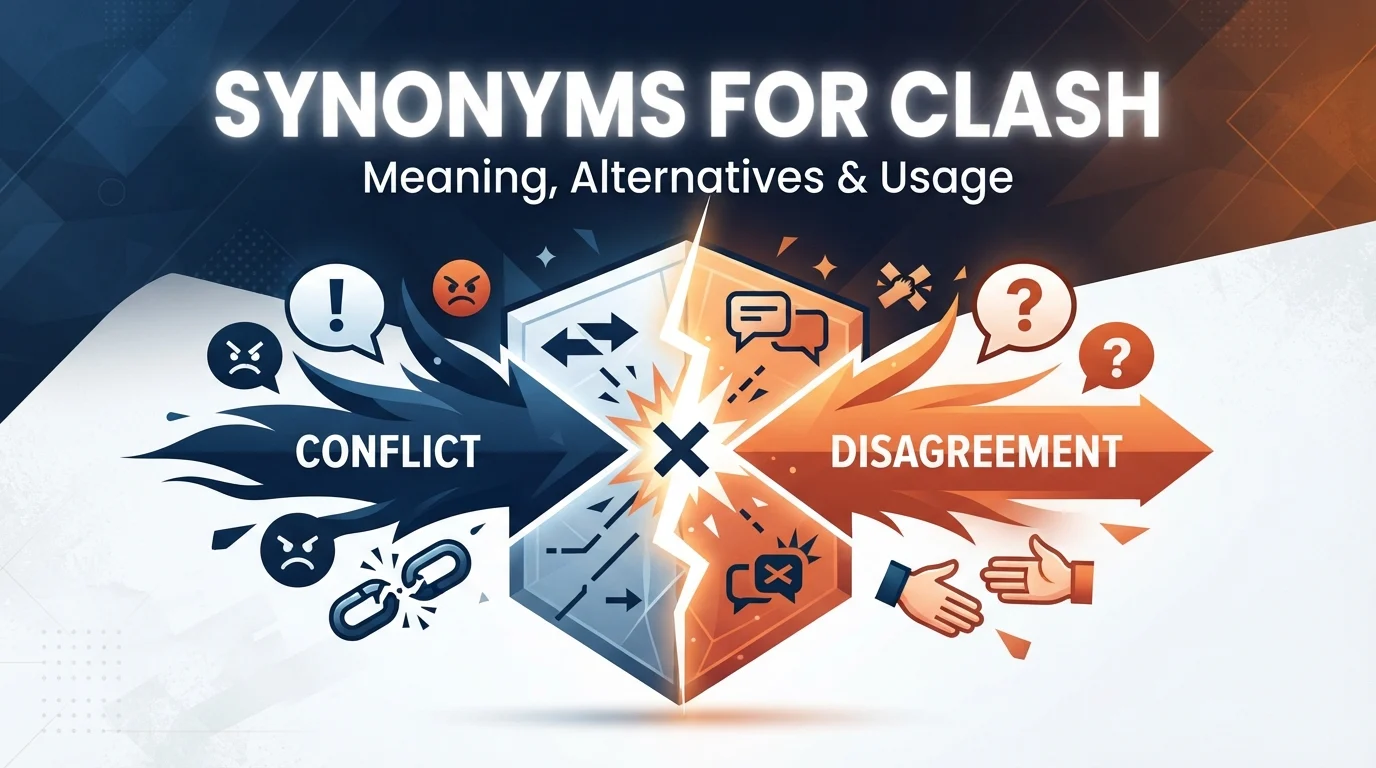
Finding the right words to describe a clash can make your writing clearer, more precise, and more natural. The word clash can describe a physical fight, a disagreement between people, a conflict of ideas, or even two things that do not work well together. Because of these different meanings, choosing the right synonym depends heavily on the situation.
Whether you are a student, ESL learner, writer, or content creator, learning synonyms for clash can help you avoid repetition and express subtle differences in meaning. For example, conflict sounds more general and formal, while confrontation often suggests a direct encounter. Disagreement is usually milder, whereas collision can describe a physical impact.
This guide explains 30 useful alternatives to clash, with simple meanings, examples, and usage notes. By the end, you will know which word fits different situations, tones, and types of conflict.
What Does “Clash” Mean?
The word clash generally means a disagreement, conflict, or fight between people or groups. It can also mean a physical collision or a situation where two things do not match or work well together.
For example:
- The two politicians clashed over the proposed law.
- The protesters clashed with police.
- The red curtains clash with the blue walls.
As a verb, clash means to disagree, fight, collide, or be incompatible. As a noun, it can refer to a conflict, confrontation, collision, or incompatibility.
The tone of clash is usually neutral, but it can suggest a noticeable or intense disagreement. The best synonym depends on whether you are describing an argument, physical conflict, competing ideas, or a visual mismatch.
30 Synonyms for Clash
Here are 30 useful words that can replace clash in different contexts.
1. Conflict
Meaning: A serious disagreement, struggle, or opposition between people, groups, or ideas.
Example:
The two departments were involved in a conflict over the new policy.
Best usage context: Formal writing, workplace situations, politics, social issues, and serious disagreements.
2. Confrontation
Meaning: A direct meeting or encounter between opposing people or groups.
Example:
The disagreement eventually led to a confrontation between the two teams.
Best usage context: Direct disputes, tense encounters, and situations where opposing sides meet.
3. Disagreement
Meaning: A situation in which people have different opinions or views.
Example:
They had a disagreement about how the project should be completed.
Best usage context: Mild or ordinary differences of opinion.
4. Dispute
Meaning: An argument or disagreement, often involving an important issue.
Example:
The neighbors had a dispute over the property boundary.
Best usage context: Legal, business, workplace, property, and formal disagreements.
5. Argument
Meaning: A disagreement in which people express opposing opinions.
Example:
The couple had an argument about household responsibilities.
Best usage context: Everyday conversations and personal disagreements.
6. Altercation
Meaning: A short, angry argument or physical fight.
Example:
The police arrived after an altercation outside the restaurant.
Best usage context: News reports and situations involving heated verbal or physical conflict.
7. Fight
Meaning: A physical struggle or a strong disagreement between people.
Example:
The two players got into a fight after the match.
Best usage context: Informal language and physical confrontations.
8. Feud
Meaning: A long-lasting and bitter disagreement between people or groups.
Example:
The two families have been involved in a feud for decades.
Best usage context: Long-term personal, family, political, or organizational conflicts.
9. Struggle
Meaning: A difficult effort or conflict between opposing forces.
Example:
The company struggled with internal conflict during the transition.
Best usage context: Social, personal, economic, or figurative conflicts.
10. Battle
Meaning: A fight or struggle between opposing sides.
Example:
The two candidates entered a fierce battle over public support.
Best usage context: Military contexts and strong figurative conflicts.
11. Contest
Meaning: A competition or struggle between people or groups trying to achieve something.
Example:
The election became a close contest between the leading candidates.
Best usage context: Competitions, elections, sports, and figurative struggles.
12. Collision
Meaning: A situation in which two physical objects hit each other.
Example:
The accident happened after a collision between two cars.
Best usage context: Physical impacts, traffic accidents, and literal collisions.
13. Confront
Meaning: To face someone or something directly, especially when there is a problem or disagreement.
Example:
She decided to confront her colleague about the mistake.
Best usage context: Directly addressing a difficult person, problem, or situation.
14. Oppose
Meaning: To disagree with or resist someone, something, or an idea.
Example:
Several members opposed the proposed changes.
Best usage context: Formal writing, politics, policies, decisions, and ideas.
15. Compete
Meaning: To try to win or achieve something against another person or group.
Example:
The two companies compete for the same customers.
Best usage context: Business, sports, education, and other competitive situations.
16. Quarrel
Meaning: An angry disagreement or argument.
Example:
The siblings had a quarrel over who should use the computer.
Best usage context: Personal disagreements, especially in informal writing.
17. Wrangle
Meaning: A long or difficult argument or disagreement.
Example:
The committee spent hours wrangling over the proposed changes.
Best usage context: Informal or journalistic writing about prolonged disagreements.
18. Bicker
Meaning: To argue repeatedly about small or unimportant matters.
Example:
The children continued to bicker over the game.
Best usage context: Minor, repetitive, or petty arguments.
19. Squabble
Meaning: A small, unimportant argument.
Example:
The two coworkers had a brief squabble about office supplies.
Best usage context: Minor disagreements that are not especially serious.
20. Strife
Meaning: Serious and continuing disagreement or conflict.
Example:
Years of political strife affected the country’s development.
Best usage context: Formal, literary, historical, and social writing.
21. Turmoil
Meaning: A state of confusion, disorder, or serious conflict.
Example:
The organization experienced considerable turmoil after the leadership change.
Best usage context: Social, political, organizational, and emotional situations involving widespread disruption.
22. Tension
Meaning: A feeling of pressure or uneasiness between people or groups.
Example:
There was growing tension between the two departments.
Best usage context: Situations where conflict is developing but may not have become an open confrontation.
23. Friction
Meaning: Disagreement or difficulty between people who do not get along.
Example:
There has been friction between the manager and his employees.
Best usage context: Workplace relationships, social interactions, and ongoing minor conflict.
24. Hostility
Meaning: Unfriendly, aggressive, or strongly negative behavior toward someone.
Example:
The negotiations continued despite growing hostility between the two sides.
Best usage context: Serious interpersonal, political, or international conflict.
25. Rivalry
Meaning: Competition between people or groups trying to outperform each other.
Example:
The rivalry between the two clubs has lasted for years.
Best usage context: Sports, business, politics, and competitive relationships.
26. Opposition
Meaning: Resistance or disagreement against a person, idea, plan, or group.
Example:
The proposal faced strong opposition from local residents.
Best usage context: Formal writing, politics, policies, proposals, and public debates.
27. Antagonism
Meaning: Strong dislike, opposition, or hostility between people or groups.
Example:
Years of antagonism made cooperation difficult.
Best usage context: Formal and academic writing about deep or persistent opposition.
28. Discord
Meaning: A lack of agreement or harmony between people or groups.
Example:
Internal discord weakened the organization.
Best usage context: Formal, academic, literary, and organizational writing.
29. Incompatibility
Meaning: A situation in which two things cannot work or exist well together.
Example:
Their disagreement reflected a deeper incompatibility in their approaches.
Best usage context: Ideas, systems, personalities, technologies, and relationships that do not work well together.
30. Divergence
Meaning: A movement or development in different directions, especially in opinions or ideas.
Example:
There was a clear divergence between the two groups’ priorities.
Best usage context: Academic, professional, analytical, and formal writing.
Quick Comparison of Synonyms for Clash
Different synonyms communicate different levels and types of conflict. The following guide can help you choose the most suitable word.
| Synonym | Main Meaning | Typical Tone | Best Context |
| Conflict | Serious opposition | Neutral/Formal | General conflict |
| Confrontation | Direct encounter | Neutral/Serious | Face-to-face conflict |
| Disagreement | Difference of opinion | Mild | Everyday situations |
| Dispute | Formal disagreement | Formal | Legal/business matters |
| Argument | Verbal disagreement | Neutral | Personal situations |
| Altercation | Heated argument or fight | Serious | News and incidents |
| Fight | Physical or verbal conflict | Informal | Everyday speech |
| Feud | Long-lasting conflict | Strong | Families/groups |
| Struggle | Difficult opposition | Neutral | Personal/social issues |
| Battle | Strong fight or struggle | Dramatic | Literal/figurative |
| Collision | Physical impact | Neutral | Vehicles/objects |
| Quarrel | Angry disagreement | Informal | Personal relationships |
| Wrangle | Prolonged argument | Informal | Debates/committees |
| Bicker | Petty argument | Mild/Informal | Small disagreements |
| Squabble | Minor argument | Informal | Trivial disputes |
| Strife | Serious conflict | Formal | Social/historical contexts |
| Tension | Pressure between sides | Neutral | Developing conflict |
| Friction | Ongoing interpersonal difficulty | Neutral | Work/relationships |
| Hostility | Aggressive opposition | Strong | Serious disputes |
| Rivalry | Competitive relationship | Neutral | Sports/business |
| Discord | Lack of harmony | Formal | Groups/organizations |
| Divergence | Difference in direction | Formal | Ideas/opinions |
| Incompatibility | Inability to work together | Formal | Systems/people |
Synonyms for Clash in Different Situations
The best synonym changes depending on what kind of clash you mean.
For a Verbal Clash
If two people disagree verbally, words such as argument, disagreement, quarrel, dispute, and confrontation may work.
For example:
- They had an argument about money.
- The two managers had a disagreement.
- The discussion turned into a confrontation.
If the argument is minor, bicker or squabble may be more appropriate.
For a Physical Clash
When clash describes physical violence, fight, altercation, confrontation, or collision may be suitable depending on the situation.
For example:
- The fans got into a fight.
- An altercation occurred outside the stadium.
- Two vehicles were involved in a collision.
Remember that collision normally refers to objects physically hitting each other, while fight usually involves people.
For a Political Clash
Political disagreements can often be described using conflict, dispute, opposition, confrontation, or strife.
For example:
The parties remain in opposition over the proposed legislation.
The word disagreement is also useful when the conflict is primarily about different opinions or policies.
For a Workplace Clash
For professional settings, conflict, disagreement, dispute, friction, and tension are often natural choices.
For example:
There has been tension between the two departments.
This sounds more measured than saying:
The two departments are constantly fighting.
For a Long-Term Clash
If a disagreement continues for a long time, feud, rivalry, strife, antagonism, or conflict may be more accurate.
For example:
The rivalry between the two organizations has continued for years.
A feud generally suggests a bitter and personal long-term conflict.
For a Clash of Ideas
When different opinions, beliefs, or approaches conflict, consider disagreement, opposition, divergence, conflict, or discord.
For example:
There was a clear divergence in their views on education.
Here, divergence is more precise than fight because no physical confrontation is involved.
For Things That Do Not Match
Sometimes clash is not about people at all. It can describe colors, styles, sounds, schedules, or ideas that do not work well together.
In these cases, incompatibility may be a useful alternative.
For example:
The two design styles have some degree of incompatibility.
For colors, however, it is often more natural to simply say:
The colors do not match.
How to Choose the Right Synonym for Clash
Choosing the right synonym becomes easier when you first identify the type and intensity of the conflict.
For Mild Conflict
Use:
- Disagreement
- Difference
- Friction
- Tension
- Bicker
- Squabble
These words are useful when the situation is relatively minor.
Example:
There was some friction between the coworkers.
For Serious Conflict
Use:
- Conflict
- Dispute
- Confrontation
- Hostility
- Strife
- Antagonism
These words work better when the disagreement is significant or ongoing.
Example:
The dispute continued for several months.
For Direct Conflict
Use:
- Confrontation
- Altercation
- Fight
- Confront
These terms suggest that opposing sides directly face each other.
Example:
The disagreement ended in a confrontation.
For Long-Term Conflict
Use:
- Feud
- Rivalry
- Strife
- Antagonism
- Conflict
These words are suitable when the problem continues over an extended period.
Example:
The families have been involved in a feud for generations.
For Formal or Academic Writing
Use:
- Conflict
- Dispute
- Opposition
- Discord
- Divergence
- Antagonism
- Incompatibility
These words can make analytical, academic, or professional writing more precise.
Example:
The study examines the divergence between the two theoretical approaches.
For Informal Writing
Use:
- Fight
- Argument
- Quarrel
- Bicker
- Squabble
- Wrangle
These words are more natural in everyday conversation and casual writing.
Example:
The kids started bickering over the television remote.
Clash vs. Conflict
Clash and conflict are closely related, but they are not always interchangeable.
Clash often suggests a noticeable encounter or disagreement:
The two leaders clashed over the proposal.
Conflict is broader and can describe an ongoing state of opposition:
The organization experienced internal conflict.
You can think of clash as something that may happen between opposing sides, while conflict can describe the broader condition or relationship.
Clash vs. Disagreement
A disagreement is usually milder than a clash.
Compare:
The students had a disagreement about the assignment.
with:
The students clashed over the assignment.
The first sentence suggests different opinions. The second can suggest a stronger or more heated disagreement.
Clash vs. Confrontation
A confrontation generally emphasizes direct contact between opposing sides.
For example:
The two employees clashed over the decision.
This tells us they strongly disagreed.
The disagreement resulted in a confrontation.
This emphasizes the direct encounter that followed.
Clash vs. Dispute
A dispute often sounds more formal and can involve an issue that requires resolution.
For example:
The neighbors had a dispute over the property.
This is particularly natural in legal, business, property, and formal contexts.
Clash vs. Rivalry
A rivalry involves competition rather than necessarily direct hostility.
For example:
There is a strong rivalry between the two teams.
The teams may compete intensely without having a personal dispute.
By contrast:
The two teams clashed after the match.
suggests a specific incident or confrontation.
Clash vs. Collision
These words have different meanings when describing physical events.
A collision occurs when physical objects hit one another:
The cars were involved in a collision.
A clash can describe physical conflict between people or groups:
The protesters clashed with police.
Therefore, collision is usually the better choice for vehicles or objects physically hitting each other.
Useful Synonyms for “Clash” in Writing
If you are trying to avoid repeating clash in an article, essay, or story, consider the surrounding sentence.
Instead of:
The two groups clashed over the issue.
You could write:
- The two groups disagreed over the issue.
- The two groups were in conflict over the issue.
- The two groups disputed the issue.
- The two groups opposed each other over the issue.
- The two groups confronted each other over the issue.
Each version creates a slightly different impression.
Synonyms for Clash in a Sentence
Here are practical examples showing how different alternatives work.
Clash:
The two teams clashed during the final.
Conflict:
The two teams experienced a serious conflict.
Confrontation:
The match ended in a confrontation between the players.
Disagreement:
The players had a disagreement about the referee’s decision.
Dispute:
The teams became involved in a dispute over the rules.
Altercation:
An altercation broke out after the match.
Rivalry:
The rivalry between the teams has lasted for years.
Tension:
Tension grew between the teams before the final.
These examples show why choosing a synonym is not simply about replacing one word with another. The meaning and tone can change slightly.
Strong Alternatives to “Clash”
If you need a powerful alternative, consider the type of situation first.
For a serious disagreement, use conflict or dispute.
For a direct encounter, use confrontation.
For a minor disagreement, use disagreement or squabble.
For a heated argument, use altercation or quarrel.
For a long-running conflict, use feud or strife.
For competition, use rivalry or contest.
For physical impact, use collision.
For differences between ideas, use divergence or opposition.
For lack of harmony, use discord.
For ongoing interpersonal problems, use friction or tension.
Why Learning Synonyms for Clash Matters
Learning alternatives to clash is useful for more than avoiding repetition.
Different synonyms allow you to communicate intensity, context, duration, and tone more accurately.
For example, saying that two friends squabbled suggests a relatively small disagreement. Saying they were involved in a serious conflict creates a much stronger impression.
Similarly, describing two companies as having a rivalry emphasizes competition, while describing them as being in conflict emphasizes opposition.
This distinction is particularly valuable in academic writing, professional communication, journalism, storytelling, and English-language learning.
Common Mistakes When Using Clash Synonyms
Using “Collision” for Every Physical Clash
A collision normally involves physical objects hitting each other. It should not automatically replace clash when people are fighting.
Incorrect or unnatural:
The protesters had a collision with police.
More natural:
The protesters clashed with police.
Using “Feud” for a One-Time Argument
A feud usually suggests an extended or recurring conflict.
For a single disagreement, argument, dispute, or confrontation is generally more appropriate.
Using “Rivalry” for Hostility
Rivalry means competition. It does not necessarily mean the people involved dislike one another.
If you want to emphasize hostility, conflict, antagonism, or hostility may communicate the idea more clearly.
Using “Bicker” for a Serious Conflict
Bicker normally describes repeated arguments about relatively small matters.
For a major disagreement, conflict, dispute, or confrontation is usually stronger.
Frequently Asked Questions About Synonyms for Clash
What is the best synonym for clash?
There is no single synonym that fits every situation. Conflict is one of the broadest alternatives, while disagreement, confrontation, dispute, altercation, and collision are more specific.
What is a simple synonym for clash?
Disagreement is a simple and common synonym when clash refers to different opinions. Fight can work when it refers to physical conflict.
What is a formal synonym for clash?
Depending on the context, formal alternatives include conflict, dispute, opposition, discord, antagonism, and divergence.
What is a synonym for a clash of opinions?
Useful choices include disagreement, conflict, opposition, divergence, and difference of opinion.
What is a synonym for a physical clash?
Depending on the situation, you can use fight, confrontation, altercation, or collision. Collision is especially appropriate when physical objects hit each other.
What is a synonym for a minor clash?
Disagreement, quarrel, bicker, squabble, and friction can describe smaller conflicts, depending on the context.
What is a synonym for a major clash?
Conflict, confrontation, battle, strife, hostility, and altercation can describe stronger forms of conflict.
Can “conflict” always replace “clash”?
No. The words overlap, but their meanings are not identical. Conflict can describe a continuing state of opposition, while clash often describes a particular disagreement, encounter, or incompatibility.
Final Thoughts on Synonyms for Clash
The word clash has several meanings, so the best replacement depends on the situation. If you are describing different opinions, disagreement may be appropriate. For a serious or ongoing problem, conflict or strife may work better. A direct encounter can be called a confrontation, while a long-running personal conflict may be a feud.
For informal writing, words such as argument, fight, quarrel, bicker, and squabble are useful. In formal or academic writing, dispute, opposition, discord, divergence, and antagonism can provide greater precision. When describing physical impact, collision is often the

I am Jace Thomas, a passionate synonym writer dedicated to making word choices simple and meaningful. I enjoy exploring language, discovering synonyms, and helping readers express ideas clearly and creatively.