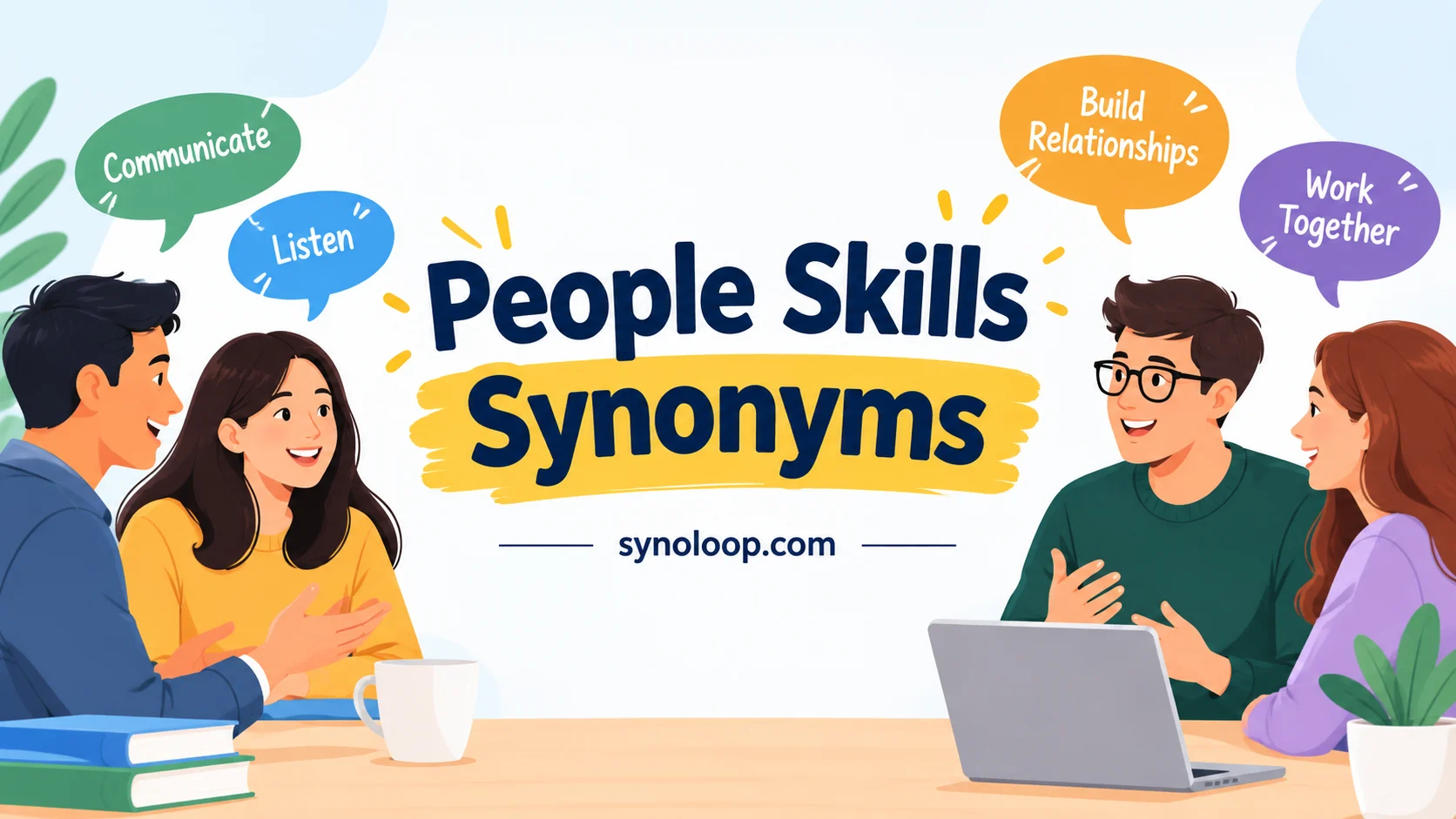
People skills are the abilities that help us communicate, connect, cooperate, and build positive relationships with others. They include qualities such as communication, empathy, listening, teamwork, patience, emotional awareness, and the ability to handle different social situations.
Finding the right people skills synonyms can make your writing more precise and professional. Whether you are updating a resume, writing a cover letter, describing a colleague, or improving your vocabulary, using a specific alternative to “people skills” can help you explain exactly what you mean.
In simple terms, people skills describe how effectively someone interacts with other people. The best synonym depends on the situation. For example, “communication skills” focuses on exchanging information, while “interpersonal skills” covers a broader ability to interact effectively with others.
What Does “People Skills” Mean?
People skills are the social and interpersonal abilities a person uses when dealing with others. They affect how someone communicates, listens, collaborates, solves disagreements, and develops relationships.
For example:
Maria has excellent people skills and can easily communicate with customers, coworkers, and managers.
The phrase is common in everyday English, workplaces, education, and professional writing. It has a generally positive and practical tone.
Depending on the context, you may want a more specific term. A resume might use “interpersonal skills,” while a workplace review might mention “teamwork,” “emotional intelligence,” or “communication abilities.”
30 People Skills Synonyms
Below are 30 useful alternatives to people skills, along with simple meanings, examples, and situations where each term works best.
1. Interpersonal Skills
Meaning: The ability to communicate and interact effectively with other people.
Example:
Her interpersonal skills help her build strong relationships with clients.
Best usage context: Resumes, job applications, education, and professional writing.
2. Communication Skills
Meaning: The ability to express ideas clearly and understand what others are saying.
Example:
Good communication skills are essential for successful teamwork.
Best usage context: Resumes, workplaces, presentations, and academic settings.
3. Social Skills
Meaning: The abilities used to interact comfortably and appropriately with others.
Example:
The workshop helps students develop better social skills.
Best usage context: Education, personal development, psychology, and everyday conversation.
4. Relationship-Building Skills
Meaning: The ability to create and maintain positive relationships with people.
Example:
Strong relationship-building skills helped him develop a loyal customer base.
Best usage context: Sales, management, networking, and customer service.
5. Emotional Intelligence
Meaning: The ability to understand and manage your emotions while recognizing the emotions of others.
Example:
Her emotional intelligence allows her to handle difficult conversations calmly.
Best usage context: Leadership, management, teamwork, and professional development.
6. Teamwork Skills
Meaning: The ability to work effectively with other people toward a shared goal.
Example:
The employer was impressed by his teamwork skills.
Best usage context: Resumes, job interviews, group projects, and workplaces.
7. Collaboration Skills
Meaning: The ability to cooperate with others and contribute to a shared task.
Example:
Collaboration skills are important when working on complex projects.
Best usage context: Business, education, technology, and professional writing.
8. Communication Abilities
Meaning: The capacity to communicate ideas, information, and feelings effectively.
Example:
Her communication abilities make her an effective team leader.
Best usage context: Professional descriptions and formal writing.
9. Social Competence
Meaning: The ability to behave effectively and appropriately in social situations.
Example:
Social competence can help young people develop healthy relationships.
Best usage context: Education, psychology, research, and formal writing.
10. People-Oriented Skills
Meaning: Abilities that help someone work effectively with and understand other people.
Example:
The position requires strong people-oriented skills.
Best usage context: Customer service, management, sales, and job descriptions.
11. Customer Service Skills
Meaning: The ability to communicate with customers and help them in a helpful and professional way.
Example:
Excellent customer service skills helped her resolve complaints successfully.
Best usage context: Retail, hospitality, sales, and support roles.
12. Listening Skills
Meaning: The ability to pay attention and understand what another person is communicating.
Example:
Strong listening skills help managers understand their employees’ concerns.
Best usage context: Leadership, counseling, teamwork, and communication.
13. Empathy
Meaning: The ability to understand or recognize another person’s feelings and perspective.
Example:
His empathy made it easier for him to support frustrated customers.
Best usage context: Leadership, healthcare, counseling, education, and relationships.
14. Rapport-Building Skills
Meaning: The ability to create trust and a comfortable connection with another person.
Example:
The salesperson quickly built rapport with the new clients.
Best usage context: Sales, interviews, teaching, networking, and customer service.
15. Networking Skills
Meaning: The ability to meet, communicate with, and maintain professional relationships with others.
Example:
Strong networking skills helped her discover several career opportunities.
Best usage context: Careers, business, conferences, and professional development.
16. Conflict-Resolution Skills
Meaning: The ability to manage disagreements and find practical solutions.
Example:
Managers need conflict-resolution skills when employees disagree.
Best usage context: Management, HR, teamwork, and leadership.
17. Negotiation Skills
Meaning: The ability to discuss different needs and reach an acceptable agreement.
Example:
His negotiation skills helped the company reach a favorable agreement.
Best usage context: Business, sales, management, and professional communication.
18. Diplomacy
Meaning: The ability to deal with sensitive situations without unnecessarily causing conflict.
Example:
She handled the disagreement with diplomacy and patience.
Best usage context: Leadership, workplaces, politics, international relations, and difficult conversations.
19. Tact
Meaning: The ability to say or do something carefully so that you do not unnecessarily offend someone.
Example:
He used tact when giving constructive feedback to his colleague.
Best usage context: Workplace communication and sensitive situations.
20. Cooperation
Meaning: The willingness and ability to work together with others.
Example:
The project’s success depended on cooperation between several departments.
Best usage context: Teamwork, education, workplaces, and community activities.
21. Adaptability
Meaning: The ability to adjust your behavior or approach when circumstances change.
Example:
Her adaptability helped her work successfully with different teams.
Best usage context: Resumes, workplaces, leadership, and changing environments.
22. Team-Building Skills
Meaning: The ability to help a group develop trust, cooperation, and effective teamwork.
Example:
The manager uses team-building skills to create a supportive workplace.
Best usage context: Management, leadership, and organizational development.
23. Leadership Skills
Meaning: The abilities needed to guide, motivate, and support other people.
Example:
Her leadership skills helped the team complete the project on time.
Best usage context: Resumes, management, career development, and professional profiles.
24. Customer Relations Skills
Meaning: The ability to develop positive and professional relationships with customers.
Example:
His customer relations skills helped increase client satisfaction.
Best usage context: Sales, hospitality, retail, and business.
25. Social Intelligence
Meaning: The ability to understand social situations and respond appropriately.
Example:
Social intelligence can help employees work effectively with different personalities.
Best usage context: Psychology, leadership, workplace communication, and personal development.
26. Conversational Skills
Meaning: The ability to participate in clear, natural, and effective conversations.
Example:
Improving her conversational skills made networking less stressful.
Best usage context: Language learning, social situations, ESL writing, and communication.
27. Persuasion Skills
Meaning: The ability to influence others through clear and convincing communication.
Example:
His persuasion skills helped him explain the benefits of the new service.
Best usage context: Sales, marketing, leadership, and negotiations.
28. Mentoring Skills
Meaning: The ability to guide, encourage, and support another person’s development.
Example:
Her mentoring skills helped new employees become confident in their roles.
Best usage context: Leadership, education, management, and professional development.
29. Relationship Management
Meaning: The ability to maintain productive and positive relationships with other people.
Example:
Effective relationship management is important when working with long-term clients.
Best usage context: Business, management, sales, and customer relations.
30. Human Relations Skills
Meaning: The ability to understand, communicate with, and work effectively with people.
Example:
Human relations skills are valuable in almost every workplace.
Best usage context: Business, management, education, and formal writing.
People Skills Synonyms at a Glance
| Synonym | Main Focus | Best Context |
| Interpersonal skills | General interaction | Resumes and workplaces |
| Communication skills | Sharing information | Jobs and education |
| Social skills | Social interaction | Everyday and educational contexts |
| Emotional intelligence | Understanding emotions | Leadership and teamwork |
| Teamwork skills | Working in groups | Jobs and projects |
| Collaboration skills | Working together | Business and education |
| Empathy | Understanding feelings | Healthcare and relationships |
| Networking skills | Professional connections | Careers and business |
| Diplomacy | Handling sensitive situations | Leadership and workplaces |
| Tact | Avoiding unnecessary offense | Difficult conversations |
| Negotiation skills | Reaching agreements | Business and sales |
| Conflict-resolution skills | Managing disagreements | Management and teamwork |
| Leadership skills | Guiding others | Management and careers |
| Listening skills | Understanding others | Communication and leadership |
| Rapport-building skills | Creating trust | Sales and customer service |
Which People Skills Synonym Should You Use?
The right synonym depends on the specific ability you want to describe.
If you mean general ability to work with people, use interpersonal skills.
If you mean expressing ideas and understanding others, choose communication skills.
If you are talking about understanding emotions, emotional intelligence or empathy may be more precise.
If the focus is on working with a group, use teamwork skills or collaboration skills.
If you are describing professional connections, networking skills or relationship-building skills may be more appropriate.
If the situation involves disagreements, terms such as diplomacy, tact, or conflict-resolution skills can provide more detail.
People Skills Synonyms for a Resume
“People skills” is understandable, but resumes often benefit from more specific language.
Instead of:
I have excellent people skills.
You could write:
I have strong interpersonal and communication skills.
Or:
I use strong relationship-building and collaboration skills to work effectively with diverse teams.
Another option is:
I have excellent customer service, active listening, and conflict-resolution skills.
Specific wording gives the reader a clearer picture of what you can actually do.
People Skills Synonyms for the Workplace
Different workplace situations call for different terms.
For teamwork, use:
- Collaboration skills
- Teamwork skills
- Cooperation
- Team-building skills
For communication, use:
- Communication skills
- Conversational skills
- Listening skills
- Communication abilities
For leadership, use:
- Leadership skills
- Emotional intelligence
- Mentoring skills
- Relationship management
For difficult situations, use:
- Diplomacy
- Tact
- Conflict-resolution skills
- Negotiation skills
For customers and clients, use:
- Customer service skills
- Customer relations skills
- Rapport-building skills
- Relationship-building skills
How to Choose the Right Synonym
For General Social Ability
Choose interpersonal skills, social skills, or social competence when you want to describe a broad ability to interact with others.
For Clear Communication
Choose communication skills, communication abilities, listening skills, or conversational skills when communication is the main focus.
For Emotional Awareness
Choose empathy, emotional intelligence, or social intelligence when understanding people’s emotions and perspectives is important.
For Teamwork
Choose teamwork skills, collaboration skills, cooperation, or team-building skills when people need to work toward a shared objective.
For Professional Relationships
Choose relationship-building skills, relationship management, rapport-building skills, or networking skills when the focus is on creating and maintaining connections.
For Conflict and Sensitive Situations
Choose diplomacy, tact, negotiation skills, or conflict-resolution skills when dealing with disagreement or sensitive communication.
For Leadership
Choose leadership skills, mentoring skills, emotional intelligence, or relationship management when describing someone’s ability to guide and support others.
Are “People Skills” and “Interpersonal Skills” the Same?
They are very similar, but they are not always interchangeable.
People skills is a broad, everyday expression for abilities that help someone interact successfully with others.
Interpersonal skills is a more formal term commonly used in professional, academic, and workplace contexts.
For example:
She has excellent people skills.
and
She has excellent interpersonal skills.
Both sentences communicate a similar idea. However, “interpersonal skills” may sound more appropriate in a resume or formal professional document.
People Skills vs. Soft Skills
People skills and soft skills overlap, but soft skills is a broader category.
Soft skills can include:
- Communication
- Teamwork
- Leadership
- Time management
- Adaptability
- Problem-solving
- Emotional intelligence
People skills mainly focus on how someone interacts with other people.
Therefore, people skills are a type of soft skill, but not every soft skill is necessarily a people skill.
Why People Skills Matter
Strong people skills can make communication easier and help people work together more effectively. They are useful in classrooms, workplaces, customer service, leadership positions, and everyday relationships.
They can also help people manage misunderstandings, listen to different perspectives, cooperate with others, and build trust.
For students and ESL learners, learning these related terms is especially useful because each word can communicate a slightly different idea. Knowing the difference between “empathy,” “communication skills,” “diplomacy,” and “teamwork” can make both speaking and writing more precise.
Frequently Asked Questions About People Skills Synonyms
What is the best synonym for people skills?
Interpersonal skills is one of the closest general synonyms for “people skills.” It works especially well in professional and academic writing.
What is another word for good people skills?
Depending on the meaning, you can use strong interpersonal skills, excellent communication skills, social competence, emotional intelligence, or relationship-building skills.
What are people skills called on a resume?
Common professional terms include interpersonal skills, communication skills, teamwork skills, collaboration skills, emotional intelligence, and relationship management.
What is a professional way to say people skills?
Interpersonal skills is a common professional alternative. You can also use a more specific term, such as “communication skills” or “relationship-building skills,” depending on the ability you want to highlight.
Are communication skills and people skills the same?
Not exactly. Communication skills are one part of people skills. People skills can also include empathy, teamwork, emotional intelligence, conflict resolution, and relationship building.
What is the opposite of poor people skills?
Depending on the situation, you might describe someone as having strong interpersonal skills, effective communication abilities, social competence, or excellent relationship-building skills.
What are examples of people skills?
Examples include communication, active listening, empathy, teamwork, collaboration, diplomacy, negotiation, adaptability, conflict resolution, and emotional intelligence.
Final Thoughts on People Skills Synonyms
There are many useful people skills synonyms, but the best choice depends on the exact meaning you want to communicate. Interpersonal skills is a strong general alternative, while terms such as communication skills, empathy, teamwork, emotional intelligence, diplomacy, and relationship-building skills describe more specific abilities.
When writing a resume, essay, professional profile, or everyday message, avoid choosing a synonym simply because it sounds more impressive. Choose the word that accurately describes the skill. Precise vocabulary makes your writing clearer, more natural, and more useful to the reader.
Learning these distinctions can also improve your overall English vocabulary. Instead of repeatedly using the broad phrase “people skills,” you can select a more precise term that matches the situation, tone, and intended meaning.

I am Ace Michael, an author passionate about words, language, and vocabulary. I enjoy exploring synonyms and finding simple, useful alternatives that help readers express their ideas clearly, naturally, and creatively. At Synoloop, I share helpful word choices to make writing easier and more effective.