The word delirious is often used to describe someone who is extremely excited, happy, or unable to think clearly. Its exact meaning depends on the context. For example, a person can be delirious with joy after receiving wonderful news, while someone who is confused or disoriented may also be described as delirious.
Learning the synonyms of delirious can help you choose a more precise word for your writing and speaking. Some alternatives emphasize happiness and excitement, while others describe confusion, irrational behavior, or a disturbed mental state.
In simple English, delirious can mean extremely excited or happy, or very confused and unable to think clearly. The tone can range from positive and enthusiastic to serious, depending on how the word is used.
What Does “Delirious” Mean?
Delirious is an adjective with two closely related uses.
First, it can describe someone who is extremely happy, excited, or joyful.
Example:
The fans were delirious with excitement after their team won.
Second, it can describe someone who is confused, disoriented, or behaving irrationally, sometimes because of illness, fever, medication, or another medical condition.
Example:
The patient became delirious during the night.
The context is important because the first use is often positive, while the second can be serious.
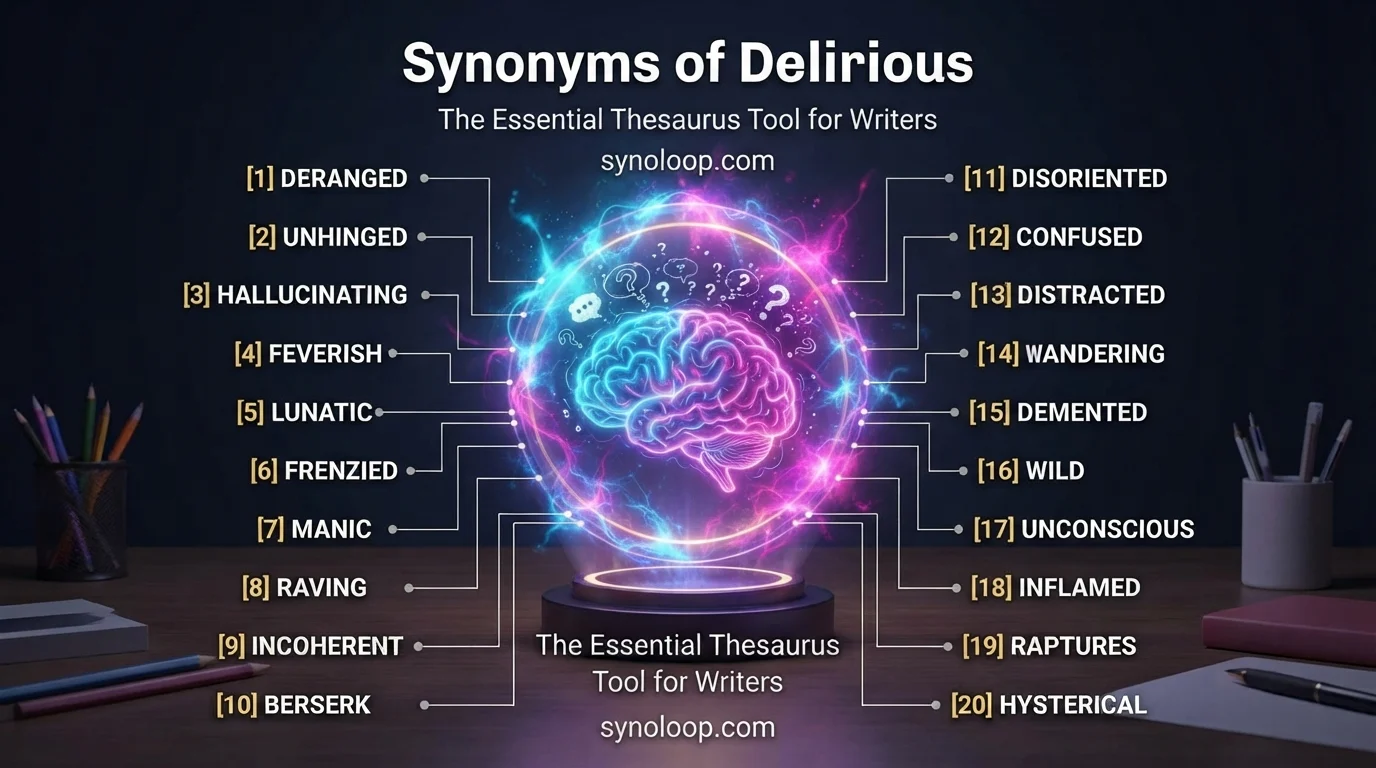
30 Synonyms of Delirious
Here are 30 useful alternatives to delirious, with simple meanings, examples, and guidance on when to use each word.
1. Ecstatic
Meaning: Extremely happy and excited.
Example:
She was ecstatic when she learned that she had won the competition.
Best usage context: Use it for very strong happiness or excitement.
2. Euphoric
Meaning: Feeling an intense sense of happiness or excitement.
Example:
The players were euphoric after winning the championship.
Best usage context: Good for intense emotional happiness, especially after a major success.
3. Elated
Meaning: Extremely happy and proud.
Example:
He felt elated after receiving the award.
Best usage context: Useful in formal and professional writing.
4. Exuberant
Meaning: Full of energy, enthusiasm, and happiness.
Example:
The children were exuberant during the school celebration.
Best usage context: Best when happiness is energetic and openly expressed.
5. Overjoyed
Meaning: Extremely happy.
Example:
Her parents were overjoyed when she came home safely.
Best usage context: A natural choice for very strong personal happiness.
6. Thrilled
Meaning: Extremely pleased and excited.
Example:
I was thrilled to receive an invitation to the event.
Best usage context: Common in everyday English when something exciting happens.
7. Jubilant
Meaning: Extremely joyful, especially after a victory or success.
Example:
The jubilant crowd celebrated the team’s victory.
Best usage context: Particularly useful for celebrations and public victories.
8. Exhilarated
Meaning: Extremely excited and energized.
Example:
She felt exhilarated after finishing the difficult race.
Best usage context: Good for excitement caused by achievement, adventure, or intense experiences.
9. Rapturous
Meaning: Showing extremely strong happiness or delight.
Example:
The audience gave the singer a rapturous welcome.
Best usage context: Useful for literary or expressive writing.
10. Joyful
Meaning: Feeling or showing great happiness.
Example:
The joyful family gathered for the celebration.
Best usage context: A simple, positive alternative for general happiness.
11. Delighted
Meaning: Very pleased or happy about something.
Example:
She was delighted with the thoughtful gift.
Best usage context: Excellent for everyday conversations and polite writing.
12. Gleeful
Meaning: Very happy and excited, sometimes in a playful way.
Example:
The children gave gleeful screams when they saw the surprise.
Best usage context: Works well for playful or childlike excitement.
13. Ecstatic with Joy
Meaning: Filled with an extremely strong feeling of happiness.
Example:
The family was ecstatic with joy when the good news arrived.
Best usage context: Use when you want to emphasize overwhelming happiness.
14. Excited
Meaning: Very enthusiastic or eager about something.
Example:
The students were excited about their upcoming trip.
Best usage context: One of the simplest and most common alternatives.
15. Enthusiastic
Meaning: Showing strong interest, excitement, or eagerness.
Example:
The audience was enthusiastic about the new performance.
Best usage context: Particularly useful in professional, academic, and everyday contexts.
16. Animated
Meaning: Full of energy and excitement when speaking or behaving.
Example:
He became animated while describing his travel experience.
Best usage context: Use when someone’s excitement is clearly visible in their behavior or speech.
17. Frenzied
Meaning: Extremely excited, uncontrolled, or energetic.
Example:
The fans created a frenzied atmosphere outside the stadium.
Best usage context: Suitable when excitement becomes chaotic or difficult to control.
18. Wild
Meaning: Extremely excited, uncontrolled, or energetic.
Example:
The crowd went wild when the singer appeared on stage.
Best usage context: Informal writing and conversations involving intense excitement.
19. Hysterical
Meaning: Extremely emotional or uncontrollably excited, laughing, crying, or reacting.
Example:
The audience became hysterical with laughter.
Best usage context: Use carefully because it can also describe extreme emotional distress or uncontrolled behavior.
20. Frenetic
Meaning: Extremely fast, energetic, and sometimes disorganized.
Example:
The office became frenetic before the deadline.
Best usage context: Good for situations involving intense and chaotic activity.
21. Confused
Meaning: Unable to understand or think clearly.
Example:
He looked confused after waking from a long sleep.
Best usage context: Use when delirious refers to mental confusion rather than happiness.
22. Disoriented
Meaning: Confused about where you are, what is happening, or what is real.
Example:
The traveler felt disoriented after waking in an unfamiliar room.
Best usage context: Appropriate for serious or medical contexts involving confusion.
23. Bewildered
Meaning: Very confused and unsure about something.
Example:
She looked bewildered by the unexpected instructions.
Best usage context: Useful when someone cannot understand a confusing situation.
24. Distracted
Meaning: Unable to concentrate because your attention is elsewhere.
Example:
He was distracted by the noise outside.
Best usage context: Use when lack of concentration is the main idea.
25. Confounded
Meaning: Completely confused or puzzled.
Example:
The unusual result left the researchers confounded.
Best usage context: Works well in formal or literary writing.
26. Irrational
Meaning: Not based on clear or sensible thinking.
Example:
Fear can sometimes cause people to make irrational decisions.
Best usage context: Use when behavior or thinking does not seem reasonable.
27. Deranged
Meaning: Extremely disturbed or unable to think normally.
Example:
The story describes a character whose behavior becomes increasingly deranged.
Best usage context: Strong word generally used for seriously disturbed behavior; avoid using it casually for ordinary confusion.
28. Distraught
Meaning: Extremely upset, worried, or emotionally distressed.
Example:
The distraught parents searched for their missing child.
Best usage context: Use when the emotional state is one of severe distress rather than happiness.
29. Unhinged
Meaning: Behaving in a highly uncontrolled or irrational way.
Example:
His unhinged reaction surprised everyone in the room.
Best usage context: Informal and strong; useful for describing extreme behavior.
30. Out of One’s Mind
Meaning: Extremely excited, upset, or unable to think normally.
Example:
She was out of her mind with excitement before the concert.
Best usage context: Informal expressions, especially when describing very strong emotions.
Synonyms of Delirious by Meaning
Not every synonym of delirious can replace the word in every sentence. The best choice depends on whether you are talking about happiness, excitement, confusion, or irrational behavior.
| Synonym | Main Meaning | Tone | Common Context |
| Ecstatic | Extremely happy | Strong, positive | Success, good news |
| Euphoric | Intense happiness | Strong | Victory, achievement |
| Elated | Very happy | Formal | Awards, achievements |
| Exuberant | Energetic happiness | Positive | People, celebrations |
| Overjoyed | Extremely happy | Warm | Personal events |
| Thrilled | Very excited | Everyday | Good news, opportunities |
| Jubilant | Joy after success | Celebratory | Victories, public events |
| Exhilarated | Highly energized | Positive | Adventure, achievement |
| Rapturous | Overwhelming delight | Literary | Art, performances |
| Delighted | Very pleased | Polite | Everyday situations |
| Frenzied | Wild excitement | Intense | Crowds, chaotic events |
| Confused | Unable to understand | Neutral | General confusion |
| Disoriented | Unsure of surroundings | Serious | Medical or unfamiliar situations |
| Bewildered | Deeply puzzled | Neutral | Difficult situations |
| Irrational | Not sensible | Negative | Decisions or behavior |
| Distraught | Extremely upset | Serious | Emotional distress |
| Unhinged | Highly irrational | Strong/informal | Extreme behavior |
Positive Synonyms for Delirious
When delirious means extremely happy or excited, these words are usually the closest choices:
- Ecstatic
- Euphoric
- Elated
- Overjoyed
- Thrilled
- Jubilant
- Exhilarated
- Delighted
- Joyful
- Rapturous
For example:
Original:
The children were delirious with excitement.
Alternative:
The children were ecstatic with excitement.
Both sentences communicate very strong happiness and excitement.
Synonyms for Delirious Meaning Confused
When delirious describes a confused mental state, positive words such as ecstatic or overjoyed are not appropriate.
Better choices include:
- Confused
- Disoriented
- Bewildered
- Confounded
- Irrational
- Distracted
For example:
Original:
The patient appeared delirious.
Alternative:
The patient appeared confused and disoriented.
This makes the intended meaning clearer.
Synonyms for Extreme or Uncontrolled Behavior
Sometimes delirious is used more loosely to describe extremely emotional or uncontrolled behavior. In these situations, words such as frenzied, hysterical, unhinged, and wild may fit depending on the sentence.
For example:
The crowd went wild after the final goal.
Here, wild describes intense excitement rather than medical confusion.
How to Choose the Right Synonym
Choosing the right synonym depends mainly on what kind of feeling or behavior you want to describe.
For Extreme Happiness
Choose:
- Ecstatic
- Elated
- Overjoyed
- Euphoric
- Joyful
These words work when someone is experiencing powerful happiness.
For Excitement and Energy
Choose:
- Thrilled
- Exuberant
- Exhilarated
- Animated
- Enthusiastic
These are useful when someone is excited, energetic, or eager.
For Celebration and Victory
Choose:
- Jubilant
- Euphoric
- Ecstatic
- Rapturous
These words work particularly well after achievements, victories, or major positive events.
For Confusion
Choose:
- Confused
- Bewildered
- Disoriented
- Confounded
These are better when delirious refers to an inability to think or understand clearly.
For Severe Emotional Distress
Choose:
- Distraught
- Hysterical
- Unhinged
These words can describe intense emotional reactions, but their meanings are not identical. Consider the exact situation before using them.
Delirious vs. Ecstatic
Delirious and ecstatic can both describe extreme happiness.
However, ecstatic is more directly associated with intense happiness or excitement. Delirious can also have a serious meaning involving confusion or altered mental functioning.
Example:
She was ecstatic about her promotion.
This clearly means she was extremely happy.
He became delirious during his illness.
Here, the meaning is very different: he became confused or mentally disoriented.
Delirious vs. Euphoric
Euphoric describes an unusually intense feeling of happiness, excitement, or well-being.
Delirious can describe extreme happiness, but it can also describe confusion.
Therefore, euphoric is often more precise when you specifically mean intense positive emotion.
Delirious vs. Frenzied
Delirious can describe extreme excitement, while frenzied emphasizes uncontrolled or chaotic energy.
Example:
The fans were delirious with excitement.
The focus is on their extreme excitement.
The fans created a frenzied atmosphere.
The focus is on the wild, chaotic energy of the crowd.
Delirious vs. Confused
These words overlap only in certain contexts.
Confused simply means unable to understand or think clearly. Delirious can imply a much more intense state of mental disturbance.
Example:
I was confused by the instructions.
But:
The patient became delirious after developing a high fever.
The second sentence describes a more serious condition.
Common Phrases with Delirious
Learning common phrases can make it easier to understand how delirious is naturally used.
Delirious with Joy
Means extremely happy.
Example:
The parents were delirious with joy when their child graduated.
Delirious with Excitement
Means extremely excited.
Example:
The fans were delirious with excitement before the final match.
Delirious with Happiness
Means overwhelmingly happy.
Example:
She was delirious with happiness after hearing the news.
Delirious with Fever
Refers to a confused mental state associated with a high fever.
Example:
The child became delirious with fever.
Tips for Using Synonyms of Delirious in Writing
The best synonym depends on the intensity, emotion, and situation.
If you are writing about happiness, words such as ecstatic, elated, and overjoyed are clear and natural.
If you are describing energetic excitement, exhilarated, exuberant, or thrilled may be more suitable.
For confusion, disoriented, bewildered, or confounded can provide greater precision.
For formal writing, avoid overly informal expressions such as out of one’s mind unless the style of the writing allows them.
Also, remember that synonyms are rarely perfect replacements. A word may be similar to delirious while having a slightly different emotional strength or tone.
Frequently Asked Questions About Synonyms of Delirious
What is the closest synonym for delirious?
There is no single synonym that works in every context. Ecstatic is a close choice when delirious means extremely happy, while disoriented or confused may be closer when it means unable to think clearly.
What is a synonym for delirious with joy?
Common choices include ecstatic, overjoyed, elated, euphoric, and jubilant.
Is ecstatic a synonym for delirious?
Yes, in contexts where delirious means extremely happy or excited. However, delirious also has a separate meaning related to confusion or disturbed thinking.
What is the opposite of delirious?
The opposite depends on the meaning. For extreme excitement, possible contrasts include calm, indifferent, or unexcited. For confusion, clear-headed, oriented, or rational may provide a contrast.
Is delirious a positive or negative word?
It can be either. Delirious with joy is positive, while being delirious from illness can describe a serious or concerning state of confusion.
What is a simple meaning of delirious?
In simple English, delirious can mean extremely happy or excited, or very confused and unable to think clearly, depending on the context.
Final Thoughts on Synonyms of Delirious
The word delirious has more than one important meaning, so choosing the right synonym requires attention to context. When it describes extreme happiness, words such as ecstatic, euphoric, elated, overjoyed, thrilled, and jubilant can communicate different shades of positive emotion.
When it describes confusion or disturbed thinking, alternatives such as confused, disoriented, bewildered, and confounded may be more appropriate.
The key is not simply to replace delirious with another word. Instead, consider the exact emotion, intensity, and tone you want to communicate. Choosing a precise synonym can make your English clearer, more natural, and more expressive.

I am Evelyn Marie, the Administrator of Synoloop. I enjoy helping readers discover useful synonyms, alternative words, and better ways to express their ideas. I focus on keeping Synoloop simple, reliable, informative, and helpful for everyone.