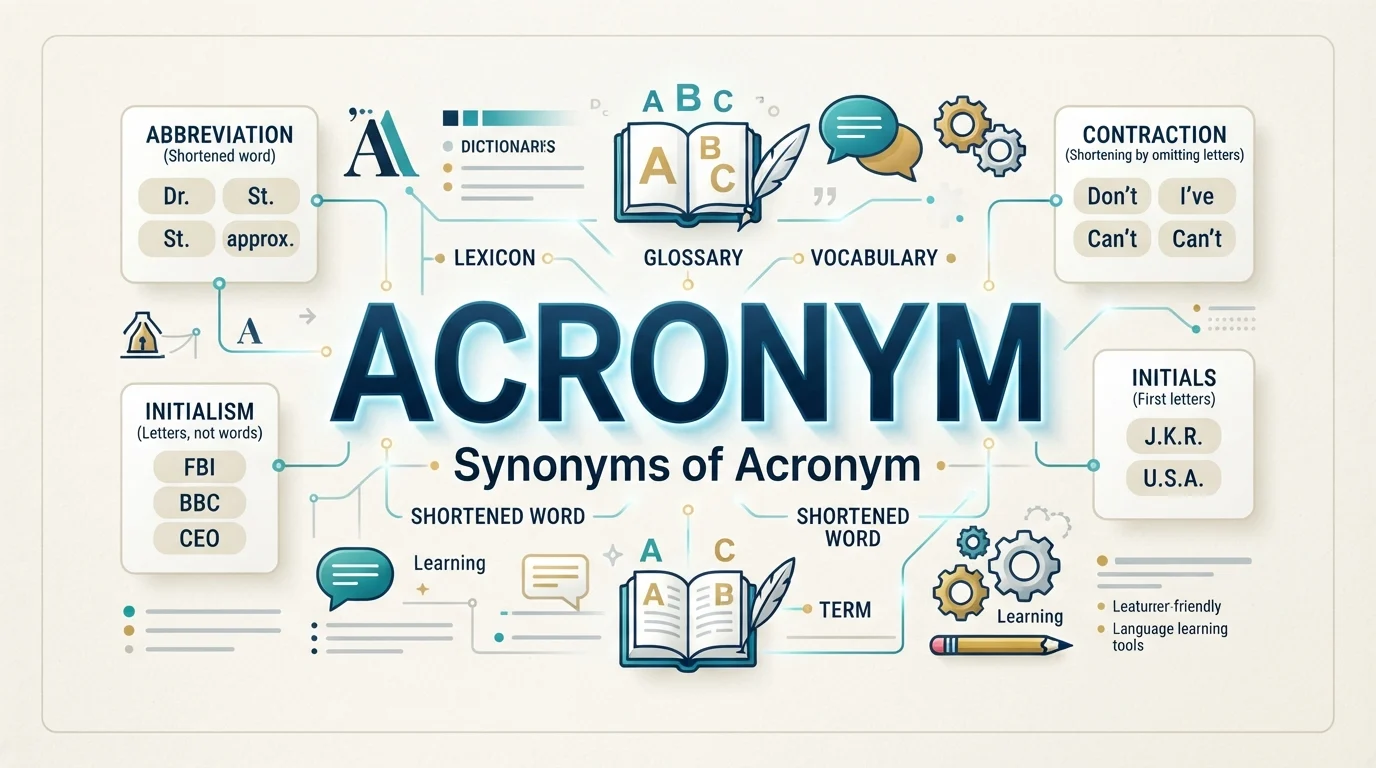
Finding the right synonyms of acronym can be useful when you are writing an essay, explaining technical language, teaching English, or simply trying to avoid repeating the same word. However, there is an important point to understand: acronym has a specific linguistic meaning, so it does not have many perfect synonyms. Many words commonly described as synonyms are actually related terms or alternative ways to describe shortened forms of words.
An acronym is a shortened form made from the initial letters or parts of a longer name or phrase. For example, NASA comes from “National Aeronautics and Space Administration.” Acronyms are common in education, business, technology, science, medicine, and everyday communication.
Understanding related vocabulary can help you choose the most accurate term for your context. Words such as abbreviation, initialism, shortened form, and short form are often useful alternatives, but they are not always interchangeable with acronym. This guide explains these differences in simple English and provides practical examples.
What Does “Acronym” Mean?
An acronym is a shortened word formed from the initial letters or parts of a longer phrase and usually pronounced as a word.
For example:
- NASA — National Aeronautics and Space Administration
- UNESCO — United Nations Educational, Scientific and Cultural Organization
- RADAR — Radio Detection and Ranging
- SCUBA — Self-Contained Underwater Breathing Apparatus
A key feature of an acronym is that it is generally pronounced as a word rather than letter by letter.
For example, NASA is pronounced “nasa,” while FBI is normally pronounced “F-B-I.” Therefore, FBI is more precisely called an initialism rather than an acronym.
In everyday writing, however, people often use acronym as a broad term for many kinds of shortened expressions.
Acronym vs. Abbreviation vs. Initialism
These terms are related, but their meanings are slightly different.
| Term | Simple meaning | Example |
| Acronym | A shortened form pronounced as a word | NASA |
| Initialism | A shortened form pronounced letter by letter | FBI |
| Abbreviation | A shortened version of a word or phrase | Dr. |
| Short form | A general term for something shortened | advertisement → ad |
| Contraction | A shortened form created by leaving out letters | cannot → can’t |
So, if someone searches for synonyms of acronym, they may actually be looking for words describing different types of shortened language.
30 Synonyms and Related Terms for Acronym
Because acronym is a specialized linguistic term, the following list includes both close alternatives and related expressions. The distinction is important for accurate writing.
1. Abbreviation
Meaning: A shortened version of a word or phrase.
Example: “Dr.” is an abbreviation of “Doctor.”
Best usage context: Use abbreviation when discussing shortened words or phrases in general.
2. Initialism
Meaning: A shortened expression made from initial letters and pronounced letter by letter.
Example: “The FBI is an initialism because each letter is pronounced separately.”
Best usage context: Use this when you want to be technically precise about letter-by-letter pronunciation.
3. Short Form
Meaning: A shorter version of a word, name, or phrase.
Example: “Ad” is a short form of “advertisement.”
Best usage context: Useful in general and beginner-friendly writing.
4. Shortened Form
Meaning: A word or expression made shorter than its original version.
Example: “The shortened form of the organization’s name is easier to remember.”
Best usage context: Good when explaining language to ESL learners.
5. Initial Letters
Meaning: The first letters of words in a phrase.
Example: “The name was created from the initial letters of the organization.”
Best usage context: Useful when explaining how an acronym is formed.
6. Initial-Letter Word
Meaning: A word created from the initial letters of several words.
Example: “UNESCO is an initial-letter word formed from a longer organizational name.”
Best usage context: Helpful in linguistic explanations.
7. Word Abbreviation
Meaning: A shortened word or expression used instead of a longer one.
Example: “The report uses several word abbreviations to save space.”
Best usage context: Suitable for general discussions of shortened language.
8. Acronymic Form
Meaning: A form created or represented as an acronym.
Example: “The company uses an acronymic form of its full name.”
Best usage context: More appropriate for formal or linguistic writing.
9. Letter-Based Shortening
Meaning: A shortened expression formed using letters from a longer phrase.
Example: “The organization created a letter-based shortening of its full name.”
Best usage context: Useful when explaining how abbreviations are constructed.
10. Name Abbreviation
Meaning: A shortened version of a person’s, organization’s, place’s, or project’s name.
Example: “The name abbreviation is widely recognized by customers.”
Best usage context: Useful in business and organizational contexts.
11. Initial-Letter Abbreviation
Meaning: An abbreviation created from the first letters of words.
Example: “The group uses an initial-letter abbreviation for its official name.”
Best usage context: Good for educational and technical explanations.
12. Shortened Name
Meaning: A shorter version of a full name.
Example: “The shortened name quickly became more popular than the official title.”
Best usage context: Use this for organizations, products, projects, or places.
13. Short Name
Meaning: A brief version of a longer name.
Example: “The short name is easier to use in everyday conversation.”
Best usage context: Best for simple, informal explanations.
14. Condensed Name
Meaning: A name reduced to a shorter form.
Example: “The organization adopted a condensed name for international audiences.”
Best usage context: Useful in formal writing.
15. Compressed Form
Meaning: A shorter version containing the essential parts of the original expression.
Example: “The technical term has a compressed form that is easier to remember.”
Best usage context: Appropriate when discussing technical or specialized language.
16. Shortened Expression
Meaning: A phrase or expression reduced to a shorter form.
Example: “The shortened expression appears frequently in online discussions.”
Best usage context: Useful when the shortened item is a phrase rather than a single word.
17. Linguistic Shortening
Meaning: The process of making a word or phrase shorter.
Example: “Linguistic shortening is common in technology and popular culture.”
Best usage context: Good for academic or language-related writing.
18. Letter Combination
Meaning: A group of letters combined to represent a longer expression.
Example: “The letter combination represents the full name of the organization.”
Best usage context: Useful when describing how an acronym is constructed.
19. Initial-Letter Combination
Meaning: A combination of the first letters of several words.
Example: “The initial-letter combination became widely recognized.”
Best usage context: Best when explaining acronym formation.
20. Verbal Abbreviation
Meaning: A shortened expression used as a spoken form.
Example: “The verbal abbreviation became common among professionals.”
Best usage context: Useful when focusing on spoken language.
21. Written Shortening
Meaning: A shortened form used primarily in writing.
Example: “The document contains several written shortenings.”
Best usage context: Suitable for discussions of written communication.
22. Nominal Abbreviation
Meaning: A shortened form used to represent a name or title.
Example: “The nominal abbreviation appears throughout the research paper.”
Best usage context: More suitable for specialized linguistic or academic writing.
23. Compact Form
Meaning: A shorter form that communicates the same basic idea.
Example: “The compact form makes the technical phrase easier to use.”
Best usage context: Useful for explaining why abbreviations are created.
24. Condensed Expression
Meaning: A shorter expression representing a longer phrase or idea.
Example: “The condensed expression is commonly used by industry professionals.”
Best usage context: Appropriate in formal explanations.
25. Shortened Label
Meaning: A brief version of a longer name or label.
Example: “The shortened label appears on the company’s internal documents.”
Best usage context: Useful for products, systems, categories, and organizations.
26. Abbreviated Name
Meaning: A name presented in a shorter form.
Example: “The abbreviated name is easier to remember.”
Best usage context: Useful for organizations, institutions, and businesses.
27. Abbreviated Expression
Meaning: A phrase represented in a shorter form.
Example: “The abbreviated expression is common in scientific writing.”
Best usage context: Good for academic and technical contexts.
28. Shortened Designation
Meaning: A shorter name or term used to identify something.
Example: “The shortened designation is used throughout the technical manual.”
Best usage context: Best for formal, technical, or professional writing.
29. Compact Label
Meaning: A brief label used instead of a longer description.
Example: “The software uses a compact label for each feature.”
Best usage context: Useful in technology, business, and user-interface contexts.
30. Reduced Form
Meaning: A version of a word or phrase that has been made shorter.
Example: “The reduced form is now more familiar than the original expression.”
Best usage context: A broad term that works when you do not need linguistic precision.
Quick Comparison of Acronym Alternatives
Not every word in the list above should replace acronym directly. The best choice depends on what you are describing.
| Term | How close is it to “acronym”? | Best use |
| Abbreviation | Very close | General shortened forms |
| Initialism | Closely related | Letters pronounced individually |
| Short form | Broad alternative | Simple everyday writing |
| Shortened form | Broad alternative | ESL explanations |
| Acronymic form | Very close | Formal linguistic writing |
| Initial-letter abbreviation | Close | Explaining formation |
| Shortened name | Related | Organizations and names |
| Abbreviated name | Related | Names and titles |
| Compact form | General | Explaining brevity |
| Reduced form | General | Broad language discussions |
Examples of Acronyms in Everyday Life
Acronyms are everywhere in modern communication. Once you understand how they work, you will notice them in almost every area of life.
Technology:
- RAM — Random Access Memory
- CAPTCHA — Completely Automated Public Turing test to tell Computers and Humans Apart
- URL — Uniform Resource Locator
Science and medicine:
- DNA — Deoxyribonucleic Acid
- MRI — Magnetic Resonance Imaging
- AIDS — Acquired Immunodeficiency Syndrome
Organizations:
- NATO — North Atlantic Treaty Organization
- UNESCO — United Nations Educational, Scientific and Cultural Organization
- UNICEF — United Nations Children’s Fund
Everyday communication:
- ASAP — As Soon As Possible
- PIN — Personal Identification Number
- SIM — Subscriber Identity Module
These examples show why shortened language is useful. Long names can be difficult to repeat, while a familiar shortened form can make communication faster.
Why Do People Use Acronyms?
Acronyms make communication more efficient.
Instead of repeating a long phrase many times, writers and speakers can introduce the full term once and then use its shortened form.
For example:
“The World Health Organization (WHO) published new guidance. According to the WHO, the guidance applies internationally.”
This approach is especially helpful in reports, academic papers, business documents, technical manuals, and scientific research.
Acronyms can also make complicated concepts easier to discuss once readers know what they represent.
However, too many unfamiliar acronyms can make writing harder to understand. Good writers introduce an acronym clearly before using it repeatedly.
How to Choose the Right Synonym for Acronym
The best alternative depends on what you actually mean.
Use “Abbreviation” for General Shortening
Choose abbreviation when you are talking about shortened words or expressions generally.
For example:
“Several abbreviations appear in the medical report.”
This is one of the safest alternatives when you are not sure which type of shortening you are dealing with.
Use “Initialism” for Letter-by-Letter Pronunciation
Use initialism when the shortened expression is pronounced as individual letters.
For example:
“FBI is an initialism.”
This distinction is useful in formal language discussions.
Use “Short Form” for Simple Explanations
Short form is easy to understand and works well for ESL learners or general audiences.
For example:
“WHO is the short form commonly used for the World Health Organization.”
Use “Shortened Name” for Organizations
When talking specifically about a long organization or company name, shortened name can be natural.
For example:
“The organization uses a shortened name in its public communications.”
Use “Acronymic Form” for Linguistic Writing
Acronymic form sounds more specialized and is appropriate when discussing language structure.
For example:
“The acronymic form is now more familiar than the organization’s original name.”
Common Mistakes When Using Acronym Synonyms
One common mistake is assuming that every abbreviation is an acronym.
Technically, acronym refers to a particular kind of abbreviation. An acronym is generally pronounced as a word, while an initialism is pronounced as individual letters.
Another mistake is using unfamiliar shortened forms without explaining them. Readers should not have to guess what a collection of letters means.
For example, instead of writing:
“The new policy was developed by the IRT.”
A clearer version would be:
“The new policy was developed by the Information Review Team (IRT).”
After introducing it once, you can use IRT throughout the rest of the document.
What Does “Demure” Mean?
Although demure is unrelated to acronyms, it is useful to understand its meaning separately when studying vocabulary and synonyms.
Demure describes someone who is quiet, modest, reserved, and often careful about how they behave or appear. It is commonly used to describe a person’s manner, expression, clothing, or behavior.
For example:
“She gave a demure smile during the formal introduction.”
The word often has a gentle or positive tone, suggesting modesty and quiet confidence. Depending on context, however, it can sometimes suggest that someone is deliberately behaving in a restrained or overly modest way.
Demure is generally used as an adjective.
30 Synonyms of Demure
Because demure has several shades of meaning, its closest synonym depends on the context.
| # | Synonym | Simple meaning | Example | Best usage |
| 1 | Modest | Not showing off | “She wore a modest dress.” | Clothing and behavior |
| 2 | Reserved | Quiet and not very expressive | “He was reserved at the meeting.” | Personality |
| 3 | Shy | Nervous around others | “The shy student avoided the spotlight.” | Social behavior |
| 4 | Bashful | Easily embarrassed | “She became bashful when praised.” | Personal reactions |
| 5 | Unassuming | Not trying to appear important | “He had an unassuming manner.” | Personality |
| 6 | Retiring | Avoiding attention | “She had a retiring personality.” | Formal descriptions |
| 7 | Quiet | Not loud or highly expressive | “She was quiet during the discussion.” | General behavior |
| 8 | Mild | Gentle and not aggressive | “He has a mild personality.” | Temperament |
| 9 | Gentle | Kind and soft in manner | “She had a gentle way of speaking.” | Personality |
| 10 | Meek | Very quiet and submissive | “The meek character rarely argued.” | Behavior |
| 11 | Subdued | Restrained or low-key | “She gave a subdued response.” | Mood and behavior |
| 12 | Soft-spoken | Speaking quietly and gently | “The teacher was soft-spoken.” | Speech |
| 13 | Discreet | Careful not to attract attention | “She was discreet about the matter.” | Conduct |
| 14 | Proper | Behaving according to social expectations | “Her behavior was considered proper.” | Formal settings |
| 15 | Ladylike | Traditionally graceful and modest | “Her manner was described as ladylike.” | Traditional descriptions |
| 16 | Refined | Polished and socially graceful | “She had a refined manner.” | Style and behavior |
| 17 | Well-mannered | Behaving politely | “The child was well-mannered.” | Social behavior |
| 18 | Courteous | Polite and respectful | “He remained courteous throughout.” | Professional settings |
| 19 | Dignified | Calm and worthy of respect | “She maintained a dignified posture.” | Formal contexts |
| 20 | Unobtrusive | Not attracting attention | “The decoration was simple and unobtrusive.” | Appearance and presence |
| 21 | Self-effacing | Avoiding praise or attention | “He was self-effacing despite his success.” | Personality |
| 22 | Timid | Lacking confidence in social situations | “The timid child spoke quietly.” | Personality |
| 23 | Diffident | Lacking confidence | “He seemed diffident when introducing himself.” | Formal writing |
| 24 | Demure-looking | Appearing modest or reserved | “She had a demure-looking style.” | Appearance |
| 25 | Restrained | Controlled and not excessive | “Her response was restrained.” | Behavior and emotion |
| 26 | Composed | Calm and controlled | “She remained composed under pressure.” | Emotional behavior |
| 27 | Decorous | Polite and socially appropriate | “Everyone maintained decorous behavior.” | Formal settings |
| 28 | Prim | Very proper and modest | “She had a prim appearance.” | Traditional or slightly critical tone |
| 29 | Chaste | Modest, especially in sexual or romantic behavior | “The character was portrayed as chaste.” | Moral or literary contexts |
| 30 | Coy | Shy or pretending to be shy | “She gave a coy smile.” | Playful or romantic contexts |
Demure Synonyms: Choosing the Right Word
These synonyms are not completely interchangeable.
If you mean quiet and private, use reserved.
If you mean not showing off, use modest or unassuming.
If you mean nervous around people, use shy or timid.
If you mean speaking gently, use soft-spoken.
If you mean socially appropriate, use proper or decorous.
If you mean calm and controlled, use composed or restrained.
If you mean playfully shy, use coy.
Choosing the right word makes your writing more precise because each synonym carries a slightly different emotional tone.
Acronym Synonyms for Academic Writing
Academic writing usually benefits from precision.
Instead of repeatedly using acronym, you can sometimes use terms such as abbreviation, initialism, shortened form, or abbreviated expression, depending on what you are describing.
For example:
“Several abbreviations are used throughout the study.”
This is better than calling every shortened expression an acronym.
When introducing specialized terminology, define it first. This helps readers understand your work without interrupting their reading.
Acronym Synonyms for Business Writing
Business communication often uses shortened names for departments, organizations, programs, and processes.
Terms such as short form, abbreviated name, shortened designation, and acronymic form can be useful depending on the situation.
For example:
“The company’s abbreviated name is used in internal reports.”
Clear communication is especially important in business because employees, customers, and stakeholders may have different levels of familiarity with industry terminology.
Acronym Synonyms for ESL Learners
For English learners, abbreviation, short form, and shortened form are usually easier to understand than specialized linguistic terms.
A useful way to remember the difference is:
Acronym: usually pronounced as a word.
Initialism: pronounced letter by letter.
Abbreviation: any shortened form in a broad sense.
Short form: a simple everyday term for something shorter.
Learning these distinctions can improve both vocabulary and writing accuracy.
Acronym vs. Initialism: Simple Examples
Consider these examples:
NASA is generally treated as an acronym because it is pronounced as a word.
FBI is an initialism because speakers normally pronounce the letters individually.
Dr. is an abbreviation because it shortens the word “Doctor.”
This simple comparison can prevent many common vocabulary mistakes.
Frequently Asked Questions About Synonyms of Acronym
What is the closest synonym of acronym?
Abbreviation is probably the closest broad alternative. However, it is a wider term because not every abbreviation is an acronym.
Is abbreviation the same as acronym?
Not exactly. An acronym is a type of abbreviation. The word abbreviation covers many different types of shortened forms.
What is another word for acronym?
Depending on the context, you can use abbreviation, initialism, short form, shortened form, acronymic form, or abbreviated expression.
What is the difference between an acronym and an initialism?
An acronym is generally pronounced as a word, while an initialism is pronounced as individual letters.
Is “short form” a synonym for acronym?
It can work as a broad, informal alternative, but it is not a precise linguistic synonym.
Why are acronyms useful?
Acronyms save time and space, make long names easier to remember, and simplify repeated references to technical or organizational terms.
Should I define an acronym before using it?
Yes. In formal, academic, and professional writing, it is usually best to introduce the full term first and place the acronym in parentheses.
For example:
“Artificial Intelligence (AI) is changing many industries.”
You can then use AI throughout the rest of the document.
Final Takeaway: Understanding Synonyms of Acronym
The phrase synonyms of acronym can refer to several related terms, but there is an important difference between a true synonym and a related linguistic expression. Abbreviation is the broadest and most useful alternative, while initialism describes a specific type of shortened expression pronounced letter by letter.
Other terms such as short form, shortened form, abbreviated name, acronymic form, compact form, and shortened expression can be useful depending on your audience and context. Choosing the right term makes your writing clearer and more accurate.
For students, ESL learners, writers, and content creators, the most important lesson is simple: do not treat every shortened expression as an acronym. Understand how the shortened form works, consider how it is pronounced, and choose the word that best describes it.
And when learning the separate vocabulary word demure, remember that it generally means quiet, modest, reserved, or restrained. Its best synonym depends on whether you are describing someone’s personality, appearance, speech, or behavior.
By understanding these distinctions, you can expand your vocabulary while also making your writing more precise, natural, and professional.

I am Evelyn Marie, the Administrator of Synoloop. I enjoy helping readers discover useful synonyms, alternative words, and better ways to express their ideas. I focus on keeping Synoloop simple, reliable, informative, and helpful for everyone.