When you are looking for synonyms of core, the right alternative depends on what you mean by “core.” The word can describe the central or most important part of something, the inner part of an object, or the main ideas and principles behind a subject. Because of these different meanings, no single synonym works perfectly in every sentence.
Understanding these differences can make your writing more precise and natural. Whether you are a student, ESL learner, writer, or content creator, choosing the right alternative to “core” can help you express ideas more clearly and avoid repetitive language.
What Does “Core” Mean?
In simple English, core means the central, most important, or essential part of something.
For example:
- Trust is at the core of a strong friendship.
- The apple core was left on the plate.
- Mathematics is a core subject in many schools.
The word can have a literal meaning, such as the inner part of a fruit, or a figurative meaning, such as the most important part of an idea, organization, or system.
Tone and Usage of “Core”
“Core” is a neutral and widely used word. It works well in academic writing, business communication, everyday conversation, technology, and professional contexts.
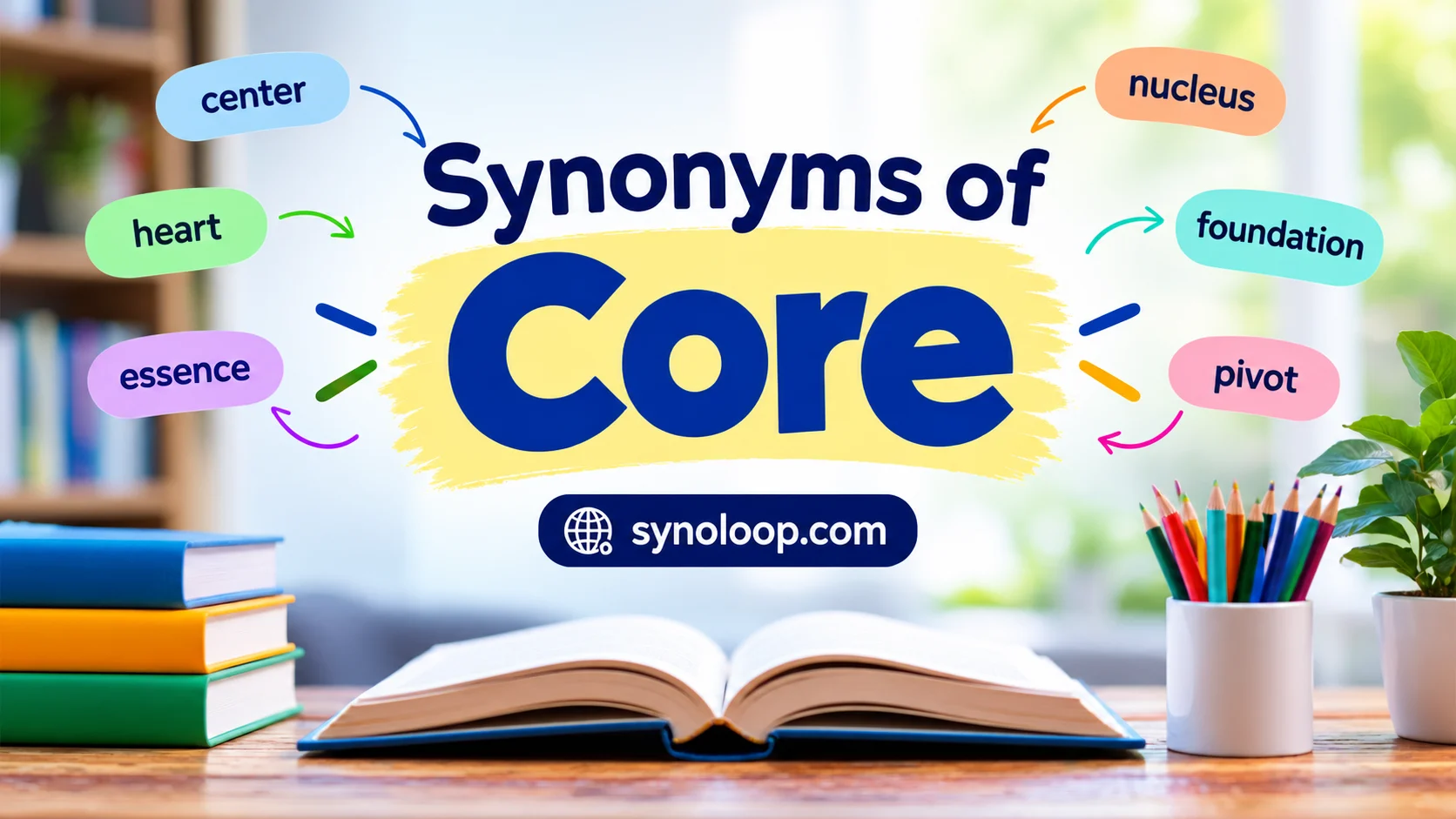
Depending on your intended meaning, words such as center, essence, heart, foundation, basis, nucleus, substance, or crux may be more precise.
30 Synonyms of Core
Below are 30 useful alternatives to “core,” with simple meanings, examples, and guidance on when to use each word.
1. Center
Meaning: The middle or central part of something.
Example:
The park is located at the center of the city.
Best usage context: Use “center” for physical or figurative central positions.
2. Essence
Meaning: The most important quality or basic nature of something.
Example:
Kindness is the essence of her character.
Best usage context: Best for describing the fundamental nature of an idea, person, or experience.
3. Heart
Meaning: The most important or central part of something.
Example:
At the heart of the problem is a lack of communication.
Best usage context: Excellent for emotional, personal, and figurative writing.
4. Foundation
Meaning: The basic support on which something is built.
Example:
Education provides the foundation for lifelong learning.
Best usage context: Use when discussing the underlying support or starting point of something.
5. Basis
Meaning: The main idea, reason, or principle on which something is based.
Example:
Trust is the basis of a healthy relationship.
Best usage context: Useful in academic, professional, and logical writing.
6. Nucleus
Meaning: The central and most important part of something.
Example:
The research team formed the nucleus of the new department.
Best usage context: Suitable for scientific, technical, and formal contexts.
7. Crux
Meaning: The most important or difficult part of an issue.
Example:
The crux of the argument is whether the plan is affordable.
Best usage context: Best for problems, arguments, debates, and complex issues.
8. Centerpiece
Meaning: The most important or noticeable part of something.
Example:
The new library became the centerpiece of the campus.
Best usage context: Useful when one feature stands out as the main attraction.
9. Kernel
Meaning: The central or essential part of an idea or matter.
Example:
There is a kernel of truth in his statement.
Best usage context: Good for ideas, arguments, and small but important truths.
10. Substance
Meaning: The important or meaningful content of something.
Example:
The presentation had plenty of style but little substance.
Best usage context: Use when emphasizing meaningful content rather than appearance.
11. Gist
Meaning: The main or general meaning of something.
Example:
I understood the gist of the article.
Best usage context: Ideal for summarizing the main idea of speech, writing, or information.
12. Mainstay
Meaning: A person or thing that provides essential support.
Example:
Tourism is a mainstay of the local economy.
Best usage context: Use when something consistently supports or sustains a system.
13. Backbone
Meaning: The main support or most important part of something.
Example:
Small businesses are the backbone of the local economy.
Best usage context: Effective in business, organizations, systems, and social discussions.
14. Pillar
Meaning: An important part that provides support.
Example:
Honesty is a key pillar of good leadership.
Best usage context: Best for principles, institutions, systems, and organizations.
15. Cornerstone
Meaning: An essential part on which something depends.
Example:
Communication is a cornerstone of effective teamwork.
Best usage context: Particularly useful for foundational principles and important practices.
16. Bedrock
Meaning: The strongest or most basic foundation of something.
Example:
Mutual respect is the bedrock of their partnership.
Best usage context: Use when emphasizing a very strong underlying foundation.
17. Foundation Stone
Meaning: A fundamental element on which something is built.
Example:
Research is a foundation stone of scientific progress.
Best usage context: Suitable for formal writing about principles, systems, and development.
18. Main Point
Meaning: The most important idea or message.
Example:
The main point of the lesson is to understand cause and effect.
Best usage context: Excellent for essays, presentations, explanations, and conversations.
19. Main Idea
Meaning: The central idea that something communicates.
Example:
The main idea of the passage is environmental responsibility.
Best usage context: Especially useful in education, reading comprehension, and academic writing.
20. Focus
Meaning: The main subject or area receiving attention.
Example:
The focus of the study is childhood development.
Best usage context: Use when “core” means the primary subject or concern.
21. Central Point
Meaning: The most important point in an argument or discussion.
Example:
The central point of the report is the need for better planning.
Best usage context: Good for essays, reports, arguments, and presentations.
22. Core Element
Meaning: An essential part of a larger system or idea.
Example:
Creativity is a core element of the design process.
Best usage context: Useful when discussing systems, strategies, programs, and processes.
23. Integral Part
Meaning: A necessary or essential part of something.
Example:
Technology has become an integral part of modern education.
Best usage context: Best when something cannot easily be separated from the whole.
24. Vital Part
Meaning: A very important or necessary part.
Example:
Exercise is a vital part of a healthy lifestyle.
Best usage context: Use when emphasizing importance or necessity.
25. Essential
Meaning: Extremely important or necessary.
Example:
Clear communication is essential for successful teamwork.
Best usage context: Excellent when “core” means necessary rather than physically central.
26. Fundamental
Meaning: Basic and extremely important.
Example:
Respect is a fundamental principle of healthy relationships.
Best usage context: Strong choice for academic, professional, and explanatory writing.
27. Principal
Meaning: The main or most important one.
Example:
The principal objective of the project is to reduce waste.
Best usage context: Formal writing, especially when describing objectives, reasons, or factors.
28. Central
Meaning: Most important or closely connected to the main subject.
Example:
The issue of fairness is central to the discussion.
Best usage context: Useful in academic, analytical, and professional writing.
29. Inner Part
Meaning: The part located inside something.
Example:
Remove the inner part of the fruit before cooking it.
Best usage context: Use for physical objects when “core” refers to something inside.
30. Inmost Part
Meaning: The deepest or most internal part.
Example:
The inmost part of the structure remained protected.
Best usage context: More literary or descriptive; useful when emphasizing depth or interior position.
Comparison Guide: When to Use Different Synonyms of Core
| Synonym | Best Meaning | Tone | Example Use |
| Center | Middle or central position | Neutral | Center of the city |
| Essence | Fundamental nature | Formal/neutral | Essence of the idea |
| Heart | Most important part | Natural/emotional | Heart of the issue |
| Foundation | Basic support | Formal | Foundation of success |
| Basis | Underlying reason | Formal | Basis of the argument |
| Nucleus | Central group or part | Technical/formal | Nucleus of a team |
| Crux | Most important issue | Formal | Crux of the problem |
| Backbone | Main support | Natural | Backbone of the economy |
| Pillar | Supporting principle | Formal | Pillar of society |
| Cornerstone | Essential foundation | Formal | Cornerstone of education |
| Bedrock | Very strong foundation | Formal | Bedrock of trust |
| Gist | Main meaning | Casual/neutral | Gist of the article |
| Focus | Main subject | Neutral | Focus of the research |
| Substance | Meaningful content | Formal/neutral | Substance of the argument |
| Fundamental | Basic and essential | Formal | Fundamental principle |
| Essential | Necessary | Neutral/formal | Essential component |
Core vs. Center: What Is the Difference?
“Core” and “center” are sometimes interchangeable, but they are not always identical.
Center usually refers to a position in the middle. For example:
The restaurant is in the center of town.
Core often suggests something more important or essential:
Trust is at the core of their relationship.
So, use center when you are talking about location or position, and use core when you want to emphasize importance or essential meaning.
Core vs. Essence: What Is the Difference?
Essence refers to the fundamental nature or quality of something.
The essence of good writing is clarity.
Core can have a similar figurative meaning, but it has a broader range of uses.
Clarity is at the core of good writing.
Both sentences work, but “essence” focuses more strongly on the nature of something, while “core” emphasizes its central importance.
Core vs. Foundation: What Is the Difference?
A foundation is something that supports or provides a base for another thing.
Education is the foundation of personal development.
A core is the central or essential part.
Education is at the core of the program.
Think of “foundation” as the base that supports something, while “core” is the central part that defines or drives it.
Core vs. Crux: What Is the Difference?
The word crux has a narrower meaning. It usually identifies the most important or difficult point in an issue, argument, or problem.
The crux of the disagreement is cost.
“Core” is much more flexible:
Customer service is at the core of the business.
Therefore, “crux” is especially useful when discussing a problem, argument, or dispute.
How to Choose the Right Synonym
Choosing the right synonym depends on what you want to communicate. Consider the meaning, context, and tone of your sentence.
For the Most Important Part
Use:
- Essence
- Heart
- Core element
- Essential
- Central
- Fundamental
Example:
Honesty is at the heart of a strong relationship.
For a Foundation or Support
Use:
- Foundation
- Basis
- Bedrock
- Cornerstone
- Pillar
- Backbone
Example:
Trust is the foundation of effective teamwork.
For the Main Idea
Use:
- Main idea
- Main point
- Gist
- Central point
- Substance
Example:
The main point of the article is easy to understand.
For Problems and Arguments
Use:
- Crux
- Heart
- Central point
- Essence
- Substance
Example:
The crux of the debate concerns the cost of the proposal.
For Physical or Inner Parts
Use:
- Center
- Inner part
- Nucleus
- Inmost part
Example:
The seed is located near the center of the fruit.
For Formal or Academic Writing
Consider:
- Fundamental
- Essential
- Basis
- Foundation
- Nucleus
- Principal
- Integral part
These choices can make academic and professional writing more precise without sounding repetitive.
Common Phrases With “Core”
Understanding common expressions can also help you use “core” naturally.
At the Core of
This means something is a central or essential part of another thing.
Communication is at the core of successful teamwork.
Core Values
This refers to the fundamental principles that guide a person, organization, or group.
The company has clearly defined core values.
Core Issue
This means the main or most important issue.
The core issue is a lack of reliable information.
Core Principle
This means a basic and important rule or belief.
Equality is a core principle of the organization.
Core Subject
A subject considered essential within a course or educational program.
English is a core subject for many students.
Core Skills
Basic or essential abilities needed for a particular activity or profession.
Writing and communication are core skills for many careers.
Why Using Synonyms of Core Improves Your Writing
Using appropriate alternatives can make your writing more precise. Instead of repeating “core” throughout an article, you can choose a word that communicates the exact relationship between an idea and the larger subject.
For example, compare these sentences:
Communication is at the core of teamwork.
Communication is the foundation of teamwork.
Both are understandable, but they create slightly different meanings. The first emphasizes communication as a central feature, while the second presents it as a supporting base.
This kind of word choice is particularly useful for students and ESL learners because it helps develop a richer vocabulary while improving sentence variety.
Synonyms of Core for Different Writing Situations
In Academic Writing
Choose words such as fundamental, basis, foundation, central, essential, and principal.
Example:
The fundamental principle of the theory is consistency.
In Business Writing
Useful choices include backbone, foundation, cornerstone, core element, and mainstay.
Example:
Customer satisfaction is a cornerstone of the company’s strategy.
In Everyday Conversation
Natural choices include center, heart, main point, focus, and main idea.
Example:
What’s the main point of the story?
In Creative Writing
Words such as heart, essence, kernel, and inmost part can add a more expressive tone.
Example:
At the heart of the story lies a search for belonging.
In Technical Writing
Consider nucleus, central component, core element, and integral part, depending on the subject.
Example:
The nucleus is the central component of the cell.
Tips for Using Synonyms Naturally
A synonym should not be chosen simply because it is different. It should fit the exact meaning of your sentence.
First, identify what “core” means in your sentence. Is it the middle of an object, the most important idea, a supporting foundation, or the main issue?
Next, consider the tone. “Heart” sounds more natural and conversational, while “fundamental” and “principal” can sound more formal.
Finally, check whether the replacement preserves the original meaning. Some synonyms are only appropriate in particular contexts. For example, crux works well for a central problem but would sound unusual when describing the inside of an apple.
Frequently Asked Questions About Synonyms of Core
What is the best synonym for core?
There is no single synonym that works in every situation. Center, essence, heart, foundation, basis, and crux can all replace “core” in particular contexts.
What is a simple synonym for core?
Center is a simple and common synonym when you mean the middle or central part. Main part is also useful when speaking in very simple English.
What is a formal synonym for core?
Depending on the context, formal alternatives include essence, foundation, basis, fundamental, principal, nucleus, and cornerstone.
What is a synonym for core in academic writing?
Useful academic alternatives include fundamental, basis, foundation, central, essential, principal, and integral part.
What is a synonym for the core of an argument?
Crux, central point, main point, essence, and heart can work depending on the exact meaning.
What is the difference between core and essence?
“Core” generally refers to the central or essential part, while “essence” focuses more specifically on the fundamental nature or quality of something.
What is the opposite of core?
Depending on the context, possible opposites include exterior, surface, edge, periphery, or secondary part. The correct opposite depends on whether “core” refers to physical position or importance.
Conclusion
The word core is versatile, but its best synonym depends on the context. When you mean the middle, center may be appropriate. When you mean the fundamental nature of something, essence can work well. For a supporting base, choose foundation, basis, cornerstone, or bedrock. When discussing the most important part of a problem, crux may be more precise.
Learning these distinctions can help you write with greater accuracy and variety. Instead of replacing “core” with any random alternative, consider the exact meaning you want to communicate and choose the word that fits naturally. This approach will make your vocabulary stronger and your writing clearer, more precise, and more engaging.

I am Evelyn Marie, the Administrator of Synoloop. I enjoy helping readers discover useful synonyms, alternative words, and better ways to express their ideas. I focus on keeping Synoloop simple, reliable, informative, and helpful for everyone.