When someone acts as though they are more important, intelligent, or impressive than they really are, the word pompous can be a useful description. It often refers to a person, speech, writing style, or manner that seems overly proud, self-important, or unnecessarily grand.
Learning the synonyms of pompous can help you express these ideas more precisely. For example, arrogant focuses on an exaggerated sense of superiority, while pretentious suggests someone is trying to appear more impressive, cultured, or important than they really are. Choosing the right synonym makes your writing clearer and more natural.
Whether you are a student, ESL learner, writer, or content creator, understanding these differences can improve your vocabulary. Below are 30 useful alternatives, with simple meanings, examples, and guidance on when each word works best.
What Does Pompous Mean?
Pompous describes someone or something that appears overly important, grand, or self-important. A pompous person may speak or behave as though they deserve special respect or admiration.
The word can also describe speech, writing, ceremonies, or language that feels excessively formal or grand.
Simple meaning: Acting or speaking as if you are more important than you really are.
Example:
The professor’s pompous speech made a simple idea sound extremely complicated.
Tone and Usage
Pompous is generally negative and is often used to criticize someone’s behavior, language, or attitude.
For example:
- Pompous person: Someone who takes themselves too seriously.
- Pompous speech: Speech that sounds unnecessarily grand or formal.
- Pompous writing: Writing that uses complicated or impressive-sounding language without a good reason.
- Pompous behavior: Actions that suggest excessive self-importance.
Because the word is critical, use it carefully when describing real people, especially in professional or sensitive situations.
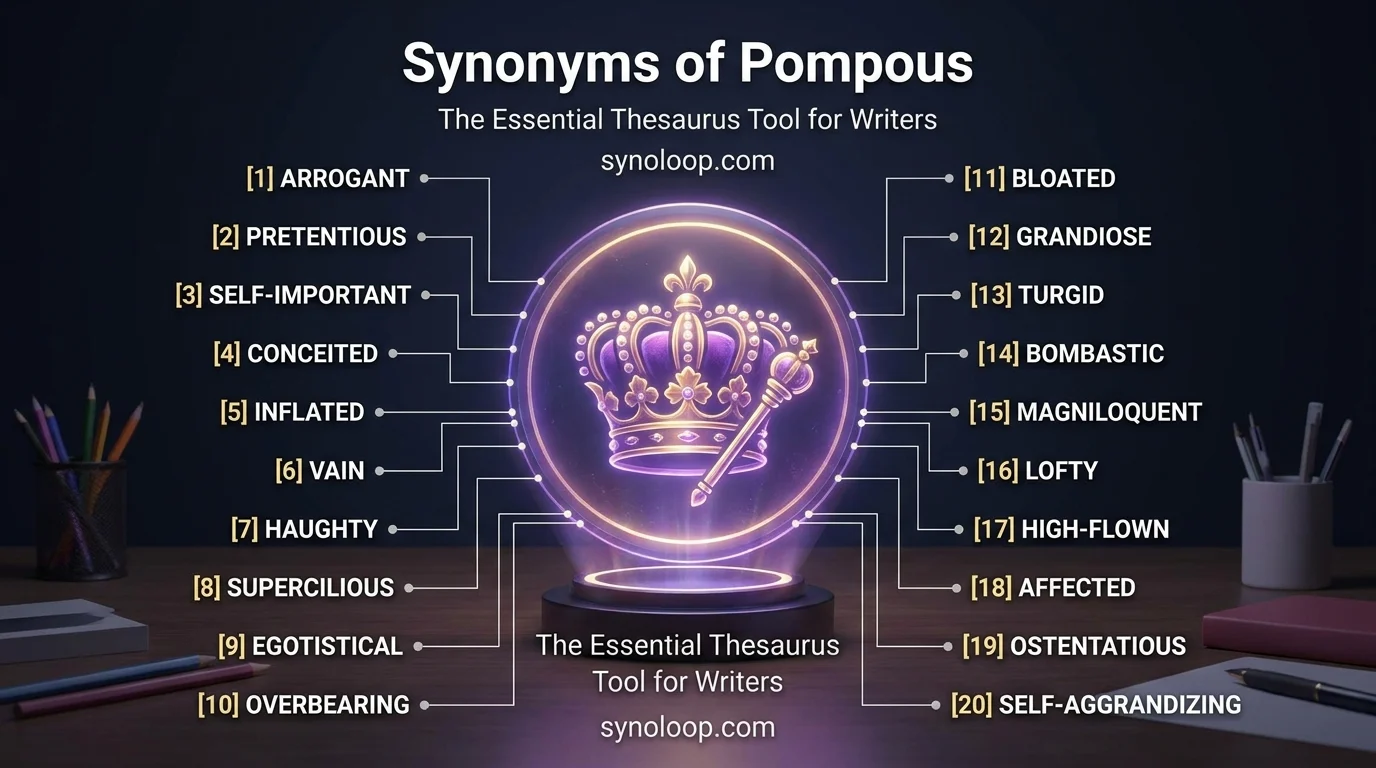
30 Synonyms of Pompous
1. Arrogant
Meaning: Believing that you are better, smarter, or more important than others.
Example:
His arrogant attitude made it difficult for his teammates to work with him.
Best usage context: Use it when emphasizing superiority or excessive self-confidence.
2. Pretentious
Meaning: Trying to appear more intelligent, important, cultured, or sophisticated than you really are.
Example:
The restaurant’s pretentious description made a simple dish sound mysterious.
Best usage context: Excellent for people, writing, language, art, or behavior that tries too hard to impress.
3. Conceited
Meaning: Having an excessively high opinion of yourself.
Example:
He was so conceited that he rarely listened to anyone else’s ideas.
Best usage context: Best for excessive self-admiration or vanity.
4. Haughty
Meaning: Acting as though you are superior to other people.
Example:
The haughty manager barely acknowledged the junior employees.
Best usage context: Useful for describing proud, superior, or unfriendly behavior.
5. Self-important
Meaning: Believing that your importance or opinions are greater than they really are.
Example:
His self-important comments annoyed everyone during the meeting.
Best usage context: Directly describes an exaggerated sense of personal importance.
6. Grandiose
Meaning: Extremely ambitious, impressive, or grand in a way that may seem unrealistic.
Example:
She presented a grandiose plan to completely transform the small company in one month.
Best usage context: Often used for plans, ideas, claims, or ambitions rather than ordinary behavior.
7. Egotistical
Meaning: Thinking too highly of yourself and your abilities.
Example:
His egotistical manner made every conversation about his achievements.
Best usage context: Use when someone’s ego or self-admiration is the main issue.
8. Overbearing
Meaning: Trying to control other people in an unpleasant or forceful way.
Example:
The overbearing supervisor constantly told everyone how to do their jobs.
Best usage context: Best for controlling personalities rather than merely proud ones.
9. Snobbish
Meaning: Believing that you are better than people considered less wealthy, educated, fashionable, or socially important.
Example:
His snobbish attitude made new employees feel unwelcome.
Best usage context: Useful when superiority is connected to social status, taste, or class.
10. Superior
Meaning: Acting as if you are better than other people.
Example:
She spoke in a superior tone whenever someone disagreed with her.
Best usage context: Particularly useful for describing someone’s attitude or tone.
11. Boastful
Meaning: Talking too proudly about your achievements, abilities, or possessions.
Example:
His boastful stories about his success quickly became tiring.
Best usage context: Use when someone frequently talks about how impressive they are.
12. Self-satisfied
Meaning: Too pleased with yourself and your achievements.
Example:
He gave a self-satisfied smile after receiving the award.
Best usage context: Good for describing a person who seems overly pleased with themselves.
13. Vainglorious
Meaning: Excessively proud of your own achievements or abilities.
Example:
The vainglorious leader spent more time praising himself than helping his team.
Best usage context: A formal or literary choice for excessive pride.
14. Ostentatious
Meaning: Designed to attract attention by looking expensive, impressive, or important.
Example:
The billionaire arrived in an ostentatious car covered with expensive decorations.
Best usage context: Best for possessions, clothing, displays, buildings, or lifestyles.
15. Showy
Meaning: Intended to attract attention through an impressive or noticeable appearance.
Example:
The designer chose a showy entrance for the award ceremony.
Best usage context: Use for appearances, performances, clothes, decorations, or displays.
16. Lofty
Meaning: Very elevated or grand in style, ideas, or language.
Example:
The politician spoke about lofty ideals but gave few practical details.
Best usage context: Useful for ideas, ambitions, language, or goals that sound elevated.
17. Highfalutin
Meaning: Using language or ideas that sound important and sophisticated but may be unnecessarily complicated.
Example:
The report was full of highfalutin language that confused ordinary readers.
Best usage context: Informal and often humorous; especially useful for unnecessarily fancy language.
18. Bombastic
Meaning: Using language that sounds powerful or impressive but is often excessive or meaningless.
Example:
The advertisement used bombastic language to promote a fairly ordinary product.
Best usage context: Excellent for speeches, writing, advertisements, and dramatic statements.
19. Inflated
Meaning: Made to seem greater, more important, or more valuable than it really is.
Example:
The article gave an inflated impression of the project’s importance.
Best usage context: Useful for claims, descriptions, reputations, prices, or expectations.
20. Magniloquent
Meaning: Using very grand and impressive language.
Example:
The speaker’s magniloquent style made the short announcement sound like a historic declaration.
Best usage context: Formal or literary writing when discussing grand language.
21. Pretending
Meaning: Acting as though something is true when it is not.
Example:
He was pretending to understand the subject so that others would admire him.
Best usage context: Use when someone’s behavior involves creating a false impression.
22. Ostensible
Meaning: Appearing or being presented as true, although the reality may be different.
Example:
The ostensible purpose of the meeting was to discuss the budget.
Best usage context: Formal writing; this is not a direct synonym for personality-based pompousness.
23. Dignified
Meaning: Calm, serious, and worthy of respect.
Example:
She maintained a dignified manner throughout the ceremony.
Best usage context: Usually positive; useful when you want to describe respectable behavior rather than criticize it.
24. Formal
Meaning: Following established rules or using serious and conventional language.
Example:
His formal writing style sounded unusual for such a casual message.
Best usage context: Use when the issue is seriousness or formality rather than arrogance.
25. Pretentious-sounding
Meaning: Seeming unnecessarily sophisticated or impressive.
Example:
The restaurant used pretentious-sounding names for its simplest dishes.
Best usage context: Helpful in everyday descriptions of language, names, or marketing.
26. Imperious
Meaning: Acting as though you have the right to command or control others.
Example:
Her imperious tone made the request sound more like an order.
Best usage context: Best for commanding, superior, or authoritative behavior.
27. Magisterial
Meaning: Showing great authority or an impressive sense of importance.
Example:
He adopted a magisterial tone while explaining a relatively simple issue.
Best usage context: Formal or literary descriptions of authoritative behavior or style.
28. Self-aggrandizing
Meaning: Making yourself appear more important, successful, or impressive.
Example:
The report contained several self-aggrandizing claims about the manager’s achievements.
Best usage context: Particularly useful for speeches, biographies, publicity, and professional writing.
29. Swaggering
Meaning: Behaving in a very confident and sometimes arrogant way.
Example:
The swaggering athlete acted as though victory was already guaranteed.
Best usage context: Best for noticeable, bold, and overly confident behavior.
30. Puffed-up
Meaning: Acting more important or impressive than you really are.
Example:
His puffed-up presentation made a simple project sound revolutionary.
Best usage context: Informal writing and conversation; often carries a humorous tone.
Pompous vs. Arrogant
These words are closely related, but they are not identical.
Pompous often focuses on a person’s grand manner, language, or exaggerated sense of importance.
Arrogant focuses more directly on believing that you are better than other people.
Example:
- The speaker sounded pompous. → His language or manner was overly grand.
- The speaker sounded arrogant. → He seemed to believe he was superior to others.
Pompous vs. Pretentious
These words are also easy to confuse.
Pompous suggests excessive importance, grandeur, or seriousness.
Pretentious suggests an attempt to appear more impressive, sophisticated, or knowledgeable than one really is.
Example:
- His pompous speech lasted an hour.
- His pretentious speech was filled with complicated words.
Someone can be both pompous and pretentious, but the two words highlight different qualities.
Pompous vs. Conceited
Conceited is mainly about having an overly positive opinion of yourself.
Pompous is broader and can describe someone’s manner, speech, behavior, or style.
For example:
She is conceited because she constantly praises herself.
She is pompous because she speaks as though everyone should admire her.
Comparison Guide: Which Synonym Should You Use?
| Synonym | Main Idea | Tone | Best For |
| Arrogant | Believes they are superior | Negative | People and attitudes |
| Pretentious | Tries too hard to impress | Negative | People, language, writing |
| Conceited | Thinks highly of themselves | Negative | Personality |
| Haughty | Acts superior | Negative | Behavior and attitude |
| Self-important | Thinks they matter excessively | Negative | People and behavior |
| Grandiose | Excessively grand | Negative/Neutral | Plans, ideas, claims |
| Egotistical | Excessive ego | Negative | Personality |
| Overbearing | Controlling others | Negative | People |
| Snobbish | Feels superior socially | Negative | Attitudes and behavior |
| Boastful | Talks proudly about achievements | Negative | Speech and personality |
| Ostentatious | Designed to attract attention | Negative/Neutral | Possessions and displays |
| Bombastic | Overly impressive language | Negative | Speech and writing |
| Highfalutin | Unnecessarily fancy | Informal/Negative | Language and ideas |
| Imperious | Commanding and superior | Negative | Tone and behavior |
| Self-aggrandizing | Makes oneself seem important | Negative | Publicity and writing |
How to Choose the Right Synonym
The best synonym depends on what exactly seems pompous. Ask yourself whether you are describing a person’s personality, their language, their possessions, or their behavior.
For Arrogant Personality
Choose:
- Arrogant
- Conceited
- Egotistical
- Haughty
- Self-important
These words work well when someone has an exaggerated opinion of themselves.
For Pretending to Be Sophisticated
Choose:
- Pretentious
- Highfalutin
- Pretentious-sounding
- Puffed-up
These are particularly useful when someone is trying to appear more intelligent, cultured, or important.
For Grand or Excessive Language
Choose:
- Bombastic
- Magniloquent
- Lofty
- Grandiose
These words are especially useful for speeches, articles, presentations, and formal writing.
For Flashy Displays
Choose:
- Ostentatious
- Showy
- Grandiose
These words can describe clothing, homes, cars, celebrations, decorations, or lifestyles that attract attention.
For Controlling or Commanding Behavior
Choose:
- Imperious
- Overbearing
- Haughty
- Superior
These choices work when a person’s manner suggests that they expect others to obey or respect them.
For Excessive Self-Praise
Choose:
- Boastful
- Self-aggrandizing
- Vainglorious
- Self-satisfied
These are useful when the main problem is someone’s constant focus on their achievements.
Are All Synonyms of Pompous Negative?
No. Although many alternatives to pompous have negative meanings, some related words are neutral or can even be positive depending on context.
For example, formal simply means following a serious or conventional style. Dignified can describe someone who behaves calmly and respectfully. Lofty can describe an admirable ideal, although it can also suggest unrealistic or overly grand thinking.
This is why replacing pompous with any synonym without checking the context can change the meaning of a sentence.
Examples of Pompous in Everyday Writing
Here are a few examples showing how pompous can be used naturally:
Person:
The pompous executive expected everyone to admire his opinions.
Speech:
Her pompous speech turned a simple announcement into a dramatic performance.
Writing:
The essay sounded pompous because it used complicated words unnecessarily.
Behavior:
His pompous behavior made a friendly conversation uncomfortable.
Style:
The author’s pompous style made the otherwise interesting book difficult to read.
Common Mistakes When Using Synonyms of Pompous
One common mistake is assuming that every related word means exactly the same thing. Synonyms usually overlap, but they often have different shades of meaning.
For example, arrogant is not always the same as ostentatious. An arrogant person feels superior, while an ostentatious person or object is designed to attract attention.
Another mistake is using formal words simply because they sound impressive. If you are writing for a general audience or ESL learners, a simple word such as arrogant, boastful, or pretentious may communicate the idea more clearly.
Finally, consider the tone. Words such as magniloquent, vainglorious, and imperious can sound formal or literary. In everyday conversation, simpler alternatives are often more natural.
Pompous Synonyms for Different Writing Situations
Academic Writing
For academic contexts, consider:
- Pretentious
- Grandiose
- Bombastic
- Self-important
- Inflated
Use these carefully and support your description with specific evidence.
Creative Writing
For fiction and storytelling, words such as these can create a stronger character description:
- Haughty
- Imperious
- Swaggering
- Conceited
- Vainglorious
They can help communicate personality without requiring a long explanation.
Everyday Conversation
More natural choices include:
- Arrogant
- Conceited
- Boastful
- Snobbish
- Pretentious
- Overbearing
These words are familiar to many English speakers and are easy to understand.
Describing Writing or Speech
Try:
- Bombastic
- Highfalutin
- Magniloquent
- Grandiose
- Lofty
- Pretentious
These words focus more on someone’s communication style than their personality.
Why Learning Pompous Synonyms Matters
Knowing several alternatives to pompous gives you more control over your vocabulary. Instead of repeating one word, you can choose a term that communicates the exact idea you mean.
For example, if someone constantly talks about their accomplishments, boastful may be more precise. If someone acts as though they are socially superior, snobbish may work better. If their language is unnecessarily grand, bombastic or highfalutin may communicate the idea more clearly.
This precision is especially valuable for students, ESL learners, writers, and content creators. Strong vocabulary is not simply about knowing difficult words; it is about knowing when and why to use them.
Frequently Asked Questions About Synonyms of Pompous
What is the closest synonym for pompous?
Pretentious, arrogant, self-important, and haughty are among the closest common alternatives. The best choice depends on the specific context.
What is a simple word for pompous?
Arrogant or self-important can be simple alternatives. If the focus is on unnecessarily fancy language, pretentious may be more accurate.
Is pompous positive or negative?
Pompous is generally negative. It usually criticizes someone or something for seeming excessively important, grand, or self-important.
What is the difference between pompous and pretentious?
Pompous emphasizes excessive grandeur or self-importance. Pretentious emphasizes trying to appear more impressive, sophisticated, or knowledgeable than one really is.
What is the opposite of pompous?
Depending on the context, possible opposites include humble, modest, simple, unpretentious, and down-to-earth.
Can pompous describe writing?
Yes. Pompous writing often uses unnecessarily complicated, grand, or formal language to make ordinary ideas sound more important.
Conclusion
The synonyms of pompous give you many ways to describe excessive pride, grand behavior, exaggerated importance, and unnecessarily impressive language. Words such as arrogant, pretentious, conceited, haughty, self-important, grandiose, and bombastic are especially useful, but each has its own shade of meaning.
The key is to choose a synonym based on the exact idea you want to communicate. Use arrogant for superiority, pretentious for trying too hard to impress, boastful for excessive self-praise, ostentatious for flashy displays, and bombastic for overly grand language.
Understanding these differences will make your English more precise, natural, and expressive. Rather than simply searching for another word for pompous, focus on the specific attitude, behavior, or style you want your reader to understand.

I am Ace Michael, an author passionate about words, language, and vocabulary. I enjoy exploring synonyms and finding simple, useful alternatives that help readers express their ideas clearly, naturally, and creatively. At Synoloop, I share helpful word choices to make writing easier and more effective.