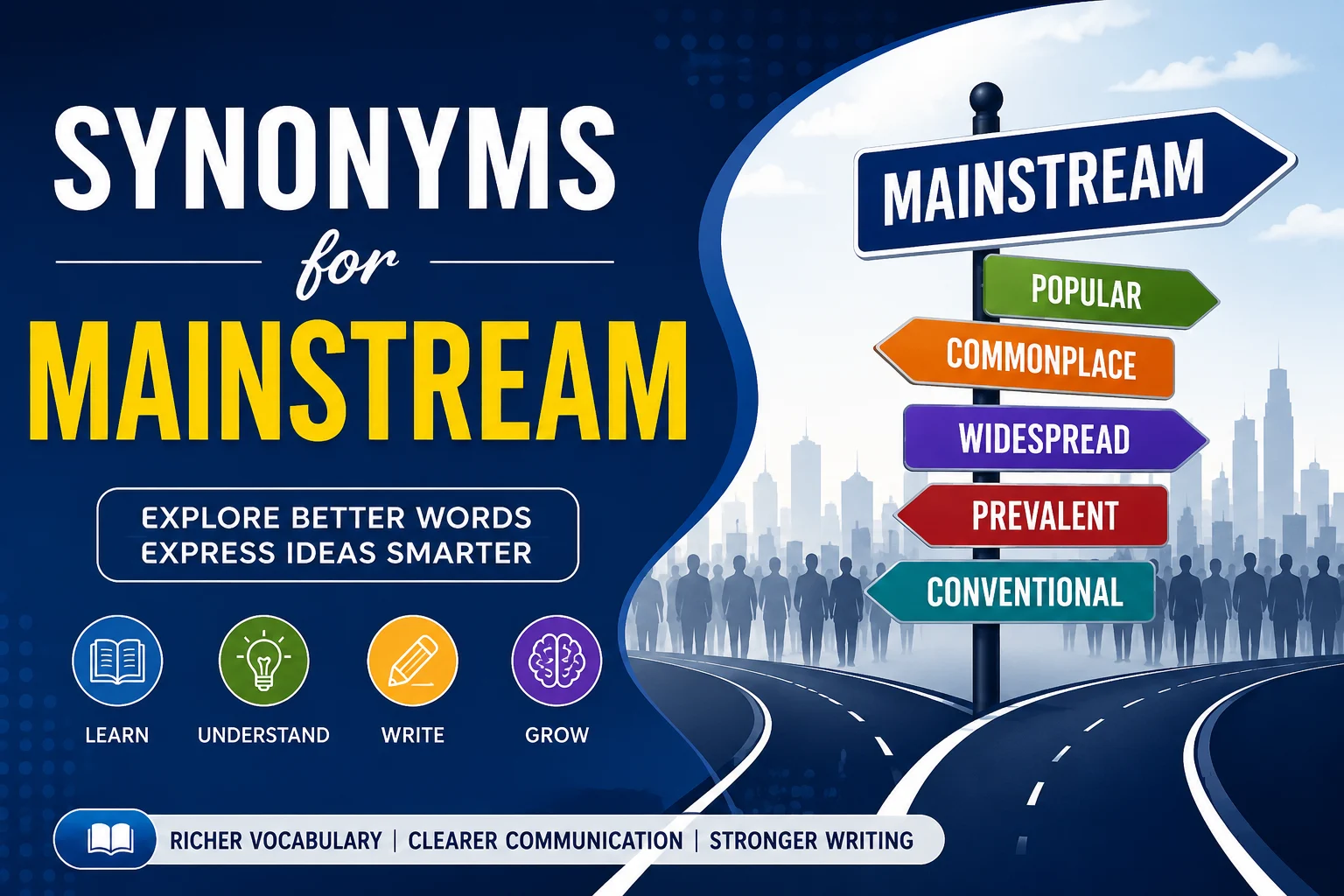
Finding the right synonyms for mainstream can make your writing more precise, natural, and interesting. The word mainstream is useful when describing ideas, opinions, entertainment, culture, products, or trends that are widely accepted, popular, or followed by a large part of society. However, repeating the same word can make your writing feel predictable.
Depending on your meaning, you may want a word that emphasizes popularity, general acceptance, conventional thinking, cultural influence, or widespread use. Words such as popular, conventional, widely accepted, common, and established can sometimes replace mainstream, but they are not always exact matches.
This guide explains useful alternatives in simple English. It also includes examples, usage notes, and a separate vocabulary section covering demure and its synonyms, so students, ESL learners, writers, and content creators can understand both vocabulary sets clearly.
What Does “Mainstream” Mean?
Mainstream describes something that is considered normal, popular, widely accepted, or commonly followed by a large number of people.
For example:
Social media has made this style of music mainstream.
Here, mainstream means the music has moved from being relatively specialized or less widely known to becoming popular among the general public.
The word can be used as both an adjective and a noun.
Mainstream as an adjective
- mainstream media
- mainstream music
- mainstream culture
- mainstream opinion
- mainstream education
Mainstream as a noun
The mainstream can mean the dominant or generally accepted ideas, practices, or culture of a society.
Example:
She prefers independent films rather than movies from the mainstream.
Why Use Synonyms for Mainstream?
Using alternatives to mainstream can help you communicate a more exact idea.
For example:
- Popular emphasizes popularity.
- Conventional emphasizes traditional or usual thinking.
- Widespread emphasizes how broadly something exists.
- Established emphasizes recognition and acceptance.
- Orthodox emphasizes conformity to accepted beliefs.
- Common emphasizes frequency or familiarity.
- Dominant emphasizes influence or control.
Choosing the right alternative is especially useful in academic writing, journalism, essays, marketing, blogs, and creative writing.
30 Synonyms for Mainstream
Below are 30 useful alternatives and closely related expressions. Some are direct substitutes, while others work better when you want to emphasize a particular aspect of the meaning.
1. Popular
Meaning: Liked, enjoyed, or followed by many people.
Example:
The artist became popular after releasing her second album.
Best usage: Use popular when you mainly mean that many people like something.
2. Conventional
Meaning: Following usual or traditional ideas, methods, or behavior.
Example:
He rejected conventional approaches to education.
Best usage: Excellent for academic or formal writing when discussing established ways of thinking or doing things.
3. Widespread
Meaning: Existing or happening in many places or among many people.
Example:
Online learning has become widespread in recent years.
Best usage: Best when the focus is on broad distribution rather than popularity.
4. Common
Meaning: Frequently found, seen, or experienced.
Example:
This is a common approach to solving the problem.
Best usage: Use it for something ordinary, familiar, or frequently encountered.
5. General
Meaning: Relating to most people or the wider public rather than a small group.
Example:
The campaign was designed for the general public.
Best usage: Useful when contrasting a broad audience with a specialized audience.
6. Conventionalized
Meaning: Developed into a commonly accepted or standard form.
Example:
The movement eventually became conventionalized within the industry.
Best usage: More specialized; useful in academic or analytical writing.
7. Established
Meaning: Well known, accepted, or recognized over time.
Example:
She decided to work for an established publishing company.
Best usage: Good when something has gained recognition, stability, or legitimacy.
8. Accepted
Meaning: Generally approved, recognized, or considered normal.
Example:
Remote work is now widely accepted in many industries.
Best usage: Use when emphasizing social or professional acceptance.
9. Widely Accepted
Meaning: Believed, supported, or approved by many people.
Example:
It is a widely accepted theory in modern science.
Best usage: Particularly useful in academic and informational writing.
10. Prevailing
Meaning: Most common, influential, or widely held at a particular time.
Example:
The prevailing attitude toward technology has changed significantly.
Best usage: Strong choice for formal writing about dominant opinions, attitudes, or conditions.
11. Dominant
Meaning: More powerful, influential, or common than others.
Example:
English remains a dominant language in international business.
Best usage: Use when you want to emphasize influence or superiority, not simply popularity.
12. Typical
Meaning: Normal or representative of a particular group or situation.
Example:
This is typical of mainstream advertising strategies.
Best usage: Appropriate when describing something that represents the usual pattern.
13. Ordinary
Meaning: Normal and not unusual or special.
Example:
The story begins with an ordinary family living in a small town.
Best usage: Useful when contrasting mainstream or normal life with unusual experiences.
14. Standard
Meaning: Commonly recognized as normal, expected, or officially accepted.
Example:
The company uses standard procedures for quality control.
Best usage: Strong for professional, technical, and academic contexts.
15. Conventionalist
Meaning: Connected with or supportive of conventional beliefs or practices.
Example:
The conventionalist approach favors established social structures.
Best usage: More specialized and generally better suited to academic discussions.
16. Orthodox
Meaning: Following traditional or officially accepted beliefs.
Example:
The researcher questioned the orthodox view of the subject.
Best usage: Especially useful for established beliefs, theories, religions, or schools of thought.
17. Traditional
Meaning: Based on ideas, customs, or practices that have existed for a long time.
Example:
The restaurant combines traditional recipes with modern techniques.
Best usage: Use when mainstream refers to long-established customs or practices.
18. Normative
Meaning: Based on what is considered normal, proper, or acceptable.
Example:
The study examines normative ideas about success.
Best usage: Mainly academic, especially in sociology, philosophy, psychology, and cultural studies.
19. Conventionalized
Meaning: Made familiar or standardized through repeated use or acceptance.
Example:
The once-unusual design became conventionalized over time.
Best usage: Best for analytical writing about how ideas or practices become standard.
20. Mass-Market
Meaning: Designed for or sold to a very large general audience.
Example:
The company transformed the niche product into a mass-market brand.
Best usage: Particularly useful for products, entertainment, advertising, and consumer culture.
21. Mainstreamed
Meaning: Brought into general acceptance, use, or participation.
Example:
The technology was gradually mainstreamed into everyday workplaces.
Best usage: Useful when describing the process of something becoming mainstream.
22. Fashionable
Meaning: Popular and considered attractive or desirable at a particular time.
Example:
Minimalist interiors became fashionable among younger homeowners.
Best usage: Best for clothing, design, lifestyles, ideas, and temporary trends.
23. Trendy
Meaning: Very fashionable or popular at the moment.
Example:
The café is known for its trendy interior design.
Best usage: Informal writing and conversations about current styles or trends.
24. In Vogue
Meaning: Currently fashionable or widely admired.
Example:
Natural materials are currently in vogue in interior design.
Best usage: Stylish expression for fashion, culture, design, and current preferences.
25. Universal
Meaning: Shared or experienced by nearly everyone or found almost everywhere.
Example:
The desire for security is close to being a universal human concern.
Best usage: Use carefully because universal is stronger than mainstream and suggests almost no exceptions.
26. Broadly Accepted
Meaning: Accepted by a large number of people or groups.
Example:
The new standard is now broadly accepted across the industry.
Best usage: Useful for professional, academic, and factual writing.
27. Popularized
Meaning: Made widely known, used, or accepted.
Example:
The television series popularized the expression among younger audiences.
Best usage: Ideal when describing how something became popular.
28. Prevailing
Meaning: Most widespread or influential at a particular time.
Example:
The prevailing opinion favored stricter environmental regulations.
Best usage: Excellent for formal discussions of opinions, attitudes, and beliefs.
29. Dominant-Culture
Meaning: Relating to the culture, beliefs, or practices that have the greatest influence in a society.
Example:
The novel challenges several assumptions associated with dominant culture.
Best usage: Particularly useful in sociology, cultural studies, and social commentary.
30. Conventional Wisdom
Meaning: An idea or belief that is generally accepted as true by many people.
Example:
The research challenges conventional wisdom about productivity.
Best usage: Use when mainstream refers specifically to commonly accepted beliefs or assumptions.
Quick Comparison: Synonyms for Mainstream
| Synonym | Main Idea | Tone | Best Context |
| Popular | Liked by many | Neutral | Entertainment, products |
| Conventional | Usual or traditional | Formal | Academic writing |
| Widespread | Found among many | Neutral | Trends, practices |
| Common | Frequently encountered | Neutral | Everyday writing |
| Established | Recognized and accepted | Formal | Institutions, industries |
| Prevailing | Most influential | Formal | Opinions, attitudes |
| Dominant | Most powerful or influential | Strong | Culture, languages, ideas |
| Orthodox | Traditionally accepted | Formal | Beliefs and theories |
| Traditional | Based on long-standing customs | Neutral | Culture and practices |
| Standard | Accepted as normal | Formal | Procedures and methods |
| Fashionable | Currently admired | Neutral | Fashion and lifestyle |
| Trendy | Popular right now | Informal | Style and culture |
| Mass-market | Made for a large audience | Commercial | Products and media |
| Widely accepted | Supported by many | Formal | Research and ideas |
| Popularized | Made widely known | Neutral | Culture and media |
Mainstream vs. Popular: What Is the Difference?
These two words are related but not identical.
Popular simply means that many people like or support something.
Mainstream often suggests that something has entered the dominant or generally accepted part of society.
Compare:
The singer is popular with teenagers.
This means many teenagers like the singer.
The singer has become mainstream.
This suggests the singer has moved beyond a particular audience and is now recognized or accepted by the wider public.
Therefore, popular is usually about being liked, while mainstream can be about being widely recognized, accepted, or culturally dominant.
Mainstream vs. Conventional
Mainstream and conventional sometimes overlap, but they emphasize different ideas.
Mainstream focuses on what is dominant or widely accepted by the larger public.
Conventional focuses on what follows established traditions, expectations, or methods.
For example:
Her music is mainstream.
This refers to broad public acceptance.
Her teaching method is conventional.
This suggests that her method follows established practices.
A thing can be mainstream without being particularly traditional.
Mainstream vs. Widespread
Widespread focuses on how broadly something occurs.
Mainstream often includes an idea of social acceptance or cultural prominence.
For example:
Smartphone use is widespread.
This means many people use smartphones.
Smartphone technology is mainstream.
This suggests it has become a normal and established part of everyday life.
How to Choose the Right Synonym for Mainstream
The best synonym depends on what you are actually trying to say.
When You Mean “Liked by Many”
Choose:
- popular
- fashionable
- trendy
- in vogue
Example:
This style of clothing is very popular among young adults.
These choices work well when discussing entertainment, fashion, products, hobbies, and trends.
When You Mean “Widely Found”
Choose:
- widespread
- common
- general
- universal
Example:
Internet access is now widespread in urban areas.
Be careful with universal. It suggests something is nearly everywhere or shared by almost everyone.
When You Mean “Generally Accepted”
Choose:
- accepted
- widely accepted
- broadly accepted
- established
Example:
The practice is now widely accepted by professionals.
These alternatives work especially well in academic, professional, and informational writing.
When You Mean “Traditional or Usual”
Choose:
- conventional
- traditional
- standard
- orthodox
- typical
Example:
The researcher questioned the conventional approach.
These words are particularly useful when talking about methods, beliefs, customs, and established practices.
When You Mean “Most Influential”
Choose:
- dominant
- prevailing
- established
Example:
The prevailing view changed after new evidence emerged.
These are stronger and more precise than simply saying mainstream.
When You Mean “Made for a Large Audience”
Choose:
- mass-market
- mainstreamed
- popularized
Example:
The company turned a niche invention into a mass-market product.
These terms work well in business, marketing, technology, media, and consumer-related writing.
What Does “Demure” Mean?
Although demure is unrelated to the meaning of mainstream, it is an important vocabulary word with several useful synonyms.
Demure means quiet, modest, reserved, and somewhat shy in behavior or appearance.
It is often used to describe someone who behaves in a calm, restrained, or modest way.
Example:
She gave a demure smile when the audience applauded.
The word can describe a person’s behavior, expression, appearance, or manner.
Tone of “Demure”
Demure usually has a gentle, refined, or elegant tone. Depending on the context, it can suggest modesty and self-control.
It is not normally a strong synonym for shy. A shy person may feel nervous around others, while a demure person may simply behave in a quiet, restrained, or modest manner.
30 Synonyms of Demure
1. Modest
Meaning: Not showing off and behaving in a restrained way.
Example:
She wore a modest dress to the formal event.
Best usage: Clothing, behavior, or personality.
2. Reserved
Meaning: Quiet and not openly expressing feelings.
Example:
He was reserved when meeting new people.
Best usage: Personality and social behavior.
3. Shy
Meaning: Nervous or uncomfortable around other people.
Example:
The shy student avoided speaking in front of the class.
Best usage: Social situations and personality.
4. Retiring
Meaning: Avoiding attention and preferring not to be noticed.
Example:
She had a retiring personality and rarely spoke about herself.
Best usage: Formal descriptions of personality.
5. Unassuming
Meaning: Not trying to attract attention or appear important.
Example:
Despite his success, he remained unassuming.
Best usage: Personality and behavior.
6. Quiet
Meaning: Not loud, active, or expressive.
Example:
She was quiet during the meeting.
Best usage: Everyday descriptions.
7. Gentle
Meaning: Calm, kind, and not harsh.
Example:
He had a gentle manner when speaking with children.
Best usage: Personality and behavior.
8. Mild
Meaning: Calm and not intense or aggressive.
Example:
She has a mild and pleasant personality.
Best usage: Character and temperament.
9. Meek
Meaning: Very quiet, gentle, and unlikely to challenge others.
Example:
The meek employee rarely disagreed with her manager.
Best usage: Use carefully because it can imply weakness or lack of assertiveness.
10. Soft-Spoken
Meaning: Speaking quietly and gently.
Example:
The professor was soft-spoken but confident.
Best usage: Speech and personality.
11. Subdued
Meaning: Quiet, restrained, or less expressive than usual.
Example:
Her subdued reaction surprised everyone.
Best usage: Emotions, behavior, colors, and atmosphere.
12. Restrained
Meaning: Controlled and not overly emotional or expressive.
Example:
He gave a restrained response to the criticism.
Best usage: Formal writing and emotional behavior.
13. Unobtrusive
Meaning: Not attracting attention or interfering with others.
Example:
The assistant remained unobtrusive throughout the event.
Best usage: Behavior, design, and presence.
14. Discreet
Meaning: Careful not to attract unwanted attention.
Example:
She was discreet about the private conversation.
Best usage: Privacy and behavior.
15. Coy
Meaning: Shy or pretending to be shy, sometimes in a playful way.
Example:
She gave a coy smile before answering.
Best usage: Playful or romantic contexts.
16. Bashful
Meaning: Easily embarrassed or shy.
Example:
The bashful child hid behind her mother.
Best usage: Informal descriptions, especially of children.
17. Timid
Meaning: Lacking confidence and easily frightened or nervous.
Example:
The timid puppy stayed close to its owner.
Best usage: Animals, children, and personality descriptions.
18. Demure
Meaning: Quiet, modest, and reserved.
Example:
She gave a demure nod.
Best usage: Elegant descriptions of behavior or appearance.
19. Unassertive
Meaning: Not strongly expressing opinions or demands.
Example:
His unassertive manner sometimes made it difficult for colleagues to know what he wanted.
Best usage: Workplace and personality discussions.
20. Unpretentious
Meaning: Not trying to appear more important, stylish, or impressive than one really is.
Example:
The restaurant has an unpretentious atmosphere.
Best usage: People, places, and lifestyles.
21. Low-Key
Meaning: Calm, simple, and not designed to attract attention.
Example:
They planned a low-key celebration at home.
Best usage: Informal modern English.
22. Calm
Meaning: Peaceful and not easily excited or upset.
Example:
She remained calm during the difficult discussion.
Best usage: General behavior and emotional situations.
23. Composed
Meaning: Calm and in control of one’s emotions.
Example:
She remained composed during the interview.
Best usage: Professional and formal situations.
24. Self-Effacing
Meaning: Avoiding praise or attention for yourself.
Example:
The award-winning writer was surprisingly self-effacing.
Best usage: Humility and personality.
25. Humble
Meaning: Not believing that you are better or more important than others.
Example:
Despite her achievements, she remained humble.
Best usage: Personality and character.
26. Modest-Mannered
Meaning: Behaving in a quiet and restrained way.
Example:
His modest-mannered personality made him easy to approach.
Best usage: Descriptive writing.
27. Unpretentious
Meaning: Simple and natural without trying to impress people.
Example:
She preferred an unpretentious style of clothing.
Best usage: Appearance, lifestyle, and personality.
28. Unassuming
Meaning: Quietly confident or modest without seeking attention.
Example:
The unassuming musician surprised everyone with her talent.
Best usage: People and personality.
29. Demure-Looking
Meaning: Having a quiet, modest, or restrained appearance.
Example:
She chose a demure-looking outfit for the ceremony.
Best usage: Informal descriptive writing.
30. Reserved-Mannered
Meaning: Behaving in a quiet and controlled way.
Example:
His reserved-mannered approach made him seem thoughtful and serious.
Best usage: Descriptive writing, though reserved is the more natural everyday choice.
Quick Comparison of Demure Synonyms
| Word | Main Meaning | Tone | Best Use |
| Modest | Not showy | Positive/neutral | Behavior, clothing |
| Reserved | Quiet and private | Neutral | Personality |
| Shy | Nervous socially | Neutral | People |
| Retiring | Avoids attention | Formal | Personality |
| Unassuming | Not attention-seeking | Positive | Character |
| Coy | Playfully shy | Context-dependent | Expressions |
| Bashful | Easily embarrassed | Gentle | Children, personality |
| Timid | Lacking confidence | Often negative | Personality |
| Composed | Emotionally controlled | Positive | Formal situations |
| Humble | Not boastful | Positive | Character |
| Soft-spoken | Speaks gently | Positive/neutral | Speech |
| Restrained | Controlled expression | Formal | Emotions |
Mainstream Vocabulary: Common Collocations
Learning collocations can help you use mainstream naturally.
Common phrases with mainstream
- mainstream media
- mainstream culture
- mainstream music
- mainstream education
- mainstream opinion
- mainstream society
- mainstream politics
- mainstream entertainment
- mainstream technology
- mainstream audience
- mainstream ideas
- mainstream products
- mainstream fashion
- mainstream acceptance
Example sentences
Streaming services have transformed mainstream entertainment.
The technology has finally gained mainstream acceptance.
The article challenges mainstream assumptions about success.
Independent artists can now reach a mainstream audience without traditional publishers.
Related Words for Mainstream
If you want to build a stronger vocabulary around this topic, learn these related expressions:
Niche: A specialized area or small market.
Alternative: Different from the usual or dominant option.
Underground: Outside the dominant culture or commercial system.
Independent: Not controlled by a major organization or established institution.
Countercultural: Opposed to dominant cultural values or practices.
Popular: Liked or followed by many people.
Conventional: Based on accepted traditions or usual methods.
Dominant: Having the greatest influence or power.
These words are especially useful when comparing mainstream ideas with alternative or specialized ones.
Examples of Synonyms for Mainstream in Sentences
Here are some practical examples showing how different alternatives change the meaning slightly.
Popular
The band’s latest song is extremely popular.
Conventional
The company moved away from conventional marketing methods.
Widespread
The practice is widespread across the industry.
Established
She joined an established technology company.
Dominant
The dominant narrative has changed over the past decade.
Prevailing
The prevailing view was challenged by new evidence.
Traditional
They combined traditional cooking methods with modern ingredients.
Mass-market
The product was redesigned for the mass-market audience.
Widely accepted
The principle is now widely accepted among researchers.
Frequently Asked Questions About Synonyms for Mainstream
What is the best synonym for mainstream?
There is no single best synonym. Popular, conventional, widespread, established, prevailing, dominant, and widely accepted can all work depending on context.
If you mean “liked by many people,” choose popular. If you mean “generally accepted,” choose widely accepted. If you mean “most influential,” choose dominant or prevailing.
What is a formal synonym for mainstream?
Some formal alternatives include conventional, established, prevailing, dominant, normative, and widely accepted.
The best choice depends on what aspect of mainstream you want to emphasize.
What is the opposite of mainstream?
Common opposites include:
- niche
- alternative
- unconventional
- nonconformist
- underground
- countercultural
- independent
- fringe
However, the exact opposite depends on context.
Is “popular” the same as “mainstream”?
Not always. Something can be popular within a small community without becoming mainstream.
Popular emphasizes being liked or followed by many people, while mainstream often suggests broader cultural recognition or acceptance.
What is a synonym for mainstream in academic writing?
Depending on the sentence, useful choices include conventional, prevailing, established, normative, dominant, and widely accepted.
Always choose the word that accurately represents the intended meaning rather than replacing mainstream automatically.
What does demure mean in simple English?
Demure means quiet, modest, and reserved in behavior or appearance.
For example:
She gave a demure smile.
The expression suggests a restrained, modest, or shy-looking smile.
Final Takeaway
The best synonyms for mainstream depend on the exact idea you want to communicate. Use popular when you mean widely liked, widespread when you mean broadly found, conventional when you mean traditional or usual, established when you mean recognized and accepted, and dominant or prevailing when you want to emphasize influence.
Good vocabulary is not simply about replacing one word with another. The strongest writing comes from choosing a word that matches the meaning, tone, audience, and context of the sentence.
For students and ESL learners, learning these distinctions can make everyday communication more precise. For writers and content creators, varied vocabulary can make articles easier to read and more engaging without resorting to unnatural keyword repetition.
When you understand the difference between popular, conventional, widespread, established, dominant, and other related terms, you can describe mainstream ideas with much greater accuracy—and make your writing sound more confident and natural.

I am Evelyn Marie, the Administrator of Synoloop. I enjoy helping readers discover useful synonyms, alternative words, and better ways to express their ideas. I focus on keeping Synoloop simple, reliable, informative, and helpful for everyone.