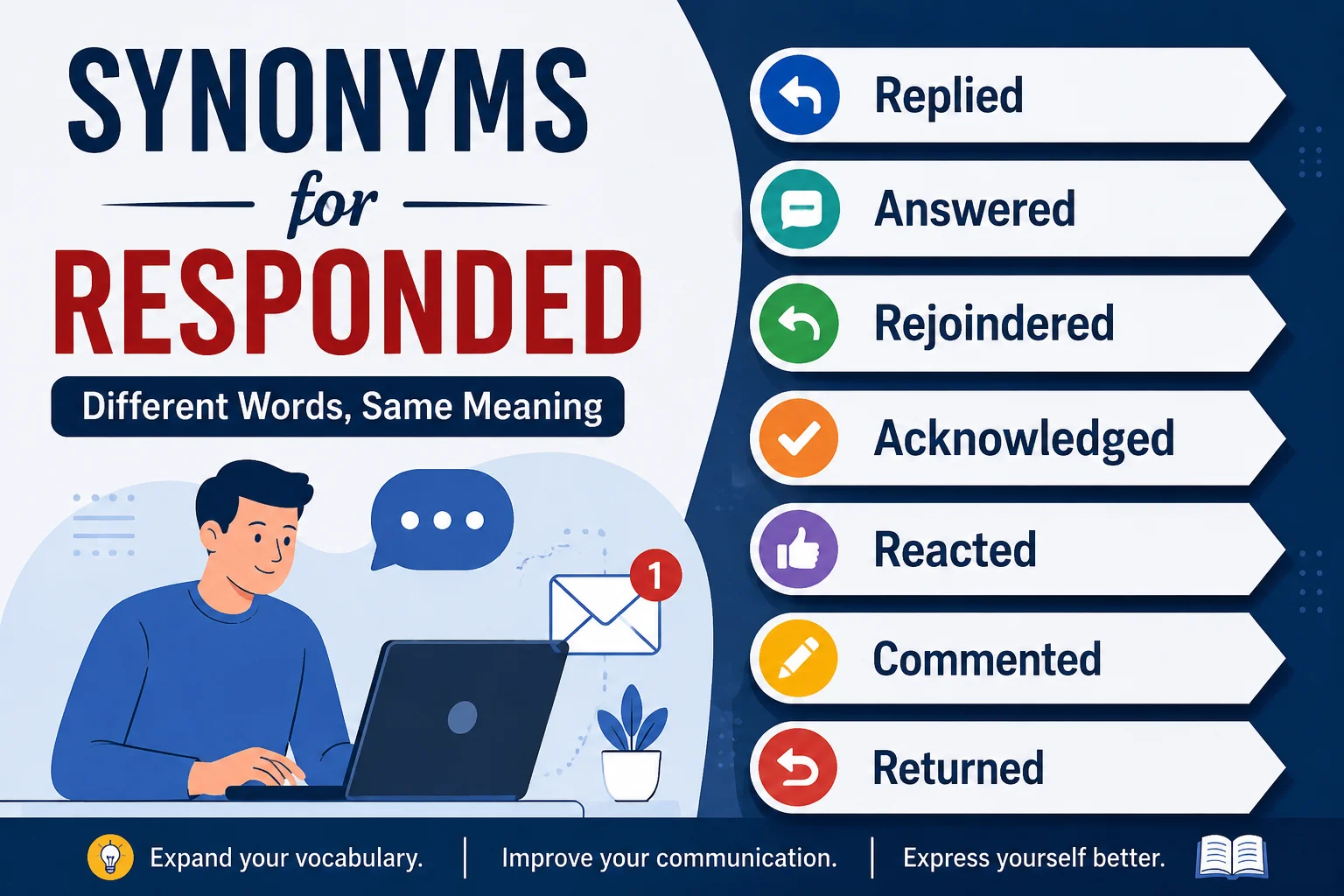
Finding the right words can make your writing clearer, more natural, and more engaging. The word responded is common in everyday English, but using the same word repeatedly can make a sentence feel plain or repetitive. Learning useful synonyms for responded can help students, ESL learners, writers, and content creators express reactions and replies more precisely.
The best alternative depends on the situation. Someone might replied to a question, answered a request, reacted to criticism, acknowledged a message, or retorted during an argument. Although these words are related, they do not always carry exactly the same meaning or tone.
This guide explains the most useful synonyms for responded in simple English. You will learn what each word means, how to use it in a sentence, and which situations are best for it. The article also includes a separate explanation of demure and 30 related words, as requested.
What Does “Responded” Mean?
Responded is the past tense of respond. It means to answer, react, or take some action because of something that was said, asked, done, or experienced.
For example:
Maria responded to the email within an hour.
Here, “responded” means Maria replied to the email.
The word can also describe a reaction rather than a spoken or written answer:
The audience responded positively to the speaker.
In this sentence, “responded” means the audience reacted positively.
Because the word can describe both an answer and a reaction, the best synonym depends heavily on context.
30+ Synonyms for Responded
Below are useful alternatives to responded, with simple meanings, examples, and guidance on when to use each one.
1. Replied
Meaning: Gave an answer to someone who spoke or wrote.
Example:
She replied to my message later that evening.
Best usage: Use this for conversations, emails, texts, letters, and direct answers.
2. Answered
Meaning: Gave a response to a question or request.
Example:
He answered the teacher’s question correctly.
Best usage: Best for questions, quizzes, requests, and direct communication.
3. Reacted
Meaning: Showed a feeling, opinion, or behavior in response to something.
Example:
The manager reacted calmly to the unexpected news.
Best usage: Use when describing an emotional, physical, or behavioral response.
4. Acknowledged
Meaning: Showed that you noticed, received, or recognized something.
Example:
The company acknowledged the customer’s complaint.
Best usage: Useful in professional, formal, and business writing.
5. Retorted
Meaning: Answered quickly and sometimes angrily or sharply.
Example:
“That isn’t true,” she retorted.
Best usage: Best for arguments, disagreements, and sharp dialogue.
6. Rejoined
Meaning: Answered someone, especially during a conversation or argument.
Example:
“I never said that,” he rejoined.
Best usage: Often used in literary, formal, or argumentative writing.
7. Countered
Meaning: Responded by presenting an opposing idea or argument.
Example:
The lawyer countered the accusation with new evidence.
Best usage: Excellent for debates, arguments, politics, and persuasive writing.
8. Addressed
Meaning: Dealt with a question, issue, concern, or problem.
Example:
The director addressed the employees’ concerns.
Best usage: Common in professional, academic, and formal writing.
9. Acknowledged
Meaning: Accepted or recognized that something existed, happened, or had been received.
Example:
She acknowledged his email with a brief message.
Best usage: Particularly useful when you want to emphasize recognition rather than a detailed answer.
10. Commented
Meaning: Gave an opinion or observation about something.
Example:
The author commented on the growing popularity of online education.
Best usage: Good for opinions, observations, interviews, articles, and discussions.
11. Remarked
Meaning: Said something as an observation or comment.
Example:
“That was an interesting idea,” the professor remarked.
Best usage: Natural in storytelling and formal or literary writing.
12. Explained
Meaning: Gave information to make something clear or understandable.
Example:
The teacher explained why the answer was incorrect.
Best usage: Use when the response provides clarification or information.
13. Clarified
Meaning: Made something clearer by providing additional information.
Example:
The manager clarified the new workplace policy.
Best usage: Best when correcting confusion or removing uncertainty.
14. Confirmed
Meaning: Stated that something was true, correct, or received.
Example:
She confirmed that she would attend the meeting.
Best usage: Useful for appointments, plans, facts, and professional communication.
15. Accepted
Meaning: Agreed to receive or approve something.
Example:
He accepted the invitation with a smile.
Best usage: Use when the response involves agreement or approval.
16. Refused
Meaning: Said no or declined to do something.
Example:
The employee refused to answer the question.
Best usage: Useful when the response is a clear rejection.
17. Rejected
Meaning: Refused to accept, approve, or agree with something.
Example:
The editor rejected the proposed changes.
Best usage: Appropriate for applications, ideas, proposals, offers, and arguments.
18. Reacted to
Meaning: Behaved or felt in a particular way because of something.
Example:
The child reacted to the sudden noise with surprise.
Best usage: Best when describing an emotional, physical, or behavioral response.
19. Responded to
Meaning: Took action or gave an answer because of something.
Example:
The organization responded to the emergency immediately.
Best usage: Useful when you need a broad alternative but want to emphasize action.
20. Addressed
Meaning: Gave attention to or dealt with an issue.
Example:
The report addressed several important environmental concerns.
Best usage: Excellent for formal essays, reports, presentations, and business writing.
21. Countered
Meaning: Gave an opposing response.
Example:
The opposition leader countered the proposal with an alternative plan.
Best usage: Use when the response challenges another idea.
22. Challenged
Meaning: Questioned or opposed an idea, statement, or decision.
Example:
The student challenged the professor’s interpretation.
Best usage: Good for debates, academic writing, and disagreements.
23. Agreed
Meaning: Expressed that you have the same opinion or accepted an idea.
Example:
She agreed with his suggestion.
Best usage: Use when the response shows approval or shared opinion.
24. Disagreed
Meaning: Expressed a different opinion.
Example:
He disagreed with the proposed solution.
Best usage: Best when the response directly opposes another person’s opinion.
25. Assured
Meaning: Told someone something confidently to remove doubt or worry.
Example:
The doctor assured the patient that everything was fine.
Best usage: Useful when a response provides confidence or reassurance.
26. Reassured
Meaning: Made someone feel less worried or afraid.
Example:
The teacher reassured the nervous student.
Best usage: Best for supportive and comforting responses.
27. Protested
Meaning: Expressed strong disagreement or objection.
Example:
The workers protested against the new policy.
Best usage: Useful when the response involves strong opposition or objection.
28. Objected
Meaning: Expressed disagreement or disapproval.
Example:
Several members objected to the proposed changes.
Best usage: Common in meetings, discussions, legal contexts, and formal writing.
29. Retorted
Meaning: Gave a quick and often sharp reply.
Example:
“You should have asked me first,” he retorted.
Best usage: Best for tense conversations, arguments, and dramatic dialogue.
30. Rebutted
Meaning: Responded to an argument by showing why it was incorrect or weak.
Example:
The researcher rebutted the criticism with strong evidence.
Best usage: Excellent for academic, legal, political, and argumentative writing.
31. Responded Positively
Meaning: Reacted with approval, enthusiasm, or support.
Example:
Customers responded positively to the new product.
Best usage: Useful when describing public opinion, feedback, or reactions.
32. Responded Negatively
Meaning: Reacted with disapproval, criticism, or opposition.
Example:
Some readers responded negatively to the controversial article.
Best usage: Useful for reviews, public reactions, feedback, and social discussions.
Quick Comparison of Synonyms for Responded
| Synonym | Main Meaning | Tone | Best Context |
| Replied | Gave an answer | Neutral | Messages and conversations |
| Answered | Gave an answer to a question | Neutral | Questions and requests |
| Reacted | Showed a response | Neutral | Emotions and behavior |
| Acknowledged | Recognized something | Formal | Business and professional writing |
| Retorted | Gave a sharp reply | Strong | Arguments and dialogue |
| Countered | Opposed an argument | Formal | Debates and discussions |
| Addressed | Dealt with an issue | Formal | Essays and reports |
| Commented | Gave an opinion | Neutral | Discussions and articles |
| Clarified | Made something clearer | Formal | Explanations and corrections |
| Confirmed | Verified something | Formal | Plans and information |
| Reassured | Reduced someone’s worry | Supportive | Personal and professional situations |
| Objected | Expressed disagreement | Formal | Meetings and arguments |
| Rebutted | Proved an argument wrong | Formal | Academic and legal writing |
| Challenged | Questioned an idea | Strong | Debates and criticism |
Synonyms for Responded in Different Situations
The best synonym changes depending on what kind of response you are describing.
Responded to a Question
Use answered, replied, or explained.
Example:
The student answered the question confidently.
Responded to an Email
Use replied, acknowledged, or confirmed.
Example:
She replied to the client’s email immediately.
Responded to Criticism
Use addressed, countered, challenged, or rebutted.
Example:
The author addressed the criticism in a later interview.
Responded During an Argument
Use retorted, rejoined, countered, or objected.
Example:
“That’s not what I meant,” she retorted.
Responded Emotionally
Use reacted, protested, or reassured, depending on the situation.
Example:
He reacted with surprise when he heard the news.
Responded in a Professional Setting
Use addressed, acknowledged, confirmed, or clarified.
Example:
The manager addressed the employees’ concerns during the meeting.
Formal Synonyms for Responded
When writing an essay, report, business document, or academic paper, some alternatives sound more professional than others.
Useful formal choices include:
- Addressed
- Acknowledged
- Clarified
- Confirmed
- Countered
- Rebutted
- Objected
- Commented
- Challenged
- Explained
For example, instead of:
The company responded to the complaints.
You could write:
The company addressed the complaints.
This version can sound more precise because it suggests that the company actively dealt with the issue.
Professional Synonyms for Responded
In workplace communication, the best synonym depends on the action taken.
Acknowledged works when someone confirms that they received information.
The manager acknowledged the employee’s request.
Confirmed works when someone verifies information.
The assistant confirmed the appointment.
Addressed works when someone deals with a problem.
The director addressed the team’s concerns.
Clarified works when someone removes confusion.
The supervisor clarified the instructions.
These choices can make professional writing more precise without making it unnecessarily complicated.
Synonyms for Responded in Academic Writing
Academic writing often requires precise descriptions of how a researcher, author, or scholar dealt with another idea.
Instead of repeatedly using “responded,” consider:
- Addressed
- Challenged
- Countered
- Rebutted
- Acknowledged
- Explained
- Commented
- Argued
- Disagreed
For example:
The researcher responded to earlier criticism.
A more precise version might be:
The researcher addressed earlier criticism.
Or, if the researcher directly argued against it:
The researcher rebutted the earlier criticism.
The second sentence gives the reader more information about the nature of the response.
Synonyms for Responded in Storytelling
Writers often need alternatives to “responded” when creating dialogue.
Instead of:
“I don’t know,” she responded.
You could write:
“I don’t know,” she replied.
For a sharper tone:
“I don’t know,” she retorted.
For an emotional reaction:
She protested, “I didn’t do it.”
For an explanatory response:
“I stayed home because I was sick,” he explained.
Choosing the right dialogue verb helps readers understand the speaker’s attitude without adding unnecessary explanation.
How to Choose the Right Synonym for Responded
Choosing the right synonym is easier when you first identify the type of response.
For a Simple Answer
Choose:
- Replied
- Answered
- Responded
These are the safest choices for ordinary communication.
For an Emotional Reaction
Choose:
- Reacted
- Protested
- Reassured
- Objected
These words tell the reader more about the person’s emotional or behavioral response.
For Professional Communication
Choose:
- Acknowledged
- Confirmed
- Addressed
- Clarified
These words work especially well in emails, reports, meetings, and workplace writing.
For Arguments
Choose:
- Retorted
- Countered
- Challenged
- Objected
- Rebutted
These words show disagreement, opposition, or a strong response.
For Academic Arguments
Choose:
- Addressed
- Countered
- Challenged
- Rebutted
- Acknowledged
These alternatives are useful when discussing how scholars respond to previous claims or criticism.
Common Mistakes When Using Synonyms for Responded
Not every synonym can replace responded in every sentence.
For example:
She responded to the email.
You can naturally change this to:
She replied to the email.
But replacing it with:
She retorted to the email.
would sound incorrect because retorted normally describes a sharp spoken reply, especially during disagreement.
Similarly:
He responded to the criticism.
could become:
He addressed the criticism.
But confirmed the criticism would have a completely different meaning.
The key is to focus on the type of response, not simply find a word that looks similar in a thesaurus.
What Does “Demure” Mean?
Demure is an adjective that describes someone who behaves in a quiet, modest, reserved, and sometimes shy way.
For example:
She gave a demure smile when everyone complimented her.
The word often describes a person’s appearance, behavior, expression, or manner. It can suggest modesty and self-control rather than loudness or attention-seeking behavior.
The tone of demure is usually gentle, polite, and somewhat formal. It is often used in descriptions of people, clothing, expressions, or social behavior.
30 Synonyms of Demure
The following words can be related to demure, although they are not all exact replacements. Each carries its own shade of meaning.
1. Modest
Meaning: Not overly proud, showy, or attention-seeking.
Example:
She wore a modest dress to the ceremony.
Best usage: Clothing, behavior, appearance, and personality.
2. Reserved
Meaning: Quiet and not likely to openly express feelings.
Example:
He was reserved during the first meeting.
Best usage: Personality and social behavior.
3. Shy
Meaning: Nervous or uncomfortable around other people.
Example:
The shy child avoided speaking in front of the class.
Best usage: Social behavior and personality.
4. Quiet
Meaning: Not loud or talkative.
Example:
She was quiet during the discussion.
Best usage: General behavior and personality.
5. Retiring
Meaning: Shy and unwilling to attract attention.
Example:
His retiring personality made him uncomfortable at large gatherings.
Best usage: Formal descriptions of personality.
6. Unassuming
Meaning: Not trying to appear important or impressive.
Example:
Despite her success, she remained unassuming.
Best usage: Personality and behavior.
7. Mild
Meaning: Gentle and not aggressive or extreme.
Example:
He had a mild and friendly personality.
Best usage: Personality, behavior, and temperament.
8. Gentle
Meaning: Kind, calm, and soft in manner.
Example:
She spoke in a gentle voice.
Best usage: Personality, speech, and behavior.
9. Subdued
Meaning: Quiet, restrained, or not very noticeable.
Example:
She gave a subdued smile.
Best usage: Expressions, emotions, colors, and behavior.
10. Unobtrusive
Meaning: Not attracting unnecessary attention.
Example:
He preferred an unobtrusive style of clothing.
Best usage: Appearance, behavior, and design.
11. Meek
Meaning: Very gentle and unlikely to argue or resist.
Example:
The meek student rarely challenged anyone.
Best usage: Personality, though it can sometimes sound negative.
12. Bashful
Meaning: Easily embarrassed or shy.
Example:
The bashful child hid behind her mother.
Best usage: Informal and descriptive writing.
13. Coy
Meaning: Shy or pretending to be shy, often in a playful way.
Example:
She gave him a coy smile.
Best usage: Playful, romantic, or literary contexts.
14. Timid
Meaning: Lacking confidence because of fear or nervousness.
Example:
The timid student hesitated before answering.
Best usage: Personality and behavior.
15. Demure
Meaning: Quiet, modest, and reserved.
Example:
She maintained a demure expression throughout the ceremony.
Best usage: Appearance, manners, and social behavior.
16. Composed
Meaning: Calm and in control of one’s emotions.
Example:
She remained composed during the difficult conversation.
Best usage: Professional and formal situations.
17. Dignified
Meaning: Calm, respectable, and serious.
Example:
He maintained a dignified manner throughout the ceremony.
Best usage: Formal descriptions of behavior.
18. Decorous
Meaning: Behaving in a socially proper and respectable way.
Example:
The guests maintained decorous behavior during the event.
Best usage: Formal and literary writing.
19. Proper
Meaning: Appropriate and socially acceptable.
Example:
She was known for her proper manners.
Best usage: Manners and social behavior.
20. Ladylike
Meaning: Traditionally associated with polite, graceful, and refined feminine behavior.
Example:
Her ladylike manner impressed the guests.
Best usage: Traditional or descriptive contexts.
21. Modest-Mannered
Meaning: Behaving in a restrained and humble way.
Example:
The modest-mannered speaker avoided excessive praise.
Best usage: Descriptive writing.
22. Unpretentious
Meaning: Simple and not designed to impress others.
Example:
Her unpretentious style made her easy to talk to.
Best usage: Personality, lifestyle, and appearance.
23. Humble
Meaning: Not thinking you are better or more important than others.
Example:
Despite winning the award, she remained humble.
Best usage: Character and attitude.
24. Self-effacing
Meaning: Not drawing attention to your own achievements or importance.
Example:
His self-effacing humor made everyone comfortable.
Best usage: Formal descriptions of personality.
25. Soft-spoken
Meaning: Speaking quietly and gently.
Example:
The soft-spoken teacher was well respected by her students.
Best usage: Speech and personality.
26. Restrained
Meaning: Controlled and not excessive in emotion or behavior.
Example:
She gave a restrained response to the criticism.
Best usage: Formal, academic, and professional writing.
27. Refined
Meaning: Elegant, polished, and socially sophisticated.
Example:
She had a refined sense of style.
Best usage: Appearance, manners, taste, and behavior.
28. Gracious
Meaning: Polite, kind, and pleasant toward others.
Example:
She was gracious when accepting the award.
Best usage: Social behavior and manners.
29. Unpretending
Meaning: Not artificial, boastful, or designed to impress.
Example:
His unpretending manner made him approachable.
Best usage: Personality and character descriptions.
30. Demure-looking
Meaning: Having a quiet, modest, or reserved appearance.
Example:
The character had a demure-looking expression.
Best usage: Descriptive and creative writing.
Demure Synonyms: Quick Comparison
| Word | Main Idea | Tone | Common Context |
| Modest | Not showy | Neutral | Appearance and behavior |
| Reserved | Emotionally quiet | Neutral/Formal | Personality |
| Shy | Uncomfortable socially | Neutral | Social situations |
| Bashful | Easily embarrassed | Gentle | Informal descriptions |
| Coy | Playfully shy | Playful | Romance and dialogue |
| Timid | Lacking confidence | Often negative | Personality |
| Composed | Calm and controlled | Positive | Professional settings |
| Dignified | Respectable and serious | Formal | Ceremonies and behavior |
| Humble | Not boastful | Positive | Character |
| Refined | Polished and elegant | Positive/Formal | Style and manners |
| Soft-spoken | Quiet voice | Positive | Speech and personality |
| Restrained | Emotionally controlled | Formal | Writing and behavior |
Demure vs. Shy
Demure and shy can overlap, but they are not identical.
Shy usually describes discomfort, nervousness, or lack of confidence around other people.
Demure suggests modesty, reserve, and controlled behavior. It does not necessarily mean that the person lacks confidence.
For example:
She was shy around strangers.
This suggests nervousness.
She gave a demure smile.
This suggests a quiet, modest, or reserved expression.
Demure vs. Modest
Modest generally means not excessive, boastful, or revealing. Demure focuses more on quiet and reserved behavior or appearance.
For example:
She was modest about her achievements.
This means she did not boast.
She had a demure manner.
This describes her quiet and reserved behavior.
Demure vs. Reserved
These words are closely related.
Reserved usually means someone does not openly express emotions or opinions.
Demure can suggest reserved behavior combined with modesty, gentleness, or a quiet appearance.
Therefore, “reserved” is often broader, while “demure” can create a more specific descriptive image.
How to Choose the Right Synonym for Demure
Choose modest when you want to emphasize a lack of showiness.
Choose reserved when you want to describe someone who does not openly express emotions.
Choose shy when nervousness or social discomfort is important.
Choose bashful when someone is easily embarrassed.
Choose composed when the person remains calm and controlled.
Choose refined when elegance and sophistication matter more than shyness.
Choose soft-spoken when the person’s quiet voice is the main feature.
Choose humble when the person avoids boasting about achievements.
Choose coy when the behavior is intentionally or playfully shy.
Frequently Asked Questions About Synonyms for Responded
What is the best synonym for responded?
Replied is often the best general synonym when someone gives an answer to another person. However, answered, reacted, addressed, and acknowledged may be better depending on the context.
What is a formal synonym for responded?
Common formal alternatives include addressed, acknowledged, clarified, confirmed, countered, and rebutted.
What is another word for responded in an email?
The most natural choices are replied, answered, acknowledged, or responded.
For example:
She replied to my email.
What is a synonym for responded in an argument?
Depending on the tone, you can use retorted, countered, challenged, objected, or rebutted.
What is a synonym for responded positively?
You can say reacted favorably, welcomed, approved, accepted, or embraced, depending on the exact meaning.
What is a synonym for responded negatively?
Possible choices include objected, protested, rejected, criticized, or reacted negatively.
What is the difference between replied and responded?
Replied usually means giving an answer to someone. Responded is broader and can mean answering, reacting, or taking action.
What is the opposite of responded?
Depending on the context, possible opposites include ignored, remained silent, dismissed, or failed to answer.
Final Takeaway
Learning synonyms for responded can make your writing more accurate and expressive. Instead of repeating the same word, choose a term that explains exactly what happened. Use replied for ordinary answers, answered for questions, reacted for emotional or behavioral responses, acknowledged for recognition, and addressed for issues or concerns.
For arguments and disagreements, words such as countered, challenged, retorted, and rebutted provide more specific meaning. In professional and academic writing, precise alternatives can make your sentences clearer and more authoritative.
The same principle applies to words such as demure. Related terms like modest, reserved, shy, composed, and refined may overlap in meaning, but each creates a slightly different impression. Understanding these differences helps you select vocabulary that matches your intended tone.
The best synonym is not always the most complicated word. It is the word that communicates your exact meaning naturally, clearly, and effectively.

I am Evelyn Marie, the Administrator of Synoloop. I enjoy helping readers discover useful synonyms, alternative words, and better ways to express their ideas. I focus on keeping Synoloop simple, reliable, informative, and helpful for everyone.