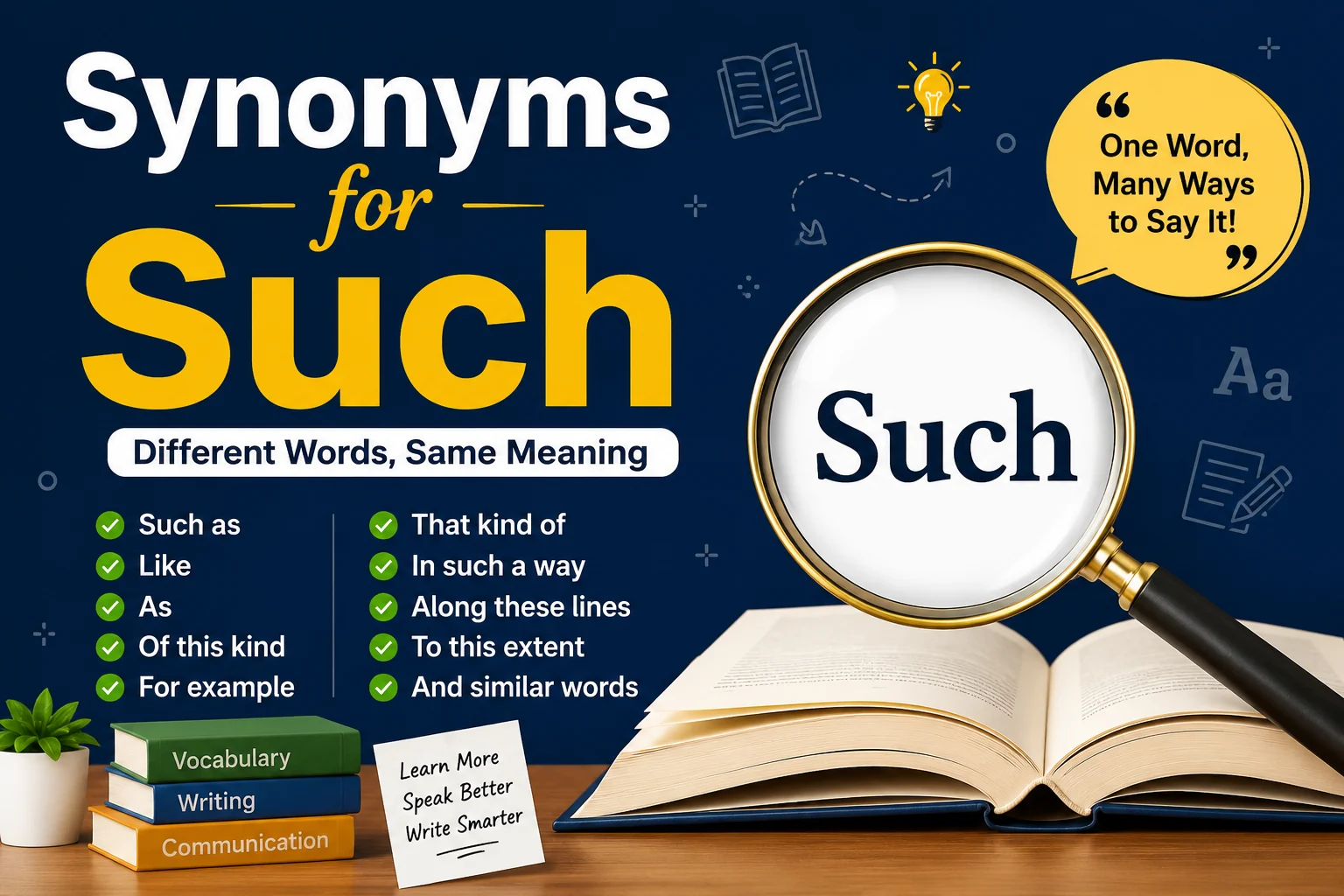
The word “such” is small, but it has many uses in everyday English. We use it to describe a particular kind of person or thing, emphasize something, refer back to an idea, or introduce examples. Because its meaning changes with context, finding the right alternative is not always as simple as replacing it with one word.
Learning synonyms for such can make your writing more precise, natural, and interesting. Students can use alternatives to avoid repetition, ESL learners can understand subtle differences in meaning, and writers can choose words that better match the tone of a sentence.
This guide explains useful alternatives to such, with simple meanings and practical examples. It also includes a separate vocabulary section on demure, as requested, with 30 related words and examples.
What Does “Such” Mean?
Such is a versatile English word used in several different ways.
It can mean “of this kind” or “of that kind.”
Such behavior is unacceptable.
Here, “such” refers to behavior of the kind just mentioned or understood.
It can also be used for emphasis.
It was such a beautiful morning.
In this sentence, “such” strengthens the description.
Another common use is to refer to something previously mentioned:
He made a promise, and such a promise should not be broken.
The exact synonym depends on how such is being used. That is why there is no single replacement that works in every sentence.
Why Learn Synonyms for Such?
Knowing alternatives to “such” is useful for several reasons.
Better writing: Replacing repeated words can make paragraphs smoother.
More precise vocabulary: Words such as similar, particular, specific, and that kind of communicate slightly different ideas.
Better academic English: Formal alternatives can help students write clearer essays and reports.
Stronger communication: Choosing a word that fits the exact context makes your meaning easier to understand.
Improved ESL vocabulary: Understanding how “such” works helps learners recognize common English sentence patterns.
Best Synonyms for “Such”
The following alternatives can work in different contexts. They are not all exact replacements because “such” has several meanings.
1. Similar
Meaning: Almost the same in quality, type, or appearance.
Example:
I have never seen a similar situation before.
Best usage: Use “similar” when comparing something with another thing.
2. Like
Meaning: Having qualities that are similar to something else.
Example:
I have never experienced anything like this.
Best usage: Common in everyday and conversational English.
3. This Kind of
Meaning: Referring to a particular type or category.
Example:
I do not enjoy this kind of music.
Best usage: Useful when “such” means a particular type.
4. That Kind of
Meaning: Referring to a type that has already been mentioned or is understood.
Example:
We should avoid that kind of behavior.
Best usage: Natural when referring to a specific type or example.
5. This Type of
Meaning: A particular category or variety.
Example:
This type of exercise can improve your balance.
Best usage: Good for educational and explanatory writing.
6. That Type of
Meaning: A particular category previously identified.
Example:
That type of mistake can be avoided with careful planning.
Best usage: Formal and informative contexts.
7. Particular
Meaning: Specific rather than general.
Example:
I am looking for a particular book.
Best usage: Use it when you want to emphasize something specific.
8. Specific
Meaning: Clearly identified or exact.
Example:
Do you have a specific reason for asking?
Best usage: Academic, professional, and technical writing.
9. Similar Such
This combination is generally not a natural synonym for “such.” Instead, writers should usually choose similar, comparable, or of that kind, depending on the sentence.
Example:
She had faced similar problems before.
Best usage: Use “similar” rather than forcing a direct replacement.
10. Comparable
Meaning: Similar enough to be compared.
Example:
The two companies have comparable levels of customer satisfaction.
Best usage: Formal, analytical, and academic writing.
11. Like This
Meaning: Similar to the thing currently being discussed.
Example:
I have never read a book like this.
Best usage: Conversational and descriptive writing.
12. Like That
Meaning: Similar to something previously mentioned.
Example:
I have never seen anyone behave like that.
Best usage: Everyday speech and informal writing.
13. Of This Kind
Meaning: Belonging to the type currently being discussed.
Example:
Problems of this kind require careful attention.
Best usage: Formal and academic writing.
14. Of That Kind
Meaning: Belonging to a previously mentioned category.
Example:
We rarely encounter difficulties of that kind.
Best usage: Formal explanations and essays.
15. Particular Kind
Meaning: A specific type or category.
Example:
This particular kind of plant needs plenty of sunlight.
Best usage: When identifying one specific variety.
16. Certain
Meaning: A specific but sometimes unnamed person, thing, or type.
Example:
Certain behaviors can damage professional relationships.
Best usage: Formal writing when referring to an identifiable category.
17. Given
Meaning: The particular thing already mentioned or provided.
Example:
Under the given circumstances, we decided to leave.
Best usage: Formal, academic, and professional writing.
18. Aforementioned
Meaning: Mentioned earlier.
Example:
The aforementioned problem affected the entire project.
Best usage: Formal documents and academic writing.
19. Previously Mentioned
Meaning: Something referred to earlier.
Example:
The previously mentioned issue remains unresolved.
Best usage: Clear formal writing.
20. The Same
Meaning: Identical or referring to the thing already discussed.
Example:
The same problem occurred again.
Best usage: When “such” refers directly to something previously identified.
21. Therefore
Meaning: For that reason.
Example:
The evidence was incomplete; therefore, the conclusion was reconsidered.
Best usage: Sometimes confused with “such,” but it is a replacement only when the sentence expresses a result.
22. So
Meaning: To a high degree or in this way, depending on context.
Example:
I have never seen so many people at one event.
Best usage: Often useful when “such” is part of an emphatic structure.
23. Extremely
Meaning: To a very high degree.
Example:
It was an extremely difficult examination.
Best usage: Use it when “such” is emphasizing intensity.
24. Very
Meaning: To a high degree.
Example:
She is a very talented musician.
Best usage: Everyday English, although sentence structure may need to change.
25. Remarkable
Meaning: Unusual or impressive.
Example:
She showed remarkable patience during the difficult situation.
Best usage: When “such” is being used to emphasize an impressive quality.
26. Exceptional
Meaning: Much better or different from what is usual.
Example:
He demonstrated exceptional leadership skills.
Best usage: Formal and professional writing.
27. Extraordinary
Meaning: Very unusual, impressive, or surprising.
Example:
They achieved an extraordinary result.
Best usage: Descriptive and persuasive writing.
28. Particular Example
Meaning: One specific example from a larger group.
Example:
This particular example shows why preparation matters.
Best usage: Essays, teaching materials, and explanations.
29. One of This Kind
Meaning: Something belonging to a particular category.
Example:
I had never encountered one of this kind before.
Best usage: More explanatory than conversational; use carefully.
30. Of a Similar Nature
Meaning: Having similar characteristics.
Example:
The organization has dealt with several problems of a similar nature.
Best usage: Formal reports, business writing, and academic contexts.
31. Of the Same Type
Meaning: Belonging to the same category.
Example:
We need equipment of the same type for the experiment.
Best usage: Technical, academic, and instructional writing.
“Such” vs. Its Best Alternatives
| Word or phrase | Main idea | Tone | Example |
| Such | This/that kind or emphasis | Neutral | Such behavior is unacceptable. |
| Similar | Almost the same | Neutral | We faced a similar problem. |
| Specific | Clearly identified | Formal/neutral | We need a specific answer. |
| Particular | One specific thing | Neutral/formal | A particular issue was discussed. |
| Like this | Similar to this | Informal | I have never seen anything like this. |
| Of this kind | This category | Formal | Problems of this kind are common. |
| Comparable | Similar enough to compare | Formal | The results are comparable. |
| Certain | A particular group or type | Formal | Certain factors affect the outcome. |
| Aforementioned | Mentioned earlier | Very formal | The aforementioned issue was resolved. |
| Extraordinary | Very unusual or impressive | Descriptive | It was an extraordinary achievement. |
How to Choose the Right Synonym for “Such”
The best alternative depends on what you actually mean.
When You Mean “This or That Kind”
Choose:
- this kind of
- that kind of
- this type of
- that type of
- of this kind
- of that kind
Example:
Such mistakes are common.
Possible rewrite:
Mistakes of this kind are common.
When You Mean “Similar”
Choose:
- similar
- like
- comparable
- of a similar nature
- of the same type
Example:
I have never experienced such problems.
Possible rewrite:
I have never experienced similar problems.
When You Mean “Specific”
Choose:
- particular
- specific
- certain
- given
Example:
Such details are important.
Depending on the intended meaning, you could write:
Specific details are important.
When “Such” Adds Emphasis
Sometimes “such” is not simply pointing to a category. It makes an adjective or noun phrase stronger.
Example:
It was such a difficult task.
A natural alternative could be:
It was an extremely difficult task.
Or:
It was an exceptionally difficult task.
In these cases, replacing “such” requires changing the sentence structure.
Common Sentence Patterns With “Such”
Understanding the original structures makes it easier to choose an appropriate synonym.
Such + Noun
Such behavior is unacceptable.
Possible alternative:
This kind of behavior is unacceptable.
Such + Adjective + Noun
It was such a beautiful place.
Possible alternative:
It was an extremely beautiful place.
Such as
“Such as” introduces examples.
We sell fruits such as apples, oranges, and bananas.
In this construction, alternatives include:
- including
- for example
- for instance
- like
Example:
We sell fruits, including apples and oranges.
Be careful: “such as” is not always interchangeable with “such.” It performs a specific grammatical function.
30 Synonyms of “Demure”
The main keyword in this article is “synonyms for such.” The following section addresses the separate vocabulary requirement for demure.
What Does “Demure” Mean?
Demure describes someone who is quiet, modest, reserved, and well-behaved, especially in appearance or manner.
It often describes a person who does not attract attention through loud behavior, excessive confidence, or flashy appearance.
The word usually has a positive or neutral tone, although the meaning can change depending on context.
Example:
She gave a demure smile and quietly returned to her seat.
“Demure” is common in descriptions of personality, clothing, facial expressions, and social behavior.
1. Modest
Meaning: Not showing off; simple and reserved.
Example:
She wore a modest dress to the ceremony.
Best usage: Clothing, behavior, and personality.
2. Reserved
Meaning: Quiet and not openly expressive.
Example:
He was reserved when meeting new people.
Best usage: Personality and social behavior.
3. Shy
Meaning: Nervous or uncomfortable around other people.
Example:
The shy student rarely spoke during class.
Best usage: Social behavior, especially when someone lacks confidence.
4. Quiet
Meaning: Not loud or highly expressive.
Example:
She has a quiet and thoughtful personality.
Best usage: Everyday English.
5. Retiring
Meaning: Avoiding attention or social activity.
Example:
He was a retiring person who preferred small gatherings.
Best usage: Formal descriptions of personality.
6. Unassuming
Meaning: Not trying to appear important or impressive.
Example:
Despite his success, he remained unassuming.
Best usage: Personality and character.
7. Mild
Meaning: Gentle and not extreme.
Example:
She has a mild and pleasant manner.
Best usage: Personality and behavior.
8. Gentle
Meaning: Kind, calm, and not harsh.
Example:
He spoke in a gentle voice.
Best usage: Behavior, voice, and personality.
9. Subdued
Meaning: Quiet, restrained, or not attention-seeking.
Example:
She wore subdued colors to the formal event.
Best usage: Appearance, mood, colors, and behavior.
10. Soft-Spoken
Meaning: Speaking quietly and gently.
Example:
The soft-spoken teacher was respected by her students.
Best usage: Voice and personality.
11. Composed
Meaning: Calm and in control of emotions.
Example:
She remained composed during the difficult conversation.
Best usage: Professional and stressful situations.
12. Poised
Meaning: Calm, confident, and graceful.
Example:
The speaker appeared poised throughout the interview.
Best usage: Formal situations and public behavior.
13. Refined
Meaning: Elegant, cultured, and socially polished.
Example:
She had a refined sense of style.
Best usage: Appearance, manners, and taste.
14. Elegant
Meaning: Graceful and attractive in a sophisticated way.
Example:
She looked elegant in a simple black dress.
Best usage: Appearance, fashion, and style.
15. Graceful
Meaning: Moving or behaving in a smooth and attractive way.
Example:
Her graceful manner impressed everyone.
Best usage: Movement, behavior, and style.
16. Dignified
Meaning: Calm, serious, and worthy of respect.
Example:
She maintained a dignified attitude during the ceremony.
Best usage: Formal and serious situations.
17. Discreet
Meaning: Careful not to attract attention or reveal private information.
Example:
He was discreet about his personal affairs.
Best usage: Behavior, privacy, and communication.
18. Unobtrusive
Meaning: Not attracting attention or interfering with others.
Example:
The assistant remained unobtrusive during the meeting.
Best usage: Formal descriptions of behavior or presence.
19. Restrained
Meaning: Controlled and not excessive.
Example:
Her response was calm and restrained.
Best usage: Emotions, behavior, writing, and style.
20. Demurely
Meaning: In a quiet, modest, or reserved manner.
Example:
She demurely lowered her eyes.
Best usage: Descriptive writing.
21. Bashful
Meaning: Easily embarrassed or shy.
Example:
The bashful child hid behind her mother.
Best usage: Informal and gentle descriptions.
22. Timid
Meaning: Lacking confidence or courage.
Example:
The timid student hesitated before answering.
Best usage: Personality; often suggests weakness more strongly than “demure.”
23. Meek
Meaning: Very quiet, gentle, and unlikely to argue.
Example:
He appeared meek during the disagreement.
Best usage: Use carefully because it can suggest excessive submissiveness.
24. Modest
Meaning: Not boastful or attention-seeking.
Example:
She was modest about her accomplishments.
Best usage: Personality and achievements.
25. Serene
Meaning: Calm and peaceful.
Example:
She had a serene expression.
Best usage: Facial expressions, moods, and settings.
26. Tranquil
Meaning: Peaceful and free from disturbance.
Example:
Her tranquil manner made everyone feel comfortable.
Best usage: Calm environments and behavior.
27. Courteous
Meaning: Polite and respectful.
Example:
He was always courteous to his guests.
Best usage: Manners and social interaction.
28. Polite
Meaning: Showing good manners and respect.
Example:
She gave a polite response.
Best usage: Everyday English.
29. Proper
Meaning: Behaving in a socially acceptable or appropriate way.
Example:
Her proper behavior was appreciated at the formal dinner.
Best usage: Formal or traditional contexts.
30. Demure
Meaning: Modest, quiet, and reserved in manner or appearance.
Example:
Her demure expression gave her a calm and graceful appearance.
Best usage: Direct use of the original word when describing modest behavior or appearance.
Demure Synonyms: Quick Comparison
| Synonym | Main meaning | Best context |
| Modest | Not showing off | Personality, clothing |
| Reserved | Not openly expressive | Personality |
| Shy | Uncomfortable socially | Personality |
| Quiet | Not loud or expressive | Everyday descriptions |
| Unassuming | Not seeking attention | Character |
| Composed | Calm and controlled | Stressful situations |
| Poised | Calm and confident | Professional settings |
| Refined | Elegant and polished | Style and manners |
| Graceful | Smooth and attractive | Movement and behavior |
| Dignified | Serious and respectable | Formal situations |
| Discreet | Careful and private | Social behavior |
| Subdued | Restrained or understated | Style and mood |
| Bashful | Easily embarrassed | Informal descriptions |
| Timid | Lacking confidence | Personality |
| Meek | Very gentle and submissive | Character descriptions |
How to Choose the Right Synonym for “Demure”
Although these words are related, they do not all have exactly the same meaning.
For Modest Behavior
Choose:
- modest
- reserved
- unassuming
- discreet
- restrained
These words work well when someone behaves without seeking attention.
For Shyness
Choose:
- shy
- bashful
- timid
- retiring
These are better when the person seems uncomfortable, nervous, or socially hesitant.
For Calmness
Choose:
- composed
- serene
- tranquil
- poised
These words focus more on emotional control than modesty.
For Elegance
Choose:
- refined
- elegant
- graceful
- dignified
These are useful when describing appearance, manners, or sophisticated behavior.
Common Mistakes When Using “Such”
Mistake 1: Treating Every Synonym as an Exact Replacement
Not every synonym works grammatically in every sentence.
For example:
It was such a beautiful day.
You cannot simply replace “such” with “similar” and keep the sentence unchanged.
A better rewrite would be:
It was an extremely beautiful day.
Mistake 2: Confusing “Such” With “Such As”
“Such” and “such as” have different grammatical functions.
Such problems can be difficult.
But:
Problems such as these can be difficult.
“Such as” is generally used to introduce examples.
Mistake 3: Using Overly Formal Alternatives
Words such as aforementioned can sound unnatural in casual conversation.
Instead of:
The aforementioned restaurant was excellent.
In everyday writing, you could simply say:
The restaurant mentioned earlier was excellent.
Mistake 4: Ignoring Tone
“Shy,” “timid,” and “meek” are related to “demure,” but they can suggest a lack of confidence. “Poised” and “composed,” on the other hand, often suggest confidence and self-control.
Choosing the right word requires attention to the feeling you want to communicate.
Synonyms for Such in Academic Writing
Academic writing often benefits from precise alternatives rather than unnecessary repetition.
Instead of repeatedly writing:
Such results show that…
You may be able to write:
These results show that…
Or:
Similar findings show that…
Or:
The findings described above show that…
The best option depends on what “such” refers to.
For formal documents, specific, particular, comparable, previously mentioned, and of this kind can be useful. However, clarity should always come before complexity.
Synonyms for Such in Everyday English
In conversation, simple expressions are usually better.
Common alternatives include:
- this kind of
- that kind of
- like this
- like that
- similar
- this type of
- that type of
- the same
For example:
I don’t like such behavior.
Natural alternatives include:
I don’t like that kind of behavior.
Or:
I don’t like behavior like that.
Both sound natural in everyday English.
Frequently Asked Questions
What is the closest synonym for “such”?
There is no single synonym that works in every situation. This kind of, that kind of, similar, particular, and specific can be close alternatives depending on the sentence.
What can I use instead of “such as”?
Depending on the sentence, you can use including, for example, for instance, or like.
Is “similar” a synonym for “such”?
Sometimes, but not always. “Similar” works when “such” refers to something of a comparable kind. It does not replace every use of “such.”
What is a formal synonym for “such”?
Depending on the meaning, formal alternatives include of this kind, of that kind, particular, specific, comparable, and aforementioned.
What are simple synonyms for “such”?
Simple alternatives include this kind of, that kind of, like this, like that, and similar.
What is the meaning of “demure”?
“Demure” means quiet, modest, reserved, and usually well-behaved in appearance or manner.
Is “shy” the same as “demure”?
Not exactly. “Shy” usually suggests nervousness or discomfort in social situations, while “demure” emphasizes modesty, reserve, and quiet behavior or appearance.
Final Thoughts
The word “such” has several meanings and grammatical uses, so choosing the right alternative requires looking at the entire sentence. Words such as similar, particular, specific, comparable, this kind of, that kind of, and of this kind can work in different situations.
The most important lesson is that synonyms are not always interchangeable. A good writer chooses a word based on meaning, grammar, tone, and context, rather than simply looking for a more complicated word.
For ESL learners and students, practicing these distinctions can make English sound more natural. For writers and content creators, using the right alternative can improve clarity, reduce repetition, and make content easier to read.
And when describing a quiet, modest, and reserved manner, demure remains a useful word, with related choices such as modest, reserved, unassuming, composed, poised, refined, and graceful depending on the exact meaning you want to express.

I am Evelyn Marie, the Administrator of Synoloop. I enjoy helping readers discover useful synonyms, alternative words, and better ways to express their ideas. I focus on keeping Synoloop simple, reliable, informative, and helpful for everyone.