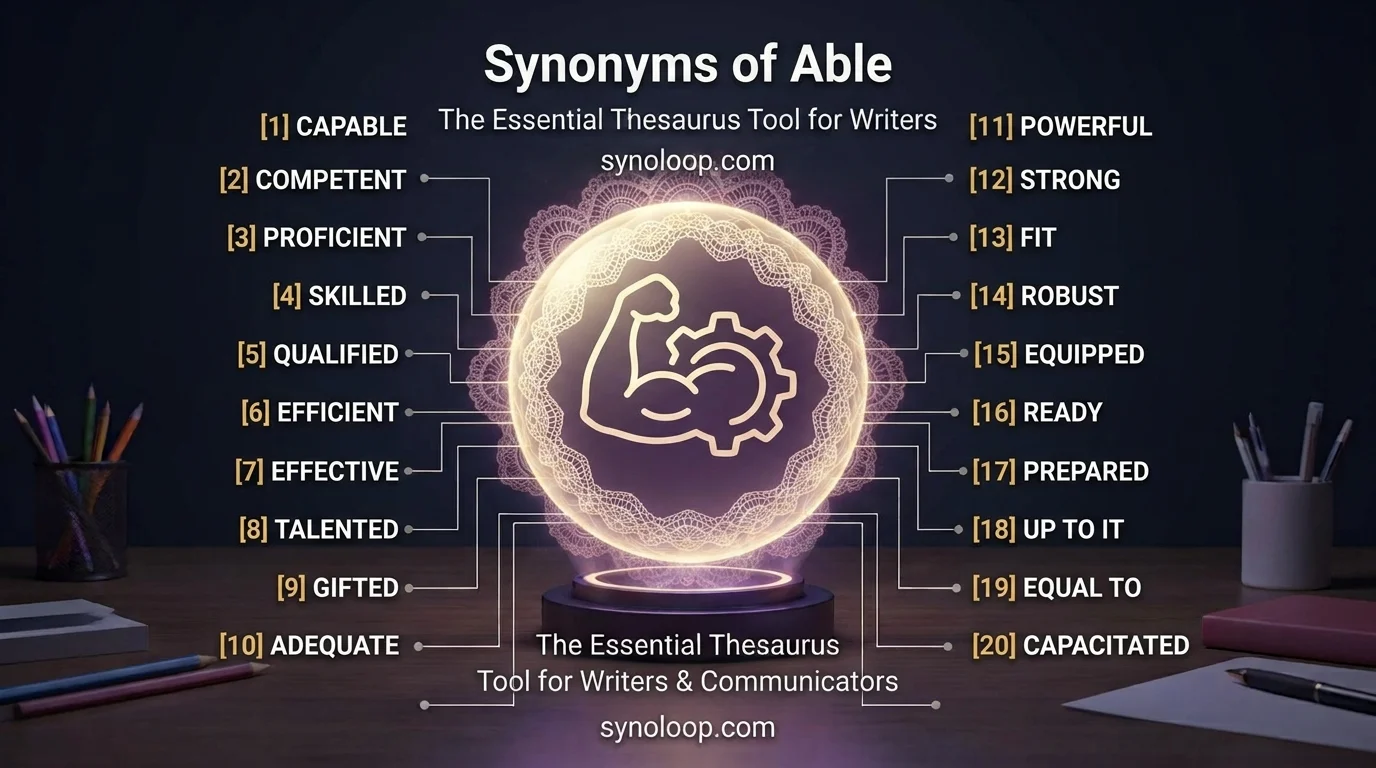
Finding the right alternative for “able to” can make your writing clearer, more natural, and more precise. The phrase is common in everyday English, academic writing, professional communication, and conversation, but repeating it too often can make sentences sound plain or repetitive.
In simple English, “able to” means having the skill, opportunity, strength, permission, or capacity to do something. The best synonym depends on what you mean. For example, capable of focuses on ability, while permitted to focuses on permission and qualified to focuses on having the necessary qualifications.
This guide explains 30 useful able to synonyms with simple meanings, examples, and usage contexts. It is designed for students, ESL learners, writers, and anyone who wants to choose more precise vocabulary.
What Does “Able To” Mean?
Able to means having the ability or capacity to do something.
For example:
She is able to solve difficult problems.
This means she has the ability to solve difficult problems.
The phrase can describe physical ability, mental ability, skills, opportunities, or circumstances.
- He is able to swim.
- We were able to finish the project.
- She is able to understand complex ideas.
- They were able to reach the destination before dark.
The appropriate synonym depends on the exact meaning you want to express.
30 Synonyms for “Able To”
Below are 30 alternatives to able to, along with simple explanations and examples.
1. Capable of
Meaning: Having the ability or skill to do something.
Example:
She is capable of handling difficult situations.
Best usage context:
Use it when emphasizing someone’s ability, skill, or potential.
2. Can
Meaning: Having the ability or opportunity to do something.
Example:
He can speak three languages.
Best usage context:
Best for everyday English and simple, direct sentences.
3. Competent to
Meaning: Having enough ability or knowledge to perform a task properly.
Example:
She is competent to manage the project independently.
Best usage context:
Useful in professional, academic, and formal contexts.
4. Qualified to
Meaning: Having the required skills, training, or qualifications.
Example:
He is qualified to teach English.
Best usage context:
Use when formal training, certification, or credentials are important.
5. Equipped to
Meaning: Having the tools, knowledge, or resources needed to do something.
Example:
The team is equipped to deal with unexpected problems.
Best usage context:
Useful when ability depends on preparation, resources, or equipment.
6. In a position to
Meaning: Having the opportunity, circumstances, or authority to do something.
Example:
We are now in a position to make a final decision.
Best usage context:
Good for professional, formal, and situational writing.
7. In a position where
Meaning: Being in circumstances that make an action possible.
Example:
She is in a position where she can help the organization grow.
Best usage context:
Useful when explaining circumstances rather than personal skill.
8. Have the ability to
Meaning: Possessing the skill or capacity to do something.
Example:
The software has the ability to process large amounts of data.
Best usage context:
Useful in academic, technical, and explanatory writing.
9. Have the capacity to
Meaning: Having enough ability, space, resources, or potential to do something.
Example:
The company has the capacity to expand internationally.
Best usage context:
Common in business, academic, technical, and formal contexts.
10. Have what it takes to
Meaning: Having the necessary qualities or abilities to succeed.
Example:
She has what it takes to become an excellent leader.
Best usage context:
Good for motivational, conversational, and informal writing.
11. Be in a position to
Meaning: Having the circumstances or authority needed to act.
Example:
The manager is in a position to approve the request.
Best usage context:
Useful when someone has authority, opportunity, or favorable circumstances.
12. Be prepared to
Meaning: Being ready and willing to do something.
Example:
The team is prepared to respond quickly.
Best usage context:
Use when readiness is more important than natural ability.
13. Be ready to
Meaning: Being prepared to do something.
Example:
We are ready to begin the meeting.
Best usage context:
Best for everyday communication and situations involving preparation.
14. Be skilled at
Meaning: Having a high level of ability in a particular activity.
Example:
She is skilled at solving technical problems.
Best usage context:
Use when emphasizing developed expertise.
15. Be proficient in
Meaning: Having a good level of skill in something.
Example:
He is proficient in several programming languages.
Best usage context:
Common in resumes, professional writing, education, and academic contexts.
16. Be adept at
Meaning: Being very good at doing something.
Example:
She is adept at explaining complex subjects clearly.
Best usage context:
Useful in polished professional and formal writing.
17. Be competent in
Meaning: Having sufficient ability or knowledge in a particular area.
Example:
The employee is competent in using the new software.
Best usage context:
Good for workplace, educational, and professional descriptions.
18. Be effective at
Meaning: Being able to produce the desired result successfully.
Example:
The new strategy is effective at reducing costs.
Best usage context:
Useful when focusing on successful results rather than personal ability.
19. Be successful in
Meaning: Achieving the desired result when doing something.
Example:
The company was successful in entering new markets.
Best usage context:
Use when the focus is on achievement or results.
20. Manage to
Meaning: Succeed in doing something, especially when it is difficult.
Example:
Despite the delay, we managed to finish the work on time.
Best usage context:
Excellent when an action required effort or overcoming difficulty.
21. Succeed in
Meaning: Successfully accomplish something.
Example:
She succeeded in completing the course.
Best usage context:
Useful in formal, academic, and professional writing.
22. Accomplish
Meaning: Successfully complete or achieve something.
Example:
The team accomplished its main objective.
Best usage context:
Best when referring to completed goals, tasks, or achievements.
23. Accomplish the task of
Meaning: Successfully complete a particular task or responsibility.
Example:
The workers accomplished the task of repairing the damaged road.
Best usage context:
Useful in formal or detailed writing.
24. Be free to
Meaning: Having permission or no restriction preventing an action.
Example:
You are free to contact us if you have any questions.
Best usage context:
Use when “able to” means having freedom or permission.
25. Be permitted to
Meaning: Having official permission to do something.
Example:
Visitors are permitted to enter the building after 9 a.m.
Best usage context:
Best for rules, policies, regulations, and formal situations.
26. Be allowed to
Meaning: Having permission to do something.
Example:
Students are allowed to use calculators during the test.
Best usage context:
Common in everyday and institutional English.
27. Be authorized to
Meaning: Having official permission or authority to do something.
Example:
Only senior employees are authorized to access the records.
Best usage context:
Use in legal, administrative, workplace, and official contexts.
28. Be in a position where one can
Meaning: Having circumstances that make an action possible.
Example:
After receiving the funding, the organization was in a position where it could expand its services.
Best usage context:
Useful for explaining how circumstances create an opportunity.
29. Be up to the task
Meaning: Having enough ability or skill to handle a particular challenge.
Example:
I believe our team is up to the task.
Best usage context:
Useful in conversational, professional, and motivational contexts.
30. Be capable of
Meaning: Having the ability or potential to do something.
Example:
This machine is capable of producing thousands of units each day.
Best usage context:
Useful in technical, professional, academic, and general writing.
Comparison Guide: Which “Able To” Synonym Should You Use?
Not every synonym for able to has exactly the same meaning. Choosing the right expression depends on what you want to emphasize.
| Synonym | Main Idea | Formality | Example |
| Can | General ability | Casual/Neutral | I can help you. |
| Capable of | Ability or potential | Neutral/Formal | She is capable of leading the team. |
| Qualified to | Training or credentials | Formal | He is qualified to teach. |
| Skilled at | Developed skill | Neutral | She is skilled at writing. |
| Proficient in | Strong practical skill | Formal | He is proficient in Spanish. |
| Adept at | High ability | Formal | She is adept at negotiation. |
| Equipped to | Resources or preparation | Neutral/Formal | We are equipped to handle the problem. |
| Manage to | Success despite difficulty | Neutral | They managed to finish early. |
| Permitted to | Official permission | Formal | Visitors are permitted to enter. |
| Allowed to | Permission | Neutral | You are allowed to leave. |
| Authorized to | Official authority | Formal | She is authorized to approve payments. |
| Prepared to | Readiness | Neutral | We are prepared to respond. |
| In a position to | Opportunity or circumstances | Formal | We are in a position to help. |
| Have what it takes | Necessary qualities | Informal | He has what it takes to succeed. |
| Up to the task | Ability to handle a challenge | Neutral | She is up to the task. |
“Able To” vs. “Can”
One of the most common questions is whether can can replace able to.
In many situations, yes.
Able to:
She is able to drive.
Can:
She can drive.
Both sentences communicate the same basic idea.
However, able to can sometimes be more useful when talking about a particular situation or achievement.
We were able to find the missing document.
Here, were able to emphasizes that the team successfully found it in a particular situation.
“Able To” vs. “Capable Of”
These expressions are closely related but have slightly different patterns.
Able to + base verb
He is able to solve the problem.
Capable of + -ing form
He is capable of solving the problem.
Both describe ability, but capable of often emphasizes someone’s potential or capacity.
“Able To” vs. “Qualified To”
These expressions should not always be treated as interchangeable.
Able to means someone has the ability to do something.
She is able to teach children.
Qualified to means someone has the necessary qualifications, training, or credentials.
She is qualified to teach children.
Someone may be able to perform a task without being officially qualified to perform it.
“Able To” vs. “Allowed To”
These two phrases have very different meanings.
Able to = having the ability or opportunity.
I am able to attend the meeting.
Allowed to = having permission.
I am allowed to attend the meeting.
This distinction is especially important for ESL learners because replacing one with the other can change the meaning of a sentence.
“Able To” vs. “Manage To”
Able to generally describes ability or possibility.
We were able to finish the project.
Manage to often suggests that something was difficult but ultimately successful.
We managed to finish the project despite the problems.
The second sentence highlights the effort or difficulty involved.
“Able To” in Different Contexts
Academic Writing
In academic writing, alternatives such as capable of, have the capacity to, and proficient in can provide greater precision.
Example:
The system has the capacity to process large datasets.
Professional Writing
Professional communication often benefits from expressions such as qualified to, equipped to, authorized to, and in a position to.
Example:
Our staff are equipped to provide technical support.
Everyday Conversation
Simple expressions such as can, able to, ready to, and allowed to are usually natural.
Example:
I can help you tomorrow.
Technical Writing
Technical contexts frequently use capable of, equipped to, and have the capacity to.
Example:
The device is capable of operating under extreme conditions.
Resumes and Professional Profiles
For resumes and profiles, words such as proficient in, skilled at, and competent in can clearly describe abilities.
Example:
Proficient in data analysis and project management.
How to Choose the Right Synonym
The easiest way to choose an alternative is to identify the exact meaning behind able to.
For General Ability
Use:
- Can
- Capable of
- Have the ability to
- Have the capacity to
Example:
The device is capable of detecting movement.
For Skills and Expertise
Use:
- Skilled at
- Proficient in
- Adept at
- Competent in
Example:
She is proficient in graphic design.
For Qualifications
Use:
- Qualified to
- Competent to
Example:
He is qualified to operate the equipment.
For Permission
Use:
- Allowed to
- Permitted to
- Authorized to
- Free to
Example:
Employees are authorized to access the system.
For Preparation or Readiness
Use:
- Ready to
- Prepared to
- Equipped to
Example:
The organization is prepared to respond to emergencies.
For Difficult Achievements
Use:
- Manage to
- Succeed in
- Accomplish
Example:
They managed to complete the project before the deadline.
For Opportunity or Circumstances
Use:
- In a position to
- In a position where
- Have the capacity to
Example:
The company is now in a position to expand.
For Informal or Motivational Language
Use:
- Have what it takes to
- Be up to the task
Example:
She has what it takes to become a successful entrepreneur.
Common Mistakes When Using “Able To” Synonyms
Using “Capable” With the Wrong Structure
Incorrect:
He is capable to solve the problem.
Correct:
He is capable of solving the problem.
Remember:
capable of + noun/-ing
Confusing Ability With Permission
Incorrect meaning:
You are able to enter the restricted area.
If you mean that someone has official permission, use:
You are authorized to enter the restricted area.
Using “Qualified” When You Only Mean “Able”
Being able to do something does not necessarily mean being qualified to do it.
For example, someone might be able to explain a subject clearly but not have the formal qualifications required to teach it professionally.
Overusing Formal Synonyms
Not every sentence needs a sophisticated alternative.
Instead of:
I am in a position to assist you.
In casual conversation, simply say:
I can help you.
Good vocabulary is not about using the most complicated word. It is about choosing the word that communicates your meaning accurately.
Why Learning Synonyms for “Able To” Matters
Learning alternatives to able to helps improve vocabulary and sentence variety.
For ESL learners, these expressions also reveal important differences in English grammar and meaning. Capable of, qualified to, allowed to, and authorized to all relate to possibility or ability, but they communicate different ideas.
For writers, choosing a precise alternative can make a sentence more informative.
Compare:
The team is able to handle the project.
With:
The team is equipped to handle the project.
The second sentence suggests that the team has the necessary resources or preparation.
Similarly:
She is able to teach English.
is different from:
She is qualified to teach English.
The second sentence specifically suggests that she meets the relevant requirements or credentials.
Frequently Asked Questions About “Able To” Synonyms
What is the most common synonym for “able to”?
Can is the most common simple alternative in everyday English. However, capable of is useful when emphasizing ability or potential.
What is a formal synonym for “able to”?
Depending on the meaning, formal alternatives include capable of, competent to, qualified to, equipped to, and in a position to.
Is “capable of” the same as “able to”?
They are closely related, but their grammar differs. Use capable of + noun/-ing, while able to + base verb.
Can “can” replace “able to”?
In many ordinary sentences, yes. For example, “She is able to swim” and “She can swim” have essentially the same basic meaning.
What is a synonym for “able to” in academic writing?
Depending on context, capable of, have the capacity to, proficient in, and competent in can work well in academic writing.
What is another word for “able”?
Possible alternatives include capable, competent, skilled, proficient, adept, and qualified, depending on the intended meaning.
What is a synonym for “able to do”?
You can use capable of doing, can do, competent to do, or in a position to do, depending on context.
What is the difference between “able to” and “capable of”?
Able to is followed by a base verb, while capable of is followed by a noun or an -ing form.
She is able to solve it.
She is capable of solving it.
Conclusion
The best able to synonyms depend on the meaning you want to communicate. Can is simple and natural, while capable of emphasizes ability or potential. Qualified to focuses on credentials, allowed to focuses on permission, skilled at emphasizes expertise, and manage to highlights successful action despite difficulty.
Instead of replacing able to randomly, first identify the idea behind the sentence. Ask whether you mean ability, skill, qualification, permission, preparation, opportunity, or achievement. Then choose the expression that matches that meaning.
Using synonyms this way makes your English more precise, natural, and effective—especially in academic writing, professional communication, everyday conversation, and content creation.

I am Evelyn Marie, the Administrator of Synoloop. I enjoy helping readers discover useful synonyms, alternative words, and better ways to express their ideas. I focus on keeping Synoloop simple, reliable, informative, and helpful for everyone.