Onomatopoeia is a fascinating type of language in which a word imitates, resembles, or suggests the sound associated with what it describes. Common examples include buzz, hiss, bang, click, and meow. These words make writing feel more vivid because readers can almost hear the action being described.
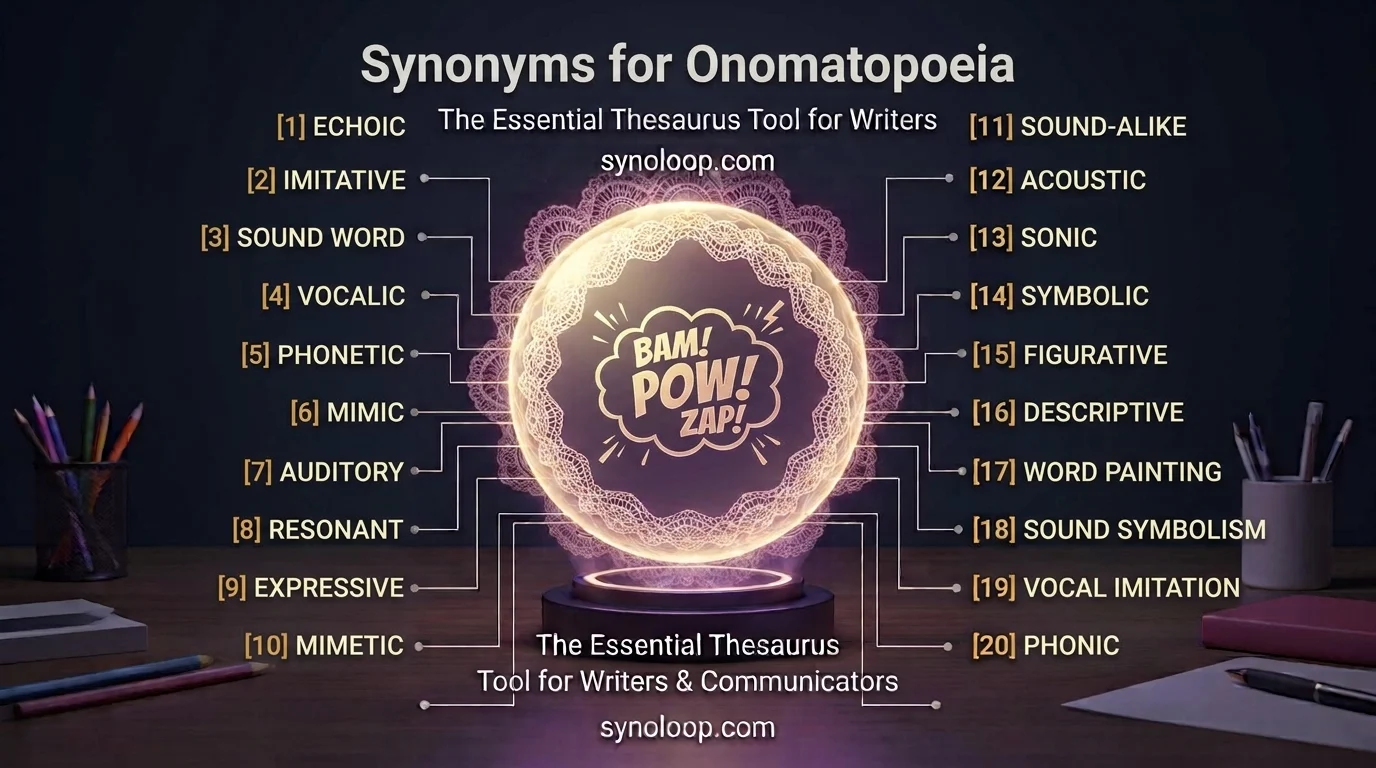
Finding useful synonyms for onomatopoeia can be helpful for students, ESL learners, writers, poets, and content creators. However, onomatopoeia is a specific linguistic device, so there is not always a perfect one-word synonym. Depending on the context, related terms such as sound word, sound imitation, and echoic word may be more appropriate.
This guide explains 30 related words and expressions in simple English. It also shows how each term differs in meaning and when it is most useful.
What Does Onomatopoeia Mean?
Onomatopoeia refers to a word that imitates or strongly suggests a real-world sound.
For example:
- Buzz imitates the sound made by a bee.
- Hiss resembles the sound of escaping air or a snake.
- Boom represents a deep, loud sound.
- Splash suggests the sound of something hitting or moving through water.
- Chirp describes the short sound made by many birds.
Onomatopoeia can make writing more descriptive and memorable. It is especially common in poetry, children’s books, comic books, advertising, fiction, and informal writing.
30 Synonyms and Related Terms for Onomatopoeia
Because onomatopoeia is a technical linguistic term, the following list includes close synonyms, related expressions, and descriptive alternatives. Some are interchangeable only in certain contexts.
1. Sound Word
Meaning: A word that represents or describes a sound.
Example: “Bang” is a common sound word used in children’s stories.
Best usage context: Simple explanations and ESL-friendly writing.
2. Sound Imitation
Meaning: The act of copying or representing a real sound with language.
Example: The writer used sound imitation to make the storm scene more vivid.
Best usage context: General explanations of onomatopoeic language.
3. Echoic Word
Meaning: A word that imitates or resembles a sound.
Example: “Hiss” is an echoic word that resembles the sound it describes.
Best usage context: Linguistics and academic writing.
4. Echoism
Meaning: The use or formation of words that imitate sounds.
Example: The poem uses echoism to recreate the sounds of the forest.
Best usage context: Literary and linguistic discussions.
5. Sound Symbolism
Meaning: The relationship between sounds in language and the ideas or qualities they suggest.
Example: The author used sound symbolism to create a playful feeling.
Best usage context: Linguistics and literary analysis.
6. Imitative Word
Meaning: A word formed to imitate something, especially a sound.
Example: “Splash” is an imitative word that suggests movement through water.
Best usage context: Educational explanations.
7. Sound-Effect Word
Meaning: A word used to represent a particular sound.
Example: The comic displayed the sound-effect word “CRASH!”
Best usage context: Comics, fiction, and visual storytelling.
8. Sound Expression
Meaning: A word or phrase used to express or represent a sound.
Example: The writer added a sound expression to make the action more dramatic.
Best usage context: General writing discussions.
9. Auditory Imitation
Meaning: The representation of a sound through language.
Example: The poem contains auditory imitation of birds singing.
Best usage context: Formal or literary analysis.
10. Phonetic Imitation
Meaning: The use of speech sounds to imitate a real-world sound.
Example: “Tick-tock” is a simple example of phonetic imitation.
Best usage context: Linguistic explanations.
11. Mimetic Word
Meaning: A word that imitates or represents an action, sound, or sensory experience.
Example: The writer chose a mimetic word to recreate the noise of falling rain.
Best usage context: Linguistics and literary studies.
12. Sound Representation
Meaning: A written representation of a sound.
Example: “Clang” is a sound representation of a sharp metallic noise.
Best usage context: Educational and descriptive writing.
13. Verbal Sound Effect
Meaning: A word or phrase that functions like a sound effect in writing.
Example: “Wham!” acts as a verbal sound effect in the comic.
Best usage context: Comics, scripts, and fiction.
14. Written Sound Effect
Meaning: A written form used to show a sound.
Example: The author used “Kaboom!” as a written sound effect.
Best usage context: Comics, novels, and creative writing.
15. Acoustic Imitation
Meaning: The representation of a real sound through language.
Example: The poem creates acoustic imitation through words such as “buzz” and “hiss.”
Best usage context: Literary and academic discussions.
16. Sound Mimicry
Meaning: The imitation of a sound using words or speech.
Example: Sound mimicry makes the children’s story more entertaining.
Best usage context: Creative writing and teaching.
17. Verbal Imitation
Meaning: Using language to imitate a sound or other real-world feature.
Example: The author uses verbal imitation to recreate the noise of machinery.
Best usage context: Literary analysis.
18. Sonic Imitation
Meaning: The imitation or representation of a sound.
Example: The poem uses sonic imitation to capture the sound of waves.
Best usage context: Poetry and literary criticism.
19. Sound Mimetic
Meaning: Describing language that imitates or resembles a sound.
Example: “Pop” has a sound-mimetic quality.
Best usage context: Linguistics and technical writing.
20. Imitative Expression
Meaning: An expression that copies or suggests a sound, action, or sensation.
Example: “Whoosh!” is an imitative expression used to suggest rapid movement.
Best usage context: Creative and descriptive writing.
21. Sound-Descriptive Word
Meaning: A word that describes or represents a particular sound.
Example: “Roar” is a sound-descriptive word for a deep, powerful noise.
Best usage context: Beginner-friendly vocabulary explanations.
22. Auditory Expression
Meaning: Language that communicates or represents something related to hearing.
Example: The author added an auditory expression to strengthen the scene.
Best usage context: Literary and academic writing.
23. Sound-Representing Word
Meaning: A word that represents a sound in written language.
Example: “Clap” can function as a sound-representing word.
Best usage context: Educational material.
24. Sound-Imitative Expression
Meaning: A word or phrase that imitates a natural or human-made sound.
Example: “Drip-drop” is a sound-imitative expression describing repeated drops.
Best usage context: Poetry, children’s literature, and creative writing.
25. Expressive Sound Word
Meaning: A sound-related word chosen to create a strong sensory effect.
Example: “Boom” is an expressive sound word that adds power to the sentence.
Best usage context: Fiction and storytelling.
26. Comic Sound Effect
Meaning: A written sound used to show an action or noise in comics.
Example: “Pow!” is a familiar comic sound effect.
Best usage context: Comics and graphic storytelling.
27. Literary Sound Imitation
Meaning: The use of language to imitate sounds in literary writing.
Example: The poet uses literary sound imitation to recreate the movement of rain.
Best usage context: Poetry and literary analysis.
28. Sound-Imagery Word
Meaning: A word that creates a mental picture or impression of a sound.
Example: “Whisper” creates strong sound imagery in the passage.
Best usage context: Creative writing and literary discussion.
29. Acoustic Expression
Meaning: An expression that communicates or represents a sound.
Example: The writer used an acoustic expression to bring the scene to life.
Best usage context: Formal and descriptive writing.
30. Onomatopoeic Expression
Meaning: A word or phrase that imitates or resembles a sound.
Example: “Splash!” is an onomatopoeic expression commonly used to represent water.
Best usage context: Linguistics, literature, and grammar explanations.
Common Examples of Onomatopoeia
Understanding examples is often easier than memorizing definitions. Here are some common onomatopoeic words:
| Word | Sound or Action Represented |
| Buzz | Sound of a bee or machine |
| Hiss | Snake or escaping air |
| Bang | Sudden loud impact |
| Boom | Deep, powerful sound |
| Pop | Short explosive sound |
| Crack | Sharp breaking sound |
| Click | Small mechanical sound |
| Clang | Metallic ringing sound |
| Splash | Sound of water |
| Drip | Sound of falling liquid |
| Whoosh | Rapid movement through air |
| Whistle | High musical sound |
| Chirp | Short bird or insect sound |
| Roar | Deep, powerful animal or environmental sound |
| Growl | Low threatening sound |
| Meow | Sound associated with a cat |
| Bark | Sound associated with a dog |
| Moo | Sound associated with a cow |
| Quack | Sound associated with a duck |
| Oink | Sound associated with a pig |
Onomatopoeia vs. Related Terms
Not every related expression means exactly the same thing. Understanding the differences can help you choose the right term.
| Term | Main Meaning | Best Context |
| Onomatopoeia | Words that imitate sounds | Linguistics and literature |
| Sound word | General term for a word representing sound | Everyday explanations |
| Echoic word | Word that resembles a sound | Linguistics |
| Sound imitation | Representation of a sound through language | General discussion |
| Sound symbolism | Sound associated with meaning or qualities | Linguistics |
| Sound effect | Representation of a sound used for dramatic effect | Film, comics, fiction |
| Sound mimicry | Imitating sounds through language | Creative writing |
| Verbal sound effect | Written language functioning like a sound effect | Scripts and comics |
| Echoism | Use or formation of sound-imitating words | Literary and linguistic contexts |
| Onomatopoeic expression | An expression that imitates a sound | Writing and grammar |
Why Is Onomatopoeia Important?
Onomatopoeia gives language a strong sensory quality. Instead of simply telling readers that something made a noise, a writer can represent the noise directly.
Compare these sentences:
Plain: The door closed loudly.
With onomatopoeia: The door slammed—BANG!
The second sentence creates a stronger impression because the reader can almost hear the event.
Onomatopoeia is particularly useful when writing action scenes, poems, stories, advertisements, comics, and children’s books.
Onomatopoeia in Creative Writing
Writers often use sound-imitating words to make scenes feel more immediate.
For example:
The rain went pitter-patter against the window.
The phrase gives readers more than information. It creates an auditory experience.
Similarly:
The old floorboard creaked beneath his feet.
The word “creaked” adds atmosphere without requiring a long description.
Onomatopoeia in Poetry
Poets frequently use sound-related language to create rhythm and sensory imagery.
Words such as crash, whisper, rumble, hiss, and splash can contribute to the mood of a poem.
Onomatopoeia can also work together with rhyme, repetition, alliteration, and rhythm to make poetry more memorable.
Onomatopoeia in Comics
Comics are one of the clearest examples of how sound words can work visually.
Expressions such as BAM!, POW!, CRASH!, and WHOOSH! allow readers to understand an action without a lengthy explanation.
These words are often displayed in large or stylized lettering so that their visual appearance reinforces the sound.
Onomatopoeia in Everyday English
Many familiar English words have sound-related origins or uses. People naturally use them in conversations and informal writing.
For example:
- “The balloon went pop.”
- “I heard a bang outside.”
- “The phone made a beep.”
- “The bacon began to sizzle.”
- “The door creaked open.”
These words make ordinary descriptions more vivid and precise.
How to Choose the Right Synonym for Onomatopoeia
The best related term depends on what you are trying to explain.
For Simple Explanations
Use:
- Sound word
- Sound expression
- Sound-descriptive word
- Sound-representing word
These are easy for beginners and ESL learners to understand.
For Linguistics
Use:
- Echoic word
- Echoism
- Sound symbolism
- Phonetic imitation
- Mimetic word
These terms are more appropriate when discussing language scientifically or academically.
For Creative Writing
Use:
- Sound imitation
- Sound mimicry
- Imitative expression
- Expressive sound word
- Sound-imitative expression
These terms work well when discussing how writers create sensory effects.
For Comics and Visual Storytelling
Use:
- Sound effect
- Comic sound effect
- Written sound effect
- Verbal sound effect
These expressions clearly describe words such as BAM!, POW!, and CRASH!
For Poetry and Literary Analysis
Use:
- Sonic imitation
- Literary sound imitation
- Acoustic imitation
- Sound imagery
- Onomatopoeic expression
These terms are useful when analyzing how sound contributes to literary style.
Are These Words Exact Synonyms of Onomatopoeia?
Not always.
This is an important distinction. Onomatopoeia is a specific linguistic concept. Some terms in this list are close alternatives, while others describe related ideas or applications.
For example, echoic word can refer closely to a sound-imitating word, whereas sound effect is broader and can include sounds that are not represented by language.
Likewise, sound symbolism is related to the connection between sound and meaning, but it is not simply another name for onomatopoeia.
Using the correct term makes your writing more accurate.
Onomatopoeia vs. Sound Effect
These two concepts are often confused.
Onomatopoeia is a linguistic feature in which a word resembles the sound it represents.
Sound effect is a broader term for an actual or represented sound used to create an effect.
For example, “buzz” can be an onomatopoeic word. A recorded buzzing noise in a movie is a sound effect.
Onomatopoeia vs. Sound Symbolism
Onomatopoeia involves a relatively direct relationship between a word and a sound.
Sound symbolism is broader. It refers to cases where certain speech sounds are associated with particular meanings, impressions, or qualities.
Therefore, the two concepts overlap but should not be treated as completely interchangeable.
Tips for Using Onomatopoeia Effectively
Choose a Sound That Fits the Action
Make sure the word matches the sound you want readers to imagine.
Avoid Overusing Sound Words
Too many sound effects can make writing feel noisy or distracting. Use them where they add meaning or atmosphere.
Consider Your Audience
Children’s books and comics can use bold expressions such as BOOM! or SPLASH!, while academic writing usually requires more precise terminology.
Think About Tone
A word such as whisper creates a different feeling from roar. Choose vocabulary that matches the mood of your scene.
Use Context
A sound word becomes more effective when readers understand what produces the sound.
Frequently Asked Questions About Synonyms for Onomatopoeia
What is another word for onomatopoeia?
There is no single perfect synonym in every context. Sound word, echoic word, sound imitation, and echoism can be useful alternatives depending on the context.
What is a simple synonym for onomatopoeia?
Sound word is one of the simplest ways to explain the concept to beginners.
What is an example of onomatopoeia?
Examples include buzz, hiss, bang, pop, splash, click, and meow.
Is “sound effect” a synonym for onomatopoeia?
Not exactly. A sound effect is a broader concept. An onomatopoeic word is specifically a word that imitates or resembles a sound.
What is an echoic word?
An echoic word is a word that imitates or resembles a sound. It is closely related to the concept of onomatopoeia.
Why do writers use onomatopoeia?
Writers use onomatopoeia to make descriptions more vivid, sensory, memorable, and engaging.
Is onomatopoeia used only in literature?
No. It appears in everyday language, comics, advertising, children’s books, journalism, fiction, poetry, and informal communication.
Conclusion
Onomatopoeia gives language the ability to suggest or imitate real-world sounds. Words such as buzz, bang, hiss, splash, pop, and crash can make writing more vivid and help readers experience a scene rather than simply read about it.
There is no single replacement that works perfectly for onomatopoeia in every situation. Terms such as sound word, echoic word, sound imitation, echoism, sound mimicry, and verbal sound effect are useful depending on whether you are writing for students, discussing linguistics, analyzing literature, or creating a comic.
The key is to choose the term that accurately matches your intended meaning. Understanding these related expressions can help students, ESL learners, writers, and content creators communicate more clearly and use sound-based language with confidence.

I am Evelyn Marie, the Administrator of Synoloop. I enjoy helping readers discover useful synonyms, alternative words, and better ways to express their ideas. I focus on keeping Synoloop simple, reliable, informative, and helpful for everyone.