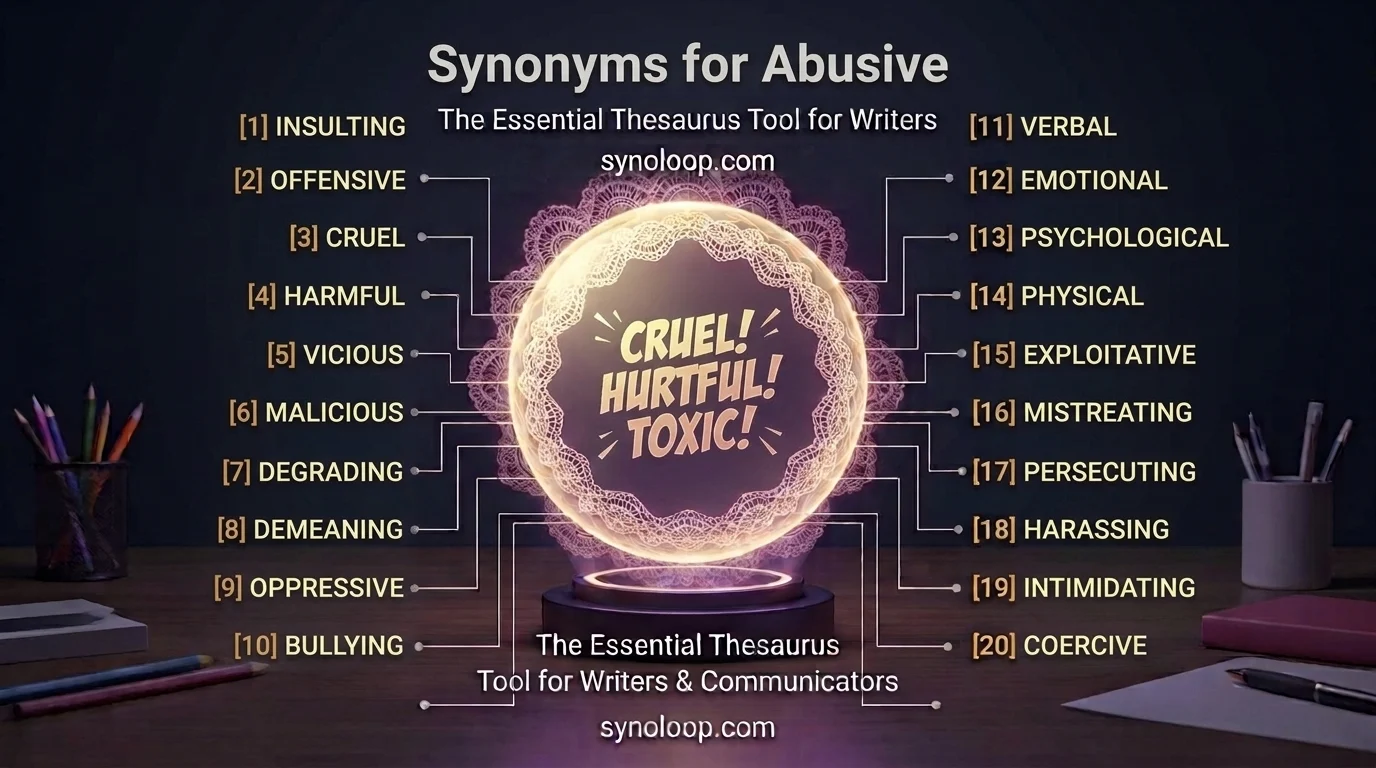
The word abusive describes behavior, language, or treatment that harms, insults, controls, threatens, or mistreats another person. It can describe many situations, from abusive language and abusive relationships to abusive behavior in workplaces, families, or other social settings.
Understanding synonyms for abusive can help you communicate more accurately. Different words can describe different forms of harmful behavior. For example, hurtful may describe words that cause emotional pain, while violent suggests physical force, and controlling focuses on restricting another person’s freedom.
For students, ESL learners, writers, and content creators, choosing the right synonym matters because these words do not always have exactly the same meaning. The context, tone, and severity of the behavior should guide your choice.
What Does “Abusive” Mean?
Abusive means treating someone in a harmful, cruel, insulting, threatening, or unfair way. It can refer to physical actions, emotional treatment, verbal attacks, or controlling behavior.
For example:
“He used abusive language during the argument.”
Here, abusive means the language was insulting, offensive, or harmful.
The word can also describe repeated harmful treatment:
“She left an abusive relationship.”
In this context, abusive suggests a pattern of harmful or controlling behavior rather than a single unpleasant incident.
Tone and Usage of “Abusive”
The word abusive is generally serious and negative. It is often used when discussing harmful treatment, mistreatment, violence, intimidation, harassment, or emotional harm.
Depending on the situation, alternatives such as hurtful, cruel, aggressive, insulting, threatening, or controlling may communicate the intended meaning more precisely.
When writing about sensitive subjects, it is useful to choose a word that accurately describes the specific behavior instead of using abusive as a general label.
30 Synonyms for Abusive
1. Cruel
Meaning: Deliberately causing pain, suffering, or distress to someone.
Example:
“The cruel treatment made the employee feel unsafe.”
Best usage context: Use cruel when emphasizing deliberate lack of kindness or compassion.
2. Hurtful
Meaning: Causing emotional pain, sadness, or distress.
Example:
“His hurtful comments damaged their friendship.”
Best usage context: Best for words or actions that cause emotional pain.
3. Insulting
Meaning: Showing disrespect or saying something offensive about someone.
Example:
“She found his insulting remarks deeply upsetting.”
Best usage context: Useful when abusive behavior mainly involves disrespectful language.
4. Offensive
Meaning: Causing anger, discomfort, or upset because something is disrespectful or inappropriate.
Example:
“The manager apologized for the offensive comments.”
Best usage context: Use when describing inappropriate or disrespectful speech or behavior.
5. Aggressive
Meaning: Forceful, hostile, or ready to attack or confront others.
Example:
“His aggressive behavior frightened the people around him.”
Best usage context: Appropriate when the behavior is hostile or confrontational.
6. Violent
Meaning: Involving physical force intended to hurt, damage, or attack.
Example:
“The argument became violent after several threats were made.”
Best usage context: Use when physical force or physical harm is involved.
7. Threatening
Meaning: Suggesting that someone may cause harm or danger.
Example:
“She received several threatening messages.”
Best usage context: Best for words, messages, gestures, or actions that communicate a threat.
8. Hostile
Meaning: Unfriendly, aggressive, or openly opposed to someone.
Example:
“The conversation became hostile very quickly.”
Best usage context: Useful for aggressive attitudes, environments, or interactions.
9. Harassing
Meaning: Repeatedly bothering, intimidating, or disturbing someone.
Example:
“He was investigated for harassing his coworkers.”
Best usage context: Use when harmful behavior is repeated or persistent.
10. Intimidating
Meaning: Making someone feel frightened, pressured, or less confident.
Example:
“His intimidating behavior prevented others from speaking freely.”
Best usage context: Useful when fear or pressure is the main issue.
11. Controlling
Meaning: Trying to control another person’s decisions, actions, relationships, or freedom.
Example:
“Her controlling partner often decided who she could meet.”
Best usage context: Appropriate when the harmful behavior centers on control.
12. Oppressive
Meaning: Treating people in a way that unfairly limits their freedom or causes suffering.
Example:
“The workers complained about the oppressive environment.”
Best usage context: Useful for severe control or unfair systems and environments.
13. Tyrannical
Meaning: Using power in a cruel, unreasonable, or unfair way.
Example:
“The leader was known for his tyrannical treatment of his staff.”
Best usage context: Often used for people who misuse authority or power.
14. Domineering
Meaning: Trying to control other people and make decisions for them.
Example:
“His domineering personality made group discussions difficult.”
Best usage context: Useful for controlling personalities and relationships.
15. Bullying
Meaning: Repeatedly frightening, humiliating, threatening, or hurting someone who is vulnerable.
Example:
“The school introduced new rules to address bullying.”
Best usage context: Best when describing repeated intimidation or mistreatment.
16. Abusive
Meaning: Involving harmful, cruel, insulting, threatening, or controlling treatment.
Example:
“The organization has a strict policy against abusive behavior.”
Best usage context: Use when the broader pattern of harmful treatment is the focus.
17. Malicious
Meaning: Intending to cause harm or trouble.
Example:
“He made a malicious accusation against his colleague.”
Best usage context: Appropriate when harmful intent is important.
18. Mean
Meaning: Unkind, unpleasant, or deliberately hurtful.
Example:
“That was a mean thing to say to someone who was already upset.”
Best usage context: Common and simple English for everyday situations.
19. Unkind
Meaning: Not caring about another person’s feelings.
Example:
“Her unkind comments made the new student uncomfortable.”
Best usage context: A softer alternative when the behavior is unpleasant but not necessarily severe.
20. Disrespectful
Meaning: Showing a lack of respect for someone.
Example:
“His disrespectful behavior was unacceptable during the meeting.”
Best usage context: Useful for rude or degrading behavior.
21. Degrading
Meaning: Making someone feel less worthy, respected, or valuable.
Example:
“The employee described the comments as degrading.”
Best usage context: Best when someone’s dignity or self-respect is being attacked.
22. Humiliating
Meaning: Causing someone to feel ashamed, embarrassed, or deeply uncomfortable.
Example:
“The public criticism was humiliating.”
Best usage context: Use when the behavior causes serious embarrassment or loss of dignity.
23. Derogatory
Meaning: Showing that someone or something is considered inferior or unworthy.
Example:
“She objected to the derogatory language used in the discussion.”
Best usage context: Particularly useful for insulting descriptions, labels, or remarks.
24. Belittling
Meaning: Making someone seem unimportant, weak, or less capable.
Example:
“His belittling comments reduced her confidence.”
Best usage context: Useful when someone repeatedly puts another person down.
25. Demeaning
Meaning: Making someone feel that they have less value or dignity.
Example:
“The workers complained about the demeaning treatment.”
Best usage context: Appropriate for behavior that attacks someone’s dignity or worth.
26. Insensitive
Meaning: Showing little awareness or concern for another person’s feelings.
Example:
“His insensitive response made the situation worse.”
Best usage context: Useful when the behavior is emotionally careless rather than intentionally violent.
27. Exploitative
Meaning: Unfairly using someone for personal benefit.
Example:
“The report described the company’s exploitative labor practices.”
Best usage context: Best when someone takes unfair advantage of another person.
28. Coercive
Meaning: Using threats, pressure, or force to make someone do something.
Example:
“The investigation focused on coercive behavior.”
Best usage context: Use when pressure or force is used to control someone’s choices.
29. Violating
Meaning: Breaking someone’s boundaries, rights, privacy, or personal space.
Example:
“She described the repeated behavior as violating her personal boundaries.”
Best usage context: Useful when someone’s personal boundaries or rights are being crossed.
30. Mistreating
Meaning: Treating someone badly, unfairly, or cruelly.
Example:
“The organization was accused of mistreating its employees.”
Best usage context: A broad term for unfair or harmful treatment.
Comparison Guide: Which Synonym Should You Use?
| Synonym | Main Idea | Best Context |
| Cruel | Deliberately causing pain | Harmful treatment |
| Hurtful | Causing emotional pain | Comments or actions |
| Insulting | Showing disrespect | Verbal attacks |
| Offensive | Causing anger or discomfort | Inappropriate language |
| Aggressive | Hostile or forceful | Confrontational behavior |
| Violent | Using physical force | Physical attacks |
| Threatening | Suggesting possible harm | Threats or warnings |
| Hostile | Strongly unfriendly | Difficult interactions |
| Harassing | Repeated unwanted behavior | Workplace or personal situations |
| Intimidating | Creating fear or pressure | Threatening conduct |
| Controlling | Restricting someone’s freedom | Relationships or authority |
| Bullying | Repeated intimidation or mistreatment | Schools, workplaces, social settings |
| Malicious | Intending to cause harm | Harmful actions or statements |
| Disrespectful | Showing lack of respect | Everyday interactions |
| Degrading | Reducing someone’s dignity | Humiliating treatment |
| Belittling | Making someone feel inferior | Personal or professional criticism |
| Coercive | Using pressure or force | Decisions and relationships |
| Exploitative | Taking unfair advantage | Work or power relationships |
| Mistreating | Treating someone badly | General harmful treatment |
Abusive vs. Cruel: What Is the Difference?
Abusive and cruel are closely related, but they are not always interchangeable.
Cruel generally focuses on causing pain or showing a lack of compassion. Abusive often suggests a broader pattern of harmful treatment, especially when someone uses power, control, threats, or repeated mistreatment.
For example:
- “The comment was cruel.” — Focuses on the hurtful nature of the comment.
- “She experienced abusive treatment.” — Suggests a broader pattern of harmful treatment.
Abusive vs. Aggressive: What Is the Difference?
Aggressive usually describes forceful, hostile, or confrontational behavior. It does not automatically mean that someone is being abusive.
For example, a person can be aggressive during a heated argument without the situation necessarily involving a pattern of abuse.
Use aggressive when hostility or confrontation is the main idea. Use abusive when the behavior involves harmful mistreatment, control, intimidation, or another serious pattern of harm.
Abusive vs. Insulting: What Is the Difference?
Insulting usually refers to disrespectful or offensive words. Abusive has a broader meaning and can include verbal, emotional, physical, or controlling behavior.
For example:
- “He made an insulting comment.”
- “She described the relationship as abusive.”
The first sentence focuses on language, while the second describes a wider pattern of harmful treatment.
How to Choose the Right Synonym for Abusive
Choosing the right synonym depends on what happened, how severe it was, and what aspect of the behavior you want to emphasize.
For Emotional Harm
Use:
- Hurtful
- Cruel
- Insensitive
- Unkind
- Demeaning
These words work well when the main issue is emotional pain or lack of compassion.
For Verbal Attacks
Use:
- Insulting
- Offensive
- Derogatory
- Belittling
- Disrespectful
These choices are particularly useful when someone uses harmful or disrespectful language.
For Threats or Fear
Use:
- Threatening
- Intimidating
- Hostile
- Aggressive
These words emphasize fear, hostility, pressure, or the possibility of harm.
For Physical Harm
Use:
- Violent
- Aggressive
- Cruel
- Harmful
These terms can be appropriate when physical force or physical danger is involved.
For Control
Use:
- Controlling
- Coercive
- Domineering
- Oppressive
- Tyrannical
These words are useful when one person attempts to control another person’s decisions, freedom, or behavior.
For Repeated Mistreatment
Use:
- Harassing
- Bullying
- Mistreating
- Abusive
- Oppressive
These words can describe ongoing or repeated harmful treatment, depending on the specific situation.
For Unfair Advantage
Use:
- Exploitative
- Coercive
- Oppressive
- Controlling
These choices are helpful when someone uses power or pressure to benefit unfairly from another person.
Synonyms for Abusive in Different Writing Situations
The best synonym can change depending on your writing style.
Academic Writing
In academic writing, more precise terms such as coercive, oppressive, exploitative, degrading, hostile, or derogatory can be useful when they accurately describe the behavior.
Example:
“The study examined coercive behavior in interpersonal relationships.”
Professional Writing
For workplace communication, terms such as harassing, disrespectful, intimidating, hostile, or inappropriate may be appropriate depending on the documented behavior.
Example:
“The employee reported repeated harassing behavior.”
Everyday English
For casual conversation, simpler words such as mean, cruel, hurtful, rude, insulting, or unkind are often easier to understand.
Example:
“That was a hurtful thing to say.”
Creative Writing
Writers can choose stronger descriptive words such as tyrannical, domineering, malicious, threatening, or degrading to create a specific impression of a character’s behavior.
Example:
“The tyrannical ruler demanded complete obedience.”
Positive or Neutral Alternatives: Use With Care
There are situations where abusive may be too broad or too strong for what you want to describe. In those cases, a more specific term can make your writing clearer.
For example:
- Instead of abusive language, consider insulting language if the issue is specifically an insult.
- Instead of abusive behavior, consider controlling behavior if control is the main issue.
- Instead of abusive comments, consider hurtful comments if emotional impact is the focus.
- Instead of abusive treatment, consider unfair treatment if the main problem is inequity rather than abuse.
Precision is especially important when discussing sensitive situations.
Common Phrases With “Abusive”
The word abusive appears in many common phrases. Understanding these combinations can help ESL learners use the word naturally.
Abusive Language
Language that insults, threatens, humiliates, or harms another person.
Example:
“The customer used abusive language toward the staff.”
Abusive Behavior
Actions or conduct that seriously mistreat another person.
Example:
“The company does not tolerate abusive behavior.”
Abusive Relationship
A relationship involving harmful patterns of control, intimidation, mistreatment, or other abuse.
Example:
“She sought support after leaving an abusive relationship.”
Abusive Treatment
Harmful or cruel treatment toward another person.
Example:
“The workers reported abusive treatment.”
Abusive Power
Using authority or influence in a harmful or unfair way.
Example:
“The organization introduced policies to prevent the abusive use of power.”
Common Mistakes When Using Synonyms for Abusive
One common mistake is assuming every synonym has exactly the same meaning. They do not.
For example, rude, insulting, and abusive can overlap, but their strength and meaning differ. Calling someone rude usually describes poor manners, while abusive behavior can involve much more serious patterns of harm or control.
Another mistake is using violent whenever something is abusive. Abuse can be verbal, emotional, psychological, financial, controlling, or otherwise harmful without involving physical violence.
A third mistake is using strong words without enough context. When writing about a real situation, specific descriptions can often be clearer than a broad label.
Why Choosing the Right Synonym Matters
Good vocabulary is not simply about finding a different word. It is about finding the most accurate word for the intended meaning.
If you want to describe emotional pain, hurtful may be more precise than aggressive. If you are discussing repeated unwanted behavior, harassing may communicate the situation more clearly. If someone is using pressure or threats to control another person, coercive may be the more specific choice.
For students and ESL learners, learning these distinctions can improve essays, conversations, reports, and creative writing.
Frequently Asked Questions About Synonyms for Abusive
What is the closest synonym for abusive?
There is no single synonym that works in every situation. Cruel, harmful, insulting, hostile, mistreating, and hurtful can all work depending on the context.
What is a softer word for abusive?
Depending on the situation, unkind, hurtful, insensitive, disrespectful, or mean may be softer alternatives. The appropriate choice depends on the specific behavior.
What is a strong synonym for abusive?
Words such as cruel, violent, oppressive, coercive, degrading, and tyrannical can express serious forms of harmful behavior when their specific meanings fit the context.
What is a synonym for abusive language?
Possible alternatives include insulting language, offensive language, derogatory language, hurtful language, and threatening language.
What is another word for an abusive person?
Depending on the behavior, you might describe the person as cruel, controlling, threatening, domineering, aggressive, or intimidating. It is usually better to describe the specific behavior rather than rely on a general label.
Is “rude” a synonym for abusive?
Sometimes, but not always. Rude generally means impolite or disrespectful, while abusive can describe much more serious and harmful behavior.
Is “toxic” a synonym for abusive?
Not exactly. Toxic is a broad informal term for a harmful or unhealthy situation or relationship. Abusive is more specific and can refer to identifiable patterns of harmful treatment.
Final Thoughts on Synonyms for Abusive
Learning synonyms for abusive can help you describe harmful behavior with greater accuracy and clarity. However, the best alternative depends on what you want to emphasize.
Use hurtful for emotional pain, insulting for offensive remarks, aggressive for hostile behavior, violent for physical force, controlling for restrictions on another person’s freedom, and coercive when pressure or force is used to influence someone’s choices.
For academic and professional writing, precise vocabulary can make your meaning clearer. For everyday English, simpler words such as mean, cruel, hurtful, and unkind may be easier for readers to understand.
The key is not simply to replace abusive with another word. Instead, identify the exact behavior and choose the synonym that communicates that meaning naturally and accurately.

I am Axel James, a passionate writer who loves exploring synonyms and alternative words. I enjoy helping readers improve their vocabulary and express ideas clearly.