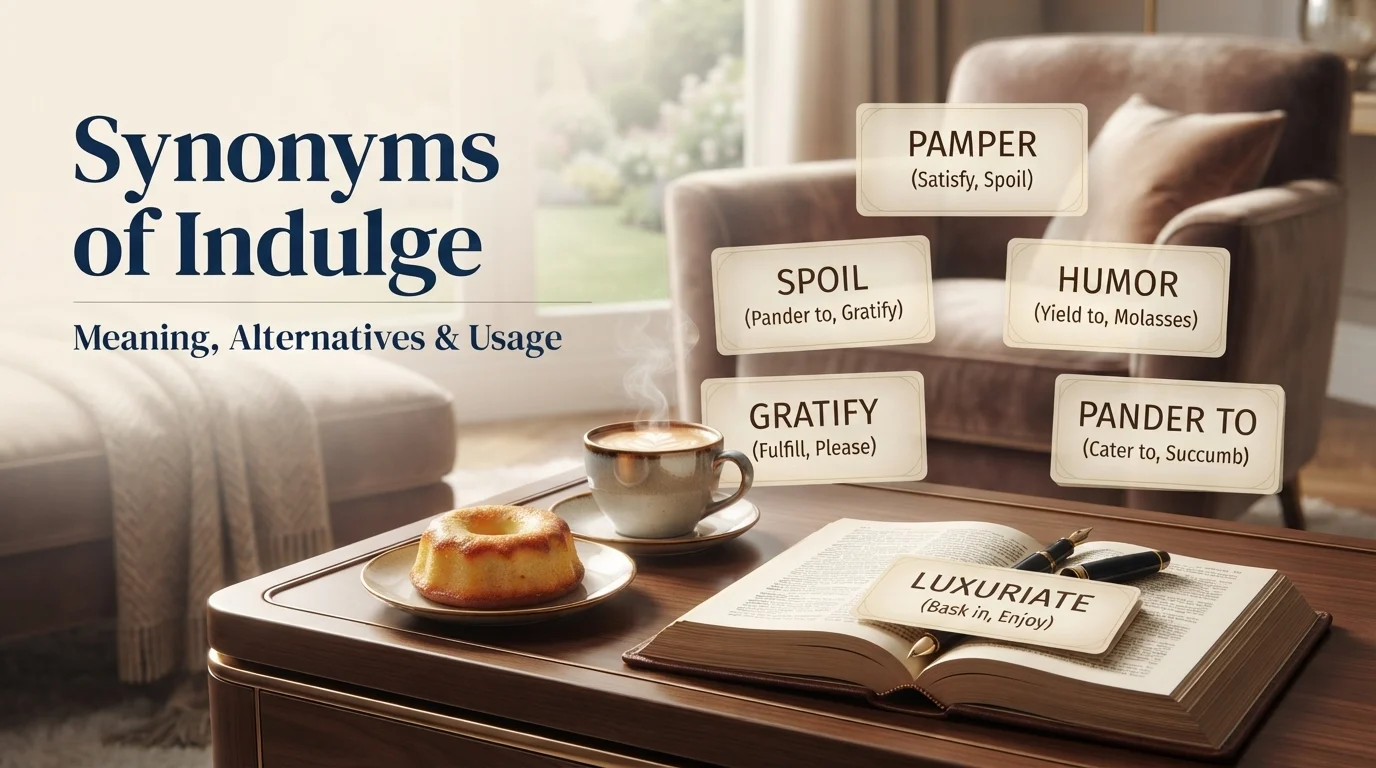
The word indulge is commonly used when someone allows themselves or another person to enjoy something, especially something pleasurable that may not always be necessary or beneficial. It can also mean giving too much attention to a particular desire, habit, activity, or feeling. Because the word has several related meanings, choosing the right synonym depends heavily on the context.
Learning the synonyms of indulge can make your writing more precise and expressive. Words such as enjoy, pamper, satisfy, gratify, and humor may seem similar, but each carries a slightly different meaning or tone. Understanding these differences is useful for students, ESL learners, writers, and content creators who want to communicate naturally.
What Does “Indulge” Mean?
Indulge generally means to allow yourself to enjoy something you want, especially when it may be considered excessive or unnecessary.
For example:
She decided to indulge in a piece of chocolate cake after dinner.
Here, indulge means allowing herself to enjoy something pleasurable.
The word can also mean to allow someone to have or do what they want, even when you might normally say no.
His parents often indulge his unusual hobbies.
In another context, indulge can mean spending time doing something enjoyable:
I like to indulge in a good book on weekends.
The tone of indulge can be positive, neutral, or slightly negative depending on context. It can suggest pleasure and self-care, but it can also imply excess or a lack of restraint.
30 Synonyms of Indulge
1. Enjoy
Meaning: To take pleasure or satisfaction from something.
Example sentence:
She enjoys listening to music while working.
Best usage context: Use this as a simple, natural alternative when the focus is on pleasure.
2. Pamper
Meaning: To treat yourself or someone else with special care, comfort, or attention.
Example sentence:
She decided to pamper herself with a relaxing spa treatment.
Best usage context: Best for self-care, luxury, comfort, and special treatment.
3. Satisfy
Meaning: To give someone what they want or need.
Example sentence:
The meal satisfied his hunger.
Best usage context: Useful for desires, needs, hunger, curiosity, or expectations.
4. Gratify
Meaning: To give someone pleasure or satisfy a desire.
Example sentence:
He took the opportunity to gratify his curiosity.
Best usage context: More formal; useful for desires, curiosity, wishes, or personal satisfaction.
5. Treat
Meaning: To give yourself or someone something enjoyable or special.
Example sentence:
I decided to treat myself to a new pair of shoes.
Best usage context: Very common in everyday English, especially for rewards and enjoyable experiences.
6. Spoil
Meaning: To give someone everything they want, sometimes too much.
Example sentence:
Her grandparents loved to spoil her with gifts.
Best usage context: Useful when generosity becomes excessive or when someone receives special treatment.
7. Humor
Meaning: To do what someone wants in order to please them or avoid an argument.
Example sentence:
She humored her friend by listening to the entire story again.
Best usage context: Best when you agree to someone’s wishes even if you do not fully share their interest.
8. Allow
Meaning: To give permission for someone to do something.
Example sentence:
The teacher allowed the students to choose their own topics.
Best usage context: Use when indulge means permitting behavior rather than enjoying something yourself.
9. Permit
Meaning: To officially or willingly allow something.
Example sentence:
The rules do not permit employees to use the equipment without training.
Best usage context: More formal than allow and useful in rules, policies, and professional writing.
10. Accommodate
Meaning: To adjust to someone’s wishes, needs, or preferences.
Example sentence:
The restaurant accommodated our request for a quiet table.
Best usage context: Useful in professional, social, and customer-service situations.
11. Fulfill
Meaning: To satisfy a desire, wish, need, or requirement.
Example sentence:
Traveling fulfilled her long-held desire to explore new countries.
Best usage context: Best for wishes, ambitions, needs, expectations, and goals.
12. Satiate
Meaning: To satisfy a desire or appetite completely.
Example sentence:
The large meal satiated his appetite.
Best usage context: More formal; especially useful for hunger, appetite, or strong desires.
13. Appease
Meaning: To make someone less angry or upset by giving them what they want.
Example sentence:
The manager offered a refund to appease the unhappy customer.
Best usage context: Use when something is given or done to calm dissatisfaction or anger.
14. Indulge in
Meaning: To allow yourself to enjoy a particular pleasure or activity.
Example sentence:
They occasionally indulge in expensive desserts.
Best usage context: Common when talking about food, entertainment, hobbies, or luxuries.
15. Revel in
Meaning: To take great pleasure or delight in something.
Example sentence:
The team reveled in its unexpected success.
Best usage context: Stronger than enjoy and often used for intense pleasure or excitement.
16. Delight in
Meaning: To take great pleasure in something.
Example sentence:
The children delighted in exploring the garden.
Best usage context: Good for writing that emphasizes genuine happiness and enjoyment.
17. Bask in
Meaning: To enjoy a pleasant feeling, situation, or experience.
Example sentence:
She basked in the praise she received after the performance.
Best usage context: Often used for enjoying attention, praise, success, warmth, or a pleasant atmosphere.
18. Luxuriate
Meaning: To relax and enjoy comfort or luxury.
Example sentence:
They luxuriated in the comfort of the quiet hotel.
Best usage context: Formal or literary writing about comfort, relaxation, or luxury.
19. Indulge Yourself
Meaning: To give yourself permission to enjoy something pleasurable.
Example sentence:
After a stressful week, he decided to indulge himself with a quiet weekend.
Best usage context: Natural phrase for self-care, relaxation, food, shopping, and leisure.
20. Mollicoddle
Meaning: To treat someone with excessive care or softness.
Example sentence:
The coach refused to mollycoddle the players.
Best usage context: Use when someone is being protected or treated too gently.
21. Coddle
Meaning: To treat someone with excessive care or attention.
Example sentence:
Parents sometimes coddle their children without realizing it.
Best usage context: Usually has a slightly negative meaning involving overprotection.
22. Spoil Yourself
Meaning: To give yourself something enjoyable or luxurious.
Example sentence:
She decided to spoil herself with a relaxing vacation.
Best usage context: Informal and positive; especially common in conversations about self-care.
23. Indulge Someone
Meaning: To give someone permission to have or do what they want.
Example sentence:
His friends indulged him when he wanted to talk about his favorite hobby.
Best usage context: Useful when describing patience, generosity, or willingness to satisfy another person’s wishes.
24. Gratify a Desire
Meaning: To satisfy something that you strongly want.
Example sentence:
He bought the book to gratify his desire to learn more about history.
Best usage context: Formal writing about wishes, curiosity, ambitions, or desires.
25. Please
Meaning: To make someone happy or satisfied.
Example sentence:
The restaurant changed the menu to please its customers.
Best usage context: Simple and versatile; useful when the focus is on making another person happy.
26. Acquiesce
Meaning: To accept or agree to something, often reluctantly.
Example sentence:
After several requests, she finally acquiesced to his suggestion.
Best usage context: Formal writing when someone gives in to another person’s wishes.
27. Yield to
Meaning: To give way to someone’s wishes, pressure, or demands.
Example sentence:
He eventually yielded to his children’s request for another movie.
Best usage context: Useful when someone gives in after resistance.
28. Give In To
Meaning: To stop resisting something and allow yourself to do or have it.
Example sentence:
She gave in to her craving for chocolate.
Best usage context: Informal English, especially for cravings, temptations, or requests.
29. Indulge a Fancy
Meaning: To allow yourself to explore or enjoy an unusual idea, desire, or interest.
Example sentence:
He indulged his fancy for collecting antique maps.
Best usage context: Literary or expressive writing.
30. Satisfy a Craving
Meaning: To give yourself the food, experience, or activity you strongly desire.
Example sentence:
She ordered a slice of cake to satisfy her craving for something sweet.
Best usage context: Best for food, strong desires, and everyday situations.
Comparison Table: Which Synonym of Indulge Should You Use?
| Synonym | Main Meaning | Tone | Best Context |
| Enjoy | Take pleasure in something | Neutral | General enjoyment |
| Pamper | Give special care or luxury | Positive | Self-care |
| Satisfy | Meet a desire or need | Neutral | Needs and desires |
| Gratify | Give pleasure or satisfaction | Formal | Desires and curiosity |
| Treat | Give something enjoyable | Casual | Rewards and experiences |
| Spoil | Give too much or special treatment | Neutral/negative | People and gifts |
| Humor | Go along with someone’s wishes | Neutral | Social situations |
| Allow | Give permission | Neutral | Permission |
| Accommodate | Meet someone’s needs | Formal | Professional settings |
| Fulfill | Complete or satisfy a desire | Formal/neutral | Wishes and goals |
| Satiate | Completely satisfy | Formal | Hunger and appetite |
| Appease | Calm someone by satisfying them | Neutral/negative | Complaints and conflict |
| Revel in | Enjoy intensely | Positive | Success and excitement |
| Delight in | Take great pleasure | Positive | Genuine enjoyment |
| Bask in | Enjoy a pleasant situation | Positive | Praise and success |
| Luxuriate | Enjoy comfort or luxury | Formal | Relaxation |
| Coddle | Treat too gently | Negative | Overprotection |
| Acquiesce | Accept reluctantly | Formal | Requests and demands |
| Yield to | Give way to pressure | Neutral | Resistance and compromise |
| Give in to | Stop resisting | Casual | Temptations and cravings |
Indulge vs. Enjoy
Indulge and enjoy are often interchangeable, but they do not always carry the same feeling.
Enjoy simply means taking pleasure in something:
I enjoy reading before bed.
Indulge can suggest that the activity is an occasional pleasure or something you might normally limit:
I indulge in chocolate on weekends.
Therefore, enjoy is broader and more neutral, while indulge can suggest treating yourself or allowing yourself more than usual.
Indulge vs. Pamper
Pamper focuses on special care, comfort, or luxury.
She pampered herself with a massage.
Indulge is broader:
She indulged in a long afternoon of shopping.
If the idea is special treatment or comfort, pamper is often the better choice. If the idea is simply allowing yourself to enjoy something, indulge works well.
Indulge vs. Spoil
These words overlap when talking about giving someone too much of what they want.
His parents spoiled him with expensive gifts.
His parents indulged his interest in expensive hobbies.
Spoil often suggests excess, while indulge can simply mean being tolerant or allowing someone to enjoy something.
Indulge vs. Gratify
Gratify is more formal than indulge.
The award gratified her desire for recognition.
She indulged in a celebration after receiving the award.
Use gratify when the focus is on satisfying a desire or emotional need. Use indulge when the focus is on allowing pleasure or satisfying a preference.
How to Choose the Right Synonym for Indulge
The best synonym depends on the situation and the tone you want.
For Pleasure and Enjoyment
Use:
- Enjoy
- Delight in
- Revel in
- Bask in
- Luxuriate
These words emphasize positive feelings and pleasure.
For Self-Care and Luxury
Use:
- Pamper
- Treat
- Spoil yourself
- Indulge yourself
- Luxuriate
These are useful when describing relaxation, shopping, food, vacations, beauty treatments, or other personal pleasures.
For Satisfying Desires
Use:
- Satisfy
- Gratify
- Fulfill
- Satiate
- Satisfy a craving
These words work well when someone gets what they want or need.
For Giving Someone What They Want
Use:
- Allow
- Humor
- Please
- Accommodate
- Spoil
These are appropriate when one person responds to another person’s wishes.
For Giving In to Pressure
Use:
- Acquiesce
- Yield to
- Give in to
- Appease
These words are especially useful when someone initially resists but eventually accepts a request or demand.
For Informal Everyday English
Choose:
- Enjoy
- Treat
- Spoil yourself
- Give in to
- Pamper
These expressions sound natural in everyday conversations and casual writing.
For Formal or Academic Writing
Consider:
- Gratify
- Fulfill
- Accommodate
- Acquiesce
- Satiate
- Appease
These choices can work better in essays, reports, professional writing, and formal discussions.
Common Phrases With Indulge
Learning common word combinations can make your English sound more natural.
Indulge in Food
He occasionally indulges in rich desserts.
This means he allows himself to enjoy food that may be considered a special treat.
Indulge in a Hobby
She indulges in gardening whenever she has free time.
This means she spends enjoyable time doing the activity.
Indulge a Child
The grandparents often indulge the children.
This means they are willing to give the children what they want or allow behavior that might normally be restricted.
Indulge a Curiosity
He opened the old box to indulge his curiosity.
This means he allowed himself to explore something because he wanted to know more.
Indulge Yourself
After completing the project, she decided to indulge herself with a relaxing evening.
This means she gave herself permission to enjoy something special.
Common Mistakes When Using Indulge
One common mistake is assuming that indulge always has a negative meaning. It does not.
For example:
She indulged in her favorite book.
This can simply describe enjoyable activity.
However:
He indulged his children too much.
Here, the word suggests excessive permissiveness.
Another mistake is using indulge when the intended meaning is simply permission. In many cases, allow or permit is clearer.
For example:
The teacher permitted students to leave early.
This is more straightforward than saying:
The teacher indulged the students by allowing them to leave early.
The second sentence adds a sense of special tolerance or generosity.
Related Words and Phrases
When learning the vocabulary surrounding indulge, these related terms can also be useful:
- Pleasure
- Enjoyment
- Satisfaction
- Gratification
- Luxury
- Self-care
- Treat
- Reward
- Craving
- Desire
- Temptation
- Permission
- Tolerance
- Excess
- Overindulgence
- Pampering
- Self-gratification
- Satisfaction of a desire
Understanding these related words makes it easier to recognize the different meanings of indulge in books, articles, conversations, and professional writing.
Why Learning Synonyms of Indulge Matters
Knowing several alternatives to indulge allows you to communicate more precisely.
For example, pamper emphasizes special care, while gratify emphasizes satisfying a desire. Humor focuses on going along with another person’s wishes, while acquiesce suggests accepting something, sometimes reluctantly. Revel in expresses intense enjoyment, while allow simply communicates permission.
For ESL learners and students, these distinctions are especially valuable because English synonyms often overlap without being completely interchangeable. Learning the context and tone of each word helps you avoid awkward sentences and develop more natural vocabulary.
For writers and content creators, using precise alternatives also improves readability. Instead of repeating indulge throughout an article, you can choose a word that communicates the exact idea you want.
Final Takeaways
The word indulge has several related meanings, including enjoying something pleasurable, satisfying a desire, allowing someone to have what they want, or giving in to a temptation or preference.
The best synonym depends on the context. Use enjoy for general pleasure, pamper for special care, gratify for satisfying a desire, humor for going along with someone’s wishes, accommodate for meeting needs, and acquiesce when someone accepts something after resistance.
Learning these differences makes your vocabulary more flexible and your writing more precise. Rather than choosing a synonym simply because it looks similar in a dictionary, consider the meaning, tone, situation, and intention behind the sentence. This approach will help you use the synonyms of indulge naturally and confidently.

I am Jace Thomas, a passionate synonym writer dedicated to making word choices simple and meaningful. I enjoy exploring language, discovering synonyms, and helping readers express ideas clearly and creatively.