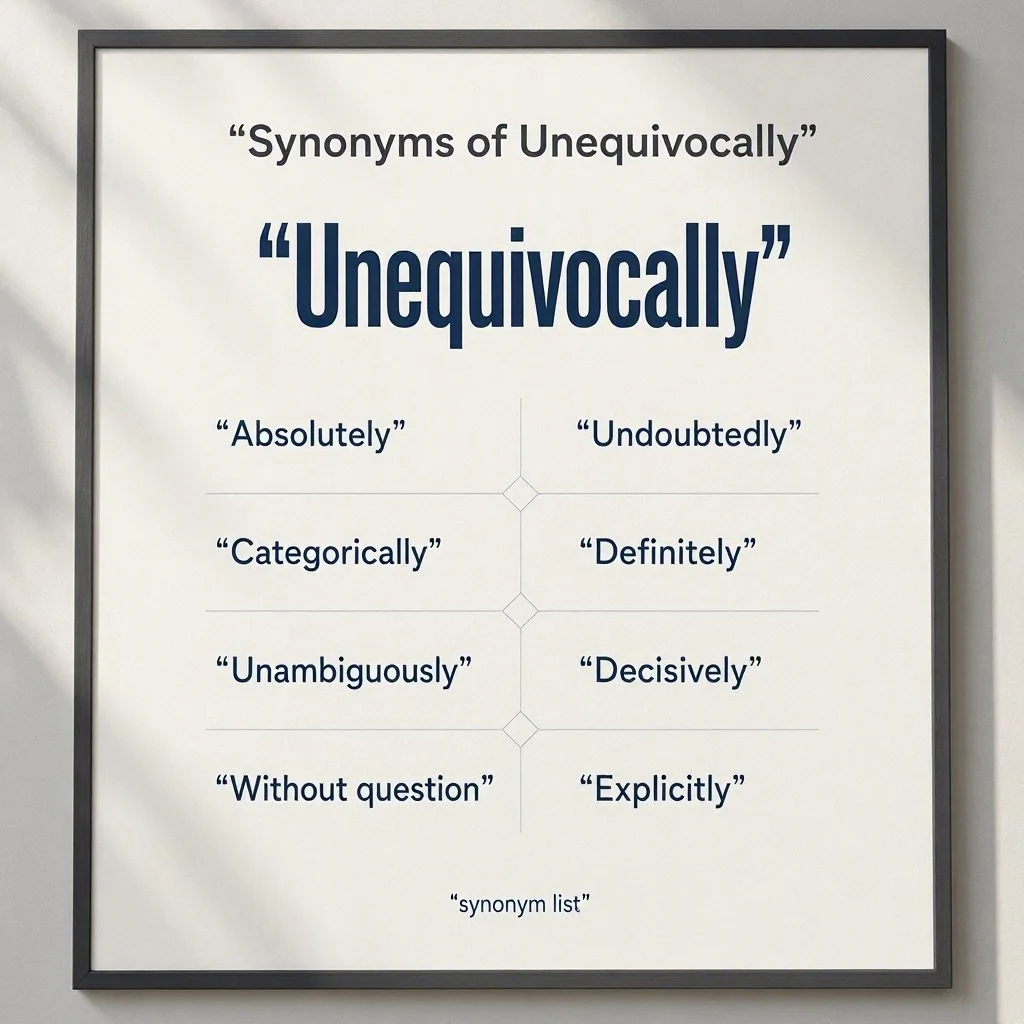
When you want to say that something is completely clear, definite, and open to no doubt, the word unequivocally is a powerful choice. However, using the same word repeatedly can make writing feel predictable. Learning useful synonyms can help students, ESL learners, writers, and content creators express certainty with greater precision.
The word unequivocally is especially common in formal writing, academic discussions, professional communication, journalism, and persuasive statements. Depending on the context, you may want a synonym that emphasizes certainty, clarity, directness, or lack of ambiguity.
Understanding the small differences between these alternatives is important. Some words are suitable for formal writing, while others sound more natural in everyday conversation.
What Does Unequivocally Mean?
Unequivocally means in a completely clear and definite way, without leaving any possibility of doubt or confusion.
For example:
The manager unequivocally rejected the proposal.
This means the manager rejected the proposal clearly and firmly, leaving no uncertainty about the decision.
Tone and Usage of Unequivocally
Unequivocally usually has a formal, confident, and authoritative tone. It is often used when someone wants to make a statement particularly clear.
You might see it in:
- Academic writing
- Business communication
- Legal contexts
- News reporting
- Formal speeches
- Official statements
- Strong arguments
In casual conversation, simpler words such as clearly, definitely, or absolutely may sound more natural.
30 Synonyms of Unequivocally
Here are 30 useful alternatives, along with simple meanings, examples, and guidance on when to use each one.
1. Clearly
Meaning: In a way that is easy to understand or recognize.
Example:
The evidence clearly supports the researcher’s conclusion.
Best usage context: Everyday, academic, and professional writing.
2. Definitely
Meaning: Certainly and without doubt.
Example:
She definitely wants to participate in the competition.
Best usage context: Everyday speech and informal or neutral writing.
3. Certainly
Meaning: Without doubt or hesitation.
Example:
The new policy will certainly affect future decisions.
Best usage context: Professional, academic, and formal communication.
4. Absolutely
Meaning: Completely and without any doubt.
Example:
The team was absolutely committed to completing the project.
Best usage context: Strong emphasis in conversation and general writing.
5. Unambiguously
Meaning: In a way that has only one clear meaning.
Example:
The instructions state unambiguously what applicants must provide.
Best usage context: Formal, academic, legal, and technical writing.
6. Indisputably
Meaning: In a way that cannot reasonably be challenged or denied.
Example:
Her contribution to the project was indisputably important.
Best usage context: Formal arguments and analytical writing.
7. Unmistakably
Meaning: In a way that is impossible to mistake for something else.
Example:
His voice was unmistakably recognizable.
Best usage context: Descriptive and general writing.
8. Definitively
Meaning: In a final and conclusive way.
Example:
The investigation definitively established the cause of the problem.
Best usage context: Formal, scientific, and professional contexts.
9. Categorically
Meaning: In a complete and definite way, often when rejecting or denying something.
Example:
The spokesperson categorically denied the allegations.
Best usage context: Formal statements, journalism, and professional communication.
10. Explicitly
Meaning: In a direct and clearly stated way.
Example:
The contract explicitly prohibits unauthorized changes.
Best usage context: Legal, academic, business, and instructional writing.
11. Directly
Meaning: In a straightforward way without avoiding the main point.
Example:
She directly addressed the concerns raised by the committee.
Best usage context: General, professional, and conversational writing.
12. Plainly
Meaning: Clearly and obviously.
Example:
The results plainly demonstrate the importance of preparation.
Best usage context: General and formal writing.
13. Unquestionably
Meaning: In a way that cannot reasonably be questioned.
Example:
The discovery was unquestionably significant.
Best usage context: Formal and persuasive writing.
14. Certainly So
Meaning: Used to express strong agreement or certainty.
Example:
The plan has challenges, but it is certainly so that preparation can reduce them.
Best usage context: Limited; usually better replaced with certainly in modern writing.
15. Firmly
Meaning: In a strong, definite, or determined manner.
Example:
The director firmly rejected the proposed changes.
Best usage context: Statements involving decisions, opinions, or refusals.
16. Positively
Meaning: With certainty or confidence.
Example:
The witness positively identified the person involved.
Best usage context: Formal or descriptive contexts where certainty is important.
17. Conclusively
Meaning: In a way that provides a final answer or proof.
Example:
The experiment did not conclusively prove the theory.
Best usage context: Academic, scientific, analytical, and legal writing.
18. Assuredly
Meaning: Certainly or undoubtedly.
Example:
The change will assuredly influence the industry.
Best usage context: Formal or literary writing.
19. Surely
Meaning: Certainly or with strong confidence.
Example:
Surely, there must be a better solution.
Best usage context: Everyday speech and rhetorical questions.
20. Unquestioningly
Meaning: Without doubt, hesitation, or questioning.
Example:
The instructions were followed unquestioningly.
Best usage context: Describing behavior or acceptance rather than simply making a clear statement.
21. Unequivocally Clear
Meaning: Completely clear and impossible to misunderstand.
Example:
The manager made her expectations unequivocally clear.
Best usage context: Professional communication and explanatory writing.
22. Beyond Doubt
Meaning: So certain that there is no reasonable doubt.
Example:
The evidence established his involvement beyond doubt.
Best usage context: Formal, legal, and persuasive writing.
23. Without Doubt
Meaning: Certainly; with complete confidence.
Example:
She is without doubt one of the most experienced members of the team.
Best usage context: General and formal writing.
24. Without Question
Meaning: Certainly and with no need for debate.
Example:
He is without question an important contributor to the project.
Best usage context: Formal and persuasive writing.
25. Beyond Question
Meaning: Not reasonably open to doubt or dispute.
Example:
The importance of effective communication is beyond question.
Best usage context: Formal and academic writing.
26. In No Uncertain Terms
Meaning: In extremely clear and direct language.
Example:
The supervisor explained in no uncertain terms that the deadline could not be extended.
Best usage context: Strong statements, especially when expressing refusal or authority.
27. Without Ambiguity
Meaning: In a way that leaves no unclear interpretation.
Example:
The instructions were written without ambiguity.
Best usage context: Technical, academic, legal, and professional writing.
28. With Certainty
Meaning: With complete confidence that something is true or will happen.
Example:
Researchers cannot say with certainty what caused the unusual result.
Best usage context: Academic, scientific, and analytical writing.
29. Beyond Dispute
Meaning: Not reasonably open to disagreement or challenge.
Example:
The value of the discovery is now beyond dispute.
Best usage context: Formal arguments and academic writing.
30. Plainly and Clearly
Meaning: In a straightforward way that is easy to understand.
Example:
The report plainly and clearly explains the risks involved.
Best usage context: Explanatory and professional writing.
Quick Comparison of Synonyms for Unequivocally
Different synonyms emphasize slightly different aspects of certainty.
| Synonym | Main Idea | Tone | Best Context |
| Clearly | Easy to understand | Neutral | General writing |
| Definitely | Certain | Neutral | Everyday communication |
| Certainly | Without doubt | Formal/neutral | Professional writing |
| Absolutely | Complete certainty | Strong | Conversation |
| Unambiguously | No possible confusion | Formal | Academic/legal |
| Indisputably | Cannot reasonably be challenged | Formal | Arguments |
| Unmistakably | Impossible to mistake | Neutral | Descriptions |
| Definitively | Final and conclusive | Formal | Research/analysis |
| Categorically | Completely and firmly | Formal | Denials/statements |
| Explicitly | Directly stated | Formal | Contracts/instructions |
| Firmly | Strongly and decisively | Neutral/formal | Decisions |
| Conclusively | Final proof or determination | Formal | Research/legal |
| Unquestionably | Cannot reasonably be questioned | Formal | Persuasive writing |
| Beyond doubt | No reasonable doubt | Formal | Legal/persuasive |
| Without question | Certainly | Formal | General/formal |
| In no uncertain terms | Very direct | Strong | Refusals/warnings |
Formal Synonyms for Unequivocally
If you are writing an academic paper, report, legal document, or professional article, some alternatives are more appropriate than others.
Useful formal choices include:
- Unambiguously
- Indisputably
- Definitively
- Categorically
- Explicitly
- Conclusively
- Unquestionably
- Beyond dispute
- Without ambiguity
- Beyond question
For example:
Less precise:
The report clearly proves the point.
More formal:
The evidence conclusively supports the conclusion.
The second version emphasizes the finality of the evidence rather than simply saying that the point is easy to understand.
Simple Synonyms for Unequivocally
For ESL learners and everyday communication, simpler alternatives are often easier.
Try:
- Clearly
- Definitely
- Certainly
- Absolutely
- Directly
- Firmly
- Surely
- Without doubt
For example:
Formal:
The organization unequivocally rejected the proposal.
Simple:
The organization clearly rejected the proposal.
Both sentences communicate certainty, but the second is easier for general readers.
Strong Synonyms for Unequivocally
Sometimes the goal is not just clarity but strong emphasis.
In these situations, you can use:
- Absolutely
- Categorically
- Indisputably
- Unquestionably
- Definitively
- Beyond doubt
- Without question
- In no uncertain terms
Consider the difference:
She clearly rejected the offer.
This tells us the rejection was easy to understand.
She categorically rejected the offer.
This emphasizes that her rejection was firm and complete.
Unequivocally vs. Unambiguously
These two words are closely related, but they are not always interchangeable.
Unequivocally focuses on certainty and the absence of doubt.
Unambiguously focuses more specifically on the absence of multiple possible meanings or interpretations.
For example:
The candidate unequivocally rejected the proposal.
The person clearly and firmly rejected it.
The instructions were written unambiguously.
The instructions had only one reasonable interpretation.
Unequivocally vs. Definitely
Definitely is a common and natural alternative to unequivocally, especially in everyday English.
However, unequivocally generally sounds more formal and can emphasize that a statement is completely clear and leaves no room for interpretation.
Definitely:
I definitely agree with you.
Unequivocally:
The report unequivocally confirms the findings.
For casual conversation, definitely is usually more natural.
Unequivocally vs. Explicitly
These words are sometimes confused.
Explicitly means something is directly stated rather than implied.
Unequivocally means something is clear and leaves no reasonable doubt.
For example:
The policy explicitly prohibits outside food.
The prohibition is directly written in the policy.
The manager unequivocally rejected the proposal.
The manager’s position was completely clear.
How to Choose the Right Synonym
The best synonym depends on what you want to emphasize.
For Simple Clarity
Use:
- Clearly
- Plainly
- Directly
- Definitely
These are easy choices for general readers and ESL learners.
For Complete Certainty
Use:
- Certainly
- Absolutely
- Unquestionably
- Without doubt
- Without question
These emphasize confidence and certainty.
For Formal Writing
Use:
- Unambiguously
- Indisputably
- Definitively
- Categorically
- Conclusively
These work well in academic, professional, analytical, and formal contexts.
For Direct Statements
Use:
- Explicitly
- Directly
- Firmly
- In no uncertain terms
These are useful when describing how someone communicates a decision, rule, refusal, or position.
For Arguments and Evidence
Use:
- Indisputably
- Conclusively
- Beyond dispute
- Beyond question
- Unquestionably
These are particularly useful when discussing evidence, facts, conclusions, or established points.
Common Mistakes When Using Synonyms for Unequivocally
Choosing a synonym based only on a dictionary definition can sometimes make a sentence sound unnatural. Context matters.
For example, explicitly is not always a direct replacement for unequivocally. Something can be explicitly stated while still being open to interpretation.
Likewise, definitively can suggest a final determination, while clearly may simply describe something that is easy to understand.
Another common mistake is using very formal words in casual conversations. Saying “I unequivocally agree” is grammatically correct, but “I definitely agree” usually sounds more natural.
Examples of Unequivocally in Sentences
Here are some examples showing how the original word works in different contexts:
Academic:
The findings unequivocally demonstrate the importance of regular testing.
Business:
The company unequivocally stated that customer privacy remains a priority.
Professional:
The manager unequivocally rejected the proposed changes.
General:
She unequivocally said that she would not attend.
Formal:
The evidence unequivocally supports the central argument.
These examples show why unequivocally is particularly useful when you want to communicate certainty and eliminate ambiguity.
Why Learning Synonyms of Unequivocally Matters
Knowing several alternatives allows you to make your writing more accurate and less repetitive.
For example, repeatedly writing:
The evidence unequivocally proves…
can make an article feel repetitive.
Instead, depending on the meaning, you might write:
The evidence clearly supports…
or:
The evidence conclusively demonstrates…
or:
The findings provide unmistakable evidence…
Each version creates a slightly different emphasis.
For students and ESL learners, learning these distinctions is especially useful because English synonyms often have similar dictionary meanings but different tones and usage patterns.
Frequently Asked Questions About Synonyms of Unequivocally
What is the simplest synonym for unequivocally?
Clearly is one of the simplest alternatives. Depending on the sentence, definitely or certainly can also work.
What is a formal synonym for unequivocally?
Unambiguously, indisputably, categorically, and definitively are useful formal alternatives.
What does unequivocally mean in simple English?
It means very clearly and definitely, with no reasonable doubt or confusion.
Is definitely the same as unequivocally?
They are similar, but not identical in every context. Definitely emphasizes certainty, while unequivocally can also emphasize that something is expressed in a way that leaves no ambiguity.
What is the opposite of unequivocally?
Depending on the context, possible opposites include ambiguously, uncertainly, vaguely, tentatively, and conditionally.
Which synonym is best for academic writing?
Words such as unambiguously, conclusively, definitively, and indisputably can work well, provided they accurately describe the evidence or claim being made.
Final Thoughts on Synonyms of Unequivocally
The word unequivocally describes something expressed with complete clarity and certainty, leaving little or no room for doubt or alternative interpretation. Its formal tone makes it particularly useful in academic, professional, analytical, and official writing.
The right synonym depends on the meaning you want to emphasize. Use clearly for simple clarity, definitely for everyday certainty, unambiguously when there is no possible confusion, categorically for firm statements, and conclusively when evidence provides a final determination.
Learning these distinctions will help you avoid repetition while making your vocabulary more precise. Instead of simply searching for a replacement word, consider the tone, context, and exact type of certainty you want to communicate. That approach will make your writing clearer, more natural, and more effective.

I am Evelyn Marie, the Administrator of Synoloop. I enjoy helping readers discover useful synonyms, alternative words, and better ways to express their ideas. I focus on keeping Synoloop simple, reliable, informative, and helpful for everyone.