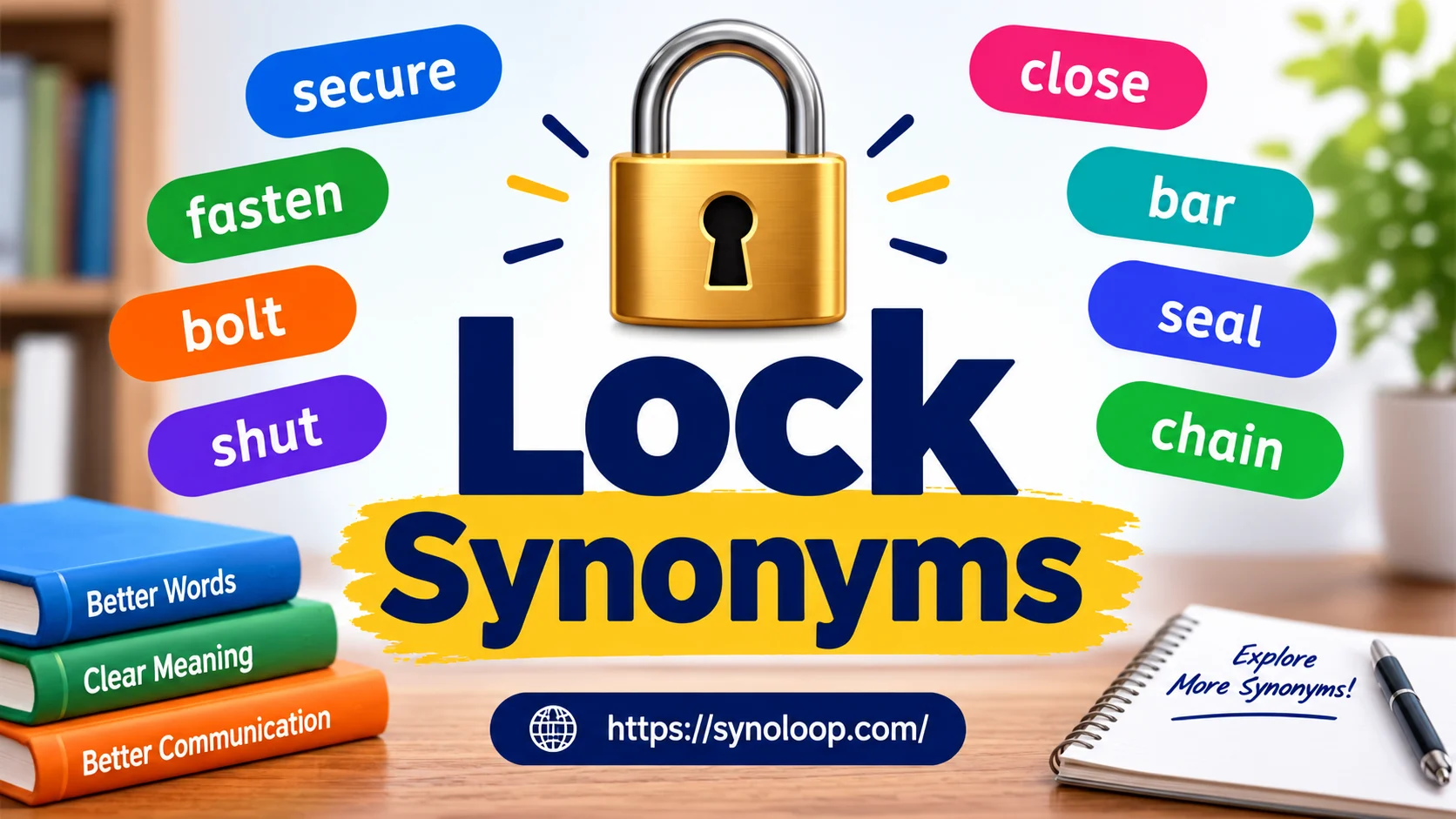
Finding the right lock synonyms can make your writing more precise, natural, and interesting. The word “lock” has several meanings depending on context. It can describe securing a door, fastening something, restricting access, fixing something firmly in place, or even controlling movement.
For students, ESL learners, writers, and content creators, understanding these differences is important. A synonym that works for a door may sound unnatural when talking about hair, machinery, security, or a river. Choosing the right alternative helps readers understand exactly what you mean.
In this guide, you will find 30 useful synonyms and related alternatives for “lock,” with simple meanings, example sentences, and practical usage notes. The goal is not simply to replace the word “lock,” but to help you choose a word that fits your exact meaning.
What Does “Lock” Mean?
The word lock can be used as both a verb and a noun.
As a verb, “lock” usually means to secure something so that it cannot be opened, moved, or accessed easily.
Example:
“Please lock the door before you leave.”
It can also mean to fasten or fix something securely.
Example:
“Make sure the wheels are locked in position.”
As a noun, a lock is a device used to secure something.
Example:
“The front door has a new lock.”
The meaning changes slightly depending on the situation, so not every synonym can replace “lock” in every sentence.
30 Synonyms for Lock
Below are 30 useful alternatives and closely related words for “lock.” Each one has a specific meaning or context.
1. Secure
Meaning: To make something safe from unauthorized access or movement.
Example:
“Please secure the windows before leaving the house.”
Best usage context: Security, buildings, equipment, and belongings.
2. Fasten
Meaning: To attach or close something firmly.
Example:
“Fasten the gate before you leave.”
Best usage context: Clothing, gates, straps, doors, and physical objects.
3. Bolt
Meaning: To secure a door or gate with a bolt.
Example:
“She bolted the back door before going upstairs.”
Best usage context: Doors and gates with bolts.
4. Latch
Meaning: To close something with a latch.
Example:
“Make sure you latch the garden gate.”
Best usage context: Gates, cabinets, boxes, and doors.
5. Bar
Meaning: To block or secure an entrance, often with a bar.
Example:
“The workers barred the entrance for safety.”
Best usage context: Entrances, windows, doors, and access points.
6. Seal
Meaning: To close something completely so that nothing can enter or escape.
Example:
“Seal the container tightly after opening it.”
Best usage context: Containers, packages, openings, and confidential spaces.
7. Shut
Meaning: To close something.
Example:
“Shut the door when you leave.”
Best usage context: Doors, windows, drawers, and openings.
8. Close
Meaning: To move something into a position that prevents an opening.
Example:
“Close the gate behind you.”
Best usage context: General everyday situations.
9. Fasten down
Meaning: To hold something firmly in place.
Example:
“Fasten down the equipment before the storm arrives.”
Best usage context: Objects that need to remain firmly positioned.
10. Immobilize
Meaning: To prevent something from moving.
Example:
“The mechanic immobilized the vehicle before making repairs.”
Best usage context: Vehicles, machinery, and technical writing.
11. Securely Fasten
Meaning: To attach something firmly and safely.
Example:
“Securely fasten the cover before operating the machine.”
Best usage context: Instructions, equipment, and safety-related writing.
12. Restrict
Meaning: To limit someone’s or something’s access or movement.
Example:
“The system restricts access to authorized users.”
Best usage context: Security, technology, rules, and access control.
13. Block
Meaning: To prevent someone or something from entering, leaving, or passing.
Example:
“The fallen tree blocked the road.”
Best usage context: Roads, entrances, passages, and access.
14. Barred
Meaning: Closed or blocked so that entry is not possible.
Example:
“The entrance was barred after midnight.”
Best usage context: Formal descriptions of restricted access.
15. Confine
Meaning: To keep someone or something within a limited area.
Example:
“The fence confines the animals to the field.”
Best usage context: People, animals, spaces, and formal writing.
16. Trap
Meaning: To prevent someone or something from escaping.
Example:
“The broken door trapped them inside the room.”
Best usage context: Situations involving inability to escape.
17. Pin
Meaning: To hold something firmly in a particular position.
Example:
“The mechanism pins the parts together.”
Best usage context: Mechanical, physical, and technical contexts.
18. Fix
Meaning: To hold something firmly in position.
Example:
“The device fixes the panel securely in place.”
Best usage context: General and technical contexts.
19. Anchor
Meaning: To hold something firmly so it cannot move freely.
Example:
“The heavy base anchors the structure to the ground.”
Best usage context: Structures, boats, objects, and figurative writing.
20. Clamp
Meaning: To hold something tightly using a device.
Example:
“Clamp the pipe before cutting it.”
Best usage context: Tools, machinery, construction, and repairs.
21. Clasp
Meaning: To fasten something with a clasp.
Example:
“She clasped the necklace around her neck.”
Best usage context: Jewelry, bags, clothing, and accessories.
22. Latch onto
Meaning: To attach or hold onto something firmly.
Example:
“The child latched onto his mother’s hand.”
Best usage context: Physical attachment and some figurative situations.
23. Shut in
Meaning: To keep someone or something inside a place.
Example:
“The storm shut the family in for the entire evening.”
Best usage context: People being kept indoors or confined.
24. Enclose
Meaning: To surround or close something within an area.
Example:
“A tall fence encloses the garden.”
Best usage context: Buildings, gardens, spaces, and formal descriptions.
25. Encapsulate
Meaning: To enclose something completely within another thing.
Example:
“The protective material encapsulates the electronic component.”
Best usage context: Technical, scientific, and formal writing.
26. Plug
Meaning: To block an opening.
Example:
“He plugged the hole with a piece of rubber.”
Best usage context: Holes, pipes, openings, and leaks.
27. Obstruct
Meaning: To block a path, opening, or process.
Example:
“Large boxes obstructed the doorway.”
Best usage context: Formal writing, roads, entrances, and processes.
28. Guard
Meaning: To protect something from unauthorized access or harm.
Example:
“Security guards protect the entrance at night.”
Best usage context: Security, people, buildings, and valuable items.
29. Protect
Meaning: To keep something safe from harm, damage, or unwanted access.
Example:
“A strong password protects your account.”
Best usage context: Security, technology, people, and belongings.
30. Secure in Place
Meaning: To hold something firmly so that it cannot move.
Example:
“Secure the ladder in place before climbing it.”
Best usage context: Equipment, furniture, tools, and safety instructions.
Lock Synonyms Comparison Guide
Different alternatives to “lock” work better in different situations. The following guide can help you choose the most natural word.
| Synonym | Main Meaning | Best Context |
| Secure | Make safe or protected | Security |
| Fasten | Attach or close firmly | Clothing, gates, straps |
| Bolt | Secure with a bolt | Doors and gates |
| Latch | Close with a latch | Doors, boxes, gates |
| Bar | Block access | Entrances and windows |
| Seal | Close completely | Containers and openings |
| Shut | Close | Everyday speech |
| Restrict | Limit access | Rules and technology |
| Block | Prevent passage | Roads and entrances |
| Confine | Keep within an area | People and animals |
| Immobilize | Prevent movement | Vehicles and machinery |
| Clamp | Hold tightly | Tools and equipment |
| Clasp | Fasten with a clasp | Jewelry and accessories |
| Enclose | Surround within an area | Gardens and structures |
| Plug | Block an opening | Holes and pipes |
| Obstruct | Get in the way or block | Formal writing |
| Guard | Protect against access or harm | Security |
| Anchor | Hold firmly | Structures and objects |
Lock as a Verb vs. Lock as a Noun
It is useful to understand whether you need a synonym for the action of locking or for the device itself.
For the verb “lock,” alternatives such as secure, fasten, bolt, latch, seal, restrict, and immobilize may work depending on the sentence.
Example:
“Lock the door.”
→ “Secure the door.”
→ “Bolt the door.”
For the noun “lock,” you may need a more specific term describing the physical mechanism.
Example:
“The lock is broken.”
Depending on the mechanism, you might refer to a bolt, latch, clasp, fastening mechanism, or security device.
How to Choose the Right Synonym for Lock
Choosing the right synonym depends on what you are trying to communicate.
For Doors and Gates
Use words such as bolt, latch, secure, fasten, or bar.
These words describe different methods of preventing a door or gate from opening.
Example:
“Latch the gate before leaving.”
For General Security
Use secure, protect, guard, or restrict.
These words are especially useful when discussing buildings, accounts, information, or personal belongings.
Example:
“Secure your account with a strong password.”
For Preventing Movement
Use immobilize, clamp, pin, anchor, or fix.
These are useful when something needs to remain in a specific position.
Example:
“Clamp the equipment securely before beginning the repair.”
For Blocking Access
Use block, bar, restrict, obstruct, or seal.
These words emphasize preventing passage or access rather than simply closing something.
Example:
“The security system restricts access to authorized personnel.”
For Keeping Something Inside
Use confine, enclose, or shut in.
These words focus on keeping a person, animal, or object within a particular space.
Example:
“The fence encloses the playground.”
For Technical Writing
Use precise terms such as immobilize, clamp, encapsulate, anchor, or secure in place.
Technical writing benefits from specificity because the reader needs to understand exactly what action is required.
Common Phrases With Lock
“Lock” appears in many common English expressions.
Lock the Door
Means to secure a door so it cannot easily be opened.
Example:
“Remember to lock the door tonight.”
Lock the Gate
Means to secure a gate.
Example:
“Please lock the gate after entering.”
Lock Something in Place
Means to secure something so it cannot move.
Example:
“The mechanism locks the handle in place.”
Lock Someone Out
Means to prevent someone from entering a place.
Example:
“I accidentally locked myself out of the house.”
Lock Something Away
Means to put something somewhere secure.
Example:
“She locked the important documents away.”
Lock Onto Something
Means to attach firmly or focus strongly on something.
Example:
“The device locks onto the signal.”
Words That Are Similar but Not Always Exact Synonyms
Some words related to “lock” should be used carefully.
Close is broader than “lock.” A door can be closed without being locked.
Secure can mean protecting something, but it does not always involve a physical lock.
Block means preventing passage, but it does not necessarily mean something has been locked.
Seal usually suggests creating a complete closure, often preventing air, liquid, or other material from passing through.
Restrict usually refers to limiting access or activity rather than physically locking something.
Understanding these differences will help you avoid awkward or inaccurate word choices.
Lock Synonyms for Different Writing Styles
Everyday English
For casual conversations, choose simple words such as:
- Close
- Shut
- Secure
- Fasten
- Lock
Academic Writing
For more formal writing, consider:
- Restrict
- Confine
- Obstruct
- Enclose
- Immobilize
Technical Writing
Technical contexts may require:
- Clamp
- Anchor
- Pin
- Immobilize
- Encapsulate
- Secure in place
Creative Writing
Creative writing gives you more flexibility. Words such as trap, confine, bar, seal, and shut in can create stronger imagery depending on the scene.
Examples of Replacing “Lock” Naturally
Here are a few examples showing how context changes the best synonym.
Original:
“Lock the door.”
Alternative:
“Secure the door.”
Original:
“Lock the gate.”
Alternative:
“Latch the gate.”
Original:
“Lock the machine in position.”
Alternative:
“Secure the machine in position.”
Original:
“The system locks users out.”
Alternative:
“The system restricts user access.”
Original:
“The device locks the parts together.”
Alternative:
“The device clamps the parts together.”
These examples show why choosing a synonym based only on a dictionary definition can sometimes produce unnatural English.
Frequently Asked Questions About Lock Synonyms
What is the closest synonym for “lock”?
Secure is one of the closest general alternatives when “lock” means making something safe or preventing unauthorized access. However, the best synonym depends on the sentence.
What is another word for lock a door?
Common alternatives include secure, bolt, latch, and bar. The appropriate choice depends on how the door is secured.
What is a synonym for lock in place?
Useful alternatives include secure, fasten, fix, anchor, pin, clamp, and immobilize.
What is a synonym for lock someone out?
Depending on the context, you can use exclude, prevent access, bar, restrict, or deny entry.
Is “secure” the same as “lock”?
Not always. “Secure” has a broader meaning. Something can be secured with a lock, but it can also be secured with a strap, rope, clamp, password, or other method.
What is the opposite of lock?
Depending on the meaning, possible opposites include unlock, open, release, free, or unfasten.
Final Thoughts on Lock Synonyms
Learning lock synonyms is useful because “lock” can describe several different actions: closing a door, preventing access, holding something in place, blocking an opening, or protecting something from unauthorized use.
Words such as secure, fasten, bolt, latch, seal, restrict, block, confine, immobilize, clamp, and anchor each express a slightly different idea. The most accurate choice depends on the object, action, and tone of your sentence.
For everyday English, simple alternatives like secure, shut, close, and fasten are often enough. For technical or formal writing, more precise words such as immobilize, clamp, encapsulate, restrict, or obstruct may communicate the intended meaning more clearly.
The key is to choose a synonym based on context rather than simply replacing one word with another. When you understand these subtle differences, your vocabulary becomes more precise, natural, and effective.

I am Jace Thomas, a passionate synonym writer dedicated to making word choices simple and meaningful. I enjoy exploring language, discovering synonyms, and helping readers express ideas clearly and creatively.