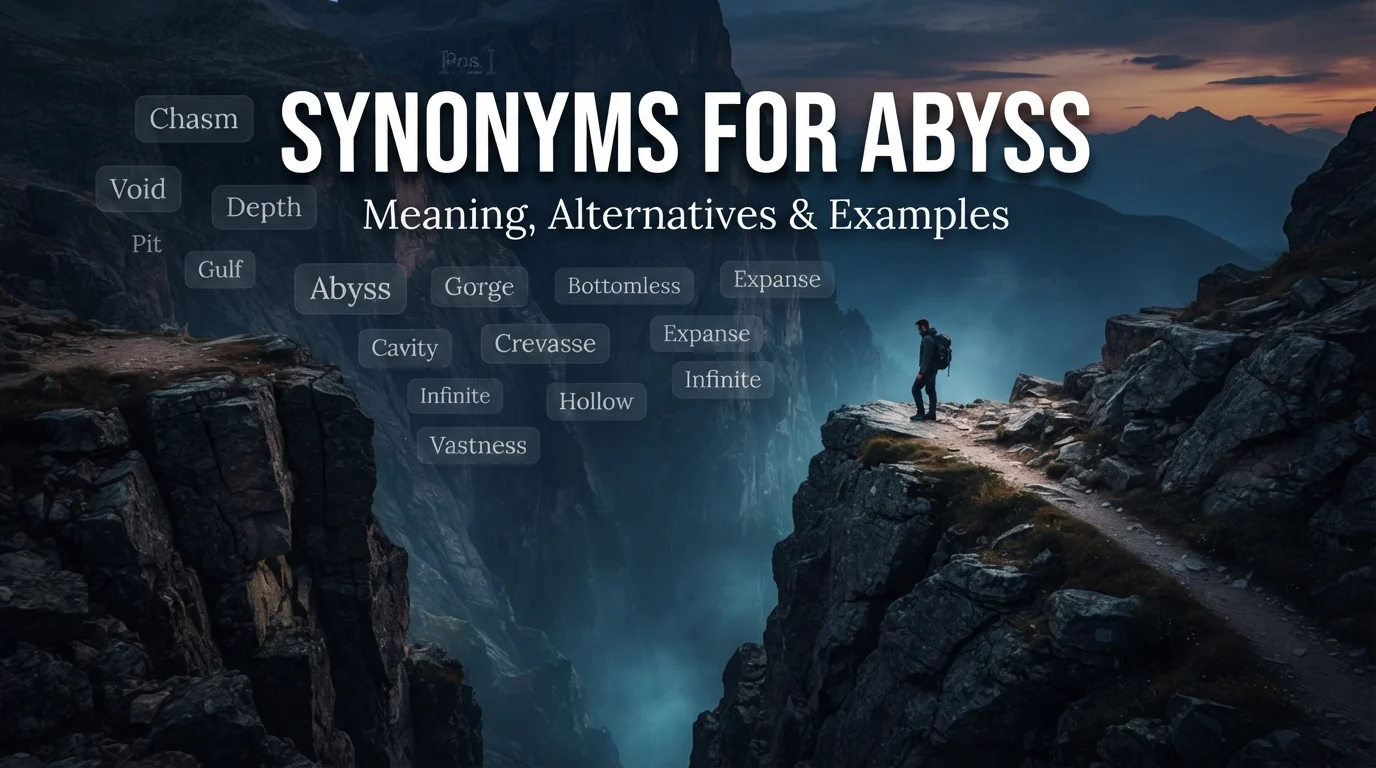
When you need a stronger or more precise word for abyss, choosing the right synonym can make your writing clearer and more expressive. The word abyss usually describes a very deep or seemingly bottomless space, but it can also describe a huge emotional, social, or conceptual gap.
This guide explores 30 synonyms for abyss in simple English. Each word includes its meaning, an example sentence, and the context where it works best. This makes the list useful for students, ESL learners, writers, and content creators who want to expand their vocabulary.
Whether you are describing a deep hole, a dangerous drop, emotional emptiness, or a major separation between people or ideas, these alternatives can help you communicate the exact meaning you intend.
What Does “Abyss” Mean?
An abyss is an extremely deep space, hole, or opening that appears to have no visible bottom. It is often associated with darkness, danger, mystery, or something difficult to measure.
Simple meaning:
An abyss is a very deep or seemingly endless space.
Example:
The explorers stared into the dark abyss below.
The word can also be used figuratively. For example, someone might say, “She felt as though she were falling into an emotional abyss.” Here, abyss does not mean a physical hole. It refers to profound sadness, emptiness, or despair.
Tone and Usage of “Abyss”
Abyss is generally a dramatic, serious, and literary word. It is common in fiction, poetry, journalism, philosophy, and descriptive writing.
It can describe:
- A deep physical space
- A seemingly bottomless hole
- Emotional emptiness
- A dangerous situation
- A major difference or separation
- An unknown or frightening future
For everyday writing, words such as depth, chasm, or pit may sound more natural. For dramatic writing, void, bottomless pit, or infinity may create a stronger effect.
30 Synonyms for Abyss
1. Chasm
Meaning: A very deep crack or opening in the ground.
Example:
The hikers carefully crossed the narrow bridge over the chasm.
Best usage context: Physical gaps, cliffs, and geological formations.
2. Gorge
Meaning: A deep, narrow valley with steep sides, usually formed by a river.
Example:
The river flowed through a spectacular mountain gorge.
Best usage context: Natural landscapes and geography.
3. Ravine
Meaning: A deep, narrow valley or channel, often formed by flowing water.
Example:
The road winds along the edge of a rocky ravine.
Best usage context: Outdoor and landscape descriptions.
4. Pit
Meaning: A deep hole or hollow in the ground.
Example:
The workers discovered a deep pit near the construction site.
Best usage context: Simple, everyday descriptions of holes.
5. Void
Meaning: An empty space, especially one that seems vast or endless.
Example:
The astronaut looked into the dark void of space.
Best usage context: Space, emptiness, philosophy, and emotional writing.
6. Depth
Meaning: The distance from the top or surface down to the bottom.
Example:
The divers could not determine the depth of the underwater cave.
Best usage context: Neutral descriptions of how deep something is.
7. Gulf
Meaning: A large gap or separation between people, ideas, or things.
Example:
There was a growing gulf between the two communities.
Best usage context: Figurative differences and divisions.
8. Chasmic Gap
Meaning: An extremely large separation or difference.
Example:
A chasmic gap separated the two competing theories.
Best usage context: Dramatic figurative writing. Use sparingly.
9. Cavern
Meaning: A large underground chamber or cave.
Example:
The explorers entered a vast cavern beneath the mountain.
Best usage context: Caves and underground settings.
10. Hollow
Meaning: An area that is lower than the land around it or an empty space inside something.
Example:
The ancient tree had a large hollow in its trunk.
Best usage context: Natural depressions and empty spaces.
11. Trench
Meaning: A long, deep ditch or narrow depression.
Example:
Scientists studied the deepest parts of the ocean trench.
Best usage context: Military, geological, and oceanographic contexts.
12. Depression
Meaning: An area of land that is lower than the surrounding surface.
Example:
Rainwater collected in a shallow depression in the field.
Best usage context: Geography and scientific descriptions.
13. Chute
Meaning: A steep passage through which something can fall or slide.
Example:
The climber slipped toward the rocky chute.
Best usage context: Steep physical passages.
14. Precipice
Meaning: A very steep cliff or the edge of a dangerous drop.
Example:
They stood carefully near the edge of the precipice.
Best usage context: Dramatic descriptions of cliffs or danger.
15. Drop
Meaning: A sudden or steep downward distance.
Example:
There was a terrifying drop beyond the narrow path.
Best usage context: Informal descriptions of steep falls.
16. Chute-like Drop
Meaning: A very steep downward passage or descent.
Example:
The trail ended in a chute-like drop into the valley.
Best usage context: Descriptive outdoor writing.
17. Infinity
Meaning: Something without an end or limit.
Example:
The stars seemed to disappear into infinity.
Best usage context: Figurative, philosophical, and poetic writing.
18. Emptiness
Meaning: A state of having nothing inside or a feeling of being emotionally empty.
Example:
After the loss, he struggled with a deep sense of emptiness.
Best usage context: Emotional and psychological descriptions.
19. Nothingness
Meaning: A complete absence of anything.
Example:
The story explores humanity’s fear of nothingness.
Best usage context: Philosophy, literature, and existential writing.
20. Vacuum
Meaning: A space containing little or no matter; figuratively, a situation where something important is missing.
Example:
The leader’s sudden departure created a vacuum in the organization.
Best usage context: Science and figurative discussions about absence.
21. Bottomless Pit
Meaning: A hole or space that appears to have no bottom.
Example:
The dark cave looked like a bottomless pit.
Best usage context: Dramatic, fictional, and descriptive writing.
22. Deep
Meaning: Extending far downward or inward.
Example:
The boat disappeared into the deep waters.
Best usage context: Simple descriptions, especially when a noun is unnecessary.
23. Depths
Meaning: The deepest parts of something.
Example:
The submarine traveled into the depths of the ocean.
Best usage context: Oceans, caves, space, and figurative writing.
24. Abyssal Depth
Meaning: An extremely deep area, especially in the ocean.
Example:
Scientists are studying life at abyssal depths.
Best usage context: Scientific and oceanographic writing.
25. Gulf of Separation
Meaning: A very large distance or difference between people or things.
Example:
Years of disagreement created a gulf of separation between the families.
Best usage context: Figurative descriptions of division.
26. Chasm
Meaning: A wide or deep gap that is difficult to cross.
Example:
A huge chasm divided the two sides of the mountain.
Best usage context: Physical gaps and strong metaphorical differences.
27. Brink
Meaning: The edge of something, especially something dangerous or significant.
Example:
The company stood on the brink of collapse.
Best usage context: Figurative situations involving danger or major change.
28. Lurking Depths
Meaning: Deep, hidden areas that seem mysterious or threatening.
Example:
Strange creatures were believed to live in the lurking depths below.
Best usage context: Creative and atmospheric writing.
29. Great Divide
Meaning: A major separation between people, groups, places, or ideas.
Example:
Education can sometimes reveal a great divide between different communities.
Best usage context: Social, political, cultural, and figurative writing.
30. Expansive Void
Meaning: A very large empty space.
Example:
The abandoned building seemed to contain an expansive void of darkness.
Best usage context: Creative, poetic, and descriptive writing.
Comparison Table: Synonyms for Abyss
| Synonym | Main Meaning | Physical or Figurative? | Tone |
| Chasm | Deep gap | Both | Strong |
| Gorge | Deep valley | Physical | Neutral |
| Ravine | Narrow deep valley | Physical | Neutral |
| Pit | Deep hole | Physical | Neutral |
| Void | Vast empty space | Both | Dramatic |
| Gulf | Large separation | Figurative | Formal |
| Precipice | Dangerous cliff edge | Physical/Figurative | Dramatic |
| Trench | Long deep depression | Physical | Technical |
| Cavern | Large underground space | Physical | Descriptive |
| Emptiness | Lack of fullness | Figurative | Emotional |
| Nothingness | Complete absence | Figurative | Philosophical |
| Vacuum | Empty space or absence | Both | Formal |
| Bottomless pit | Apparently endless hole | Both | Dramatic |
| Depths | Deepest parts | Both | Literary |
| Brink | Edge of a situation | Figurative | Serious |
| Great divide | Major separation | Figurative | Formal |
Physical Synonyms for Abyss
If you are describing an actual deep space or hole, choose a word that clearly communicates the physical feature.
Good choices include:
- Chasm
- Gorge
- Ravine
- Pit
- Cavern
- Trench
- Hollow
- Precipice
- Depths
For example:
The climbers looked down into the abyss.
could become:
The climbers looked down into the chasm.
Here, chasm is more specific because it suggests a deep crack or opening.
Figurative Synonyms for Abyss
When abyss represents a major emotional or conceptual gap, physical synonyms may not work well.
Consider:
- Void
- Gulf
- Emptiness
- Nothingness
- Vacuum
- Great divide
- Brink
- Infinity
For example:
He felt as if he were falling into an abyss.
Depending on the intended meaning, you could write:
He felt as if he were falling into a void.
or:
He struggled with a profound sense of emptiness.
The second version makes the emotional meaning clearer.
Synonyms for Abyss in Literature and Creative Writing
Writers often use abyss because it creates a feeling of mystery, darkness, danger, or the unknown.
Words such as void, bottomless pit, nothingness, and depths can produce a similar atmosphere.
For example:
She stared into the abyss and wondered what waited below.
A more poetic version could be:
She stared into the endless void, wondering what waited beyond the darkness.
The best choice depends on whether you want the reader to imagine depth, emptiness, danger, or mystery.
Synonyms for Abyss in Academic Writing
Academic writing usually benefits from precision rather than dramatic language.
Instead of using abyss broadly, consider words such as:
- Depth
- Depression
- Trench
- Gulf
- Gap
- Difference
- Separation
- Vacuum
For example:
There is an abyss between the two theories.
In an academic context, a more precise sentence might be:
There is a significant gap between the two theories.
This sounds clearer and less literary.
How to Choose the Right Synonym
For a Deep Hole
Use pit, chasm, or hollow.
These words work well when describing a physical opening or depression.
For a Deep Natural Valley
Use gorge or ravine.
These are especially useful in geography and outdoor descriptions.
For a Vast Empty Space
Use void, vacuum, or emptiness.
These words can describe physical or metaphorical absence.
For a Major Difference
Use gulf, gap, or great divide.
These are useful when describing differences between people, groups, or ideas.
For Emotional Emptiness
Use emptiness, void, or nothingness.
These choices are common in reflective and literary writing.
For Danger
Use precipice or brink.
These words emphasize being close to a dangerous edge or situation.
For Scientific Writing
Use depth, trench, or depression when they accurately describe the physical feature.
Scientific writing generally benefits from exact terminology.
For Poetic Writing
Use void, depths, nothingness, or infinity.
These words can create a mysterious or philosophical atmosphere.
Abyss vs. Chasm
Although abyss and chasm are sometimes interchangeable, they are not identical.
An abyss emphasizes extreme or seemingly endless depth. A chasm usually emphasizes a deep gap, crack, or separation.
Abyss:
The cave descended into darkness and seemed to contain an endless abyss.
Chasm:
A narrow bridge crossed the enormous chasm.
Choose abyss when depth and mystery are important. Choose chasm when the idea of a gap or separation is more important.
Abyss vs. Void
An abyss generally suggests extreme depth, while a void emphasizes emptiness.
Abyss: A deep or seemingly bottomless space.
Void: An empty or seemingly limitless space.
For example:
The diver disappeared into the abyss.
suggests great depth.
The spacecraft drifted through the void.
suggests the vast emptiness of space.
Abyss vs. Gulf
A gulf is usually a separation or large difference, especially between people, groups, or ideas.
For example:
There was a gulf between the wealthy and the poor.
Here, gulf does not mean a physical abyss. It means a significant social or economic divide.
Abyss vs. Pit
A pit is usually a straightforward physical hole.
Abyss sounds more dramatic and can suggest enormous or immeasurable depth.
Pit:
The workers dug a deep pit.
Abyss:
The explorers looked into a dark abyss.
Use pit for ordinary physical descriptions and abyss when you want a stronger or more dramatic sense of depth.
Common Phrases With “Abyss”
Understanding common expressions can help you use the word naturally.
Stare Into the Abyss
This means to look into something extremely deep or frightening. It can also have a figurative meaning involving fear, uncertainty, or difficult circumstances.
Fall Into the Abyss
This can describe physically falling into a deep space or metaphorically entering a difficult or hopeless situation.
Edge of the Abyss
This phrase describes being very close to a dangerous or catastrophic situation.
Emotional Abyss
This refers to profound emotional emptiness, sadness, or despair.
Abyss of Uncertainty
This describes a situation where the future is extremely unclear or unknown.
Frequently Asked Questions
What is the closest synonym for abyss?
Chasm is often one of the closest alternatives when abyss refers to a deep physical gap. Void can be closer when the intended meaning is vast emptiness.
What is a simple word for abyss?
Depending on the context, simple alternatives include hole, depth, gap, pit, or deep space.
Is “void” a synonym for abyss?
Yes, in some contexts. Both can describe a vast or seemingly endless space. However, abyss emphasizes depth, while void emphasizes emptiness.
Is “chasm” the same as “abyss”?
Not exactly. A chasm is generally a deep gap or opening, while an abyss often suggests extreme or seemingly bottomless depth.
What is an emotional synonym for abyss?
Void, emptiness, and nothingness can work when abyss describes a profound emotional state.
What is the opposite of abyss?
Depending on context, possible opposites include surface, summit, peak, height, or fullness. The best opposite depends on whether abyss is being used physically or figuratively.
Final Thoughts on Synonyms for Abyss
The best synonym for abyss depends on what you are trying to describe. If you mean a deep physical gap, chasm, pit, ravine, or gorge may be appropriate. If you mean vast emptiness, void, nothingness, or emptiness can express the idea more precisely.
For figurative writing, gulf and great divide can describe major differences, while brink can communicate danger or an approaching crisis. In scientific or academic writing, more precise terms such as depth, trench, and depression are often preferable.
The key is not simply to replace abyss with another word. Choose a synonym that matches the meaning, tone, audience, and context of your sentence. This will make your writing more accurate, natural, and engaging.

I am Evelyn Marie, the Administrator of Synoloop. I enjoy helping readers discover useful synonyms, alternative words, and better ways to express their ideas. I focus on keeping Synoloop simple, reliable, informative, and helpful for everyone.